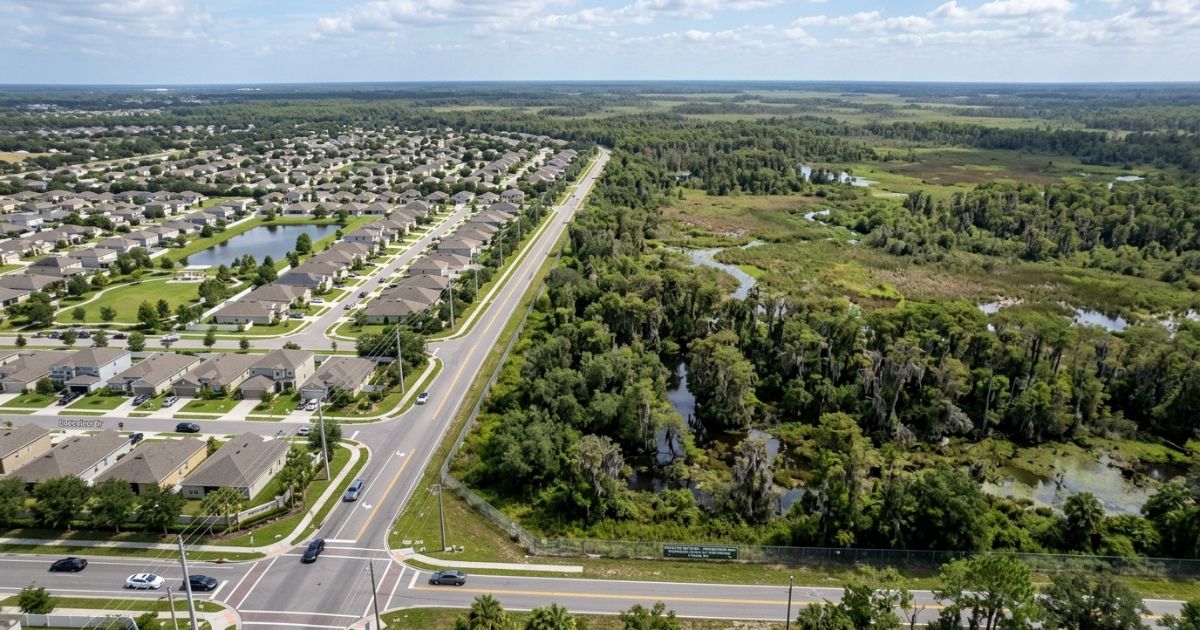
Buying cheap land in Florida sounds like a smart move — until you discover the lot can’t receive a building permit. Or the zoning doesn’t allow residential use. Or a wetland covers half the property. Or connecting to utilities would cost more than the land itself.
The deed looks clean. The price feels right. The county records show no liens. And none of that tells you whether you can actually build on the land.
Most first-time buyers assume that owning a lot means having the right to build on it. That assumption is one of the most expensive mistakes in Florida real estate.
Table of Contents
- Can you build on any land in Florida?
- Why zoning is the first thing you need to check
- How flood zones affect what you can build — and at what cost
- Why wetlands can make a lot unbuildable
- What deed restrictions and CC&Rs actually do to your plans
- The utility problem no listing will tell you about
- Side-by-side: what blocks construction and what it costs to fix
- Mistakes most Florida land buyers make before closing
- Hidden costs of land with construction restrictions
- ✅ Immediate Actions — Start Now
- 📚 Glossary
- FAQ
Can you build on any land in Florida?
The short answer is no — and that surprises more buyers than it should.
Florida has millions of vacant lots for sale at any given time. A notable share of them sit on the market precisely because experienced buyers already know something that casual buyers don’t: they can’t be built on, or can only be developed at a cost that makes no financial sense.
For a lot to be buildable, it must satisfy all of the following at the same time:
- Zoning compatible with the intended use (residential, commercial, agricultural)
- Flood zone classification that allows construction without prohibitive cost
- No wetlands covering the area where construction is planned
- Legal road access to a public street or a recorded easement
- Utility access — water, sewer, and electricity available or feasibly installable
- No deed restrictions or CC&Rs that prohibit the intended type of construction
- Lot dimensions that meet the county’s minimum size and setback requirements
A recorded deed proves ownership. It says nothing about whether the land can be developed. Verifying buildability before making an offer is the single most important step any land buyer can take in Florida.
Short answer: No. Owning a Florida lot does not mean you can build on it. Zoning, flood classification, wetlands, deed restrictions, and utility availability all determine buildability — independently of who holds the title.
Why zoning is the first thing you need to check
Zoning determines the legal use of every parcel of land in Florida. Each county and municipality maintains its own zoning code, and the designation on your lot controls what can be built there — or whether anything can be built there at all.
What the most common Florida zoning designations mean
| Designation | Typical Use | Residential Construction Allowed? |
|---|---|---|
| RSF / R-1 | Single-family residential | Yes — one home per lot |
| RMF / R-3 | Multi-family residential | Yes — apartments or multiple units |
| AG / A-1 | Agricultural | Limited — farmhouse may be allowed |
| C-1 / B-1 | Commercial | No — not for pure residential use |
| CON / P | Conservation / Park | Generally prohibited |
| PUD | Planned Unit Development | Depends on the approved plan |
When the zoning designation isn’t enough
Zoning is the starting point — not the finish line. Many Florida counties add regulatory overlays on top of basic zoning. These are additional layers of restriction that apply to specific areas regardless of the underlying zone, including wildlife corridors, wellfield protection zones, historic districts, and coastal construction setback lines.
A lot zoned R-1 in a wildlife corridor overlay may still require environmental studies and mitigation before a permit is issued. A lot in a coastal zone needs to comply with Florida’s Coastal Construction Control Line regulations, which can limit what’s buildable on the oceanward portion of the property.
You can check zoning for free using any county’s GIS portal — search by parcel number or address. It takes about five minutes and should happen before you write any offer.
Short answer: Zoning controls what can legally be built on a Florida lot. Agricultural, conservation, and commercial designations can block residential construction entirely. Check the county GIS portal before making any offer — it's free, public, and takes minutes.
How flood zones affect what you can build — and at what cost
Florida is flat, coastal, and hurricane-prone. A large portion of the state sits in FEMA-designated flood zones, and those designations have direct consequences for construction — not just for insurance.
Zone AE (Special Flood Hazard Area with calculated Base Flood Elevation) imposes mandatory technical requirements for any new structure:
- The finished floor elevation must be at or above the Base Flood Elevation (BFE), with most counties requiring an additional 1–2 feet of freeboard above that
- Building permits in AE zones go through an extra layer of technical review
- Flood insurance on the finished structure will be expensive and mandatory if you carry a mortgage
Zone VE (coastal high-velocity wave zone) goes further: structures must be built on pilings or columns engineered to withstand wave impact. That requirement alone can add $20,000–$60,000 to construction costs before a single wall goes up.
What flood zones don’t tell you
FEMA flood maps reflect the official risk assessment at the time they were drawn. They don’t capture local drainage issues, subsidence in older subdivisions, or areas that flood regularly during heavy rainfall despite a Zone X (low risk) designation. In practice, a Zone X lot in a poorly drained neighborhood in Hillsborough or Broward County can flood more often than a managed Zone AE lot in a well-engineered community.
Verify the flood zone at msc.fema.gov using the property address or GPS coordinates. The lookup is free and takes under a minute.
Short answer: Lots in FEMA flood zones AE and VE can be built on, but construction requires mandatory elevation compliance and engineered foundations that can add $20,000–$60,000 or more to total project costs. Always verify flood zone classification before buying vacant land in Florida.
Why wetlands can make a lot unbuildable
Wetlands are among the most common — and least advertised — reasons why Florida lots can’t be built on. These are marsh areas, swamps, and areas with hydric vegetation protected simultaneously under the federal Clean Water Act and Florida state law.
Building in wetlands without a permit from the U.S. Army Corps of Engineers and the applicable Water Management District is illegal. Penalties include heavy fines and mandatory environmental restoration at the landowner’s expense.
More practically: getting that permit is extremely difficult. The permitting process is long, expensive, and frequently ends in denial. For most buyers, a lot with significant wetland coverage is simply not buildable for practical purposes — even if zoning says otherwise.
Why wetlands don’t always look like wetlands
This is the part that catches buyers off guard. Wetlands aren’t always the obvious marshes you picture. In dry seasons, a wetland area can look like dry scrub or grassy land. Lots that were partially drained years ago may still be classified as wetlands under current federal and state definitions.
The only reliable way to know is a wetland delineation — a site inspection by a credentialed environmental consultant. In counties like Collier, Hendry, or Glades, where undeveloped land is abundant and inexpensive, wetland coverage is one of the primary reasons large tracts trade at steep discounts.
Short answer: Wetlands on a Florida lot can eliminate most or all of its buildable area, regardless of zoning or lot size. Wetland presence is rarely disclosed in listings and requires a professional site inspection to identify — especially during dry months when the land appears dry.
What deed restrictions and CC&Rs actually do to your plans
Even when zoning, flood zones, and wetlands all check out, a lot may still have private restrictions that limit or prohibit the type of construction you’re planning. These restrictions are recorded in the property’s title documents — not in county zoning records — and they travel with the land no matter how many times it changes hands.
The most common types:
- Deed restrictions — clauses recorded in the original deed or a subsequent instrument that impose conditions on use: minimum home size, required exterior materials, prohibitions on mobile or manufactured homes, restrictions on outbuildings or secondary structures
- Subdivision CC&Rs (Covenants, Conditions & Restrictions) — rules that govern an entire platted subdivision, enforceable even if no active HOA exists. These can include architectural approval requirements, height limits, and setback standards more restrictive than the county’s own code
- Conservation easements — recorded agreements that permanently protect natural features of the property. A conservation easement can prohibit construction on part or all of a lot — permanently, across all future owners
None of these show up in a zoning check. They only appear in a full title search conducted by a real estate attorney or title insurance company. This is one of the core reasons title insurance exists — and why skipping it on a vacant land purchase is a significant financial risk.
Short answer: Deed restrictions and CC&Rs are legally binding private limitations that run with the land forever. They can prohibit the type of construction you're planning regardless of what zoning allows. They only surface in a complete title search — which should always be conducted before closing on any Florida land purchase.
The utility problem no listing will tell you about
A lot can have perfect zoning, acceptable flood zone status, no wetlands, and a clean title — and still be economically undevelopable because of what it costs to connect basic services.
In urban and suburban Florida, most lots sit within service areas for public water and sewer. But in rural counties, exurban fringes, and older subdivisions that were platted before infrastructure expansion, the gap between the lot and the nearest utility line can translate into costs that exceed the value of the land itself.
What to budget when utilities aren’t already there
- Well drilling for potable water: $5,000–$20,000 depending on depth and local aquifer conditions
- Septic system: $8,000–$20,000, subject to lot size, soil percolation, and setback requirements
- Electric service extension: $10,000–$50,000 when the nearest transformer is a significant distance away
- Public utility connection fees (impact fees): $5,000–$30,000 per connection, paid to the county at time of development even when service lines are nearby
Beyond utilities, check road access. A lot without legal frontage on a public road — or without a recorded access easement — is legally inaccessible regardless of what the aerial photo shows. This issue appears most often with landlocked parcels in rural counties like Okeechobee, DeSoto, and Highlands.
Short answer: The absence of on-site utilities can add $30,000–$100,000 to the real cost of developing a Florida lot. Confirm water, sewer, electricity availability, and legal road access with the county before making any offer on rural or semi-rural land.
Side-by-side: what blocks construction and what it costs to fix
| Restriction Type | Impact on Construction | Can It Be Resolved? | Estimated Resolution Cost |
|---|---|---|---|
| Incompatible zoning | Blocks intended use entirely | Sometimes — via rezoning or variance | $2,000–$15,000 + no approval guarantee |
| Flood zone AE/VE | Raises construction cost significantly | Yes — with mandatory technical compliance | $20,000–$60,000 in elevation and foundation |
| Wetlands | Reduces or eliminates buildable area | Rarely — federal/state permit usually denied | $10,000–$50,000+ in studies and permitting |
| Deed restriction | Limits construction type or size | Sometimes — via legal challenge | $5,000–$20,000+ in legal fees |
| Conservation easement | Permanently prohibits development | Generally no | Not applicable |
| No utility access | Raises development cost dramatically | Yes — at significant expense | $15,000–$100,000 depending on distance |
| Undersized lot | Insufficient buildable area after setbacks | Difficult — requires variance approval | $2,000–$10,000 in administrative process |
Mistakes most Florida land buyers make before closing
Treating a low price as a signal of opportunity. In most cases, a lot priced significantly below market has a reason — flood zone restrictions, wetland coverage, incompatible zoning, or absent utilities. The market already knows what casual buyers often don’t. A low price reflects that knowledge.
Skipping the zoning check before making an offer. Zoning is free to verify, takes minutes, and is available on every county’s public GIS portal. Waiting until after a contract is signed is how buyers lose their earnest money deposit on a lot that never could have served their intended use.
Assuming a recorded deed means the land is buildable. A deed confirms legal ownership. It says nothing about zoning, flood zone classification, wetland presence, deed restrictions, or utility access. These are entirely separate layers of due diligence.
Ignoring flood zone classification because construction isn’t immediate. Buyers who plan to build later still need to evaluate flood zone status at purchase time. The cost of elevation compliance and engineered foundations in Zones AE and VE is a real expense that needs to factor into the total investment calculation from the start.
Not hiring a wetland specialist before buying rural or vegetated land. Wetlands don’t always look like wetlands — especially in dry months. In counties with significant undeveloped land like Collier, Charlotte, or Okeechobee, wetland coverage is one of the most common reasons rural lots are priced below comparable parcels.
Skipping title insurance on a vacant lot purchase. Title insurance on land is inexpensive relative to the risk it covers — undisclosed liens, unreleased easements, deed restrictions buried in historical documents, and chain-of-title errors that wouldn’t surface in a surface-level search. For vacant land, it’s not optional due diligence. It’s basic financial protection.
Hidden costs of land with construction restrictions
When a Florida lot has restrictions that complicate or block construction, the financial consequences extend well beyond the obvious:
- Rezoning or variance petition: formal application to change zoning or obtain an exception. Fees range from $2,000 to $15,000, the process can take months, and approval is not guaranteed
- Environmental impact study: required when wetlands, protected species habitat, or a history of industrial use is present. Cost: $5,000–$30,000 depending on scope and county
- Elevation certificate and flood zone compliance: on AE and VE lots, bringing a structure to required elevation can add $10,000–$50,000 to total project cost before any vertical construction begins
- Legal fees for deed restriction challenges: contesting an old or potentially invalid deed restriction requires real estate litigation — expensive, slow, and uncertain in outcome
- Reduced resale liquidity: lots with significant restrictions have a much smaller pool of potential buyers. That means longer time to sell, lower offers, and the real possibility of selling at a loss if circumstances change
The combined effect of these costs can turn a parcel that looked inexpensive into one of the worst performing assets in a real estate portfolio.
✅ Immediate Actions — Start Now
- Find the parcel number for the lot you’re evaluating on the county Property Appraiser’s portal
- Look up the zoning designation on the county GIS portal — confirm the intended use is permitted by right
- Verify the flood zone at msc.fema.gov using the property address or GPS coordinates
- If the lot has dense vegetation, is near water, or is in a rural county, commission a wetland delineation before making any offer
- Contact the county utilities department to confirm water and sewer service availability for the parcel
- Check the county’s Land Development Code for applicable setbacks and minimum lot size requirements
- Confirm legal road access — verify the lot has frontage on a public road or a recorded access easement
- Before closing, hire a real estate attorney or title company to conduct a full title search and issue title insurance
📚 Glossary
Buildable lot: A parcel that legally allows the intended construction, with compatible zoning, utility access, no prohibitive wetlands, and no deed restrictions blocking the proposed use.
Zoning: The county or municipal system that defines permitted land uses for each parcel — residential, commercial, agricultural, industrial, or conservation.
Base Flood Elevation (BFE): The water surface elevation that FEMA projects a 1% annual chance flood event would reach at a given location. New construction in Zone AE must have finished floors above this level.
Flood Zone AE: A Special Flood Hazard Area with calculated BFE. New construction requires elevation compliance and detailed permit review.
Flood Zone VE: A coastal high-velocity wave zone. Construction requires pile or column foundations engineered to withstand wave impact — significantly more expensive than standard construction.
Wetland: A federally and state-protected area characterized by hydric soils and water-tolerant vegetation. Construction in wetlands requires permits that are difficult to obtain and frequently denied.
Deed restriction: A clause recorded in a property’s deed that imposes permanent conditions on how the land can be used — enforceable against all future owners.
CC&Rs (Covenants, Conditions & Restrictions): Rules governing an entire subdivision that bind all property owners within it, regardless of whether a homeowners association is actively enforcing them.
Conservation easement: A recorded legal agreement that permanently limits development on a property for conservation purposes. Transfers with the property to all future owners.
Variance: A formal exception granted by a county board that allows a use or configuration that doesn’t conform to standard zoning rules. Requires an application, public hearing, and board approval — and can be denied.
Impact fee: A charge collected by the county when a new property connects to public utilities or other infrastructure. Typically paid by the developer or builder at time of permit issuance.
Title search: A review of the chain of recorded documents for a property — deeds, liens, easements, and restrictions — to identify any issues that affect ownership or use.
Parcel number: The unique identification number assigned to each land parcel by the county Property Appraiser. Used to access all public records for a specific lot.
FAQ
Can you build on any land in Florida? No. A Florida lot must satisfy multiple independent requirements before it can legally receive a building permit: compatible zoning, acceptable flood zone classification, no prohibitive wetland coverage, legal utility access, and no deed restrictions blocking the intended construction. A recorded deed confirms ownership only — not the right to build.
Why are some Florida lots so cheap? Low prices usually reflect known limitations. Lots with flood zone restrictions, wetland coverage, incompatible zoning, or no utility access consistently trade below market because buyers who do their homework won’t pay full price for land that can’t be developed. The discount reflects the market’s collective knowledge about the parcel’s constraints.
Can you build in a FEMA flood zone in Florida? Yes, in most cases — but with mandatory technical requirements. Zone AE lots require finished floors above the Base Flood Elevation, often with additional freeboard required by the county. Zone VE lots require pile or column foundations engineered for wave impact. These requirements add substantial cost and must be factored into any development budget.
What is a wetland delineation? A wetland delineation is a formal assessment conducted by a qualified environmental consultant to identify and map the extent of wetlands on a specific parcel. It is the only reliable way to determine wetland presence before purchase — particularly on vegetated lots or rural land where wetland boundaries aren’t visually obvious.
Do deed restrictions expire in Florida? Not automatically. Deed restrictions in Florida do not expire simply because of age or changes in ownership. Some may be unenforceable if the conditions that justified them no longer exist, or if there’s been widespread violation — but that determination requires a legal analysis. Never assume an old deed restriction is expired without consulting a real estate attorney.
What happens if I buy land and can’t build on it? You still own the land and are responsible for property taxes. Your options are limited: hold and wait for regulatory changes, attempt a rezoning or variance petition, or sell — likely at a loss if the restrictions are significant. Prevention is the only practical strategy: verify buildability thoroughly before closing.
Building on Florida land is entirely possible — and for the right lot, it’s one of the most rewarding investments you can make in the state. But the land purchase itself requires careful due diligence that goes well beyond reading the listing description or checking the price against comparable sales.
The buyers who avoid expensive mistakes are the ones who verify zoning, flood zone, wetlands, utility access, and title restrictions before writing a single offer. That process takes days, not months — and it costs a fraction of what a bad purchase costs to unwind.
TerraNoble provides bilingual support in English and Portuguese for buyers evaluating land in Florida. If you have questions about a specific lot’s buildability, the county permitting process, or how to interpret what a title search reveals, our team can help you get clear answers — without the pressure to make a decision before you’re ready.