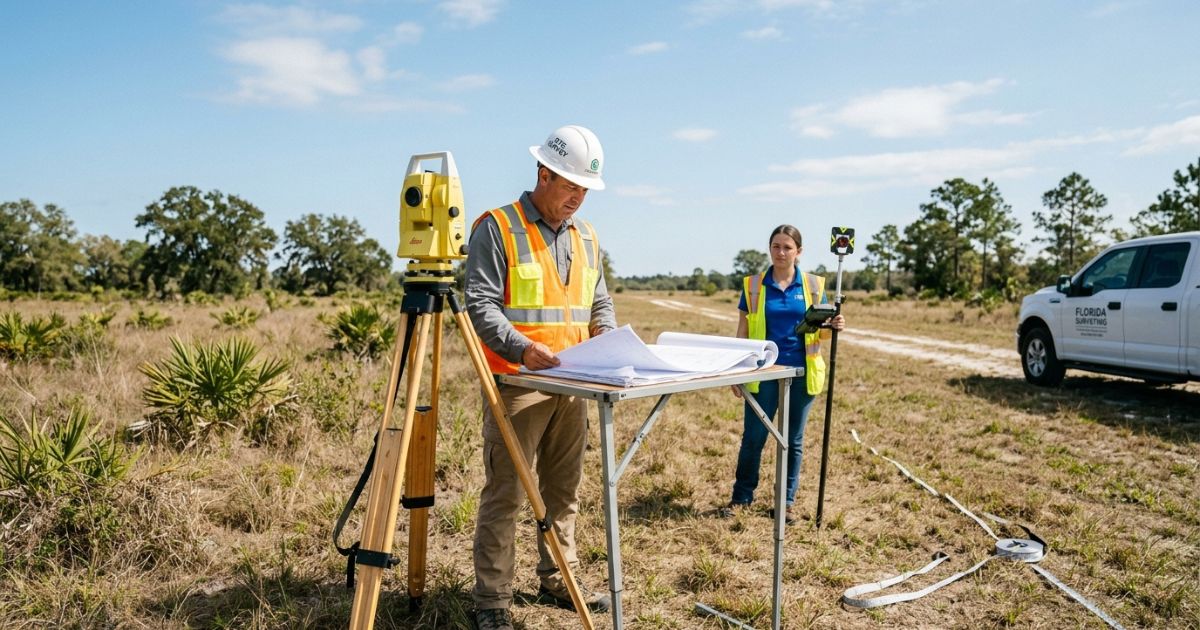
Buying land in Florida sounds straightforward — find a lot, make an offer, close the deal. But a significant number of buyers discover after the fact that the lot they purchased cannot legally receive a building permit, lacks utility connections that would cost tens of thousands of dollars to install, or sits in a flood zone that makes construction technically and financially impractical.
The deed looks clean. The price seems right. The location makes sense. And none of that tells you whether the land can be developed.
Most people think buying land is mainly about finding the right location. In reality, what determines value is what you’re legally and physically able to build on it.
This guide walks through the specific verifications experienced buyers make before placing any offer on vacant land in Florida — all based on publicly available information you can access for free.
Table of Contents
- What does “buildable” actually mean in Florida?
- How to check zoning before buying land in Florida
- Why flood zone classification affects more than just insurance
- Utility access: the cost no listing ever mentions
- Deed restrictions and subdivision CC&Rs that run with the land
- Minimum lot size, setbacks, and what they mean for your plans
- How to research a parcel using free county tools
- Common mistakes first-time land buyers make in Florida
- Hidden costs of lots with construction limitations
- Glossary
- Immediate Actions
- FAQ
What does "buildable" actually mean in Florida?
A buildable lot is one that meets all the legal, technical, and infrastructure requirements needed to receive a permanent structure for its intended use. It is not simply any parcel with a recorded deed.
For a lot to be practically buildable, it needs to satisfy all of the following:
- Compatible zoning — the land use designation must allow what you plan to build (residential, commercial, mixed-use)
- Minimum lot size — the parcel must meet the county’s minimum area and frontage requirements for that zone
- Legal access — the lot must connect to a public road or have a recorded access easement
- Acceptable flood zone — the FEMA classification must allow construction, or the cost of compliance must be financially workable
- Available utilities — water, sewer, and electricity must either be accessible or feasible through individual systems (well, septic, off-grid)
- No prohibitive restrictions — deed restrictions, CC&Rs, or conservation easements must not prevent the intended use
A lot can have a clear title, no outstanding liens, and still be completely unusable for your purposes. Verifying each of these points before you make an offer is what separates a smart purchase from an expensive lesson.
Short answer: A buildable lot in Florida legally permits the construction of its intended use, with compatible zoning, physical access, available infrastructure, and no prohibitive deed restrictions. A recorded deed alone does not guarantee any of this.
How to check zoning before buying land in Florida
Zoning determines what can be built on a given parcel — single-family residential, multifamily, commercial, agricultural, industrial, or mixed-use. Every Florida county maintains its own zoning code, and the designation on your lot controls what’s permitted.
Where to find zoning information
Most Florida counties provide free public GIS (Geographic Information System) portals where you can search by parcel number or address. These tools show:
- The current zoning designation of the parcel
- Permitted uses by right and conditional uses requiring approval
- The Future Land Use Map — which indicates where the area is heading long-term
Common zoning designations and what they allow
| Designation | Typical Use | Residential Construction Allowed? |
|---|---|---|
| RSF-1 / R-1 | Single-family residential | Yes — one home per lot |
| RMF / R-3 | Multifamily residential | Yes — apartments or multiple units |
| AG / A-1 | Agricultural | Limited — farmhouse may be permitted |
| C-1 / B-1 | Commercial | Not for pure residential use |
| PUD | Planned Unit Development | Depends on the approved plan |
| CON / P | Conservation / Preserve | Generally no |
When zoning alone isn’t enough
The zoning designation is the starting point — not the finish line. Many areas carry overlay districts that layer additional regulations on top of the base zone: historic preservation areas, wildlife corridor buffers, wetland transition zones, and coastal construction control lines. These overlays apply regardless of the underlying zone.
Zoning can also change. A parcel with residential zoning today may be reclassified in a future county comprehensive plan update, especially in rapidly developing areas.
Short answer: Look up the parcel number on the county GIS portal to see the current zoning designation and permitted uses. Agricultural, conservation, or commercial zoning can make residential construction impossible without a rezoning process — which takes months, costs money, and isn't guaranteed to succeed.
Why flood zone classification affects more than just insurance
Most buyers associate FEMA flood zones with insurance costs. For vacant land, the implications go further: the flood zone classification determines what can be built, how it must be built, and at what additional cost.
Parcels in FEMA Special Flood Hazard Areas — particularly zones AE and VE — impose mandatory construction standards on any new structure:
- The finished floor elevation must be above the BFE (Base Flood Elevation) — and many Florida counties require an additional 1 to 2 feet of freeboard above that
- In Zone VE (coastal wave-action zones), structures must be built on pilings or columns engineered to withstand wave impact forces — not standard slab-on-grade construction
- Building permits in SFHAs require additional technical review and specific documentation that standard parcels don’t
This means a lot in Zone AE that looks like a bargain may require $20,000 to $60,000 in additional foundation work and elevation compliance before a house can sit on it. In Zone VE, costs can be even higher.
To check the flood zone for any Florida parcel, go to msc.fema.gov and enter the address or GPS coordinates. The search is free and takes under two minutes.
Short answer: Parcels in FEMA high-risk zones (AE, VE) require elevated construction and additional permitting that can add tens of thousands of dollars to development costs. Flood zone verification should happen before you make any offer — not during inspection.
Utility access: the cost no listing ever mentions
A lot can have the right zoning and an acceptable flood zone — and still be financially unworkable because of what it costs to bring utilities to it.
Water and sewer
In urban and suburban Florida, most lots connect to public water and sewer systems. In rural areas, outer suburban fringes, and cheaper parcels farther from established infrastructure, the situation is often different:
- Well installation: $5,000 to $20,000 depending on depth and local aquifer conditions
- Septic system: $8,000 to $20,000, with size and placement restrictions tied to lot dimensions and soil type
- Public connection when available but not connected: impact fees of $5,000 to $30,000 are common before the county will extend service to an unconnected parcel
The county utilities department can confirm whether a specific parcel falls within the public water and sewer service area. If it doesn’t, you need a feasibility assessment from a licensed contractor before you commit.
Electricity and road access
- Electric service extension: in remote areas, running a line from the nearest transformer can cost $10,000 to $50,000 depending on distance
- Legal road access: lots without frontage on a public road require a recorded access easement — without one, the parcel may be legally landlocked regardless of its physical location
| Infrastructure | Cost if already available | Cost if absent |
|---|---|---|
| Public water | Impact fee: $3,000–$15,000 | Well: $5,000–$20,000 |
| Public sewer | Impact fee: $3,000–$15,000 | Septic system: $8,000–$20,000 |
| Electricity | Connection: $1,000–$5,000 | Line extension: $10,000–$50,000 |
| Road access | Already guaranteed | Easement: variable + legal fees |
Short answer: Missing infrastructure can add $30,000 to $100,000 to the real cost of developing a parcel. Always confirm utility availability with the county before making an offer on rural or semi-rural land — the listing price never includes this.
Deed restrictions and subdivision CC&Rs that run with the land
Even when zoning permits your intended use and utilities are available, a parcel may carry private restrictions that limit or prohibit certain types of construction. These restrictions are recorded in the deed or in documents linked to the title — and they bind every future owner.
The most common types:
- Deed restrictions — clauses in the original deed that impose conditions on use: minimum home size, approved building materials, prohibitions on certain commercial activity, limits on accessory structures
- Subdivision CC&Rs — when a lot is part of a platted subdivision, the Covenants, Conditions & Restrictions of that subdivision apply even if there is no active HOA managing the community
- Conservation easements — recorded easements that permanently preserve natural features of the parcel and may prohibit construction on part or all of the lot
These restrictions do not expire when ownership changes. They cannot be waived unilaterally. The only way to identify them is through a proper title search conducted by a real estate attorney or title insurance company before closing.
Short answer: Deed restrictions and CC&Rs are privately recorded limitations that follow the land permanently. They exist independently of zoning and can prohibit construction types, minimum structure sizes, or specific land uses — even on lots that appear unrestricted at first glance.
Minimum lot size, setbacks, and what they mean for your plans
Even a lot with perfect zoning may not support the structure you have in mind if it doesn’t meet the county’s size and dimensional requirements.
Every Florida county defines:
- Minimum lot area — the square footage a parcel must have to be considered buildable in a given zone
- Minimum frontage — the minimum width of road-facing frontage required
- Setbacks — the mandatory distances between any structure and the lot’s property lines (front, sides, and rear)
A small lot with generous setback requirements may produce a buildable area — the portion of the lot where construction is actually allowed — too small for any practical structure. For example: a 5,000 sq ft lot with a 25-foot front setback, 10-foot side setbacks, and a 20-foot rear setback may have a buildable envelope of less than 2,000 sq ft.
These rules are published in the county’s Land Development Code or Unified Land Development Code, both available free on the official county website.
How to research a parcel using free county tools
Every meaningful piece of information about a Florida parcel is available to the public. This is one of the most important things first-time buyers don’t realize: you can verify most of this before making any contact with the seller.
Step-by-step verification process
-
Find the parcel number — it appears in most listings, or you can locate it through the county Property Appraiser portal using the address. The parcel number is the master key to all public records about the lot.
-
Search the Property Appraiser website — confirms ownership, lot size, assessed value, tax history, and any recorded improvements or exemptions.
-
Check zoning on the GIS portal — enter the parcel number to see the current zoning designation, overlay districts, and the Future Land Use Map classification.
-
Verify flood zone at FEMA — go to msc.fema.gov and enter the address or parcel coordinates to pull the official FIRM map designation.
-
Confirm utility service area — contact the county or municipal utilities department to confirm whether the parcel falls within the public water and sewer service boundary.
-
Order a title search before closing — a real estate attorney or title insurance company will review the complete chain of title, identify any liens, deed restrictions, easements, and other encumbrances that affect the property.
Common mistakes first-time land buyers make in Florida
Treating price as a proxy for value. A lot priced far below comparable parcels in the same area usually has a reason — a restrictive flood zone, absent infrastructure, conservation easements, or contamination history. The due diligence step exists to find that reason before the money changes hands.
Skipping zoning verification before making an offer. Checking a zoning designation takes about two minutes on the county GIS portal. Waiting until after contract execution to do this risks losing an earnest money deposit if the zoning turns out to be incompatible with the intended use.
Assuming a deed equals development rights. A recorded deed confirms ownership. It says nothing about what can be built. These are two entirely different questions.
Underestimating infrastructure costs on rural parcels. Cheap land in outlying areas often lacks public water, sewer, and grid power. The cost of installing individual systems — or running lines from the nearest infrastructure — can easily exceed the purchase price of the lot itself.
Ignoring subdivision documents. Old platted subdivisions sometimes carry CC&Rs recorded decades ago that were never removed from title. These can include restrictions that seem unusual by today’s standards but remain fully enforceable.
Buying without title insurance. Title insurance on vacant land is inexpensive relative to the protection it provides. It covers hidden defects in the chain of title — old liens, missed heirs, recording errors — that don’t surface in a basic search.
Hidden costs of lots with construction limitations
Beyond direct infrastructure costs, parcels with zoning, flood, or title complications often generate additional expenses that buyers don’t anticipate:
- Variance or rezoning petition: formal request to the county for a zoning exception or reclassification — process can cost $2,000 to $15,000 in fees and professional services, with no guarantee of approval
- Environmental study: required in areas with wetlands, protected species habitat, or prior industrial use — costs $5,000 to $30,000 depending on scope
- Elevation compliance: in high-risk FEMA zones, raising a structure above BFE can add $10,000 to $60,000 to the construction budget
- Utility extension or alternative systems: off-grid development in remote areas can cost more than the land itself
- Reduced resale liquidity: lots with significant restrictions have a narrower buyer pool, which limits future exit options and can result in capital loss
📚 Glossary
Buildable lot: A parcel that meets all legal, technical, and infrastructure requirements to receive a permanent structure for its intended use. A recorded deed does not guarantee buildability.
Zoning: The county’s land use classification system that determines what types of structures and activities are permitted on a given parcel.
Parcel number: The unique identifying number assigned to each land parcel by the county. Used to access all public property records.
Setback: The minimum required distance between a structure and a property line — front, rear, and sides. Setbacks reduce the usable buildable area within a lot.
Flood zone: The FEMA classification indicating the flood risk level of a specific area, as shown on Flood Insurance Rate Maps (FIRMs). Zones AE and VE are high-risk and impose mandatory construction standards.
BFE (Base Flood Elevation): The estimated water surface elevation during a 1% annual chance flood event. New construction in FEMA SFHAs must have finished floors above this level.
SFHA (Special Flood Hazard Area): FEMA’s designation for high-risk flood zones (AE, VE, AH, AO) where flood insurance is required for federally backed mortgages and where strict construction standards apply.
Deed restriction: A clause recorded in the property deed that imposes conditions or prohibitions on land use. These bind all future owners and do not expire with ownership changes.
CC&Rs (Covenants, Conditions & Restrictions): A set of rules governing land use within a subdivision or planned community, recorded as part of the plat. They apply even if no active HOA exists.
Conservation easement: A permanently recorded restriction that limits development of a parcel to protect its natural features. Can prohibit construction on part or all of a lot.
Wetland: A federally and state-protected area of saturated or seasonally flooded land. Construction in wetlands requires special environmental permits and is frequently denied.
Title search: A review of the complete recorded history of a property’s ownership, liens, easements, and encumbrances by a licensed attorney or title company.
Impact fee: A one-time charge by the county for connecting a new development to public water, sewer, or other infrastructure systems. Typically paid by the buyer or builder at time of development.
Variance: A formal county approval allowing a deviation from standard zoning rules. Requires a petition process, public notice, and board review — and can be denied.
Access easement: A recorded legal right to cross another party’s land to reach a parcel that lacks direct road frontage. Required for landlocked lots.
✅ Immediate Actions — Start Now
- Find the parcel number for any lot you’re evaluating through the county Property Appraiser portal
- Look up the zoning designation on the county GIS portal — confirm it matches your intended use
- Go to msc.fema.gov and check the FEMA flood zone classification for the parcel
- Contact the county utilities department to confirm whether public water and sewer service is available at that address
- Check the Property Appraiser portal for outstanding tax liens or recorded encumbrances
- Review the county Land Development Code for minimum lot size, frontage, and setback requirements in that zone
- If the lot is near water, vegetation, or has a low-lying appearance, request a preliminary wetland assessment before closing
- Before signing any contract, hire a real estate attorney or title company to run a full title search
Buying land in Florida can be a sound financial decision — but only when made with the right information. The verifications described in this guide are not bureaucratic hurdles. They’re the difference between a parcel that works for your goals and one that costs far more than its purchase price suggests.
Most of these checks are free, publicly available, and can be done before you ever speak to a seller. The cost of verifying upfront is zero. The cost of discovering problems after closing can be very high.
TerraNoble offers bilingual support in English and Portuguese for buyers evaluating land in Florida. If you have questions about zoning, flood classifications, utility access, or the due diligence process for a specific parcel, our team can provide practical guidance without pressure.
Get in touch for a no-obligation conversation.
FAQ — Frequently Asked Questions
Can I build on any vacant land in Florida? No. A lot must have compatible zoning, meet minimum size requirements, have legal road access, feasible utility connections, and be free of prohibitive deed restrictions to be considered buildable. The existence of a recorded deed does not guarantee any of those conditions are met.
How do I find out if a Florida lot is zoned for residential use? Search the parcel number on the county’s GIS portal. The current zoning designation and permitted uses are displayed for free. Every Florida county maintains this portal and makes the data publicly accessible.
Does a flood zone mean I can’t build on a lot in Florida? Not necessarily. High-risk zones (AE, VE) allow construction but impose mandatory requirements: finished floors must be above the BFE, and in Zone VE, elevated foundation systems are required. These requirements add cost but don’t prevent construction outright. Zone X parcels have minimal restrictions.
What is an Elevation Certificate and do I need one? An Elevation Certificate is a technical document prepared by a licensed surveyor that records the finished floor elevation of an existing structure relative to the BFE. It’s required by most insurers to price flood insurance accurately in SFHA zones. For vacant land, it becomes relevant once you begin the permit and construction process.
What are deed restrictions and how do I find them? Deed restrictions are clauses recorded in the property’s chain of title that impose conditions or prohibitions on land use — they bind all future owners and do not expire. The only way to identify them reliably is through a full title search conducted by a real estate attorney or title insurance company.
Can foreigners buy land in Florida? Yes. Foreign nationals can purchase land in Florida without restrictions on ownership. The process is similar to that for U.S. buyers, though tax treatment on future sale proceeds may differ. A real estate attorney familiar with international transactions can clarify the implications for your specific situation.
How much does title insurance cost on vacant land in Florida? Title insurance premiums on vacant land are based on the purchase price and are typically lower than on improved properties. For a $50,000 lot, owner’s title insurance commonly runs $500 to $900. Given the protection it provides against undiscovered deed issues, liens, and encumbrances, it is almost always worth the cost.