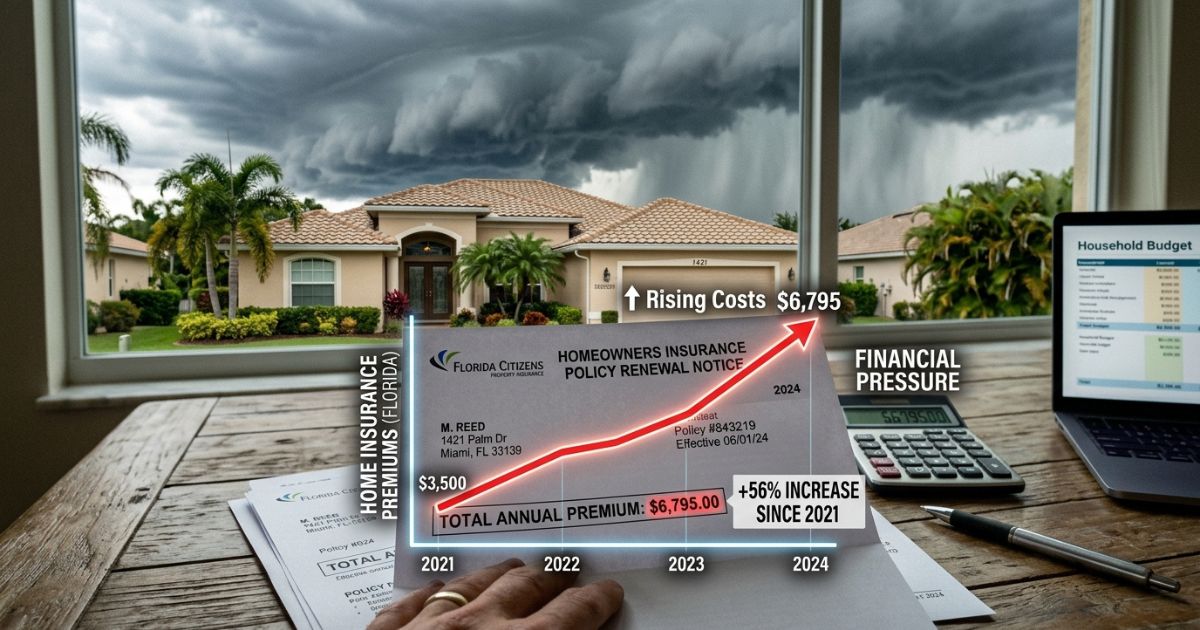
You find a home in Florida that fits your budget. Then you request an insurance quote — and the annual premium comes back at $5,000, $7,000, sometimes more. That single number can quietly make an affordable property expensive to own for as long as you hold it.
This is the reality a growing number of Florida buyers and homeowners are navigating. Home insurance in Florida isn’t just expensive — it’s become one of the most significant ongoing costs of owning property in the state. And unlike the purchase price, it doesn’t stay fixed.
Understanding why costs are rising, which factors affect your specific premium, and what you can verify before buying is not optional financial knowledge in Florida. It’s the difference between a property that stays affordable over time and one that doesn’t.
Why Florida homeowners insurance is the most expensive in the country
Florida leads every other state in average homeowners insurance premiums. In 2024 and 2025, the typical annual cost ranged from $4,000 to $6,000 — compared to a national average between $1,500 and $2,000. In coastal areas, premiums regularly exceed $10,000 per year when wind coverage is included.
Short answer: Florida's insurance costs are driven by a combination of severe hurricane exposure, years of litigation abuse, an exodus of private insurers from the state, and rising global reinsurance costs. No single cause created the crisis — and no single fix will resolve it quickly.
The core drivers:
- Frequent and intensifying hurricanes — Ian (2022), Nicole (2022), Irma (2017), and others produced insured losses that required insurers to fundamentally reprice Florida risk
- Assignment of Benefits (AOB) fraud — for years, unscrupulous contractors took over homeowners’ insurance claim rights and filed inflated or fraudulent lawsuits against carriers, raising costs across the entire market
- Litigation abuse — Florida generated a disproportionate share of all U.S. property insurance lawsuits, adding operational costs that every policyholder ultimately paid through higher premiums
- Private insurer withdrawals — dozens of companies stopped writing new policies in Florida, reduced their exposure, or became insolvent, leaving fewer competitive options for homeowners
- Reinsurance cost increases — insurers buy their own insurance to protect against catastrophic losses; as global climate-related disasters increased reinsurance costs worldwide, Florida carriers passed those increases to policyholders
| State | Average Annual Premium (2024) | Compared to Florida |
|---|---|---|
| Florida | $4,000 – $6,000+ | — |
| Texas | $2,800 – $3,800 | ~40% less expensive |
| Louisiana | $2,500 – $3,500 | ~35% less expensive |
| National average | $1,500 – $2,000 | 2–3× less expensive |
| Ohio | $900 – $1,400 | 4–5× less expensive |
What Citizens Insurance is — and why it matters to every Florida property owner
When private insurers refuse to write coverage or exit the market entirely, homeowners are left with one fallback: Citizens Property Insurance Corporation, the state-backed insurer of last resort created by Florida’s legislature.
The problem is that Citizens was never designed to be the dominant insurer in the state — and yet it has become exactly that, with well over a million policies in force at recent peaks. This creates a systemic financial risk that affects more than just Citizens policyholders.
If a major hurricane produces losses that overwhelm Citizens’ reserves, the state has the authority to levy a Citizens assessment — a surcharge applied to nearly all property insurance policies in Florida, regardless of which company you use. That means a catastrophic season could raise your insurance costs even if your own home is never touched.
Florida’s legislature has passed a series of reforms aimed at stabilizing the market: limiting attorney fees in insurance litigation, tightening AOB rules, and offering incentives for private carriers to absorb Citizens policies. These reforms have begun to show results, but premium relief for most homeowners is still materializing slowly.
Homeowners insurance, flood insurance, and wind coverage are three separate policies
One of the most expensive misunderstandings in Florida real estate is assuming that standard homeowners insurance covers all storm-related damage. It doesn’t.
Homeowners insurance covers:
- Structural damage from wind-driven rain that enters through a breach in the structure
- Fire, theft, and vandalism
- Personal liability on the property
- Loss of use if the home becomes uninhabitable
Flood insurance is entirely separate and must be purchased independently — typically through the National Flood Insurance Program (NFIP) or a private flood carrier. It covers:
- Flood damage from overflowing bodies of water
- Storm surge
- Heavy rainfall accumulation when the ground is saturated
Wind insurance in some coastal counties is sold separately from standard homeowners policies. In high-risk coastal zones, the standard carrier may exclude windstorm coverage entirely, requiring a separate policy through Citizens’ wind program or a private wind carrier.
| Coverage Type | What It Protects | Average Annual Cost (FL) | When Required |
|---|---|---|---|
| Homeowners Insurance | Structure, personal property, liability | $4,000 – $6,000+ | Required by mortgage lenders |
| Flood Insurance (NFIP) | Flood and storm surge damage | $700 – $2,500 | Required in FEMA high-risk zones with federal financing |
| Wind Insurance | Windstorm damage in coastal areas | $1,000 – $4,000 | Required separately in some coastal counties |
In many parts of South Florida and along the Gulf Coast, a homeowner may be carrying all three policies simultaneously — with a combined annual cost that can easily exceed $10,000 to $12,000.
What actually determines the cost of your specific policy
Insurance premiums in Florida aren’t set by state averages — they’re calculated based on the specific characteristics of the individual property. Two homes on the same street can carry very different premiums.
Factors that push premiums higher:
- Location in or near a FEMA flood zone, especially Zone AE or VE
- Proximity to the coast (within 1, 3, or 5 miles affects wind exposure pricing)
- A roof that is more than 10–15 years old or lacks a current wind mitigation certification
- Absence of hurricane-rated impact windows or storm shutters
- Construction predating 2002 (before Florida adopted a significantly stronger building code following Hurricane Andrew)
- Prior claims history on the property, as reported in the CLUE report
- Distance from a fire station or hydrant
Factors that reduce premiums:
- A new roof with a valid wind mitigation report showing its certified resistance to uplift
- Impact-resistant windows and exterior doors
- Construction to the current Florida Building Code
- Home security system monitored by a central station
- Elevation above the Base Flood Elevation (BFE) for properties in flood zones
A wind mitigation inspection — typically $75 to $150 — can produce documented credits that reduce annual premiums by 20% to 40% on qualifying properties. The inspection cost is usually recovered in the first year of savings.
What buyers need to verify before making an offer on any Florida property
Insurance is not a cost to discover after closing. It’s a variable that should enter your financial analysis before you make any offer — because the premium on the specific property you’re considering may be very different from general market estimates.
Short answer: Before making any offer on a Florida property, get actual insurance quotes using the property's exact address. The real annual cost may change the math on whether the property is affordable to hold long-term.
What to verify before closing:
- Flood zone classification — check the FEMA Flood Map Service Center with the property’s address or parcel ID before submitting any offer
- CLUE report — request the Comprehensive Loss Underwriting Exchange report to see the property’s claims history for the past seven years
- Roof age and condition — a roof over 15–20 years old can result in coverage limitations, significantly higher premiums, or outright refusal by private carriers
- Wind mitigation report — if the current owner has one, ask for it; the documented features may transfer significant discounts to your policy
- Actual insurance quotes — get at least three real quotes from licensed Florida insurers using the property address, not a zip code estimate
- Citizens Insurance status — if the property is insured through Citizens, understand why. Private carriers may have refused coverage for reasons worth investigating before you commit
- Flood insurance requirement — determine separately whether flood insurance will be required, and get a quote that reflects the property’s specific flood zone designation
Common mistakes buyers make about Florida insurance costs
- Calculating affordability using only the mortgage payment and property taxes, then discovering the insurance cost changes the monthly budget significantly
- Assuming homeowners insurance covers flood damage — and learning otherwise after a storm
- Using zip-code-level insurance estimates instead of getting real quotes tied to the specific property
- Buying in a coastal area without pricing wind coverage separately before closing
- Ignoring the age and condition of the roof during the property evaluation — one of the most common reasons private carriers decline to write coverage
- Not pulling the CLUE report and being surprised by a history of major water or wind claims
What to verify before closing on any Florida property
- Search the property address on the FEMA Flood Map Service Center and record the flood zone designation before making any offer
- Pull at least three real homeowners insurance quotes tied to the specific property address — not a zip code estimate
- Determine whether a separate flood insurance policy is required or strongly recommended given the flood zone classification
- Request the CLUE report to review the property’s full claims history
- Ask for any existing wind mitigation report and confirm it’s current
- Check the roof age, material, and condition — and factor in potential replacement costs if it’s aging
- Calculate the total annual insurance cost (homeowners + flood + wind, if applicable) before determining whether the property fits your long-term budget
📚 Glossary
Assignment of Benefits (AOB) — A legal arrangement in which a homeowner transfers the right to receive insurance claim proceeds to a third party, typically a contractor. When abused, it was used to file inflated or fraudulent claims against insurers, driving up costs across Florida’s insurance market.
Base Flood Elevation (BFE) — The height that floodwaters are projected to reach during a 100-year flood event in a given area, as determined by FEMA. Properties built above the BFE carry lower flood risk and typically pay lower flood insurance premiums.
Citizens Property Insurance — The Florida state-backed insurer of last resort, created for homeowners who cannot obtain coverage in the private market. Due to private insurer withdrawals, it has become the largest property insurer in the state.
CLUE Report — Comprehensive Loss Underwriting Exchange report. A seven-year history of insurance claims filed on a specific property, maintained by LexisNexis. A standard due diligence tool in Florida real estate transactions.
Flood Insurance (NFIP) — Coverage for flood and storm surge damage, administered through the National Flood Insurance Program. Not included in standard homeowners policies — must be purchased separately.
Homeowners Insurance — A standard property insurance policy covering structural damage, personal property, and liability. Does not include flood coverage under a typical policy form.
Reinsurance — Insurance purchased by insurance companies to protect themselves against catastrophic loss years. When global reinsurance costs rise — as they have following climate-related disasters worldwide — those increases are passed through to policyholders.
Wind Mitigation Report — A certified inspection report that documents specific construction features of a home that reduce wind damage risk. Qualifying features generate premium discounts that are applied directly to the homeowners insurance policy.
✅ Immediate Actions — Start Now
- Search the property address on the FEMA Flood Map Service Center and confirm the flood zone classification before making any offer
- Get at least three actual homeowners insurance quotes using the property’s exact address — not a zip code estimate
- Ask the seller or listing agent for the property’s most recent wind mitigation report and CLUE report
- Confirm whether a separate flood insurance policy is required or advisable, and get a specific quote for that address
- Check the age, material, and condition of the roof — factor in replacement cost if the roof is aging
- Add up the total annual insurance cost (homeowners + flood + wind) and include it in your affordability calculation before committing to any offer
- If the property is insured through Citizens, ask why private carriers aren’t covering it
FAQ — Frequently Asked Questions
Why is home insurance in Florida so much more expensive than in other states? The combination of frequent and severe hurricanes, years of litigation abuse and AOB fraud, the withdrawal of private insurers from the market, and rising global reinsurance costs has created a structural insurance crisis in Florida. Premiums reflect both the actual risk profile and the elevated cost of operating in the Florida market.
Does homeowners insurance cover flood damage in Florida? No. Standard homeowners policies do not cover flood damage. Flood coverage must be purchased separately through the National Flood Insurance Program (NFIP) or a private flood insurer. This is a common and costly misunderstanding among first-time Florida buyers.
What is Citizens Insurance, and should I be concerned if a property uses it? Citizens Property Insurance is the state-backed insurer of last resort. If a property is covered by Citizens, it often means private carriers have declined or priced coverage out of reach. It’s worth investigating the reason — it may reflect something about the property’s risk profile that deserves attention before closing.
How much does the roof affect my insurance premium? Significantly. A roof older than 15–20 years can result in higher premiums, reduced coverage, or outright refusal by private carriers. A newer roof with a wind mitigation certification can reduce your annual premium by 20% to 40% depending on the materials and installation method.
Is flood insurance required for all Florida properties? Only for properties in FEMA high-risk flood zones (Zones AE, VE, and similar designations) with federally backed mortgage financing. Outside those zones, or for cash purchases, it is not legally required — but it is strongly recommended in most parts of Florida given the state’s storm surge and rainfall exposure.
Can I reduce my insurance costs after buying a Florida home? Yes. Installing impact-resistant windows and doors, replacing an aging roof with a hurricane-rated product, getting a wind mitigation inspection, and raising a structure above the Base Flood Elevation can all generate documented insurance discounts. In some cases, the annual savings exceed the cost of the improvements within a few years.
Conclusion
Florida’s insurance market isn’t expensive by accident. It reflects decades of hurricane losses, a legal environment that for years rewarded litigation over legitimate claims resolution, and the withdrawal of private capital from a market that became difficult to underwrite profitably.
For anyone buying property in Florida, treating insurance as an afterthought is one of the most common and costly financial mistakes in the state. A home that looks affordable at the purchase price can become genuinely difficult to sustain when annual insurance costs are factored into the full picture.
The good news is that this is knowable before you close. Real insurance quotes, flood zone verification, roof condition, and claims history are all verifiable before any commitment is made — and they give you the full financial picture the listing price alone will never show.
TerraNoble offers bilingual guidance in English and Portuguese for buyers evaluating property across Florida. If you want to understand the real cost of owning a specific property — insurance included — our team is here to help.