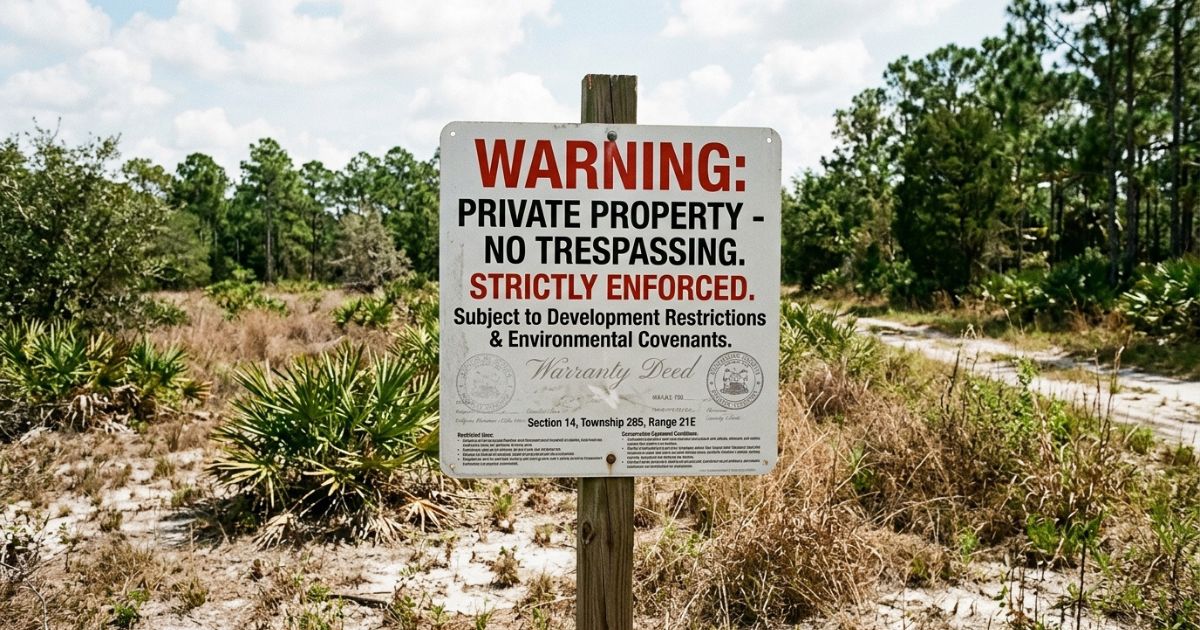
A parcel can look exactly right: good location, reasonable price, open land with room to build. But if something goes unverified before closing — an unresolved lien, an incompatible zoning classification, soil that won’t pass a percolation test — the problem doesn’t disappear. It transfers to the new owner along with the deed.
What concerns experienced buyers isn’t the parcel that looks obviously problematic. It’s the one that looks fine on the surface but carries a history that nobody mentioned.
This guide covers the warning signs that appear most often — and that buyers who skipped due diligence tend to discover only after the deal is done.
Why a price well below market value is the first red flag to investigate
Land priced significantly below comparable parcels in the same area rarely represents a hidden gem. More often, it signals that the seller is aware of something the buyer hasn’t found yet.
The most common reasons for artificially low land prices in Florida include:
- Accumulated back taxes — unpaid property taxes from prior years that are recorded against the parcel and transfer to the new owner at closing
- Zoning that doesn’t match the intended use — a parcel classified as agricultural, for example, may prohibit residential construction without a special use approval from the county
- Recorded environmental issues — mapped wetlands, contaminated soil, or protected habitat designations that restrict or prevent development
- Pending litigation against the title (lis pendens) — an active lawsuit that can block or delay the legal transfer of ownership
Short answer: Before making any offer on land priced below market comparables, pull the tax history at the county tax collector's website and commission a professional title search. What doesn't appear in the listing almost always appears in those documents.
Is this parcel in a flood zone — and what the listing probably doesn’t tell you
Florida has one of the highest concentrations of flood-zone properties in the United States. But flood zone classification rarely appears prominently in land listings — and buyers who don’t verify this before closing are often caught off guard by insurance requirements that can significantly increase the true cost of ownership.
Flood zones are designated by FEMA and organized by risk level:
| FEMA Zone | Risk Level | Flood Insurance |
|---|---|---|
| Zone X (unshaded) | Minimal risk | Not required |
| Zone X (shaded) | Moderate risk | Recommended, not required |
| Zone AE / AH / AO | High risk — 100-year flood plain | Required for federally backed loans |
| Zone VE | Very high risk — coastal wave action | Required; premiums are substantial |
Beyond insurance, parcels in high-risk flood zones face more restrictive building requirements: mandatory elevated foundations, stricter county permit conditions, and limitations on how the land can be graded or developed. These requirements drive up construction costs even when the land purchase price seems reasonable.
The verification is free and takes minutes: search the parcel address or ID on the FEMA Flood Map Service Center before making any offer.
No legally guaranteed road access — one of the most serious red flags in land buying
A parcel without direct, legally guaranteed access to a public road is described as landlocked. To use or develop a landlocked lot — to build on it, run utilities to it, or even legally access it — the owner must have a recorded access easement: a right-of-way across neighboring private property that grants legal passage to the road.
The critical problem: neighboring landowners are not obligated to provide access. Without a recorded easement in the title, the buyer may be purchasing a parcel they cannot legally use.
Warning signs related to access:
- The only way in or out is through a dirt path with no formal recorded status
- The listing describes access through a neighbor’s property without specifying an easement
- The land survey shows the parcel with no frontage on any public or private road
- The seller explains access verbally but cannot produce a recorded easement document
Short answer: Before closing, confirm in the title history that a recorded access easement exists and review its exact terms. A landlocked parcel without a valid, recorded easement may be legally unusable — regardless of what the seller says in conversation.
Hidden deed restrictions and zoning classifications that don’t match your plans
Zoning and deed restrictions are two separate systems that both control what you can do with a piece of land — and both can quietly eliminate the use you planned without the listing ever mentioning it.
Zoning is set by the county and determines the permitted use categories: residential, commercial, agricultural, industrial. A parcel zoned agricultural may carry significant restrictions on residential construction. A residentially zoned parcel in certain Florida counties may prohibit short-term rental activity entirely.
Deed restrictions are limitations written directly into the property’s title — often by the original developer of the subdivision or by prior owners. Unlike zoning, they cannot be modified by petitioning the county. They travel with the land through every future sale and bind every future owner permanently.
Common red flags in this category:
- An older subdivision with no clear documentation of its original deed restrictions
- A seller who doesn’t know the HOA rules or claims the association “isn’t active”
- A zoning classification that doesn’t match what’s been built on surrounding lots
- A listing that mentions “mixed use potential” or “commercial upside” without specifics on the actual zoning
County zoning can be verified through the county property appraiser’s website. Deed restrictions only surface through a full title search and review of the recorded documents.
Liens, unpaid taxes, and title problems that transfer to the buyer
Every financial encumbrance recorded against a Florida property travels with that property to the next owner. A buyer who closes without verifying the title history can inherit debts that have nothing to do with their own transaction.
The most common encumbrances found on vacant parcels:
- Back taxes — property taxes unpaid from prior years. On lots that have sat idle for extended periods, the accumulated amount can be substantial
- HOA liens — unpaid association fees that were recorded as a claim against the title
- Mechanic’s liens — debts owed to contractors for work performed on the property that was never paid
- Lis pendens — a recorded notice of pending litigation that can block the title transfer entirely
Short answer: A professional title search — conducted by a title company or real estate attorney — identifies all recorded encumbrances before closing. The cost is small relative to the risk of discovering a lien after you've taken ownership.
What the soil can actually support — and what it won’t
In areas of Florida without access to municipal sewer service, a private septic system is the only option for wastewater management. Septic installation requires county approval, and that approval depends on the results of a percolation test measuring how well the soil absorbs water.
If the soil fails — too much clay content, a shallow water table, or saturated conditions — the county denies the septic permit. Without an approved septic system and no municipal sewer connection available, the parcel cannot legally support any habitable structure.
Additional soil conditions that create significant construction problems:
- Shallow water table — widespread across Florida, especially in low-lying areas. Affects foundation design, septic feasibility, and any below-grade construction
- Contaminated soil — parcels with a history of agricultural chemical application, fuel storage, or light industrial use may require environmental remediation before any construction can begin
- Protected wetlands — land mapped as wetlands by federal or state agencies is heavily regulated. Building on or altering wetlands requires special permits and is frequently prohibited
| Soil Condition | Construction Impact | Estimated Additional Cost |
|---|---|---|
| Clay-heavy soil (poor percolation) | May disqualify septic system installation | $10,000 – $40,000 for alternative systems |
| High water table | Requires elevated foundation and drainage engineering | $15,000 – $50,000+ |
| Contaminated soil | Environmental remediation required before construction | $20,000 – $200,000+ |
| Mapped wetlands | Construction restricted or prohibited | Variable — may eliminate development entirely |
HOA financial health — the red flag most buyers overlook entirely
When a parcel sits inside a planned subdivision with an HOA, the buyer takes on financial obligations that exist regardless of construction: HOA dues are owed monthly or annually even when the lot is completely empty.
Beyond the recurring fees, an often-overlooked red flag is the financial condition of the HOA itself. An association with inadequate reserves can issue special assessments — unplanned charges levied against all property owners in the community to cover unexpected expenses. These can run into the thousands of dollars per owner and arrive without much warning.
What to verify before purchasing in an HOA community:
- Current financial statements and the reserve fund balance
- History of special assessments over the past five years
- Any pending litigation involving the HOA
- The full CC&Rs (Covenants, Conditions & Restrictions) — the governing document that controls what you can and cannot do with your land
Sellers who can’t produce these documents, or who describe the HOA as “inactive” or “not really enforced,” are a red flag on their own.
The most common mistakes buyers make when they miss the red flags
- Purchasing below-market land without investigating why the price is low
- Not checking flood zone classification before making an offer
- Trusting a seller’s verbal assurances about road access without verifying the recorded easement
- Assuming the zoning matches the intended use without confirming deed restrictions
- Closing without a professional title search and discovering liens afterward
- Skipping a percolation test in areas without municipal sewer service
What to verify before closing on any Florida land parcel
- Search the parcel on the FEMA Flood Map Service Center to confirm flood zone classification
- Check back taxes and tax history at the county tax collector’s website using the parcel ID
- Verify the current zoning classification at the county property appraiser’s site and confirm it supports your intended use
- Request the full HOA document package (CC&Rs, financial statements, fee history) if the parcel is in a planned community
- Commission a professional title search to surface liens, deed restrictions, easements, and pending litigation before making any formal offer
- Order a land survey to confirm legal boundaries, verify recorded easements, and identify any encroachments
- Arrange a percolation test if the parcel will depend on a septic system — before closing, not after
📚 Glossary
Back taxes — Unpaid property taxes from prior tax years. In Florida, they are recorded against the property and transfer to the new owner at closing unless resolved beforehand.
Deed restrictions — Use limitations recorded in a property’s title by the original developer or prior owners. They bind all future owners permanently and cannot be changed by the county’s zoning process.
Easement — A recorded legal right that allows a third party to use a defined portion of a property for a specific purpose — utility infrastructure, neighboring access, drainage maintenance, or a public right-of-way.
Flood zone — A FEMA designation reflecting the statistical flood risk of a specific area. Determines insurance requirements and influences construction standards.
Landlocked — A parcel with no direct frontage on a public road. Legal use or development requires a recorded access easement across adjacent private property.
Lien — A financial claim recorded against a property — unpaid taxes, HOA fees, contractor judgments — that transfers to the new owner at closing if not cleared beforehand.
Lis pendens — A recorded notice of pending legal action against a property. Can delay or prevent a title transfer until the underlying litigation is resolved.
Percolation test — A county-required soil evaluation that measures drainage capacity to determine whether a parcel can support a private septic system. A failed test can prevent the county from issuing a septic permit.
Special assessment — An unplanned charge issued by an HOA to all community property owners, typically to cover major repairs or expenses that exceed the association’s reserve fund.
Title search — A professional review of the complete recorded history of a property to identify all liens, easements, deed restrictions, encumbrances, and legal actions that affect the title.
Wetlands — Areas designated by federal or state authorities as ecologically sensitive. Construction on or alteration of mapped wetlands is heavily regulated and frequently prohibited without special permits.
✅ Immediate Actions — Start Now
- Search the parcel address or ID on the FEMA Flood Map Service Center and record the flood zone classification
- Look up the parcel at the county tax collector’s website to check for back taxes and review the tax history
- Verify the current zoning classification at the county property appraiser’s site and confirm it’s compatible with what you plan to build
- If the parcel is in a subdivision, ask the seller for the CC&Rs, HOA financial statements, and the past five years of meeting minutes
- Hire a title company or real estate attorney to conduct a complete title search before submitting any formal offer
- Order a professional land survey to confirm legal boundaries, easement locations, and road access status
- If municipal sewer isn’t available, arrange a percolation test through the county before closing — not after
FAQ — Frequently Asked Questions
How do I find out if a Florida parcel has unpaid taxes or liens? Search the county tax collector’s website using the parcel ID — tax records are public and searchable for free. A professional title search covers liens more broadly, including HOA assessments, contractor judgments, and other recorded claims.
Does a flood zone designation affect buying vacant land in Florida? Yes. Beyond future flood insurance costs when construction begins, the flood zone classification can restrict the type of foundation required, the minimum finished floor elevation, and how the land can be graded. In high-risk zones, these requirements add substantially to construction costs.
How do I confirm that road access to a parcel is legally guaranteed? Through the title search and a land survey. A valid access easement must be recorded in the county’s property records — not just described verbally by the seller. If an easement doesn’t appear in the title history, legal access is not guaranteed.
Are sellers required to disclose problems with a property in Florida? Florida law requires sellers to disclose known material defects that are not easily visible to the buyer. However, sellers are not required to investigate issues they don’t know about — and many recorded problems (liens, easements, deed restrictions) only surface through a formal title search, not a walkthrough.
Do I need a real estate attorney to buy vacant land in Florida? It’s not legally required, but it’s strongly recommended — especially for foreign buyers or first-time purchasers in the U.S. An attorney reviews the title, interprets deed restrictions and HOA documents, and identifies risks that aren’t apparent without knowledge of Florida property law.
Can a deed restriction be removed after purchase? Generally no. Deed restrictions are recorded in the title and bind the property indefinitely. In limited cases, it’s possible to petition a court for modification or removal, but the process is expensive, time-consuming, and uncertain in outcome.
Conclusion
Most problems that surface after a Florida land purchase were accessible for verification before closing. Not because the seller concealed them — but because the buyer didn’t know what to ask for, or assumed the listing would have flagged anything important.
Red flags like a below-market price, undisclosed flood zone classification, missing road access documentation, and unresolved title encumbrances aren’t rare. They’re a normal part of the land market. Well-prepared buyers identify them early enough to renegotiate, reprice, or move on to a cleaner opportunity.
Due diligence isn’t what slows a purchase down. It’s what makes the purchase worth doing.
TerraNoble offers bilingual guidance in English and Portuguese for buyers evaluating land across Florida. If you’re looking at a parcel and want to understand what to verify before moving forward, our team is here to help.