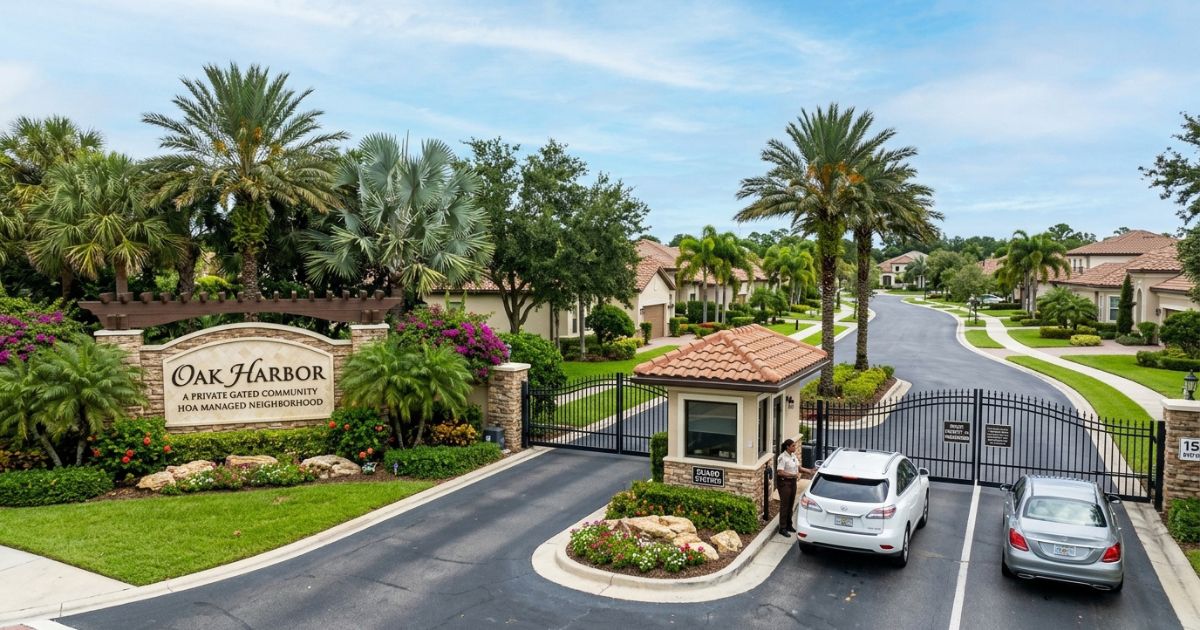
You close on a home in a beautiful Florida community. The neighborhood is clean, the landscaping is immaculate, and everything looks well-maintained. A few months later, you receive a formal notice: your mailbox doesn’t match the approved model, your car is parked in the wrong spot, and your fence paint color violates community standards. You now have 30 days to fix it — or daily fines will start accumulating.
This isn’t an unusual story in Florida. It’s what happens when buyers focus entirely on price, location, and square footage — and skip the step of reading the HOA documents before signing anything.
Most buyers assume a property is theirs to use as they choose. When a Homeowners Association is involved, that assumption can be very expensive.
Table of Contents
- What is an HOA and why does it exist?
- What rules can an HOA actually enforce?
- How much does HOA membership cost?
- What happens if you break HOA rules?
- HOA financial health: a risk most buyers ignore
- How to properly review an HOA before closing
- HOA vs. non-HOA properties in Florida
- Common mistakes buyers make
- Glossary
- Immediate Actions
- FAQ
What is an HOA and why does it exist?
An HOA — Homeowners Association — is a private organization that governs a residential community by setting and enforcing rules, managing shared spaces, and collecting fees from all property owners. When you purchase a home within an HOA-governed community, membership is automatic. You cannot opt out, and the obligations transfer with the property to every future owner.
HOAs were originally created by developers to protect the long-term value of planned communities. By ensuring all homeowners maintain their properties to a consistent standard, the association helps prevent the kind of visible decline that can drag down neighboring property values. Over time, that mission expanded — and today, HOA rules can cover everything from approved fence styles to short-term rental policies.
In Florida, HOAs are governed primarily by the Florida Homeowners’ Association Act (Chapter 720 of the Florida Statutes). This law defines what associations can and cannot do, how fees must be managed, and what rights homeowners retain — including the right to attend board meetings, review financial records, and challenge decisions.
Short answer: An HOA is a legally binding private organization that governs how you use your property within a community. Membership is mandatory when you buy, and the rules carry the same weight as a contract.
What rules can an HOA actually enforce?
The scope of HOA authority varies widely from one community to another. Some associations focus narrowly on maintaining curb appeal. Others regulate daily life in considerable detail. The most common areas of enforcement in Florida HOA communities include:
Exterior appearance
- Approved paint colors for siding, doors, and trim
- Fence type, height, and material restrictions
- Approved mailbox styles and landscaping standards
- Seasonal decorations (limits on duration and visibility)
- Satellite dishes and solar panel placement rules
Property use
- Short-term rental restrictions (Airbnb, Vrbo, and similar platforms)
- Pet policies — breed, weight, and number restrictions
- Parking rules for recreational vehicles, boats, and trailers
- Prohibition on visible home-based commercial activity
Maintenance obligations
- Lawn mowing frequency and acceptable grass height
- Driveway and sidewalk cleanliness standards
- Acceptable roof and exterior paint condition
- Removal of inoperative or abandoned vehicles
Community behavior
- Quiet hours and noise restrictions
- Pool, gym, and common area usage policies
- Visitor parking rules
- Garbage and recycling procedures
Some HOA governing documents run dozens of pages. Reviewing them fully before making an offer is not optional — it’s one of the most important steps in the buying process.
How much does HOA membership cost?
The monthly fee is the most visible cost, but it’s rarely the only one. Understanding the full cost structure is essential before calculating whether a property fits your budget.
| Cost Type | What It Covers | Typical Range in Florida |
|---|---|---|
| Monthly HOA fee | Common area maintenance, management, shared insurance | $150 – $600/month |
| Special assessment | Unplanned major repairs or capital improvements | $500 – $10,000+ (occasional) |
| Transfer fee | Paid at closing to register as a new member | $100 – $500 |
| Fines | Penalties for rule violations | $25 – $100/day per violation |
| Reserve contribution | Long-term capital fund for future major repairs (may be included in monthly fee) | Varies |
A $350/month HOA fee might look manageable in isolation. Combined with your mortgage, property taxes, homeowners insurance, and flood insurance, it adds $4,200 to your annual cost of ownership — and that figure typically increases over time. Many HOAs raise fees annually, and there’s no market mechanism preventing increases.
Short answer: Beyond the monthly fee, HOA membership may include transfer fees at closing, periodic special assessments for unplanned repairs, and daily fines for rule violations. Total annual HOA costs can easily exceed $5,000 depending on the community.
What happens if you break HOA rules?
HOAs have real legal tools to enforce compliance. The process typically escalates through clear stages:
- Written notice — the HOA sends a formal letter describing the violation
- Correction period — usually 30 days to remedy the issue
- Daily fines — if uncorrected, fines begin accumulating per day
- Hearing before the board — the homeowner may present their case
- Legal action — the association can pursue unpaid amounts through the courts
- Lien on the property — the HOA can record a lien against the title
Under Florida law updated in 2024, an HOA cannot foreclose on a property solely due to unpaid fees. However, an outstanding lien will prevent a clean title transfer — which effectively blocks you from selling or refinancing until the debt is resolved.
HOA financial health: a risk most buyers ignore
One of the least-examined aspects of buying into an HOA community is the financial condition of the association itself. An underfunded HOA — one with depleted reserves, high delinquency rates among residents, or a history of poor management — can become a costly problem for every homeowner in the community.
Warning signs of a financially troubled HOA:
- Reserve fund significantly below recommended levels for the size of the community
- Frequent special assessments in recent years, suggesting recurring budget shortfalls
- Pending or active litigation against the association or filed by it
- High delinquency rate among current owners, reducing the association’s revenue
- Unwillingness to provide financial documents for review before closing
Florida law requires the HOA to provide buyers with an Estoppel Certificate before closing. This document confirms all amounts owed on the property, the current fee structure, and any known pending assessments. It typically costs $200–$400 and is a non-negotiable part of a thorough due diligence process.
How to properly review an HOA before closing
Before making an offer on any property within an HOA community, request and read the following documents:
Documents to request
- CC&Rs (Covenants, Conditions & Restrictions) — the primary governing document
- Bylaws — rules for how the association is governed and managed
- Rules & Regulations — supplementary operational policies
- Current annual budget — how fee revenue is allocated
- Reserve study and reserve fund balance — long-term financial health
- Estoppel Certificate — current financial standing of the specific property
- Meeting minutes from the last two years — reveals ongoing disputes and decisions
Questions every buyer should ask
- What is the current monthly fee, and how has it changed over the past five years?
- Are there any approved or pending special assessments?
- What is the community’s delinquency rate on HOA fees?
- Are short-term rentals permitted? If so, under what conditions?
- What pets are allowed, and are there breed or weight restrictions?
- Is there any active litigation involving the HOA?
Short answer: Request the CC&Rs, bylaws, budget, reserve fund report, and Estoppel Certificate before closing. Pay close attention to rental restrictions, pet policies, and the association's financial reserves — these are the areas that most frequently surprise buyers after purchase.
HOA vs. non-HOA properties in Florida
Not every property in Florida comes with an HOA. For some buyers — particularly investors or those seeking more flexibility — a non-HOA property may be a better fit.
| With HOA | Without HOA | |
|---|---|---|
| Monthly fees | Mandatory ($150–$600+/month) | None |
| Appearance standards | Strictly enforced | Freedom within county zoning rules |
| Short-term rentals | Often restricted or prohibited | Governed by municipal zoning only |
| Neighborhood upkeep | Consistently maintained | Depends on individual owners |
| Resale value stability | Generally more consistent | May vary with neighborhood conditions |
| Use flexibility | Restricted by governing documents | Significantly more flexible |
The right choice depends on your goals. A well-run HOA community can offer genuine benefits — consistent maintenance, shared amenities, and neighborhood standards that protect long-term value. For investment properties, short-term rental strategies, or buyers who simply want fewer restrictions, a non-HOA property in a well-zoned area often makes more financial sense.
Common mistakes buyers make
Not reading the CC&Rs before closing. This is the single most common mistake. The documents are available before closing and must be read in full — not just summarized by an agent.
Assuming rules are flexible or negotiable. HOA rules are contractual. Requesting an informal exception rarely works, especially for short-term rental restrictions or pet policies. If the rule is in the CC&Rs, it applies to you.
Ignoring the history of special assessments. Recurring special assessments over the past few years are a clear signal of either financial mismanagement or an aging physical infrastructure — both of which point to predictable future costs.
Buying an investment property without verifying rental restrictions. Many Florida HOAs prohibit short-term rentals entirely, or require minimum lease terms of six to twelve months. Discovering this after purchasing a property intended for rental income is a serious and difficult-to-reverse problem.
Failing to factor HOA fees into affordability calculations. A property that looks affordable on paper can become a financial strain when you add $400/month in HOA fees, especially when combined with mortgage payments, property taxes, and insurance obligations.
📚 Glossary
HOA (Homeowners Association): A private organization that governs a residential community by enforcing rules, managing shared spaces, and collecting fees from all property owners.
CC&Rs (Covenants, Conditions & Restrictions): The primary governing document of an HOA, detailing all use restrictions, appearance standards, and behavioral rules that apply to every property in the community.
Special Assessment: An unplanned, one-time charge levied on all homeowners in an HOA community to cover unexpected expenses or major capital improvements not funded by regular reserves.
Estoppel Certificate: A legally required document issued by the HOA confirming all amounts owed on a specific property and the current fee structure. Required in Florida before any property sale closes.
Lien: A legal claim recorded against a property’s title to secure the payment of a debt. An HOA lien for unpaid fees prevents a clean title transfer and can block a sale until resolved.
Reserve Fund: A long-term savings fund maintained by the HOA to cover future major repairs and replacements — roofs, pool resurfacing, irrigation systems, and similar capital expenses.
Deed Restrictions: Limitations recorded directly on the property deed that restrict how the land or structure can be used, independent of HOA rules. Both can apply simultaneously.
✅ Immediate Actions — Start Now
- Confirm with the seller or listing agent whether the property belongs to an HOA community
- Request the CC&Rs, bylaws, and Rules & Regulations before signing any offer
- Review the current monthly fee and the fee history for the past five years
- Ask specifically about short-term rental restrictions before assuming Airbnb is allowed
- Request the reserve fund report and most recent annual budget
- Ask whether any special assessments have been approved or are under discussion
- Obtain the Estoppel Certificate before closing
- Check whether the HOA has any active legal disputes
- Calculate total annual ownership cost including all HOA fees and potential assessments
Buying in Florida is a strong move for many families and investors — and an HOA community can be an excellent choice when the association is well-run and the rules align with how you intend to use the property. The goal isn’t to avoid HOAs. It’s to understand exactly what you’re committing to before the paperwork is signed.
TerraNoble provides bilingual guidance in English and Portuguese for buyers navigating Florida’s real estate market. Whether you have questions about HOA rules, zoning restrictions, property taxes, or the full closing process, our team can walk you through every step — without pressure and without confusion.
FAQ — Frequently Asked Questions
Can an HOA increase fees without notifying homeowners? No. Florida HOAs are legally required to notify homeowners of fee increases and must follow procedures outlined in the governing documents. Significant increases above a certain threshold typically require a vote.
Can I refuse to join an HOA when buying a property? No. HOA membership is automatic and mandatory when you purchase a property within a governed community. There is no opt-out option.
Can an HOA prevent me from selling my home? An HOA cannot directly block a sale, but an outstanding lien for unpaid dues will prevent a clean title transfer — effectively halting the sale until the debt is paid in full.
Do the same HOA rules apply to foreign buyers? Yes. HOA rules apply to all property owners equally, regardless of nationality or country of residence.
How can I tell if an HOA is financially healthy? Request the reserve fund study, annual budget, and meeting minutes from the past two years. A financially healthy HOA maintains adequate reserves, shows low delinquency rates among residents, and holds regular, documented board meetings.
Can an HOA prohibit service animals? No. Service animals and properly documented emotional support animals are protected under federal law, regardless of HOA pet restrictions.
What is the Florida HOA Act? The Florida Homeowners’ Association Act (Chapter 720, Florida Statutes) is the state law that governs HOA operations, defines homeowner rights, and establishes the legal procedures associations must follow for fee collection, fines, and enforcement.