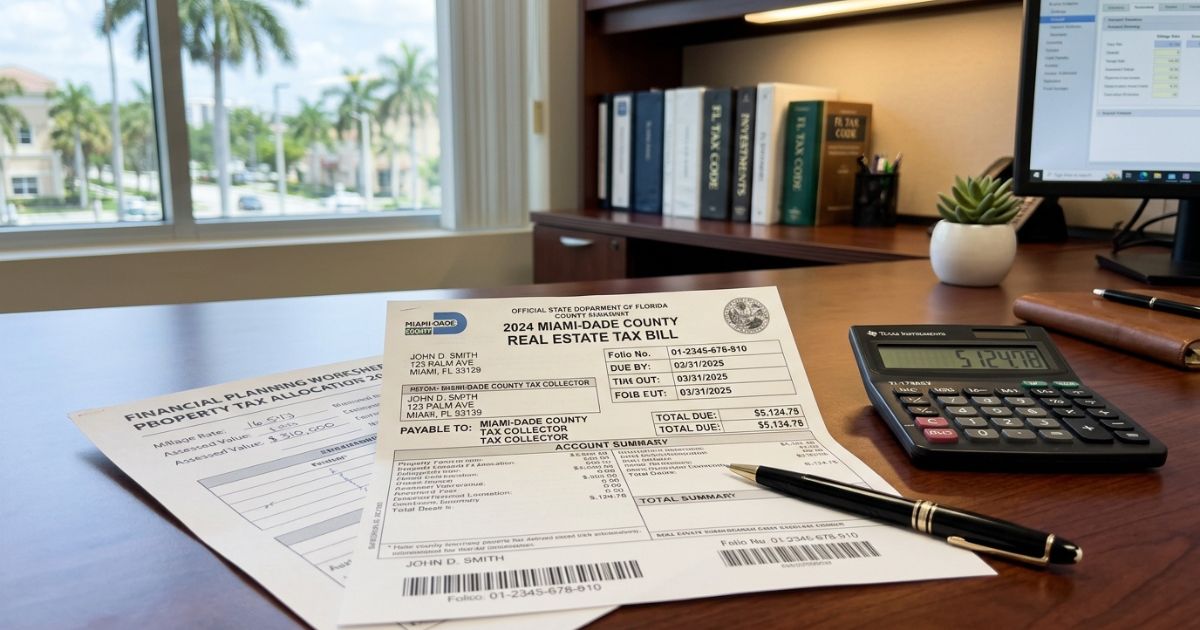
Buying property in Florida is exciting — until the first tax bill arrives and the number looks nothing like what you expected. Florida has no state income tax, which draws millions of residents and investors every year. But the absence of income tax doesn’t mean the absence of taxation. Property taxes in Florida are real, recurring, and can be surprisingly high depending on where you buy, what type of property you own, and whether you qualify for any exemptions.
The problem isn’t that the tax system is unfair. It’s that most buyers — especially first-timers and international buyers — don’t understand how it works before they sign. They see the price of the property, calculate a rough annual payment, and miss the details that can shift that number by thousands of dollars per year.
This guide walks you through exactly how Florida property taxes are calculated, what exemptions exist, how rates vary by county, and what common mistakes cost buyers more than they should pay.
Table of Contents
- How Florida property taxes are calculated
- What is the Florida homestead exemption — and who qualifies?
- How the Save Our Homes cap protects long-term owners
- How property tax rates vary by county in Florida
- Do foreigners pay higher property taxes in Florida?
- How property taxes differ for vacant land vs. residential homes
- When and how to pay your Florida property tax bill
- Common mistakes that cause buyers to overpay
- Hidden annual costs beyond the property tax bill
- Glossary
- Immediate Actions
- FAQ
How Florida property taxes are actually calculated
Florida property taxes are based on two variables: the assessed value of the property (set by the county Property Appraiser) and the millage rate applied by local taxing authorities.
The formula is straightforward:
Annual tax = Taxable value × Millage rate
The taxable value is the assessed value minus any exemptions you qualify for. The millage rate is the combined rate from the county, municipality, school district, and any special districts in your area. It’s expressed in mills — one mill equals $1 of tax per $1,000 of taxable value.
A practical example:
- Property assessed at $450,000
- Homestead exemption: $50,000
- Taxable value: $400,000
- Total millage rate: 18 mills (1.8%)
- Estimated annual tax: $7,200
One important detail most buyers miss: when a property changes hands, the assessed value is reset to market value for the new owner. If the previous owner had years of protection under the Save Our Homes cap (explained below), their tax bill could have been significantly lower than yours will be — even for the exact same property.
Short answer: Florida property taxes are calculated by multiplying the property's taxable value (assessed value minus exemptions) by the local millage rate. Total effective rates typically range between 1% and 2.5% of the assessed value per year, varying by county, city, and school district.
What is the Florida homestead exemption — and who actually qualifies?
The homestead exemption is one of the most valuable tax benefits available to Florida property owners. It can reduce your taxable value by up to $50,000 — and it comes with additional protections that extend well beyond a simple discount.
Who qualifies for the homestead exemption?
To be eligible, you must:
- Own the property as of January 1 of the tax year
- Use the property as your primary permanent residence
- Be a Florida domiciliary — meaning Florida is your legal home state
- Have the property titled in your name
How the exemption works
The $50,000 exemption is applied in two parts:
- The first $25,000 applies to all taxing authorities (county, city, school, special districts)
- The second $25,000 applies to all non-school taxes only
At a millage rate of 18 mills on a home valued at $350,000, the homestead exemption can reduce your annual tax bill by $700 to $1,100 compared to owning the same home without it.
What disqualifies you from the homestead exemption?
- Using the property as a rental or investment property
- Claiming homestead in another state
- Not being a permanent U.S. resident (applies to many international buyers)
- Missing the March 1 filing deadline for the year you want the exemption
Short answer: The Florida homestead exemption reduces taxable value by up to $50,000 for owners who use the property as their primary residence and are permanent Florida residents. Foreign nationals without U.S. permanent residency generally do not qualify.
How the Save Our Homes cap protects long-term property owners
Once a property has an active homestead exemption, Florida’s Save Our Homes (SOH) provision kicks in automatically. It’s a constitutional protection that limits how fast your assessed value can grow — regardless of what the market does.
Under Save Our Homes, your assessed value cannot increase by more than 3% per year (or the Consumer Price Index inflation rate, whichever is lower).
Over time, this creates a widening gap between market value and assessed value. A homeowner who bought a house in 2010 for $250,000 might now have a market value of $600,000 — but an assessed value of only $320,000 because of the SOH cap. Their tax bill reflects the lower number.
The important catch for buyers: SOH follows the owner, not the property. When you purchase a home, you start fresh. Your first assessed value is based on today’s market value — and you’ll likely pay significantly more in taxes than the seller was paying, even for the exact same house.
This is one of the most common surprises for first-time buyers in Florida. Always calculate the property tax you will pay as a new owner, not what the current owner pays.
How property tax rates vary by county in Florida
Florida has 67 counties, and each sets its own millage rate based on local budget needs. Cities, school districts, and special taxing districts add their own rates on top. The combined rate determines your total tax burden.
| County | Approximate Total Millage | Est. Annual Tax on $350,000 Home* |
|---|---|---|
| Miami-Dade | ~19–22 mills | $6,650 – $7,700 |
| Broward | ~18–21 mills | $6,300 – $7,350 |
| Palm Beach | ~17–20 mills | $5,950 – $7,000 |
| Orange (Orlando) | ~16–19 mills | $5,600 – $6,650 |
| Hillsborough (Tampa) | ~18–21 mills | $6,300 – $7,350 |
| Collier (Naples) | ~10–13 mills | $3,500 – $4,550 |
| Flagler | ~13–16 mills | $4,550 – $5,600 |
| Alachua (Gainesville) | ~20–23 mills | $7,000 – $8,050 |
*Estimates before exemptions. Verify current rates on the official Property Appraiser website for the relevant county.
Metro counties like Miami-Dade and Broward tend to have higher combined rates because of the density of municipal and special district taxes layered on top of the county rate. Rural counties and some Southwest Florida counties like Collier often run lower — making them worth comparing if taxes are a major consideration in your buying decision.
Short answer: Florida property tax rates vary significantly by location. Rural and coastal Southwest Florida counties often have lower effective rates (1.0%–1.3%), while urban South Florida and North Central Florida counties can reach 2.0%–2.3% of assessed value.
Do foreigners pay higher property taxes in Florida?
The short answer is: not a higher rate — but effectively a higher bill. The millage rate itself doesn’t change based on your nationality. What changes is your access to exemptions and caps that reduce the taxable base.
Foreign nationals and international investors who purchase Florida property generally:
- Do not qualify for the homestead exemption — they pay taxes on the full assessed value
- Are not protected by the Save Our Homes cap — their assessed value can rise with the market each year
- May face additional federal tax obligations — including FIRPTA withholding on property sales and federal income tax on rental income
On a $400,000 property at a millage rate of 19 mills, the difference between paying with and without the homestead exemption is roughly $950 per year. Over a 10-year holding period, that’s nearly $10,000 in additional taxes compared to an equivalent resident owner.
For Brazilian buyers and other international investors working with TerraNoble, understanding this gap before purchase helps set realistic expectations for annual ownership costs — and builds a more accurate investment model.
Short answer: Foreign buyers pay the same millage rate as domestic buyers, but they typically don't qualify for the homestead exemption or Save Our Homes cap — resulting in a higher effective tax burden on the same property.
How property taxes differ for vacant land versus residential homes
Buying vacant land in Florida comes with a distinct set of tax rules — and most of them are less favorable than residential home ownership.
| Feature | Vacant Land | Residential Home (with Homestead) |
|---|---|---|
| Homestead exemption | Not available | Up to $50,000 reduction |
| Save Our Homes cap | Not available | Max 3% annual increase |
| Agricultural classification | Possible (if actively farmed) | Rarely applicable |
| Annual value increase risk | Full market exposure | Limited by SOH cap |
| Tax base | Full assessed value | Assessed value minus exemptions |
One option worth knowing about: if a parcel of vacant land qualifies for agricultural classification (meaning it’s actively used for farming, timber, or ranching), the county may assess it at a significantly lower value than market price. This can dramatically reduce the annual tax — but requires an application and ongoing qualification.
When and how to pay your Florida property tax bill
Florida follows a fixed annual tax calendar. Understanding these dates is important — late payments carry penalties, and early payments earn meaningful discounts.
Key dates in the tax calendar:
- July–August — The Property Appraiser’s office finalizes assessed values
- August–September — TRIM Notices (Truth in Millage) are mailed to property owners, showing the proposed assessed value and estimated tax
- October — Taxing authorities finalize millage rates at public hearings
- November — Tax bills (tax notices) are mailed
- November–March — Payment window with progressive discounts
- April 1 — Payment deadline. After this date, interest and penalties apply
Early payment discounts:
| Payment Month | Discount |
|---|---|
| November | 4% |
| December | 3% |
| January | 2% |
| February | 1% |
| March | No discount |
| April and after | Penalties apply |
On a $7,000 tax bill, paying in November saves $280 compared to paying in March. On higher-value properties, the savings compound quickly. If you own multiple properties, the November deadline is worth calendaring well in advance.
Common mistakes that cause buyers to overpay on property taxes
Using the seller’s tax bill as your estimate
This is the most common and expensive mistake. If the seller has owned the home for 10 or 15 years with homestead and SOH protection, their assessed value may be 30% to 60% below current market value. When you buy, the county resets the assessment to today’s market value — and your first tax bill will likely be much higher than theirs.
Missing the homestead exemption filing deadline
Eligible buyers who close in the fall sometimes don’t think about filing until the following year — and miss the March 1 deadline. That means paying a full year of taxes without the exemption. The filing must be done by March 1 of the year for which you want the benefit.
Not reviewing the TRIM Notice
Every August or September, property owners receive a TRIM Notice showing the proposed assessed value and estimated tax. Many homeowners ignore it. But this is your only window to challenge an overvaluation through the Value Adjustment Board (VAB) before the assessment is finalized. Missing this window means paying on an inflated value for the entire year.
Assuming all tax estimates are equivalent across buyers
A property listed by an investor who never applied for homestead will show a different tax history than a home sold by a long-term owner with deep SOH savings. Never assume the tax history reflects what you will owe — always calculate from your purchase price.
Hidden annual costs beyond the property tax bill
Property tax is one recurring cost — but it sits alongside several others that can significantly increase the total annual cost of ownership in Florida:
- Homeowners insurance — Florida has some of the highest rates in the country due to hurricane exposure. Annual premiums for a standard home commonly range from $3,000 to $8,000 depending on location, age of structure, and coverage level
- Flood insurance — required by lenders for homes in FEMA-designated high-risk flood zones, and recommended for many others. Average cost under the NFIP runs $900 to $2,500 per year, but can be significantly higher in coastal AE or VE zones
- HOA fees — in planned communities, HOA monthly fees can range from $150 to over $1,000 depending on amenities and community type
- CDD fees — Community Development District fees are levied in many master-planned communities and appear as a separate line item on the tax bill, not included in the millage rate you calculated
- Maintenance costs for vacant land — counties may cite landowners for overgrown vegetation or standing water on unimproved lots, adding unexpected compliance costs
Understanding the full annual cost of ownership — not just the purchase price or the tax rate — is what separates buyers who feel prepared from buyers who feel blindsided.
📚 Glossary
Property tax: An annual tax levied on real property based on its assessed value and local millage rates.
Assessed value: The value assigned to a property by the county Property Appraiser for tax purposes. May differ from market value.
Market value: The estimated fair market value of the property, determined by the Property Appraiser and used as the basis for the assessed value.
Millage rate: The tax rate expressed in mills. One mill equals $1 per $1,000 of taxable value. The total millage is the sum of rates from the county, city, school district, and special districts.
Homestead exemption: A Florida tax benefit that reduces the taxable value of a primary residence by up to $50,000 for qualifying owners.
Save Our Homes (SOH): A constitutional cap that limits the annual increase in assessed value for homestead properties to 3% or the rate of inflation, whichever is lower.
TRIM Notice: Truth in Millage Notice. Mailed annually by the Property Appraiser, it shows the proposed assessed value and projected tax before the final bill is issued.
Value Adjustment Board (VAB): An independent board that hears property owner appeals challenging the assessed value set by the Property Appraiser.
Agricultural classification: A special land use classification that can substantially reduce the assessed value of qualifying rural or farming properties.
Tax deed sale: A public auction conducted by the county to recover unpaid property taxes. An owner who fails to pay for two or more years risks losing the property through this process.
CDD fee: Community Development District fee. Charged in planned communities to cover infrastructure costs such as roads, drainage, and parks. Appears as a separate line on the annual tax bill.
FIRPTA: Foreign Investment in Real Property Tax Act. A federal requirement that applies withholding tax to property sales by foreign nationals in the United States.
✅ Immediate Actions — Start Now
- Look up the current assessed value and tax history of any property you’re considering on the county Property Appraiser’s website
- Calculate the property tax you will owe as the new owner — use the purchase price as the assessed value starting point, not the seller’s current bill
- Confirm whether you qualify for the homestead exemption before closing — and mark March 1 as your filing deadline if you do
- Add all annual costs together: property tax, homeowners insurance, flood insurance, HOA, and CDD fees — that’s your true cost of ownership
- Request a copy of the most recent TRIM Notice and review the assessed value before making an offer
- If you’re an international buyer, consult a CPA experienced in cross-border real estate transactions to understand your full federal tax obligations
- If purchasing vacant land, ask whether the parcel qualifies for agricultural classification and what that would mean for your annual tax
Understanding this system is what separates informed buyers from surprised ones
Florida property taxes are not punishing by national standards — but they are real, recurring, and easy to miscalculate if you rely on the wrong information. The buyers who manage ownership costs well are the ones who ran the numbers correctly before closing, not the ones who discovered the true figure on their first November tax bill.
TerraNoble works with buyers at every stage of the purchase process, including helping you understand the full annual cost of ownership before you commit. Our bilingual team — fluent in English and Portuguese — can walk you through the tax landscape for any property you’re considering in Florida.
Ready to explore land or property opportunities in Florida with a clear picture of what ownership actually costs? Contact TerraNoble for a no-obligation conversation. We’ll help you make a confident, well-informed decision.
FAQ — Frequently Asked Questions About Florida Property Taxes
Does Florida have a state income tax? No. Florida has no state income tax, which is one of the reasons it attracts so many residents and investors. However, property owners still pay annual property taxes at the local level, and federal income tax obligations apply as normal.
How do I find the exact property tax for a specific Florida home? Visit the Property Appraiser website for the county where the property is located. Every county in Florida offers a public search tool where you can look up any parcel by address or folio number to see its assessed value, tax history, and current millage rate.
Can I appeal my property tax assessment in Florida? Yes. After receiving your TRIM Notice in August or September, you have a window to file a petition with the Value Adjustment Board (VAB). You’ll need to present evidence that the assessed value exceeds the market value — comparable sales in the area are the most effective supporting documentation.
What happens if I don’t pay my Florida property tax? After one year of delinquency, the county sells a tax certificate against the property (allowing investors to earn interest). If taxes remain unpaid for two years or more, the county can initiate a tax deed sale — a public auction that can result in the loss of the property.
Can I pay my Florida property taxes in installments? Florida offers an installment payment plan for property owners who apply by April 30. Payments are divided into four installments (June, September, December, March), each with a small discount applied to the applicable portion.
Is the homestead exemption automatic after I buy a home? No. You must apply for it. The application must be submitted to the county Property Appraiser’s office by March 1 of the year for which you want the exemption. It does not apply retroactively.