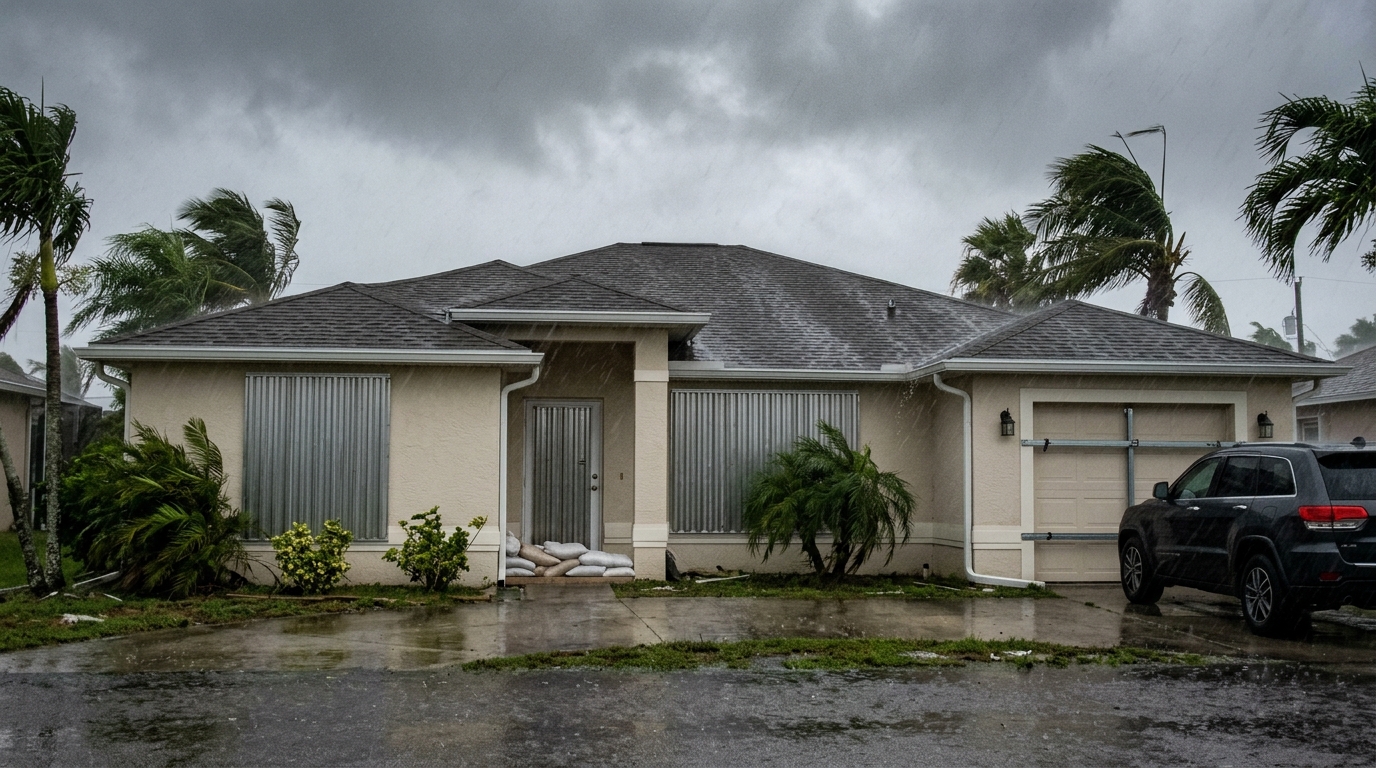
You bought a home in Florida, signed up for homeowners insurance, and checked hurricane coverage off your list. Then a major storm hits — and when you file the claim, you find out that a significant portion of the damage isn’t covered. Or that your deductible alone wipes out most of the payout.
This isn’t a rare scenario. It happens every hurricane season to homeowners across the state who believed they were protected. Hurricane insurance in Florida is real, it matters enormously, and it can be the difference between recovering and starting over. But it has specific limits, exclusions, and cost structures that most people never read until it’s too late.
This article breaks down exactly what hurricane insurance covers, what it excludes, how deductibles work in practice, and what you should verify before buying any Florida property.
What does hurricane insurance actually cover in Florida?
In Florida, hurricane insurance isn’t sold as a standalone policy. It’s built into your homeowners insurance (also called hazard insurance) as a wind peril coverage. What distinguishes it from regular wind damage is the special deductible that kicks in when the National Hurricane Center officially names a storm.
Short answer: Hurricane insurance in Florida covers structural damage caused by hurricane-force winds — including roof damage, broken windows, compromised walls, and rain that enters through wind-created openings. It does not cover flooding or storm surge, which require a separate flood insurance policy.
Typical coverages under a standard homeowners policy include:
- Dwelling coverage — damage to the home’s structure: roof, walls, windows, doors, and attached structures
- Rain intrusion through structural damage — if wind opens a gap and rain enters through it, the interior damage is generally covered
- Loss of use / additional living expenses — hotel stays or temporary rentals while repairs are underway, up to your policy’s limit
- Other structures — detached garage, fence, shed, or deck, if included in your policy
- Personal property — furniture, appliances, electronics, clothing, depending on coverage type (replacement cost vs. actual cash value)
What hurricane insurance does NOT cover — and surprises most homeowners
This is where claims break down. Several categories of storm-related damage fall entirely outside standard hurricane coverage.
Storm surge and flooding:
The most destructive force in a coastal hurricane isn’t the wind — it’s storm surge, the wall of ocean water pushed inland by the storm. Storm surge can inundate entire neighborhoods in minutes and cause far more structural damage than wind. It is not covered by homeowners insurance. You need a separate flood insurance policy, typically through NFIP (National Flood Insurance Program) or a private flood insurer.
Water entry through undamaged openings:
If your windows or doors weren’t damaged by the storm and you left them open or unprotected, the insurer may deny the interior water damage claim entirely.
Fallen trees with no structural contact:
If a tree falls in your yard but doesn’t strike an insured structure, the cost of removal is typically not covered.
Pre-existing moisture, rot, or mold:
If an adjuster finds evidence that moisture damage or mold existed before the hurricane, coverage can be reduced or denied on those specific items.
Outdoor equipment and detached personal property:
Solar panels, portable generators, patio furniture, and detached outbuildings may not be covered unless specifically listed in your policy or added via endorsement.
| Type of Damage | Covered by Homeowners? | Where to Get Coverage |
|---|---|---|
| Roof damage from wind | Yes | Homeowners insurance |
| Windows broken by debris | Yes | Homeowners insurance |
| Rain entering through wind damage | Yes (with conditions) | Homeowners insurance |
| Storm surge flooding | No | Flood insurance (NFIP or private) |
| Groundwater flooding from heavy rain | No | Flood insurance |
| Water entering through undamaged windows | Generally no | Check policy endorsement |
| Fallen tree not hitting a structure | Generally no | Not typically insurable |
| Outdoor furniture, solar panels, generators | Often no | Separate endorsement |
How does the hurricane deductible work in Florida?
Florida’s hurricane deductibles work very differently from a standard insurance deductible — and this surprises many homeowners at the worst possible moment.
Short answer: In Florida, the hurricane deductible is calculated as a percentage of your home's insured value — not a flat dollar amount. A 2% hurricane deductible on a home insured for $400,000 means $8,000 comes out of your pocket before the insurer pays anything.
The most common hurricane deductible tiers in Florida:
- 2% — the statutory minimum for most residential properties
- 5% — common in coastal zones or with last-resort insurers
- 10% — found in very high-risk areas or for older homes
A real-world example:
Your home is insured for $350,000 with a 5% hurricane deductible.
- Your hurricane deductible = $17,500
- If your roof sustains $22,000 in damage, you pay $17,500 and the insurer pays $4,500
- For the insurer to cover a significant portion, damage must substantially exceed your deductible
This structure keeps premiums viable given Florida’s extreme storm risk — but it means moderate hurricane damage may be entirely absorbed by the homeowner.
Does the hurricane deductible apply to every storm?
No. The hurricane deductible only activates when the National Hurricane Center issues a Hurricane Watch or Hurricane Warning for your area. A powerful tropical storm that causes comparable damage but doesn’t receive an official hurricane designation would be subject to your standard all-perils deductible — which is typically a flat dollar amount and usually much lower.
This means the official storm classification at the time of the event can directly affect how much you pay out of pocket.
How much does hurricane coverage cost in Florida?
Hurricane coverage isn’t priced separately — it’s embedded in your overall homeowners insurance premium. Florida has the highest homeowners insurance costs of any U.S. state, and proximity to the coast is the biggest cost driver.
Rough annual premium ranges for Florida residential properties:
- Central Florida (Orlando, Gainesville, Ocala): $3,000 – $5,000/year
- Atlantic Coast (Miami, Fort Lauderdale, Palm Beach): $5,000 – $10,000+/year
- Gulf Coast (Naples, Fort Myers, Tampa, Sarasota): $4,500 – $9,000+/year
- Pre-2002 construction or older roofs: can exceed $12,000/year in some markets
In coastal areas where wind coverage, flood insurance, and sometimes a separate wind-only policy are all required, total annual insurance costs can easily exceed $12,000–$15,000 per year for a single property.
What is wind mitigation and how does it lower your premium?
Florida law requires insurers to offer premium discounts for homes with documented wind-resistant features. A wind mitigation inspection — performed by a licensed inspector — evaluates your home’s construction and produces a report that you submit to your insurer.
Features that generate the largest discounts:
- Hip roof (slopes on all four sides) versus a gable roof (triangular ends) — hip roofs perform significantly better in high winds
- Roof-to-wall connections — stronger hurricane clips or straps reduce the risk of roof detachment
- Impact-resistant windows and doors — tested to withstand flying debris and pressure
- Hurricane shutters — certified panels or accordion shutters that protect openings
- Roof age — newer roofs, especially those installed since the 2007 Florida Building Code revision, generate better credits
The inspection costs $75–$150 and can produce annual premium savings of several hundred to several thousand dollars. If you own a Florida home and don’t have a current wind mitigation report on file with your insurer, it’s worth scheduling one.
What is Citizens Insurance and should you avoid it?
Citizens Property Insurance Corporation is the state-created insurer of last resort — designed for homeowners who can’t find coverage in the private market. In recent years, it has grown into one of the largest homeowners insurers in the state, not because it’s the best option, but because the private market has retreated from Florida’s risk exposure.
Important things to know about Citizens:
- It is a legitimate option — not a scam or substandard coverage
- Coverage can be more restrictive than comparable private policies in some areas
- If a catastrophic hurricane exhausts Citizens’ reserves, all Florida property owners — not just Citizens policyholders — may face a special assessment to cover the shortfall
- The state has been actively reducing Citizens’ exposure and encouraging private insurers to return to the market
If a private insurer offers comparable coverage at a reasonable price, most licensed agents recommend taking it over Citizens.
Common mistakes homeowners make with hurricane insurance
Assuming flood is included: The single most common and costly misunderstanding. Flooding from storm surge is not covered by homeowners insurance. Period. Flood insurance is a separate policy.
Not calculating the real deductible: A 5% deductible on a $500,000 home is $25,000. That number needs to be part of your financial planning before — not after — a storm.
Insuring for market value instead of replacement cost: Homeowners insurance covers the cost to rebuild, not what you paid for the home or what it would sell for. If rebuilding costs more than the coverage limit, the payout will be proportionally reduced. This is called a co-insurance penalty and it’s more common than most people realize.
Skipping the wind mitigation inspection: Many homeowners overpay on premiums for years without knowing they qualify for significant discounts.
Not requesting the CLUE report before buying: The CLUE report (Comprehensive Loss Underwriting Exchange) shows a property’s claim history for the past seven years. A home with repeated claims can be difficult or expensive to insure, and some insurers may decline coverage altogether.
Letting the policy renew without reviewing changes: Florida’s insurance market is volatile. Carriers raise deductibles, change coverage terms, or don’t renew policies. Review your policy terms at every renewal.
📚 Glossary
Homeowners Insurance: A broad residential policy covering the structure, personal property, liability, and — in Florida — wind damage from named storms with a hurricane deductible.
Hurricane Deductible: A percentage-based deductible (typically 2%–10% of insured value) that applies specifically to claims from named hurricane events. Higher than a standard all-perils deductible.
Flood Insurance: A separate policy from homeowners insurance that covers damage caused by flooding, including storm surge. Managed by NFIP or private flood insurers.
Storm Surge: A rapid rise in coastal water levels driven by hurricane winds and pressure. The leading cause of hurricane fatalities and structural damage in coastal areas — and not covered by standard homeowners insurance.
Wind Mitigation Inspection: A professional inspection that documents your home’s wind-resistant construction features and generates a report used to qualify for insurance premium discounts.
CLUE Report: A seven-year history of insurance claims filed on a specific property. Buyers should request this before closing on any Florida home.
Citizens Property Insurance Corporation: Florida’s state-created insurer of last resort for homeowners unable to obtain coverage in the private market.
Replacement Cost Coverage: Insurance that pays to rebuild or replace damaged property at current prices, without deducting for depreciation. More comprehensive — and more expensive — than actual cash value coverage.
Additional Living Expenses (ALE): Coverage for temporary housing costs (hotel, short-term rental) while your home is being repaired after a covered loss.
✅ Immediate Actions — Start Now
- Locate your current policy and find your hurricane deductible percentage — calculate the actual dollar amount against your home’s insured value
- Confirm whether flood insurance is included or needs to be purchased separately
- Verify that your dwelling coverage reflects current rebuilding costs, not purchase price or market value
- Schedule a wind mitigation inspection if you don’t have a current report on file
- Request the CLUE report on any Florida property before closing
- Review your policy at renewal for coverage changes or deductible increases
- Get quotes from at least three insurers — Florida premiums vary significantly between carriers for the same property
Conclusion
Hurricane insurance in Florida is a critical protection — but it only works as expected when you understand what it actually covers. The gap between what most homeowners believe they have and what their policy actually provides can cost tens of thousands of dollars after a single storm.
Knowing your deductible, confirming that flood coverage is separate, and keeping your policy current with a wind mitigation report are practical steps that can protect your family’s financial stability when it matters most.
This information is educational and does not replace the advice of a licensed insurance professional. Every property is different, and the right coverage depends on your specific location, construction, and risk profile.
If you’re considering buying property in Florida and want to understand how total ownership costs — including insurance — affect the real cost of the investment, TerraNoble offers bilingual guidance in English and Portuguese to help you navigate these decisions clearly and without pressure.