You found the property. The price is right. The location checks out. You’ve reviewed the listing, walked the lot, and you’re ready to make an offer. There’s just one step most buyers either delay or skip entirely — confirming that the land they’re about to purchase has the boundaries they think it has.
Boundary disputes, encroachments from neighboring structures, and undisclosed easements are not rare edge cases. They’re among the most common post-closing surprises in Florida real estate. And in almost every case, a current land survey — completed before closing — would have flagged the issue while the buyer still had options.
Most people think property boundaries are obvious. In reality, what’s recorded in the title, what’s physically on the ground, and what both parties assumed can be three different things.
This guide answers the questions buyers ask most: whether a survey is required in Florida, what it actually reveals, which type applies to your purchase, and what happens when you skip it.
Table of Contents
- Is a land survey required in Florida?
- What does a land survey actually show?
- What problems does a survey uncover before closing?
- Which type of survey do you need?
- How much does a land survey cost in Florida?
- What happens if you buy without a survey?
- Common mistakes buyers make about surveys
- Hidden costs of skipping the survey
- Glossary
- Immediate Actions
- FAQ
Is a land survey required in Florida?
Florida law does not require a land survey for every property purchase. But whether one is required in practice depends on how you’re buying and what you plan to do with the property.
| Situation | Survey Required? |
|---|---|
| Conventional bank financing | Usually required by the lender |
| Cash purchase (no financing) | Not legally required — but strongly recommended |
| Applying for a building permit | Required by most Florida counties |
| Obtaining title insurance | Some policies require a current survey |
| Subdividing a parcel | Required for county approval |
| Resolving a boundary dispute | Required for any legal proceeding |
The pattern is clear: the more you plan to do with the property — build, subdivide, finance, insure — the more likely you’ll need a survey at some point. Doing it before closing means you have leverage to renegotiate or walk away if problems surface. Doing it after means you own the problem.
Short answer: A land survey is not always legally mandatory in Florida, but lenders, counties, and title insurers frequently require one. Cash buyers who skip it are absorbing unknown risk that a current survey would have quantified.
What does a land survey actually show?
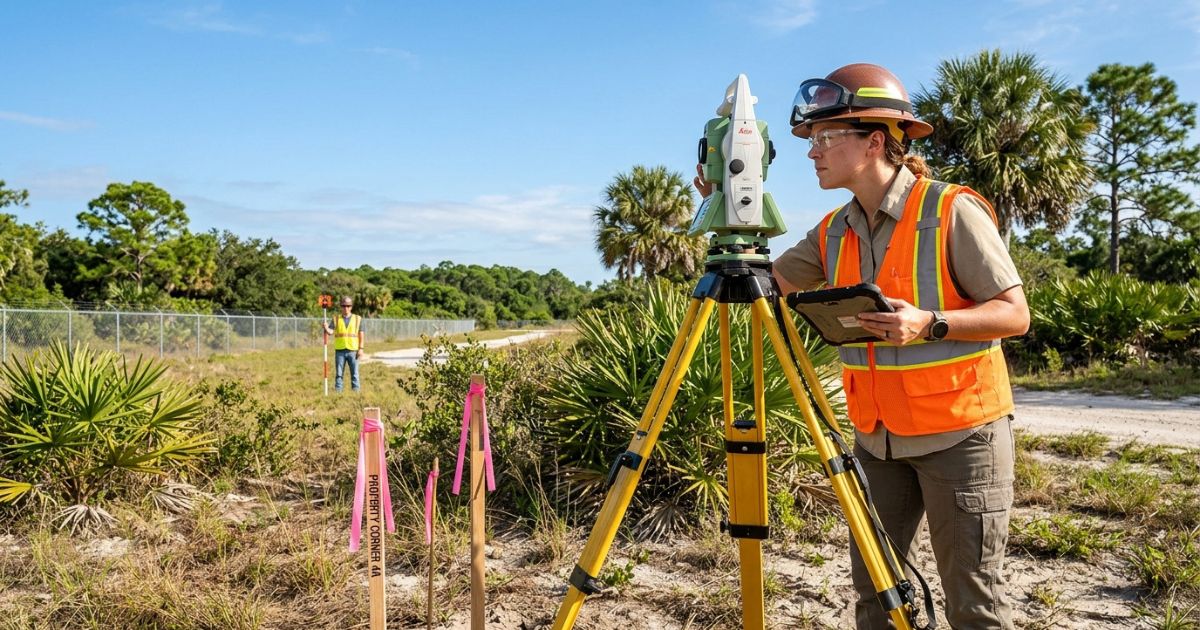
A land survey is a technical document prepared by a licensed surveyor — a state-certified professional registered with the Florida Board of Professional Surveyors and Mappers. It is based on field measurements, county records, and georeferenced coordinates.
A completed survey shows:
- Exact property boundaries — precisely where the parcel begins and ends, with dimensions verified in the field
- Recorded easements — areas where utilities, municipalities, or neighboring owners have a legal right to use part of the land
- Encroachments — structures (fences, sheds, walls, driveways) from neighboring properties crossing into the lot, or vice versa
- Flood zone markers — visual identification of FEMA flood zone classifications affecting part or all of the parcel
- Utility lines — underground and overhead infrastructure running through or adjacent to the lot
- Survey monuments — physical markers placed in the field confirming legal boundary points
Short answer: A land survey is the only document that ties what's written in the deed to what physically exists on the ground. It doesn't interpret the title — it confirms whether reality matches it.
What problems does a survey uncover before closing?
Most serious boundary issues are invisible without a professional survey. They don’t show up in listing photos, casual walkthroughs, or basic title searches.
Encroachments from neighboring structures
Fences built slightly off-line, garages expanded without precise measurement, sheds placed without setback verification — these create encroachments that affect both properties. If you buy without knowing, the encroachment becomes your problem to resolve. Depending on how long the structure has been in place, Florida’s adverse possession laws can complicate resolution further.
Easements that restrict what you can build
An easement gives a third party the legal right to use a portion of your land. A utility company may have the right to maintain power lines across the lot. A drainage easement may prohibit permanent structures in a specific area. A neighbor’s recorded access easement may limit where you can place a fence or driveway. Some easements sit directly where a buyer planned to build — and only a survey reveals that conflict before it costs money.
Boundary discrepancies and measurement gaps
Legal descriptions in deeds can differ from actual field measurements. A parcel described as 0.5 acres may measure slightly smaller — or larger. In some rural areas of Florida, especially in older subdivisions in counties like Polk, Highlands, and Putnam, legal descriptions were written from surveys decades old and contain accumulated errors. If you’re paying for a specific acreage, verify it.
Landlocked parcels without recorded access
Some Florida lots don’t have direct frontage on a public road. Legal access depends on a recorded easement over an adjacent parcel. If that easement isn’t confirmed — or doesn’t exist in the title record — the property may be legally landlocked. That affects financing, permitting, and resale value. A survey makes the access situation unambiguous.
Short answer: The four most common issues revealed by surveys in Florida are encroachments, restrictive easements, boundary measurement discrepancies, and missing access rights. All four are invisible without the document.
Which type of survey do you need?
Not all surveys are the same. The right type depends on your transaction and intended use.
Boundary Survey The standard choice for residential land purchases. Confirms the legal boundaries of the parcel, identifies encroachments, and maps recorded easements. Accepted by most title companies for residential transactions in counties like Orange, Hillsborough, Sarasota, and Lee.
ALTA/NSPS Land Title Survey The most comprehensive standard, required by commercial lenders and some title insurers. Includes everything in a boundary survey plus detailed information on improvements, utilities, easements, and zoning setbacks. Required for commercial transactions or higher-value purchases where the lender demands it.
Topographic Survey Maps the elevation contours and physical features of the land. Critical for lots near water, in flood zones, or on slopes — any situation where terrain directly affects construction planning or drainage.
Flood Elevation Certificate Not a full survey, but a complement to one. Determines the exact elevation of the structure or lot relative to the FEMA Base Flood Elevation. Required by flood insurance underwriters for accurate premium calculation. Two lots in the same FEMA flood zone can have dramatically different insurance costs depending on elevation.
Construction Survey Used during the building phase to stake out where structures, utilities, and access points will be placed. Required for building permit applications in most Florida counties.
How much does a land survey cost in Florida?
Survey costs in Florida vary by type, parcel size, county, and turnaround time. General ranges:
| Survey Type | Estimated Cost |
|---|---|
| Boundary survey (standard residential lot) | $300 – $700 |
| ALTA/NSPS Land Title Survey | $1,000 – $3,000+ |
| Topographic survey | $500 – $2,000 |
| Construction survey | $500 – $1,500 |
| Flood Elevation Certificate | $150 – $500 |
For most residential land purchases, a boundary survey in the $300–$700 range is sufficient to confirm boundaries, easements, and encroachments. Put that number next to the cost of resolving a boundary dispute after closing — which routinely runs $5,000 to $30,000 or more — and the math becomes straightforward.
Short answer: A boundary survey for a standard residential lot in Florida typically costs $300–$700. It is one of the best-cost protection steps available in any property purchase.
What happens if you buy without a survey?
Buying without a survey isn’t against the law. What it means is that you’ve accepted unknown risk on boundary and encroachment issues — and if something surfaces after closing, your options narrow considerably.
Boundary disputes become your problem to resolve Once you own the property, any disagreement with a neighboring owner over where the boundary sits has to be settled between the two of you — or in court. Without a pre-purchase survey, establishing what existed at the time of closing is harder. The cost of litigation or mediation starts at several thousand dollars and climbs quickly.
Encroachments discovered during construction If a neighboring structure turns out to cross your boundary line, construction can be halted while the issue is resolved. The cost isn’t just the legal resolution — it’s the suspended timeline, contractor holding fees, and redesign work that accompany any delay.
Title insurance with survey exceptions Many title insurance policies exclude coverage for matters that a survey would have revealed. If you close without a survey and a boundary problem surfaces later, your title insurer may decline coverage under that exception. Read the policy language before assuming you’re protected.
Permit complications Florida counties require a current survey for most building permit applications. If the survey completed at that point reveals a discrepancy — a different boundary than assumed, an easement in the wrong place — you may need to revise plans, adjust setbacks, or resolve the issue before the permit is issued.
Common mistakes buyers make about surveys
- Relying on the seller’s old survey — A survey reflects conditions at the time it was done. Fences, structures, and utility installations that happened afterward aren’t reflected. A survey from 10 or 15 years ago does not confirm current conditions.
- Treating county GIS maps as authoritative — GIS parcel maps are planning and reference tools. They carry margin-of-error disclaimers and are not legally binding boundary documents. They cannot substitute for a field survey.
- Deferring until after closing — The logic of “I’ll get a survey when I build” ignores that some problems — an easement that prohibits the planned structure, a boundary that changes the buildable area — affect the value of the purchase itself. Discovering this after closing doesn’t undo the contract.
- Skipping the Flood Elevation Certificate in flood-prone areas — Knowing that a lot is in FEMA Flood Zone AE tells you the risk classification. It doesn’t tell you the precise elevation — which is what determines the actual annual flood insurance cost. Two neighboring lots in the same zone can have a $2,000/year difference in premiums based on elevation alone.
Hidden costs of skipping the survey
| Issue Discovered After Closing | Potential Cost |
|---|---|
| Boundary dispute litigation | $5,000 – $30,000+ |
| Encroachment removal (neighboring structure) | $3,000 – $15,000 |
| Project redesign due to unmapped easement | $2,000 – $10,000 |
| Construction delay from permit complication | Weeks to months of suspended work |
| Flood insurance premium adjustment (elevation surprise) | $500 – $3,000/year above estimate |
Every item in that table costs more than a boundary survey. None of them are hypothetical — they’re the categories of problem that regularly surface in Florida land purchases where due diligence was compressed.
📚 Glossary
Land Survey: A technical document prepared by a licensed professional that establishes the precise legal and physical boundaries of a property using field measurements and county records.
Boundary Survey: The standard survey type for residential purchases. Defines lot boundaries, identifies easements, and flags encroachments.
ALTA/NSPS Survey: A comprehensive survey standard required by commercial lenders and some title insurers. Covers boundaries, improvements, easements, utilities, and zoning setbacks in detail.
Encroachment: A structure — fence, shed, wall, driveway — from a neighboring property that physically crosses into the boundary of another parcel without legal authorization.
Easement: A recorded right that allows a third party (utility company, municipality, neighboring owner) to use a defined portion of the property for a specific purpose.
Flood Elevation Certificate: A document that measures the exact elevation of a structure or lot relative to the FEMA Base Flood Elevation. Used by insurers to calculate flood insurance premiums.
Licensed Surveyor: A state-certified professional authorized to conduct legally binding land surveys. In Florida, surveyors must be licensed by the Board of Professional Surveyors and Mappers.
Building Permit: County-issued authorization to begin construction. Most Florida counties require a current survey as part of the permit application package.
Title Search: A review of public records to confirm the legal ownership history of a property and identify liens, judgments, or encumbrances. Distinct from — and complementary to — a land survey.
✅ Immediate Actions — Start Now
- Before making any offer, ask the seller whether a current survey exists — and check the date
- Hire an independent licensed surveyor (not one referred by the seller or seller’s agent) for a boundary survey
- If the lot is near water or in a known flood area, add a Flood Elevation Certificate to the scope
- Ask your title company to review recorded easements alongside the survey results before closing
- Confirm with the county whether a current survey will be required for your building permit application
- Review your title insurance policy language for survey exceptions before assuming coverage is complete
A survey is one of the cheapest protections available — and one of the most skipped
Land buyers in Florida spend weeks researching prices, locations, and market trends. Many spend less than an hour on the question of whether the land they’re buying is exactly what the deed says it is.
A land survey doesn’t answer every question in a property purchase. But it answers the fundamental one: do the boundaries, easements, and physical conditions of this lot match what’s recorded — and what you’re paying for? For buyers planning to build, finance, or eventually resell, that answer is load-bearing.
TerraNoble works with buyers navigating land purchases in Florida and offers bilingual support in English and Portuguese. If you have questions about what to verify before making an offer — or want a second opinion on a lot you’re evaluating — reach out for a no-pressure conversation.
FAQ — Frequently Asked Questions
Is a land survey legally required when buying property in Florida? Not in all transactions. Florida law does not mandate a survey for every purchase. However, lenders typically require one for financed deals, counties require it for building permits, and title insurers may require it for certain policies. Cash buyers who waive the survey are accepting boundary and easement risk without documentation.
Can I use the seller’s existing survey? Only with caution. A survey reflects conditions at the time it was prepared. Any fences, structures, or utility work done since that date are not reflected. If the survey is more than a few years old, commission a new one — especially if you’re buying vacant land where neighboring development may have changed conditions.
How long does a land survey take in Florida? A standard boundary survey on a residential lot typically takes 3–10 business days, depending on county, parcel size, and surveyor workload. Build that window into your due diligence period — most Florida purchase contracts include a 7–30 day inspection period for exactly this type of verification.
Does a land survey replace a title search? No. They address different risks. A title search examines the legal ownership history — liens, judgments, prior conveyances, deed restrictions. A land survey confirms the physical boundaries and what’s on the ground. Both are needed; neither substitutes for the other.
What’s the difference between a survey and a Flood Elevation Certificate? A boundary survey establishes where the property sits legally. A Flood Elevation Certificate measures the lot’s elevation relative to FEMA’s Base Flood Elevation and is used to determine flood insurance costs. Properties in any FEMA flood zone should have both documents before closing.
Who pays for the survey — buyer or seller? In Florida, the buyer typically pays for the survey when it’s ordered for their own due diligence. In some negotiations, particularly where the seller has offered to provide documentation, costs can be shared. There is no fixed rule — it’s a negotiable term in the purchase contract.