You’ve found a lot in Florida. The price is right, the location works, and the zoning allows what you have in mind. Before you submit an offer, there’s one infrastructure question most first-time land buyers don’t think to ask until it’s already costing them money: does this lot have a working septic system, is it connected to the public sewer, or does it have neither?
The answer determines more than you might expect. It affects how much you’ll spend on maintenance over time, what you can build and where on the lot, whether the soil will even support the system you need, and how easily you can sell the property later. It’s not a footnote — it’s a fundamental property characteristic that should be confirmed before any offer is signed.
Most buyers assume that sewage infrastructure is a solved problem. In reality, septic tank age, drain field condition, soil type, and sewer availability vary significantly across Florida counties — and the gaps only become visible when you look for them.
This guide explains what septic and sewer mean in practice, how to verify which system applies to any Florida lot, and what each scenario means for your costs, construction plans, and risk exposure.
Table of Contents
- What is a septic tank and how does it work?
- What is municipal sewer and how does it differ?
- Septic vs sewer: direct comparison
- How do you verify which system a lot uses?
- When does a septic tank become a problem?
- Hidden costs buyers don’t see before closing
- Common mistakes land buyers make
- Glossary
- Immediate Actions
- FAQ
What is a septic tank and how does it work?
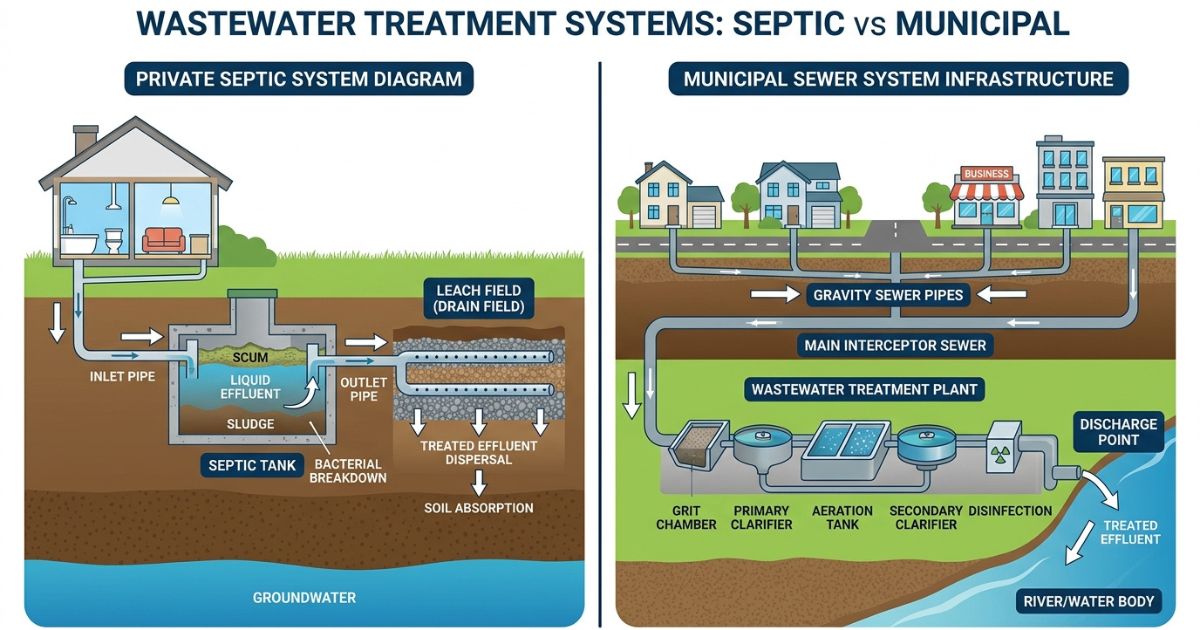
A septic tank is a self-contained, on-site wastewater treatment system installed within the boundaries of the property itself. It has no connection to municipal sewer infrastructure. Everything generated by the household is treated on-site.
The system operates in two stages:
- The tank — a buried concrete or plastic vessel that receives all wastewater from the home. Inside, solids settle to the bottom as sludge while fats and grease float to the top. The clarified liquid in the middle, called effluent, flows out to the second stage.
- The drain field (leach field) — a network of perforated pipes buried in gravel-filled trenches that distribute effluent across a designated area of the lot. The soil filters and biologically treats the liquid before it reaches the water table.
The system requires routine maintenance: accumulated sludge must be pumped out by a licensed professional every 3 to 5 years, depending on household size and usage. Skip that maintenance long enough, and the tank fills to capacity — leading to drain field failure, sewage backup, or surface contamination. All three outcomes are expensive to fix.
In Florida, septic systems are standard in rural areas, unincorporated lots, and properties in lower-density counties such as Highlands, Polk, Putnam, and Marion — anywhere the municipal sewer network hasn’t extended.
Short answer: A septic tank is a private, on-lot wastewater system that requires periodic maintenance and occupies real estate on the parcel — space that can't be built on. It works well when properly maintained, but its condition and soil suitability must be verified before purchase.
What is municipal sewer and how does it differ?
Municipal sewer — or simply “sewer” — is the public wastewater collection network operated by a city, county, or utility authority. Properties connected to sewer run a service line from the structure to the public main in the street. Wastewater is then transported to a centralized treatment facility.
From the property owner’s standpoint, sewer is operationally simpler: no on-site tank to maintain, no drain field occupying part of the lot, no pumping schedule, no soil suitability requirements. The owner pays a monthly utility fee and the wastewater infrastructure is managed by the municipality.
Properties with sewer access tend to attract broader buyer interest for several reasons:
- No maintenance liability — there’s no system on the property that can fail, fill up, or contaminate the soil
- No drain field setbacks — the lot’s full footprint is available for construction
- Easier permit approvals — counties often have fewer auxiliary requirements for sewer-connected lots
- Market preference — many buyers, particularly those from urban areas, default to expecting sewer access
The limitation is availability. Sewer infrastructure doesn’t reach every part of Florida. In rural counties and lower-density areas, the network simply doesn’t exist. And where it does exist but a lot isn’t yet connected, getting connected typically costs $5,000 to $20,000 or more, depending on the distance to the main, the county’s connection fee, and any required road work.
Short answer: Municipal sewer eliminates the on-site treatment burden entirely. But availability depends on location, and connecting a lot that isn't yet tied in carries real cost. Verify both availability and connection status — not just one.
Septic vs sewer: direct comparison
| Factor | Septic Tank | Municipal Sewer |
|---|---|---|
| System location | On the property | External municipal network |
| Owner maintenance | Pumping every 3–5 years | None — municipal responsibility |
| Monthly cost | None (absent failure) | Utility fee: ~$30–$80/month |
| Pumping cost | $300–$500 every 3–5 years | Not applicable |
| Replacement cost | $5,000–$15,000+ | Connection cost: $5,000–$20,000+ |
| Lot area consumed | Drain field restricts construction | No lot area consumed |
| Soil requirements | Must pass percolation test | No soil requirements |
| Availability | Universal — works on any approvable lot | Depends on local infrastructure |
| Market perception | Neutral to slightly negative | Preferred by most buyers |
How do you verify which system a lot uses?
This is a pre-offer verification, not a post-closing discovery. There are four reliable ways to confirm the wastewater situation for any Florida parcel.
1. Check the County Health Department records
The Florida Department of Health maintains county-level databases of permitted and inspected septic systems. Most County Health Departments allow online parcel lookups — search by address or parcel ID number. A registered system will show the permit date, system type, and any inspection history. No record found can mean no system exists yet, or that a system was installed without proper permitting (itself a red flag).
2. Search the County Property Appraiser database
The Property Appraiser’s site for most Florida counties includes utility details for each parcel — including whether the property is connected to public water and sewer or relies on well and septic. It’s a quick first check before going deeper.
3. Contact the local utility authority directly
If the area is served by a municipal or county utility, calling that authority directly gives you definitive confirmation of whether the parcel has an active sewer connection, whether sewer runs in front of the lot but the property isn’t connected yet, or whether no sewer infrastructure exists in the area at all. Each scenario has different cost implications.
4. Order a professional septic inspection
For lots with an existing septic system, a licensed inspector will assess the tank’s condition, probe the drain field, locate the system’s components, and review any prior pumping records. Budget $200–$500 for the inspection. If the system is near the end of its serviceable life — typically 25 to 40 years — negotiate repair or replacement as a contract condition before closing.
Short answer: The County Health Department database and Property Appraiser site are your fastest starting points. For lots with existing septic, follow up with a professional inspection. Don't rely on the seller's description alone — verify through public records.
When does a septic tank become a problem?
Septic systems work reliably when they’re properly sized, correctly installed, regularly maintained, and the soil is appropriate. Problems appear predictably in a handful of situations that buyers can identify before closing — if they look.
Aging system without maintenance history
A well-maintained septic tank has a functional lifespan of 25 to 40 years. One that hasn’t been pumped on schedule can fail well before that. If the seller can’t provide pumping records or an inspection report, that absence is informative. Assume the worst and price it into your offer or make inspection a closing condition.
Drain field saturation or failure
The drain field is the more vulnerable component. It can fail from overloading, soil compaction, root intrusion from nearby trees, or chronic saturation during Florida’s rainy season. Replacing a drain field costs $3,000 to $10,000 depending on size and soil. Replacing the entire system runs $5,000 to $15,000 or more. None of this is visible on a walkthrough.
Soil that doesn’t support a new system
On vacant land with no existing septic, the soil must pass a percolation test (perc test) before the county will approve installation. Florida soils vary significantly. In areas with high clay content, shallow water tables, or dense flatwoods soils — common in parts of Polk, Highlands, Collier, and Lee counties — conventional septic systems may not be approvable. Alternative systems (mound systems, aerobic treatment units) that meet county requirements can cost two to three times more than a standard install.
Drain field setbacks limiting construction
Florida counties require minimum setback distances between septic components and any permanent structure — typically 5 to 75 feet depending on the component and structure type. On smaller lots, the drain field footprint and its required setbacks can eliminate the areas where a buyer planned to build a garage, add a pool, or place a second structure. This is especially relevant in counties like Sarasota, Manatee, and Pinellas where lot sizes tend to be smaller.
Mandatory sewer connection when infrastructure expands
When a municipality extends its sewer network into an area that previously relied on septic tanks, it can — and often does — require existing property owners to connect within a specified period. The connection cost is borne by the owner. In active development corridors around Orlando, Tampa, and Jacksonville, this scenario is not hypothetical. Buyers in these areas should ask whether the county has expansion plans before assuming the septic system they’re buying will remain the permanent solution.
Hidden costs buyers don't see before closing
| Scenario | Estimated Cost |
|---|---|
| Routine septic pumping (every 3–5 years) | $300–$500 |
| Professional septic inspection | $200–$500 |
| Component repair (pump, baffle, valve) | $500–$3,000 |
| Drain field replacement | $3,000–$10,000+ |
| Full septic system replacement | $5,000–$15,000+ |
| Percolation test on vacant land | $500–$1,500 |
| Alternative system (non-approvable soil) | $10,000–$30,000+ |
| Mandatory municipal sewer connection | $5,000–$20,000+ |
None of these costs appear in the purchase price. They emerge after closing — and they’re the buyer’s responsibility from the moment the deed transfers.
Common mistakes land buyers make
-
Assuming vacant land has no septic — lots that previously held structures may have a buried, decommissioned, or poorly documented septic system. The system doesn’t disappear when the house does. Verify with the County Health Department regardless of what’s visible on the lot.
-
Skipping the perc test on rural land — in areas without sewer access, a lot’s buildability for residential use depends entirely on the soil passing the perc test. This is not a paperwork formality — it’s a physical test that some soil types fail. Discovering this after closing on an undevelopable lot is an expensive outcome.
-
Taking the seller’s word without records — “the septic is in good shape” is not a representation with any legal standing unless it’s backed by documentation and a current inspection. Request records; if none exist, make a professional inspection a condition of the contract.
-
Not checking drain field setbacks against the build plan — before you sign a contract based on what you plan to build, confirm that the drain field location — existing or required — doesn’t conflict with the setback distances that would restrict your design. Pull the county’s septic setback requirements and overlay them against the lot’s planned use.
-
Ignoring future sewer expansion plans — in growth corridors, connecting to municipal sewer may shift from optional to mandatory within years of purchase. A quick call to the county utility authority can tell you whether expansion is planned and whether connection will eventually be required.
📚 Glossary
Septic Tank: A buried, on-site wastewater treatment vessel that separates solids from liquid and allows the clarified effluent to flow to the drain field. Requires periodic pumping by a licensed professional.
Drain Field (Leach Field): The soil absorption area where treated effluent from the septic tank is distributed and filtered through the ground. Occupies a defined area of the lot and restricts construction within and around it.
Percolation Test (Perc Test): A soil absorption test required by Florida counties before approving the installation of a new septic system. Measures how quickly the soil drains water — a proxy for whether it can safely treat septic effluent.
Sewer (Municipal): The public wastewater collection and treatment network operated by a city, county, or utility district. Properties connected to sewer have no on-site treatment system.
Setback: The minimum distance required by county code between a septic system component (tank, drain field) and any structure, property line, well, or water body. Setbacks restrict where construction is permitted on the lot.
County Health Department: The county-level agency in Florida responsible for permitting, inspecting, and maintaining records for private septic systems. The primary source for verifying whether a system exists and its permit status.
Property Appraiser: The county office responsible for property valuation and records. Property Appraiser websites often list utility information — including whether a parcel is on public sewer — for each parcel in the county.
Mound System: An alternative septic system design used when the water table is too high or the soil doesn’t drain well enough for a conventional drain field. More expensive to install and maintain than a standard system.
✅ Immediate Actions — Start Now
- Look up the parcel in the County Health Department database to confirm whether a permitted septic system exists — and its installation date
- Check the County Property Appraiser site for listed utility information on the parcel
- Contact the local utility authority to confirm sewer availability and whether the lot is currently connected
- If the lot has an existing septic system, order a professional inspection before submitting an offer or as a contract contingency
- If the lot is vacant and in an area without sewer, ask the county whether a perc test will be required before construction approval
- Review the county’s septic setback requirements and confirm they don’t conflict with your intended build footprint
- Ask the county utility authority whether sewer expansion is planned for the area — and whether connection would eventually be required
The question most buyers ask too late — and how to ask it early
Florida land buyers spend significant energy on price negotiation, zoning verification, and flood zone checks. The wastewater question gets treated as a detail — something the contractor will sort out later. It isn’t a detail.
A septic system in unknown condition is a liability that transfers with the deed. Soil that won’t support a new system can render a lot unbuildable for its intended use. A mandatory future sewer connection in a growth corridor can add tens of thousands of dollars to the cost of the project — years after closing, with no warning.
All of this is verifiable before you sign. County health records, property appraiser data, and a professional septic inspection together cost a fraction of what any of these scenarios costs to fix after closing. That’s the trade-off: a few hours of due diligence before the offer, or an unquantified liability after.
TerraNoble offers bilingual guidance in English and Portuguese for buyers navigating land purchases in Florida. If you’re evaluating a lot and want to know what infrastructure checks to run before making an offer, reach out for a no-obligation conversation.
FAQ — Frequently Asked Questions
Does every Florida lot need a septic system? No. Lots connected to a municipal sewer system don’t need on-site treatment. But lots without sewer access — common in rural and lower-density areas — must have an approved septic system to support residential or commercial use. On vacant land, this requires a perc test and county permit before installation.
How do I find out if a Florida lot has a septic system? Search the County Health Department’s online database using the property address or parcel ID. Most Florida counties maintain searchable permit records for all licensed septic systems. The County Property Appraiser site is a useful secondary check for utility status.
What happens if the soil fails a percolation test? Conventional septic installation is not approved. Depending on the degree of failure, you may be able to install an alternative system — a mound system or aerobic treatment unit — at higher cost. In some cases, the lot may not be approvable for residential construction at all without access to municipal sewer. This is worth knowing before purchase, not after.
Can a county force me to connect to sewer if I already have a working septic? Yes, in some circumstances. When a municipality extends its sewer network to an area, it can require property owners to connect within a set timeframe. This has happened in parts of Orange, Hillsborough, and Pinellas counties. The connection cost — typically $5,000 to $20,000 — is the owner’s responsibility. Buyers in active development corridors should ask about expansion plans before closing.
Is it a red flag if a lot has no septic permit on record? It can be. A lot with a structure but no permitted septic may have an unpermitted system — which is a code violation and a liability. It could also mean the system predates current permit requirements, or that records are incomplete. Either way, commission an independent inspection to locate and assess any system present before assuming the property is compliant.
Does having sewer vs septic affect property value? Generally yes, particularly in suburban and semi-urban markets. Sewer-connected properties tend to attract broader buyer demand and easier financing. The impact varies by county and market — in rural areas where septic is universal, it’s less of a differentiating factor. In growth areas or near municipal boundaries, sewer access can meaningfully affect list price and days on market.