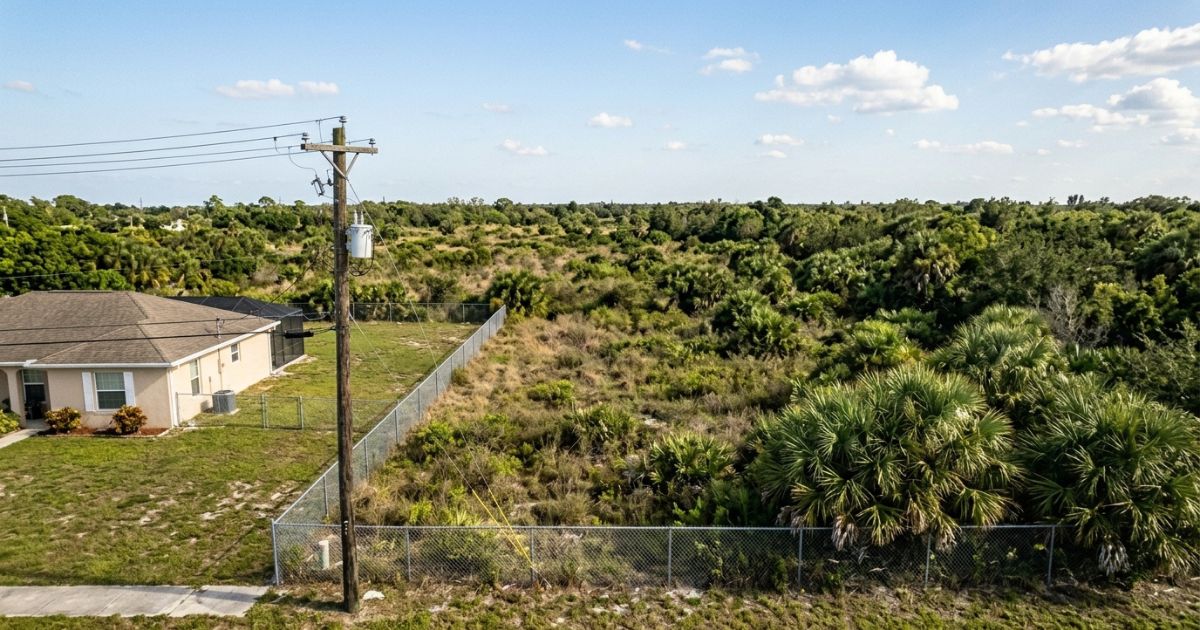
Buying a Florida lot that looks priced right and zoned correctly is a good start. What experienced buyers check next — before any offer is signed — is whether the parcel has working utility connections. Not because utilities are glamorous, but because their absence is one of the most reliable ways that an attractive asking price hides a far larger total cost.
The visible price of a lot and the real cost of making it buildable are two different numbers. Electricity, water, sewer, and internet access determine how large that gap is — and in rural or unincorporated areas of Florida, that gap can run from $15,000 to well over $60,000 before a single building permit is pulled.
Most land buyers focus on price per acre. Experienced buyers focus on what it costs to turn that acre into something usable. Utility access is where the largest hidden expenses tend to live.
This guide explains what utilities mean in the context of a Florida land purchase, how each type affects market value and construction costs, and exactly what to verify before making an offer.
Table of Contents
- What counts as “utility access” on a Florida land parcel?
- How does utility access affect land value in Florida?
- Land with utilities vs. land without: the real cost difference
- Which utilities should buyers verify before making an offer?
- Hidden costs of utility extensions and installations
- Common mistakes land buyers make about utilities
- How to verify utility access before closing
- Glossary
- Immediate Actions
- FAQ
What counts as "utility access" on a Florida land parcel?
In real estate, utilities refers to the essential infrastructure services that may or may not be available — or already connected — to a given property. For land buyers in Florida, the relevant categories are:
- Electricity — grid power delivered by utilities such as Florida Power & Light (FPL) or Duke Energy
- Public water — municipal water supply operated by the county or a utility district
- Sewer — the public wastewater collection network managed by a municipality or county
- Natural gas — available in some urban and suburban areas, but absent across much of rural Florida
- Internet and broadband — fiber, cable, or fixed wireless; access varies dramatically by county and street
Not every lot has all of these. In unincorporated and rural areas of Florida — Highlands, Hardee, Lafayette, Gilchrist, and parts of Marion and Alachua counties, for example — it’s routine to find parcels with no public water, no sewer, and no grid power within practical reach. The infrastructure simply doesn’t extend that far yet.
Short answer: Utility access on a Florida lot means the availability and connection status of electricity, water, sewer, natural gas, and internet. Each service may be available at the street but not connected to the parcel, or absent from the area entirely. Both scenarios have very different cost implications for the buyer.
How does utility access affect land value in Florida?
Florida land is priced on a spectrum that reflects, among other factors, how ready a lot is to be developed. Utility access is one of the clearest signals of development readiness — and the market prices it accordingly.
A lot with full utility connections — public water, sewer, and grid power at the parcel boundary — costs less to build on. The buyer knows what exists, connection fees are predictable, and no time or capital is spent on alternative systems. That certainty has value.
A lot without utilities requires the buyer to source or build that infrastructure independently. Depending on what’s missing, that means:
- A well and pump system for water supply ($5,000–$15,000 to drill and install)
- A septic system for wastewater ($5,000–$20,000 for conventional, more for alternative systems)
- An electric service extension to reach the parcel ($10,000–$30,000 or more per mile depending on the utility)
These costs don’t show up in the listing price. Savvy buyers know they exist — and they discount their offers accordingly. A parcel listed at a seemingly attractive price per acre in Polk County or Okeechobee County may require $30,000 or more in infrastructure before construction can begin. That changes the math on what the land is actually worth.
Short answer: Lots with utility access sell for more because they cost less to develop. Lots without utilities require buyers to fund infrastructure that should have been priced into the land — and often isn't. The gap between asking price and true acquisition cost is widest on rural parcels with no utility connections.
Land with utilities vs. land without: the real cost difference
| Factor | Lot With Utility Access | Lot Without Utility Access |
|---|---|---|
| Infrastructure startup cost | Connection fees: $500–$5,000 | Installation: $15,000–$65,000+ |
| Construction complexity | Lower — standard permitting process | Higher — additional county approvals |
| Financing availability | Broader lender options | More restrictive — some lenders decline |
| Resale appeal | High — easier to market and sell | Narrower buyer pool — price often discounted |
| Risk of unexpected costs | Low | High — depends on soil, distance, county rules |
| Time to break ground | Shorter — fewer infrastructure steps | Longer — installations can add months |
| Long-term ownership cost | Predictable monthly utility fees | Variable — maintenance, repairs, possible mandatory connections |
Which utilities should buyers verify before making an offer?
Does the lot have grid electricity — or is an extension required?
Confirm whether utility poles and active electrical lines exist at or adjacent to the parcel boundary. Proximity is not the same as connection. A pole at the edge of the property may still require a new service run to be installed by the utility — a process that can take months and cost $10,000 to $30,000 depending on distance.
Contact FPL, Duke Energy, or the relevant local utility directly and provide the parcel address. They can confirm whether service exists and give a written estimate for connection if it doesn’t. Get this before signing a contract, not after.
Is public water available at the street, or does the lot require a private well?
In high-density and suburban markets — Broward, Miami-Dade, Pinellas, Sarasota — public water is standard. In lower-density markets, private wells are common and often the only option. A properly drilled well can last for decades and costs $5,000 to $15,000 depending on depth and soil. But in areas with high mineral content, saltwater intrusion, or agricultural runoff, water quality may require treatment systems that add cost and complexity.
The County Property Appraiser site is the fastest first check. Look up the parcel and review any listed utility data. Follow up directly with the county utility department if the information is incomplete or unclear.
Is the lot connected to public sewer, or does it need a septic system?
This is one of the most consequential infrastructure questions for any Florida land purchase. Lots without sewer access need a private septic system. Installing one on vacant land requires a percolation test to verify the soil can support wastewater treatment. In Florida counties with high water tables or dense clay soils — parts of Collier, Lee, and Putnam counties — soil can fail that test, making conventional septic systems unapproved and pushing buyers toward alternative systems that cost two to three times more.
Beyond installation cost, a septic system occupies meaningful lot area through its drain field, creates setback restrictions that can eliminate planned construction zones, and requires ongoing maintenance. Verify sewer status with the County Health Department and the county’s utility authority before any offer is made.
Is broadband internet available — and does it matter for how you’ll use the lot?
For buyers planning a primary residence or a short-term rental property, internet availability is no longer optional. In suburban Florida, fiber and cable coverage is broad. In rural counties — Lafayette, Glades, Dixie, Hamilton — fixed wireless or satellite may be the only options, with meaningful limitations on speed and monthly cost.
If your planned use of the property depends on reliable internet, check coverage maps from major providers and verify service at the parcel address before closing. A lot without broadband access will narrow the pool of future buyers significantly.
Hidden costs of utility extensions and installations
| Utility | Scenario | Estimated Cost |
|---|---|---|
| Electricity | Grid extension to the parcel (per mile) | $10,000–$30,000+ |
| Water | Private well drilling and installation | $5,000–$15,000 |
| Water | Municipal connection (tap fee) | $1,000–$8,000 |
| Water | Treatment system for contaminated well | $2,000–$10,000+ |
| Sewer | Conventional septic system installation | $5,000–$20,000 |
| Sewer | Alternative septic system (failed perc test) | $10,000–$30,000+ |
| Sewer | Mandatory municipal sewer connection | $5,000–$20,000 |
| Internet | Satellite service (no cable or fiber available) | $500 install + $100–$200/month |
None of these costs appear in the listing. They materialize after closing — when negotiation leverage is gone and the buyer is solely responsible for whatever the lot requires.
Common mistakes land buyers make about utilities
-
Assuming “subdivided” means “served” — subdivision platting means the land was legally divided. It does not mean water, sewer, or power were ever extended to each parcel. Many platted lots in Florida’s older subdivisions — including some in Pasco, Levy, and Hernando counties — lack basic utility infrastructure decades after being platted.
-
Treating a nearby utility pole as a confirmed connection — infrastructure at the road does not equal infrastructure at the parcel. The distance between a power line and an unconnected lot still costs money and time to bridge. Always confirm with the utility company in writing.
-
Skipping the perc test on rural vacant land — in areas without sewer access, a lot’s ability to support residential construction depends entirely on the soil passing the percolation test. This is a physical test, not a formality. Some soils fail. Finding out after closing is a significantly more expensive lesson.
-
Not accounting for mandatory future connections — Florida counties in active growth corridors sometimes require property owners to connect to new municipal sewer lines when infrastructure reaches their area. Buyers in counties like Osceola, St. Lucie, and Flagler should ask about expansion plans and whether connection will eventually be required — and at what cost.
-
Assuming internet is a solvable problem — satellite internet works in most locations, but it has real limitations in speed, latency, and reliability. For buyers whose property use plans depend on robust connectivity, this is a verification step, not an afterthought.
How to verify utility access before closing on a Florida lot
1. Run the parcel through the County Property Appraiser site
Most Florida county Property Appraiser databases list utility information for each parcel. Look up the lot by address or parcel ID and check the utility data recorded. This is a starting point — not a definitive answer — but it surfaces red flags quickly.
2. Contact each utility company directly
For electricity, call FPL or the relevant utility and provide the parcel address. They confirm whether service exists and can estimate the cost of a new connection. For water and sewer, contact the county utility department. Ask specifically whether the parcel is currently connected, whether infrastructure runs in front of the lot, and what the tap fee would be for a new connection.
3. Search the County Health Department database for septic records
If you’re buying in an area without sewer, check whether a permitted septic system is already on record for the parcel. If there’s no record and you’re buying vacant land, ask whether a perc test will be required before the county will approve construction.
4. Require documentation as a contract condition
If the seller represents that utilities are available or connected, request written confirmation from the relevant authorities — not just verbal assurance. Make any significant utility uncertainty a contingency in the purchase contract, giving you a defined period to verify before you’re committed.
📚 Glossary
Utilities: The essential infrastructure services — electricity, water, sewer, natural gas, and internet — that may or may not be available to a given property. Their presence or absence directly affects land value, development cost, and construction feasibility.
Tap Fee: A one-time charge collected by a county or municipality to connect a new parcel to the public water or sewer network. Typically ranges from $1,000 to $10,000 or more depending on the county and connection distance.
Well (Private Water Well): An on-site water supply system drilled into the ground to access the local aquifer. Required when no public water supply reaches the parcel. Depth, soil conditions, and water quality vary significantly by county and location.
Percolation Test (Perc Test): A soil absorption test required by Florida counties before approving a new septic system installation on vacant land. Measures how quickly the soil drains water. Soils that drain too slowly or too quickly may not support a conventional system.
Septic System: An on-site wastewater treatment system required on lots without access to municipal sewer. Includes a buried tank and a drain field that occupies part of the lot. Requires periodic maintenance and creates construction setback restrictions.
Setback: The minimum required distance between a utility component — such as a septic tank or drain field — and any permanent structure. Setbacks restrict where buildings, pools, and additions can be placed on the lot.
Service Extension: The process of bringing a utility line — electrical, water, or telecommunications — from an existing infrastructure point to a parcel not yet connected. Cost depends on distance, materials, and the utility company’s requirements.
Property Appraiser: The county office responsible for property records and valuation. Property Appraiser websites often list utility details — including water and sewer status — for each parcel, and are a useful first verification step.
✅ Immediate Actions — Start Now
- Look up the parcel on the County Property Appraiser site and review any listed utility data for the lot
- Contact FPL or the relevant electric utility to confirm whether grid power is available at the parcel — and request a written estimate if a new service connection is needed
- Call the county utility department to verify public water and sewer status for the parcel, including whether the lot is connected, whether infrastructure runs at the street, and what the tap fee is for connection
- If the lot is in an area without sewer, contact the County Health Department to confirm whether any septic permit is on record — and whether a perc test will be required before construction approval
- Check broadband coverage maps from major providers using the parcel address, and confirm actual service availability if internet access is critical to your intended use
- Add a utility verification contingency to the purchase contract, giving yourself a defined due diligence window to confirm infrastructure status before you’re committed to closing
- Ask the county utility authority whether sewer or water expansion is planned for the area — and whether future connection would be mandatory and at whose cost
The asking price is not the acquisition cost
A Florida lot listed at $40,000 per acre may be exactly that — or it may be $40,000 per acre plus $50,000 in infrastructure before construction can begin. Utility access is the single largest driver of that gap.
The verification steps are straightforward. County websites, utility company calls, and a brief due diligence period are enough to surface what’s actually available — and what it will cost to fill in what isn’t. Buyers who skip these steps discover the answers after closing, when the costs are entirely theirs and the leverage to renegotiate is gone.
TerraNoble offers bilingual guidance in English and Portuguese for buyers evaluating land in Florida. If you’re looking at a parcel and want to know what infrastructure checks to run before making an offer, get in touch for a no-obligation conversation.
FAQ — Frequently Asked Questions
Does utility access affect how much I can finance on a land purchase? Yes, in some cases. Lenders — particularly those offering land loans or construction-to-permanent financing — may require that a parcel have verified utility access before approving a loan. Lots without water, sewer, or electricity may be classified as unimproved land and carry more restrictive financing terms or higher down payment requirements.
How do I find out if public water and sewer are available for a specific Florida lot? Start with the County Property Appraiser site, which often lists utility data by parcel. Then contact the county’s utility department directly with the parcel ID and address. They can confirm whether infrastructure exists at the street, whether the lot is currently connected, and what the tap fee would be for a new hookup.
Can I build on a Florida lot without electricity? You can apply for a building permit, but you’ll need a plan for electricity before occupancy is approved. Solar-plus-battery systems can meet this requirement in some counties, but the specific requirements depend on local code. Confirm with the county building department before assuming off-grid solutions will satisfy permit conditions.
What happens if the soil on my lot fails the percolation test? Standard septic installation won’t be approved. Depending on the degree of failure, alternative systems — mound systems, aerobic treatment units, or drip-irrigation systems — may be permitted at significantly higher cost. In some cases, the soil may be unsuitable for any on-site wastewater system, making the lot unbuildable for residential use without sewer access. This is a scenario to identify before closing, not after.
Is having a well instead of public water a disadvantage when selling? In rural markets where wells are standard, not particularly. In suburban or transitional markets where buyers expect public water, a well can narrow the buyer pool and affect pricing. More consequential is water quality — a well with elevated iron, sulfur, or coliform bacteria will require documented treatment to satisfy buyers and lenders. Test the water and document the results as part of any pre-listing or pre-offer verification.
Does internet availability affect Florida land value? Increasingly yes. As remote work and short-term rental use have grown, broadband access has shifted from a convenience to a determining factor in how a property can be used. In rural Florida counties where only satellite internet is available, this limits the property’s appeal to buyers who need reliable connectivity — a segment that has grown considerably in recent years.