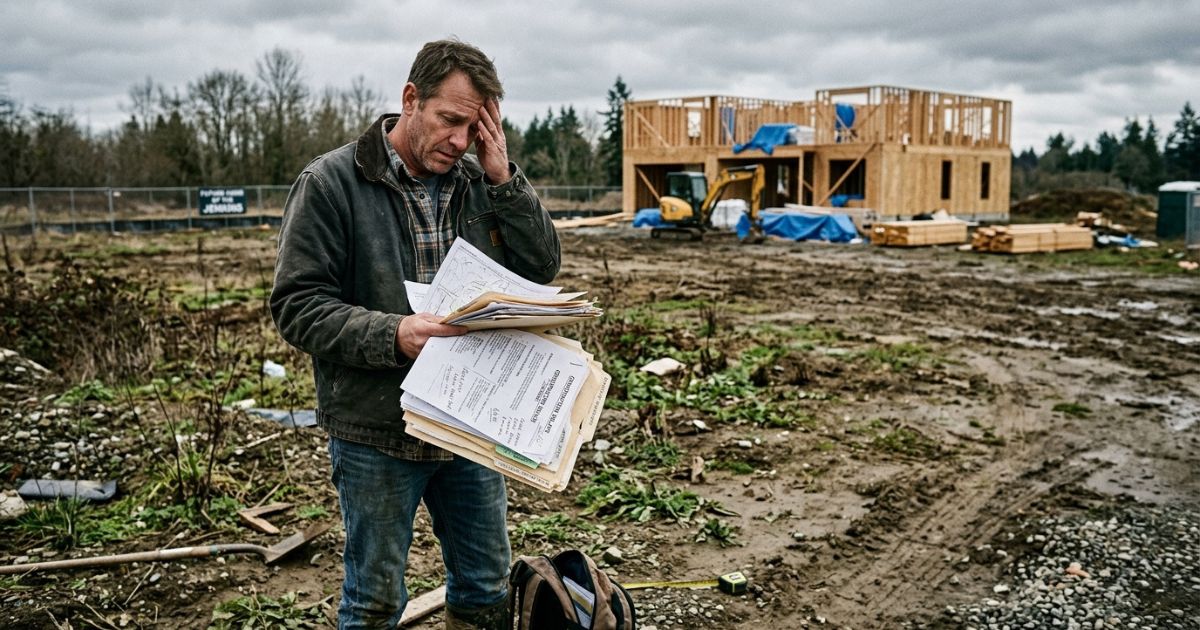
Buying vacant land feels more straightforward than buying a house. No tenants, no renovation estimates, no structure to inspect. What you see is what you get — or at least that’s how it seems.
The problem is that an empty lot carries an entire layer of information that doesn’t show up on a site visit: what’s recorded in the title, which restrictions travel with the property forever, what the soil can physically support, and who holds the legal right to cross your land. Buyers who don’t investigate these points before closing tend to discover them afterward — at a point where the options for fixing things are limited and expensive.
This guide covers the details that most commonly get missed — not the obvious ones, but the ones that keep appearing in the stories of land purchases that didn’t go as planned.
Is the title clean? What most buyers don’t think to check
Most buyers assume that if a property is listed for sale, the title is clear. That assumption turns out to be wrong more often than it should.
Liens — financial claims recorded against a property — can include unpaid back taxes, HOA assessments, contractor debts, and outstanding mortgages. On parcels that have sat idle for years, accumulated back taxes are common, and they transfer to the new owner at closing unless cleared beforehand. The buyer doesn’t just inherit the land — they inherit the debt attached to it.
Beyond liens, a proper title search should also surface:
- Easements — recorded rights that allow third parties (utilities, neighbors, municipalities) to use part of the property for specific purposes: running power lines, accessing adjacent lots, or maintaining drainage infrastructure. An easement can sit directly in the area where you planned to build.
- Encroachments — structures or fences from neighboring properties that cross the legal boundary line. These only appear in a land survey, not in a title search, which is why both are needed.
- Lis pendens — a notice of pending legal action recorded against the property. Active litigation can delay or block a transfer of ownership entirely.
Short answer: Before closing on any land in Florida, hire a title company or real estate attorney to conduct a full title search. The search surfaces liens, easements, and recorded encumbrances that never appear in the listing — and discovering them after you own the property is significantly more expensive than finding them before.
What are deed restrictions — and why they follow the land forever
Deed restrictions are use limitations written directly into the title of a property. Unlike zoning — which is set by the county and can be changed through a formal petition process — deed restrictions are permanent. They travel with the land through every future sale and bind every future owner.
A parcel may be zoned residential by the county and still carry deed restrictions that prohibit:
- Structures below a specified minimum square footage
- Certain building materials, roof types, or exterior colors
- Fences, outbuildings, sheds, or accessory dwelling units
- Subdividing the parcel into smaller lots
- Short-term rental use or any commercial activity
Deed restrictions appear in the title history — not in the listing, not in the county’s public zoning portal. Without a title search and a careful read of the recorded documents, there’s no way to know what use limitations you’re agreeing to take on.
Does this lot have an HOA — and what does that cost on vacant land?
Lots inside planned subdivisions often belong to a Homeowners Association (HOA) even when they’re completely empty. HOA dues are owed monthly or annually regardless of whether any structure has been built. Buyers who purchase lots for future development frequently underestimate this ongoing cost.
HOA fees on vacant lots in Florida typically range from $100 to $500 per month, depending on the subdivision, amenities, and how assessments are structured. Over three to five years of land ownership before construction begins, that’s a real number that belongs in the total cost calculation.
Beyond fees, HOA communities impose construction requirements that can significantly affect your project:
- Architectural plans must be submitted for HOA review and approval before construction begins
- Specific materials, colors, and finishes may be required or prohibited
- Maximum and minimum square footage requirements may be enforced independently of county zoning
- Start-and-completion timelines may require construction to begin within a set period after purchase
Ignoring HOA rules during the build phase can result in fines, stop-work orders, or forced modifications. All of it is discoverable before purchase — if you ask for the documents.
Short answer: Before making an offer on any lot in a planned community, request the full HOA document package: CC&Rs (Covenants, Conditions & Restrictions), bylaws, fee schedule, and meeting minutes. Review them carefully or have a real estate attorney flag anything that affects your intended use.
What the soil can actually support — and what it can’t
In areas without access to municipal sewer service, a private septic system is the only option for wastewater treatment. Installing a septic system in Florida requires county approval — and that approval depends entirely on the results of a percolation test, which measures how well the soil absorbs water.
If the soil doesn’t percolate within acceptable parameters — too much clay content, a high water table, or soil saturation — the county will deny the installation permit. No septic permit means no habitable structure. If there’s no municipal sewer hookup available either, the parcel effectively cannot be built on.
Soil conditions affect more than septic viability:
- Load-bearing capacity — expansive or unstable soils may require specialized foundations that add significantly to construction costs. This comes up frequently in parts of Florida with organic or peat-heavy soils.
- Contamination — parcels with a history of agricultural chemical use, fuel storage, or light industrial activity may have soil contamination requiring environmental remediation before construction can begin.
- Shallow water table — common across much of Florida, a high water table affects drainage, foundation design, and the feasibility of any below-grade construction.
| Soil Condition | Impact on Construction | Estimated Additional Cost |
|---|---|---|
| Coarse sand (good percolation) | Favorable for septic and standard foundation | Low — standard baseline |
| Clay-heavy soil (poor percolation) | May disqualify septic system installation | $10,000 – $40,000 for alternative systems |
| High water table | Requires elevated foundation and drainage engineering | $15,000 – $50,000+ |
| Contaminated soil | Environmental remediation required before any construction | $20,000 – $200,000+ |
Property taxes on vacant land — no homestead exemption
Florida homeowners who occupy their property as a primary residence qualify for the homestead exemption, which reduces the taxable value of the property by up to $50,000 and caps annual assessment increases at 3% per year under the Save Our Homes provision.
Vacant land does not qualify. Empty lots are assessed at full market value with no cap on annual increases. In fast-appreciating areas of Florida — which describes many counties across the state — that means property taxes on an undeveloped lot can climb meaningfully year over year while you wait to build.
Buyers planning to hold land for several years before breaking ground need to factor this into their financial projections. The carrying cost of vacant land is higher than it looks when you account for full-assessed-value property taxes with no homestead protection.
Short answer: Look up the current assessed value and tax bill for any parcel you're considering at the county tax collector's website. Assume that number will increase annually without a cap until the property becomes a primary residence. Build that into your total cost of ownership calculation.
Does the lot have guaranteed access to a public road?
A parcel without direct frontage on a public road is legally described as landlocked. To use or develop a landlocked lot, the owner needs a recorded access easement — a legal right-of-way across adjacent property that grants passage to a public road.
Purchasing a landlocked parcel without first confirming that a valid, recorded access easement exists is one of the more serious mistakes a land buyer can make. Neighboring landowners are not obligated to grant passage, and obtaining an access easement through the courts (an “easement by necessity”) can take years and cost tens of thousands of dollars — with no certainty of outcome.
Before making any offer on a parcel without obvious road frontage, verify:
- Whether a recorded access easement exists in the title
- The width and legal description of the access corridor (too narrow for construction equipment is a real problem)
- The physical condition of the access route and whether it can support the traffic a building project generates
Common mistakes buyers make on vacant land purchases
- Skipping the title search — assuming a listed property has a clean title without professional verification
- Missing recorded easements — purchasing without knowing that utility companies or neighboring owners hold legal rights to use part of the parcel
- Not reading HOA documents — discovering after closing that monthly fees and construction restrictions are more limiting than expected
- Skipping soil testing — moving forward with construction plans without confirming the soil supports a septic system or standard foundation
- Underestimating carrying costs — not accounting for full-rate property taxes, with no homestead cap, over multi-year hold periods
- Not confirming road access — making an offer on a parcel that has no guaranteed legal right-of-way to a public road
What to verify before closing on vacant land
- Hire a title company or real estate attorney to conduct a complete title search — liens, easements, deed restrictions, and pending litigation
- Request and read all HOA documents (CC&Rs, bylaws, current fees) if the parcel sits within a planned community
- Order a land survey to confirm legal boundaries, actual acreage, encroachments, and easement locations
- Arrange a percolation test if the parcel will depend on a private septic system
- Confirm road access is legally established through a recorded easement before going under contract
- Check the county tax collector’s records for back taxes and calculate the annual tax burden without homestead protection
Glossary
Title search — A professional examination of a property’s recorded history to identify liens, easements, deed restrictions, pending litigation, and any other encumbrances on the title.
Lien — A legal financial claim attached to a property — such as unpaid taxes, an HOA debt, or a contractor judgment — that transfers to the new owner if not resolved before closing.
Easement — A recorded legal right that allows a third party to use a defined portion of a property for a specific purpose, such as running utility lines, accessing an adjacent parcel, or maintaining drainage infrastructure.
Deed restrictions — Use limitations written into a property’s title that remain in force permanently, binding every future owner regardless of county zoning changes.
Homestead exemption — A Florida tax benefit that reduces the assessed value of a primary residence by up to $50,000 and caps annual assessment increases at 3% under the Save Our Homes provision. Vacant land does not qualify.
Percolation test — A county-required soil test that measures drainage capacity to determine whether a parcel can support a septic system. Failed results can prevent habitable construction.
Landlocked — A parcel with no direct access to a public road. Requires a recorded access easement across adjacent property to be legally usable.
CC&Rs (Covenants, Conditions & Restrictions) — The governing document of a homeowners association that defines rules, restrictions, and obligations for all property owners within the community.
Lis pendens — A recorded notice that a legal action is pending against a property. Can delay or block a title transfer until the litigation is resolved.
Land survey — A professional measurement and documentation of a parcel’s legal boundaries, actual dimensions, physical features, and any encroachments or easements that affect the property.
Immediate actions — Start now
- Request the parcel ID from the seller and look up the tax history at the county tax collector’s website
- Search whether the lot belongs to an HOA — if yes, request the full CC&Rs, bylaws, and current fee schedule
- Hire a title company or real estate attorney to run a complete title search before making any formal offer
- Order a professional land survey to confirm legal boundaries, verify easements, and identify encroachments
- Verify that the lot has a recorded access easement to a public road — especially for parcels without obvious road frontage
- Ask the county whether municipal sewer is available, or arrange a percolation test if a septic system will be needed
- Calculate the annual property tax at full assessed value — without homestead protection — and include it in your total holding cost estimate
Conclusion
Vacant land has fewer visible parts than a finished home — but carries the same legal and documentary complexity of any other real property. The difference is that the problems don’t surface during a walkthrough. They surface in records, maps, and county documents that only reach the buyer if they know what to ask for.
A professional title search, a land survey, a careful read of the HOA documents, and confirmation of easements and deed restrictions aren’t bureaucratic hurdles. They’re the tools that separate a purchase you understand from one that generates costs and complications for years afterward. The buyers who do this work before closing rarely regret it. The ones who skip it almost always do.
TerraNoble provides bilingual guidance in English and Portuguese for buyers evaluating land and real estate across Florida. If you’re looking at a parcel and want to understand what to verify before moving forward, our team is here to help.