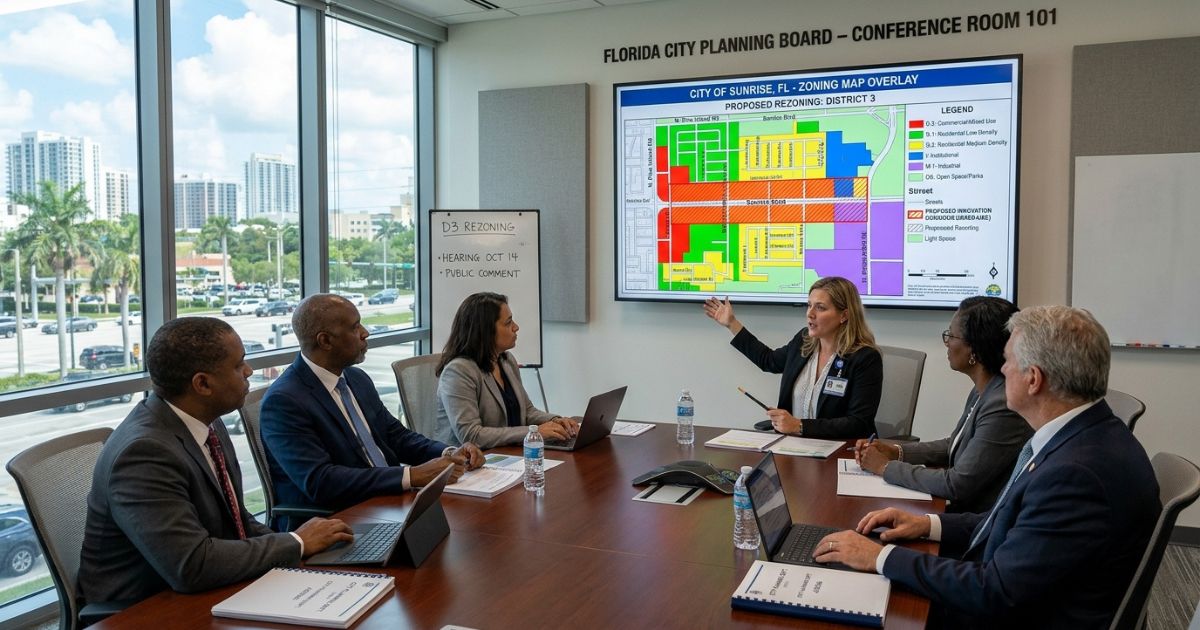
You find a Florida property that checks all the obvious boxes — good location, fair price, clean title. You move forward with an offer. Then, weeks later, you learn the zoning doesn’t allow what you planned to do with it. The lot is zoned agricultural in a county where residential permits require rezoning. Or there’s a conservation overlay that limits development to a fraction of the parcel. Or the municipality has its own zoning layer on top of the county code, and both need to be satisfied.
None of that was in the listing. And none of it is hidden — it was all publicly available the entire time.
Most buyers assume that if a property can be purchased, it can be used however they intend. Zoning says otherwise. What you’re legally allowed to do with a Florida property is determined by the county, the municipality, and — in some cases — by private restrictions that follow the land indefinitely.
This guide explains how to look up zoning restrictions for any Florida property, what to do with what you find, and what else to check that goes beyond the basic zoning designation.
Table of Contents
- What zoning restrictions actually control in Florida
- How to look up zoning for any Florida property — step by step
- How to read a Florida zoning designation
- Overlay districts: the restrictions layered on top of base zoning
- Zoning vs. deed restrictions: two separate systems, both matter
- What conditional uses mean — and why they’re not a guarantee
- How zoning can change after you buy
- Red flags that require deeper investigation
- Common zoning mistakes Florida buyers make
- Hidden costs when zoning doesn’t fit your plans
- Glossary
- Immediate Actions
- FAQ
What zoning restrictions actually control in Florida
Zoning is the legal framework through which Florida counties and municipalities classify land and govern its use. Every parcel in the state carries a zoning designation — assigned by the county or city — that determines what can be built on it, how it can be used, and what physical constraints apply to any development.
Specifically, zoning controls:
- Permitted uses by right — what you can do without needing any special approval (example: build a single-family home in an RSF zone)
- Conditional uses — what might be allowed with county or municipal review and approval, but isn’t guaranteed
- Prohibited uses — what the zone explicitly bars, regardless of what you request
- Density — how many units or structures are allowed per acre
- Setbacks — minimum distances between structures and property lines
- Height limits — maximum building height in the zone
- Impervious surface coverage — maximum percentage of the lot that can be paved or built on
Understanding the zoning designation before purchase isn’t optional due diligence. It is the foundation for everything else — permits, financing, insurance, and eventual resale all depend on what the zoning allows.
Short answer: Zoning restrictions in Florida control what you can build, how you can use the land, and what physical parameters any construction must meet. These rules are set by the county or municipality, vary by parcel, and are publicly available before you buy.
How to look up zoning for any Florida property — step by step
Every piece of zoning information you need is available free of charge through official government portals. You do not need to hire anyone to complete this initial verification.
Step 1 — Find the parcel number
The parcel number (also called Parcel ID, Folio Number, or Tax ID depending on the county) is the unique identifier assigned to every piece of land. It’s the key to accessing all public records about a property.
You can find it:
- Directly in the property listing (many include it)
- By searching the address on the county Property Appraiser portal
- On any recent tax bill associated with the property
Step 2 — Search the county GIS portal
Every Florida county maintains a public GIS (Geographic Information System) portal with interactive maps that include zoning layers. Enter the parcel number or address to see the current zoning designation applied to the lot.
Common county GIS portals:
| County | GIS / Zoning Portal |
|---|---|
| Miami-Dade | gis.miamidade.gov |
| Broward | gis.broward.org |
| Palm Beach | discover.pbcgov.org/pzb |
| Orange (Orlando area) | ocfl.net/GrowthMgmt |
| Hillsborough (Tampa area) | hcpafl.org |
| Lee (Fort Myers area) | leegis.com |
| Collier | colliercountyfl.gov/your-government/divisions-s-z/zoning |
| Sarasota | sarasotacountyfl.gov/government/planning-and-development |
Step 3 — Read the Land Development Code
The zoning label (such as “RSF-1” or “C-2”) is a shorthand. The full meaning — all permitted uses, conditional uses, setback requirements, height limits, and other restrictions — is spelled out in the county’s Land Development Code (sometimes called the Unified Land Development Code, Zoning Code, or Land Use Regulations). This document is published on every Florida county’s official website and is searchable by zone designation.
Step 4 — Check the Future Land Use Map
Beyond current zoning, review the Future Land Use Map (FLUM) in the county’s comprehensive plan. The FLUM shows how the county intends to develop each area long-term. A parcel currently zoned agricultural that sits in an area classified as “Residential Medium” on the FLUM may be a candidate for future rezoning — but a parcel in a “Conservation” FLUM designation almost certainly isn’t.
Step 5 — Check for municipal zoning
If the property is within an incorporated city or town (not in the unincorporated county), the municipality may have its own separate zoning code on top of the county’s. In Florida, incorporated cities — like Naples, Coral Gables, or Winter Park — control zoning within their boundaries independently. Contact the city’s planning or zoning department to confirm which code applies.
Short answer: Look up the parcel number on the county GIS portal to see the current zoning designation. Then read the corresponding section of the county's Land Development Code to understand what that designation actually permits. For properties inside incorporated cities, check the municipality's zoning code separately.
How to read a Florida zoning designation
Florida county zoning designations follow recognizable patterns, but each county uses its own naming system. Here are the most common structures you’ll encounter:
| Typical Designation | Category | Primary Use | Residential Construction? |
|---|---|---|---|
| RSF-1, R-1, SF-1 | Residential | Single-family home | Yes — one unit per lot |
| RSF-2, R-2, TF | Residential | Two-family (duplex) | Yes — up to two units |
| RMF, R-3, MF | Multifamily residential | Apartments, condos | Yes — multiple units |
| AG, A-1, A-2 | Agricultural | Farming, ranching | Limited — farmhouse may be allowed |
| C-1, B-1, NC | Neighborhood commercial | Small retail, services | Generally no |
| C-2, C-3, GC | General commercial | Retail, offices, services | No |
| I-1, LI, M-1 | Industrial / Light industrial | Warehouses, manufacturing | No |
| PUD | Planned Unit Development | Mixed — defined by approved plan | Depends on the specific plan |
| CON, P, OS | Conservation / Preserve / Open Space | Natural or public land | Generally no |
What the numbers mean
In many Florida counties, the number after the letter prefix indicates density or intensity. RSF-1 is typically lower density (larger minimum lot size) than RSF-3 or RSF-4. A higher number often means more units per acre are permitted. Always verify the specific standards in the county code — don’t assume the pattern holds across different counties.
PUD designations require special attention
A PUD (Planned Unit Development) designation means the parcel is subject to a specific approved development plan rather than standard zone-by-zone rules. That plan may allow residential, commercial, or mixed uses — but only the specific document governing that PUD can tell you what’s actually permitted. If a parcel is zoned PUD, request the approved PUD master plan from the county planning department before drawing any conclusions about what you can build.
Overlay districts: the restrictions layered on top of base zoning
Many Florida counties and municipalities apply overlay districts — additional layers of regulation that sit on top of the base zoning designation and can impose restrictions the base zone doesn’t require.
Overlays don’t replace zoning. They add to it. A parcel zoned RSF-2 in a coastal overlay zone must comply with both the RSF-2 standards and the coastal overlay requirements — whichever is more restrictive governs.
Common overlay types in Florida:
- Coastal Construction Control Line (CCCL): Limits construction within a defined distance of the mean high-water line. Administered by the Florida Department of Environmental Protection — requires a separate permit for any structure within the control line.
- Wetland buffer overlay: Many counties require development setbacks from wetland boundaries, in addition to state and federal wetland regulations.
- Historic preservation overlay: Imposes design and material standards on structures in designated historic areas. Applies to renovations and new construction alike.
- Wildlife corridor overlay: Restricts fencing types, outdoor lighting, and certain structures in areas designated as wildlife movement corridors.
- Transit corridor overlay: Governs density, building setbacks from road rights-of-way, and parking minimums along designated transit routes.
- Affordable housing overlay: In some counties, allows increased density in exchange for affordable unit requirements.
To check for overlays, activate the overlay layers in the county GIS portal. Not all GIS portals show every overlay automatically — if you’re uncertain, contact the county planning department directly and ask whether any overlay districts apply to the specific parcel.
Short answer: Overlay districts add restrictions on top of base zoning and are easy to miss when looking only at the primary zoning designation. Always check the GIS portal for active overlay layers, and confirm with the county planning department if you're uncertain.
Zoning vs. deed restrictions: two separate systems, both matter
One of the most common misunderstandings among first-time buyers is treating zoning as the only restriction on land use. In Florida, zoning and deed restrictions are entirely separate systems — and both apply simultaneously.
Zoning is public law set by the county or municipality. It defines the minimum legal framework for land use in a given area. It can be changed by official process.
Deed restrictions (also called restrictive covenants) are private contractual limitations recorded in the property’s chain of title. They run with the land — meaning they bind every future owner, regardless of what the zoning allows. They are often more restrictive than zoning and are very difficult to remove.
| Feature | Zoning | Deed Restrictions |
|---|---|---|
| Set by | County or municipality | Prior owner, developer, or subdivision |
| Where to find it | County GIS portal / Land Development Code | Full title search by attorney or title company |
| Can it be changed? | Yes — through variance or rezoning process | Rarely — requires consent of all benefitted parties |
| Enforced by | County or municipal code enforcement | Neighboring property owners or HOA |
| Common examples | Residential-only use, height limits, setbacks | Minimum home size, material restrictions, no short-term rentals |
| Expires? | Only if officially changed | Generally no — runs with the land indefinitely |
A parcel zoned single-family residential may carry a deed restriction prohibiting short-term rentals, requiring minimum 2,000 sq ft of living space, or banning fences over four feet — none of which would appear in any GIS search. These restrictions only surface in a full title search, which is why title insurance matters even for vacant land purchases.
Short answer: Zoning and deed restrictions are independent systems that both apply to a property simultaneously. Zoning appears in county records and is publicly searchable. Deed restrictions are recorded in the title chain and only appear through a full title search. You need to check both.
What conditional uses mean — and why they're not a guarantee
Within any zoning designation, the Land Development Code typically distinguishes between uses permitted by right and conditional uses (sometimes called special uses or special exceptions).
A use permitted by right means exactly that — you can do it without special permission, provided you meet all technical standards (setbacks, height, parking, etc.).
A conditional use means the activity might be allowed, but only after a formal review and approval process. This typically involves:
- A formal application to the county or municipal planning department
- Staff review against specific criteria in the code
- A public notice period
- A hearing before the planning board or commission
- A decision that may include conditions, modifications, or denial
There is no guarantee a conditional use application will be approved. Neighbors can object. Planning boards can deny applications that don’t meet all criteria. Even well-prepared applications sometimes fail.
If your planned use for a Florida property depends on a conditional use approval, be clear-eyed about what that means before you close: you are buying a property without certainty that your intended use will ever be permitted. Understanding this risk — and structuring any contract accordingly, with a due diligence period long enough to resolve the question — is essential.
How zoning can change after you buy
Zoning is not a permanent guarantee. Florida counties and municipalities revise their comprehensive plans and zoning codes regularly, and those revisions can reclassify entire zones.
Upzoning
Upzoning increases the density or intensity of permitted use in a zone. Converting a single-family residential area to multifamily, or a residential area to commercial, are forms of upzoning. This can raise land values in some contexts but significantly change the character of a neighborhood.
Downzoning
Downzoning reduces what’s permitted. A parcel purchased for future multifamily development that gets downzoned to single-family between purchase and development may lose substantial value. In Florida’s fast-developing coastal and suburban corridors, this is not a hypothetical risk.
Comprehensive plan amendments
Florida law requires counties to update their comprehensive plans periodically, and those updates can change Future Land Use designations county-wide. A parcel in a growth corridor today may be reclassified in ways that affect long-term development potential.
How to monitor
County planning departments typically post agendas for zoning hearings and comprehensive plan amendment proceedings on their websites. Checking for any proposed changes affecting the area before closing is reasonable due diligence, especially in fast-developing counties like St. Johns, Osceola, or Polk.
Red flags that require deeper investigation
When reviewing zoning for a Florida property, these findings should prompt a closer look before any purchase decision:
- Conservation or preservation designation (CON, P, OS): May prohibit any development whatsoever — not just residential construction, but any permanent structure
- Agricultural zoning in urban or suburban context: Residential use may not be permitted or may require rezoning with no guaranteed outcome
- PUD designation without an available master plan: Without the specific approved plan, you cannot know what the designation actually permits
- Any parcel that straddles two zoning designations: Part of the lot may be completely undevelopable, reducing the effective usable area significantly
- Active wetland flags or conservation easements on the parcel: These add layers of restriction beyond the base zoning and can affect most or all of the lot
- Recent variance denials on record: County records of past applications for the same parcel indicate that others have tried — and failed — to use the property in ways that weren’t permitted
- FLUM designation inconsistent with current zoning: Points toward possible rezoning in the future, in either direction
- Property inside a municipality that has its own separate zoning code: Adds a second layer of rules that must both be satisfied
Common zoning mistakes Florida buyers make
Treating the listing description as a substitute for zoning verification. Listings describe a seller’s intentions or a broker’s interpretation. Neither is legally binding. The only authoritative source for what a property can be used for is the official zoning designation from the county or municipality.
Checking only the base zone and missing overlay restrictions. The GIS portal may show “RSF-1” clearly — but coastal construction control, wetland buffer, or historic preservation overlays don’t always appear on the same layer. Activating all overlay layers and calling the planning department to confirm is not excessive caution; it’s basic due diligence.
Assuming zoning permits short-term rentals. Florida has a complicated and frequently changing regulatory landscape around short-term rentals. State law limits local governments’ ability to prohibit STRs in some circumstances, but many municipalities have regulations in place. Zoning is only one layer — deed restrictions, HOA rules, and local licensing requirements all affect whether you can legally rent a property short-term.
Relying on a variance to make the purchase work. A variance is a formal request for an exception to zoning rules. The process takes time, costs money in fees and professional services, involves public hearings, and can be denied. Buying land with the assumption that a variance will be granted is not a strategy — it’s a gamble.
Not checking both county and municipal zoning. In incorporated areas, buyers sometimes check one layer and assume they’ve done the full verification. In cities with their own zoning codes, both county and municipal rules may apply.
Ignoring the Future Land Use Map. Current zoning tells you what’s allowed today. The FLUM tells you what the county plans for the area long-term — and that context matters for any investment with a multi-year horizon.
Hidden costs when zoning doesn't fit your plans
When a property’s zoning doesn’t align with your intended use, the path forward involves time, money, and uncertainty:
- Variance petition: Formal application to the county for a specific exception to zoning rules — typically $2,000 to $15,000 in application fees and professional services, with no guaranteed approval and a timeline of 2 to 6 months
- Rezoning application: Formal request to change the parcel’s zoning designation — more complex than a variance, often involving public hearings and comprehensive plan amendments, with costs of $5,000 to $30,000 and timelines of 6 months to 2 years or more
- Conditional use application: Even for uses that are theoretically permitted with approval, the application process involves fees, professional preparation, and public hearings
- Opportunity cost: While you wait for zoning decisions, the property is unproductive and capital is tied up
- Reduced resale market: Parcels with non-conforming use situations, conservation designations, or ongoing zoning disputes have a narrower buyer pool — limiting exit options and potentially forcing discounted sales
- Earnest money loss: If a contract doesn’t include adequate due diligence provisions and zoning problems are discovered too late, deposited earnest money may not be recoverable
📚 Glossary
Zoning: The legal system by which counties and municipalities classify land parcels and regulate their permitted uses, development density, and physical construction parameters.
Land Development Code (LDC): The comprehensive document published by a Florida county or municipality that specifies zoning designations, permitted uses, conditional uses, setbacks, height limits, and all other development standards.
GIS (Geographic Information System): Interactive mapping platform maintained by Florida counties that displays parcel boundaries, zoning designations, overlay districts, and other land use data. Available free to the public.
Parcel number: The unique identification number assigned to every land parcel by the county. Used to access all public records including zoning, ownership, tax history, and assessed value.
Future Land Use Map (FLUM): A component of the county comprehensive plan that designates the intended long-term land use for every area. May differ from current zoning and indicates the direction of future rezoning decisions.
Overlay district: An additional layer of zoning regulation that applies to a specific geographic area on top of the base zoning. Overlay rules add to — and may be more restrictive than — the base zone requirements.
Use permitted by right: A land use activity that the zoning code allows in a given zone without requiring any special approval beyond standard building permits and technical compliance.
Conditional use: A land use activity that is potentially permitted in a zone but requires formal review and approval from the county or municipal planning board before it can proceed. Approval is not guaranteed.
Variance: A formal county or municipal approval allowing a specific deviation from standard zoning requirements. Requires a petition process, public notice, and board decision — and can be denied.
Rezoning: The formal process of changing a parcel’s zoning designation. Requires application, staff review, public hearings, and governing board approval. Timeline is typically 6 months to 2 years.
Deed restriction: A private legal clause recorded in a property’s chain of title that imposes conditions or prohibitions on land use. Binds all future owners and is independent of zoning.
CC&Rs (Covenants, Conditions & Restrictions): Rules governing land use and development within a subdivision or planned community, recorded as part of the plat. They apply to all parcels in the subdivision regardless of whether an active HOA exists.
Non-conforming use: A land use or structure that was legally established under prior zoning rules but no longer conforms to current zoning requirements. May continue but typically cannot be expanded.
CCCL (Coastal Construction Control Line): A state-designated line along Florida’s coastline marking the seaward boundary for building regulation. Construction within the CCCL requires a separate DEP permit.
PUD (Planned Unit Development): A zoning designation for comprehensively planned developments where permitted uses and development standards are defined by a specific approved master plan rather than standard zone rules.
✅ Immediate Actions — Start Now
- Find the parcel number for any property you’re evaluating through the county Property Appraiser portal
- Search the parcel number on the county GIS portal to see the current zoning designation
- Read the corresponding section in the county’s Land Development Code to understand all permitted uses and development standards
- Activate overlay layers in the GIS portal and identify any overlay districts that apply to the parcel
- Check the Future Land Use Map to understand the county’s long-term intentions for that area
- If the property is inside an incorporated city or town, contact the municipal planning department to confirm whether a separate municipal zoning code applies
- Verify that your intended use is a permitted use by right — not a conditional use requiring separate approval
- Before signing any contract, hire a real estate attorney or title insurance company to conduct a full title search and identify deed restrictions, CC&Rs, and easements
The information you need to evaluate a Florida property’s zoning restrictions is publicly available, free to access, and obtainable before you speak to any seller. The county GIS portal, the Land Development Code, the Future Land Use Map, and the Property Appraiser database together answer most of the critical questions about what a parcel can actually be used for.
What creates expensive problems is not complicated zoning law — it’s the assumption that zoning has been verified when it hasn’t. A property that looks right in every visible way can carry restrictions that fundamentally change what it’s worth to you. Taking two hours to verify the zoning picture completely is the easiest risk-reduction step available to any buyer.
TerraNoble offers bilingual support in English and Portuguese for buyers evaluating properties in Florida. If you have questions about how to interpret a zoning designation, what a specific overlay district means for a parcel you’re considering, or how to navigate a county’s planning portal, our team can help with clear, practical guidance — no pressure, no obligation.
Get in touch for a no-obligation conversation.
FAQ — Frequently Asked Questions
How do I find the zoning of a property in Florida? Look up the parcel number on the county GIS portal using the property address or parcel ID. Every Florida county maintains a public GIS system that shows current zoning designations by parcel. The search is free and requires no registration. For properties inside incorporated cities, also check whether the municipality has a separate zoning code.
What does RSF-1 zoning mean in Florida? RSF-1 stands for Residential Single-Family, Density 1 — typically the lowest-density single-family residential zone in a county. It generally permits one home per lot with the largest minimum lot sizes in the residential category. Exact standards vary by county, so check the specific Land Development Code for setbacks, minimum lot area, and frontage requirements.
Can I change the zoning on a Florida property I own? Yes, through a rezoning application to the county or municipality. The process involves staff review, public notice, hearings, and a governing board vote — and there is no guarantee of approval. Rezoning typically takes 6 months to 2 years and costs thousands of dollars in fees and professional services. Purchasing property contingent on a future rezoning carries significant risk.
What is the difference between zoning and deed restrictions in Florida? Zoning is public law set by the county or municipality and visible in the GIS portal. Deed restrictions are private contractual limitations recorded in the property’s chain of title — they run with the land, bind all future owners, and are often more restrictive than zoning. Deed restrictions only appear through a full title search. Both systems apply simultaneously and independently.
Does zoning in Florida allow Airbnb or short-term rentals? It depends on the specific zoning designation, overlay rules, municipal regulations, and any deed restrictions on the property. Florida state law limits some local restrictions on short-term rentals, but municipalities retain some regulatory authority. Zoning is only one layer to check — county licensing, municipal regulations, HOA rules, and deed restrictions may also apply. Verify all layers before assuming short-term rental use is permitted.
What is an overlay district and how does it affect my property? An overlay district adds a layer of regulation on top of base zoning. It can impose additional restrictions on construction, design, use, or density in specific geographic areas — coastal zones, historic districts, wildlife corridors, and transit corridors are common examples in Florida. The more-restrictive rule governs. Overlays appear in the GIS portal as a separate layer and are specified in the county’s zoning code.
How long does a variance take in Florida? Depending on the county, a variance application typically takes 2 to 6 months from submission to decision. The process includes staff review, public notice (usually 15–30 days), and a hearing before the planning board or zoning board of adjustment. Approval requires meeting specific criteria under the code — a variance cannot simply be granted because it’s convenient. Professional preparation by a land use attorney or planning consultant is advisable.