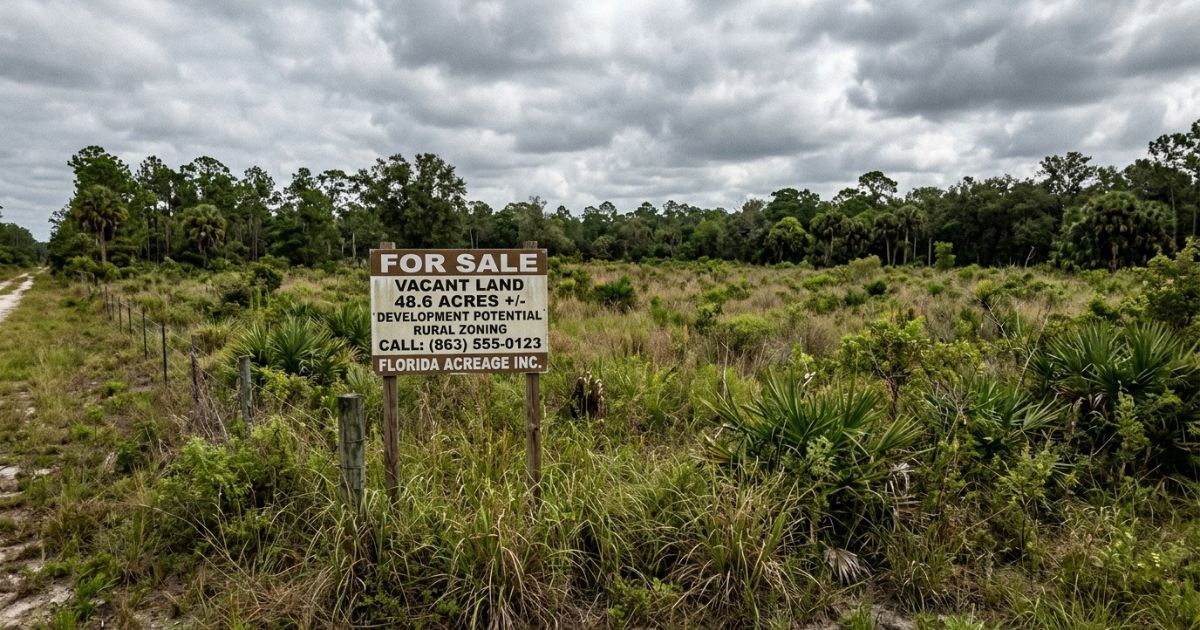
A Florida land listing priced at $15,000 looks like an opportunity that’s hard to pass up. The price is low, the location seems reasonable, and the idea of owning land — or building on it — feels within reach. What most buyers discover too late is that there’s almost always a specific reason the price is that far below market. And finding out why after the purchase is far more expensive than finding out before.
Most people assume cheap land is simply undervalued or overlooked. In reality, inexpensive Florida parcels are usually cheap because something makes them difficult — or legally impossible — to develop the way the buyer intends. The discount is real. But so is the cost that explains it.
This guide covers the most common traps, how to identify them before you commit, and what every land buyer in Florida should verify before making an offer.
Why cheap Florida land is usually cheap for a reason
In Florida’s real estate market, price is a direct reflection of what a parcel can do. When a lot sits significantly below comparable properties in the same area, something is limiting its usefulness — and that factor rarely appears in the listing description.
Understanding why the price is low is the most important step any buyer can take before purchasing vacant land in Florida.
Short answer: Inexpensive Florida parcels are typically priced low because of flood zone classifications, restrictive zoning, lack of utility access, wetland designations, or environmental limits that prevent standard development. The low price reflects those constraints — not a market inefficiency you can exploit.
Is the land in a flood zone? What FEMA maps reveal before you buy
Florida is largely flat, with significant portions of the state sitting close to sea level. A large share of available land — especially affordable parcels in rural and coastal-adjacent counties — falls within FEMA-designated flood zones, and many listings don’t lead with that information.
Parcels classified in high-risk zones (AE, VE, or AH on FEMA flood maps) carry direct financial consequences for any buyer planning to build:
- Mandatory flood insurance for any structure financed through a lender — annual premiums can exceed $3,000 and go much higher in the highest-risk zones
- Minimum elevation requirements: construction must meet or exceed the Base Flood Elevation (BFE) for the zone, which typically means an elevated foundation
- Elevated foundation costs: raising a structure above the BFE adds $20,000 to $60,000 to construction costs, depending on the required lift height and building type
- Long-term resale limitations: future buyers will face the same flood zone constraints, which narrows the market and can suppress the property’s appreciation
A flood zone classification doesn’t always make a parcel undevelopable — but it changes the true cost of the land significantly. That cost almost never appears in the listing price.
Short answer: Before making any offer on Florida land, check the parcel's flood zone designation for free at msc.fema.gov. A five-minute search can reveal a $40,000 development cost that was never mentioned in the listing.
Can you build what you want? How zoning restrictions limit your options
Zoning is the county-level legal framework that defines what can be built on any given parcel. Every county in Florida maintains its own zoning code, and a piece of land that looks buildable may have a classification that prohibits the buyer’s intended use entirely.
Common zoning-related surprises that catch Florida land buyers off guard:
- Agricultural (AG) classification — many rural parcels are zoned for farming or livestock, not residential construction. Building a standard home often requires a special exception or rezoning approval
- Conservation zoning — land classified as conservation cannot be developed at all in most cases
- Minimum lot size and setback requirements — even on residentially zoned land, mandatory setbacks from property lines, roads, and wetlands can reduce the buildable area to a fraction of the total parcel size
- Deed restrictions — limitations written into the title that follow the property regardless of zoning changes. These can prohibit specific building types, sizes, or uses that don’t appear in the county’s public records
Rezoning is possible in Florida, but the process involves public hearings, county commission review, and approval from the planning board. It can take six to eighteen months and offers no guarantee of success. Buying land with the expectation of changing the zoning before researching the process is one of the most expensive assumptions a buyer can make.
| Zoning Classification | Typical Permitted Use | Risk for Residential Buyers |
|---|---|---|
| R-1 / R-2 (Residential) | Single-family homes | Low — verify setbacks and minimum build size |
| AG (Agricultural) | Farming, rural use | High — standard residential construction often restricted |
| C / B (Commercial) | Retail, business use | High — residential use typically not permitted |
| Conservation | Environmental preservation | Very high — development almost always prohibited |
Does the land have utilities? The connection costs nobody talks about
“Utilities” means the basic infrastructure every developed property needs: electricity, water, sewer, and in some cases natural gas. In established neighborhoods and subdivisions, these connections are already present or close to the property line. On rural and undeveloped land, the situation is very different — and the cost to bring utilities to an unserved parcel can easily exceed the purchase price.
What buyers need to budget for when utilities aren’t already available:
- Electricity: connecting to the nearest power line costs between $5,000 and $30,000 depending on distance and terrain
- Public water: a connection to municipal water service ranges from $3,000 to $20,000; alternatively, drilling a private well can cost $8,000 to $15,000 or more depending on depth
- Sewer or septic: a public sewer connection typically runs $8,000 to $25,000; a private septic system costs $5,000 to $15,000, but requires county approval based on soil testing
- Road access: if the parcel lacks a direct connection to a public road, purchasing an easement or building a private access road adds further cost — and without legal access, the land may be unlendable and difficult to sell
These figures are real costs that affect the total investment in any parcel — but they rarely appear anywhere in a listing description.
Short answer: Before making an offer on any vacant land in Florida, ask directly: does this parcel have access to electricity, water, and sewer? If the answer is no or unclear, get utility connection quotes before proceeding. Those numbers change the economics of the purchase entirely.
Are there wetlands on the property? Why environmental designations can make land unusable
Florida has one of the largest concentrations of protected wetlands in the United States, and many inexpensive rural and semi-rural parcels contain portions classified as wetlands under federal and state law. These areas are regulated by both the Army Corps of Engineers at the federal level and the Florida Department of Environmental Protection (FDEP) at the state level.
Building on wetlands is effectively prohibited without significant permitting, which in practice means:
- Permit applications take years and cost tens of thousands of dollars in studies, engineering reports, and filing fees — with no guaranteed approval
- Mitigation requirements: even partial wetland fill may require purchasing credits in a wetland mitigation bank, which adds cost and complexity to any development plan
- Partial wetland coverage reduces buildable area: a five-acre parcel with four acres of designated wetlands is, practically speaking, a one-acre buildable parcel at a five-acre price
Wetland presence can be checked at no cost through the National Wetlands Inventory maintained by the U.S. Fish and Wildlife Service (fws.gov), and through the water management district maps for the relevant region of Florida.
What does cheap Florida land actually cost to develop? A realistic breakdown
The table below illustrates how costs accumulate on a parcel that looks inexpensive at the listing stage:
| Cost Item | Estimated Range |
|---|---|
| Land purchase price | $20,000 |
| Land survey | $800 – $2,000 |
| Soil and percolation testing | $500 – $1,000 |
| Flood zone elevation requirements | $20,000 – $60,000 |
| Electricity connection | $5,000 – $30,000 |
| Septic system or sewer connection | $5,000 – $25,000 |
| Road or driveway access | $3,000 – $15,000 |
| Annual flood insurance | $1,500 – $4,000/year |
| Total additional cost estimate | $35,800 – $137,000+ |
A parcel listed at $20,000 can require over $100,000 in additional investment before a single foundation is poured.
Common mistakes first-time Florida land buyers make
- Buying based on price without checking zoning — discovering after closing that the intended use is prohibited is one of the most expensive and frustrating outcomes in land buying
- Skipping the wetlands check — protected environmental areas don’t appear in listing descriptions, but they determine what’s actually buildable
- Assuming utilities are available — rural listings often have no infrastructure, and buyers find out only after they’ve committed to the purchase
- Not checking FEMA flood maps — a parcel in a high-risk zone carries development and insurance costs that fundamentally change the investment calculation
- Relying on verbal representations — every critical claim about what a parcel can do should be verified through public records and independent professionals, not just the seller or listing agent
Red flags that a cheap Florida parcel may be a trap
- Price is significantly lower than comparable nearby lots with no explanation
- Listing description is vague about utilities (“buyer to verify all utilities”)
- Photos show dense vegetation, standing water, or marshy areas
- The parcel has been on the market for an unusually long time without selling
- Zoning described only as “check with county” without specifics
- Location is isolated with no visible road access or neighboring development
None of these signals automatically disqualifies a purchase — but each one requires investigation before any offer is made.
What to verify before buying any Florida land parcel
- Confirm the zoning classification directly with the county planning department and verify what uses are permitted
- Check the FEMA flood zone designation at msc.fema.gov before estimating any development costs
- Search for wetland coverage on the National Wetlands Inventory at fws.gov
- Contact the county’s public works or utilities department to confirm utility availability at the parcel line
- Order a professional land survey to confirm legal boundaries, actual acreage, and potential encroachments
- Pull the county tax records to check for any outstanding back taxes or liens
- Review the title history with a real estate attorney before signing any contract
Glossary
Zoning — County-level regulations that define which types of construction and land uses are legally permitted on a specific parcel.
Setbacks — Mandatory minimum distances that any structure must maintain from property lines, roads, and adjacent parcels.
Wetlands — Federally and state-protected areas (marshes, swamps, mangroves) where development is heavily restricted or prohibited.
Flood zone — A FEMA designation indicating the statistical risk of flooding for a specific area. High-risk zones (AE, VE) require flood insurance and may impose construction elevation requirements.
Base Flood Elevation (BFE) — The minimum height above which construction must be built in a flood zone to comply with FEMA standards. Structures built below BFE face higher insurance costs and permitting obstacles.
Utilities — The basic infrastructure connections a property needs to be usable: electricity, water, and sewer or septic.
Land survey — A professional measurement and documentation of a parcel’s legal boundaries, dimensions, and physical characteristics.
Deed restrictions — Use limitations written into the title that follow the property regardless of zoning and cannot be removed by county approval alone.
Lien — A legal financial claim attached to a property — such as unpaid taxes, a mortgage, or contractor debt — that transfers to the new owner if not cleared before closing.
Percolation test — A soil absorption test required to evaluate whether a parcel can support a septic system.
Immediate actions — Start now
- Look up the parcel’s flood zone designation at msc.fema.gov — free and takes under five minutes
- Check the zoning classification at the county property appraiser’s website for the relevant county
- Search for wetland coverage at the National Wetlands Inventory (fws.gov)
- Call or email the county utilities department to confirm whether electricity, water, and sewer are available at the parcel
- Request a professional land survey before submitting a final offer
- Pull the county tax records to verify there are no outstanding back taxes or liens on the property
- Consult a Florida real estate attorney before signing any purchase contract for vacant land
FAQ — Frequently asked questions about cheap Florida land
Why is some Florida land priced so much lower than nearby parcels? Usually because of one or more limiting factors: flood zone classification, restrictive or agricultural zoning, wetland designations, absence of utility access, or unresolved title issues. The lower price reflects those constraints — it’s not a market inefficiency.
Can you build on flood zone land in Florida? In many cases yes, but with significant conditions. Structures must meet or exceed the Base Flood Elevation for the zone, which typically requires an elevated foundation. In coastal VE zones, restrictions are even more stringent. The cost to comply can add $20,000 to $60,000 or more to the construction budget.
How do I check zoning before buying land in Florida? Visit the county property appraiser’s website for the county where the parcel is located. Most Florida counties publish zoning classifications and future land use maps online at no charge. You can also call the county planning department directly.
Do wetlands affect suburban parcels, not just rural land? Yes. Wetland designations appear on suburban and peri-urban parcels as well — parcel size is not a reliable indicator. The only way to confirm wetland status is to check the National Wetlands Inventory and consult with the relevant water management district.
Can I rezone a Florida parcel after buying it? Rezoning is possible but involves a formal application, public hearings, and county commission approval. The process typically takes six to eighteen months and approval is not guaranteed. Buying with rezoning as a prerequisite is a significant financial risk.
Can foreigners and non-residents buy vacant land in Florida? Yes. Non-residents and foreign nationals have the same right to purchase land in Florida as U.S. citizens. The same zoning, flood zone, wetland, and development regulations apply equally to all buyers.
Conclusion
A below-market land price in Florida is a data point, not a gift. It almost always reflects something real — a legal restriction, an environmental designation, an infrastructure gap, or a development cost that makes the parcel less useful than it appears on paper. The buyers who come out ahead are the ones who understand exactly why the price is low before they decide whether that trade-off makes sense.
Every constraint discussed in this guide is verifiable before you make an offer. A land survey, a quick FEMA check, a call to the county planning department, and a conversation with a real estate attorney cost a fraction of what they save. Informed buyers don’t avoid inexpensive land — they simply know what they’re buying before they commit.
TerraNoble provides bilingual guidance in English and Portuguese for buyers exploring land and real estate opportunities across Florida. If you’re evaluating a parcel and want to understand what you’re actually buying before you proceed, our team is here to help. Reach out for a no-obligation conversation.