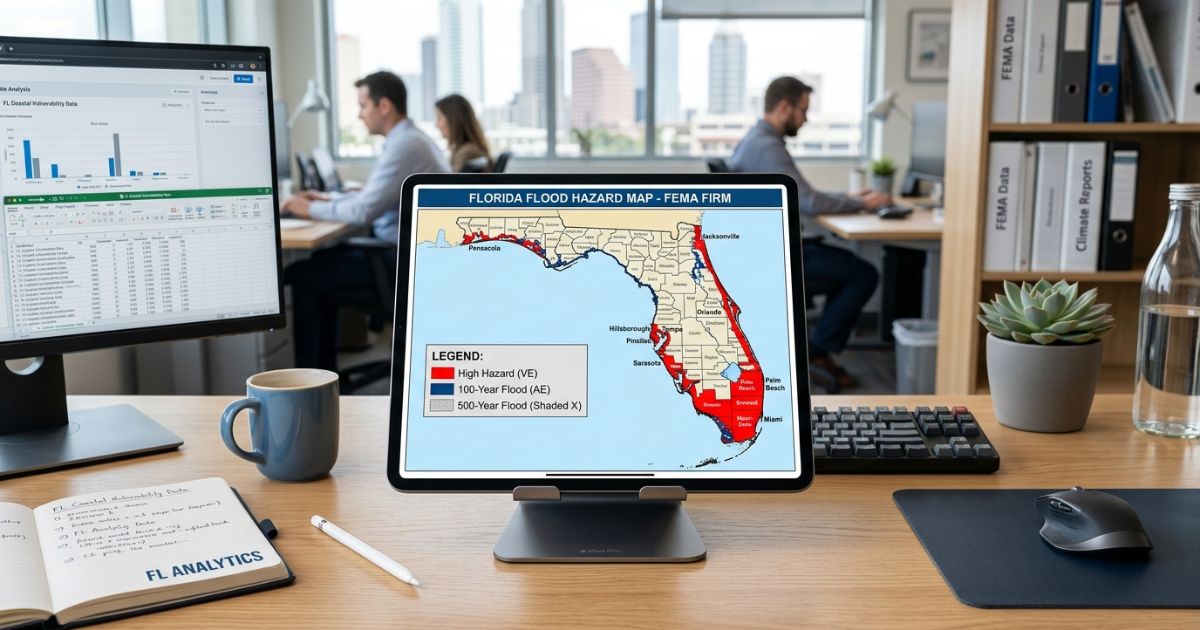
You found a property you like. The price is right, the location works, and everything looks good on paper. Then, weeks into the transaction, you discover the property sits in a high-risk flood zone — and the flood insurance alone will cost you $3,000 or more per year, every year you own it.
That’s not a rare scenario in Florida. It happens to buyers who skip one simple, free verification step before making an offer. The flood zone designation of a property affects insurance requirements, financing approval, construction regulations, and long-term ownership costs. Understanding it before you buy isn’t optional — it’s one of the most financially important checks you can make.
Most people assume property decisions come down to price and location. In reality, recurring annual costs — including flood insurance — are what create long-term financial pressure.
Table of Contents
- What is a flood zone?
- How FEMA classifies flood zones in Florida
- Why your flood zone directly affects what you pay
- When is flood insurance required in Florida?
- What flood zones mean for vacant land buyers
- How to look up any property’s flood zone for free
- What happens when FEMA remaps your flood zone?
- Common mistakes buyers make about flood zones
- Hidden costs tied to high-risk flood zones
- Glossary
- Immediate Actions
- FAQ
What is a flood zone?
A flood zone is a geographic designation assigned by FEMA — the Federal Emergency Management Agency — based on the estimated flood risk for a given area. FEMA publishes these designations through official documents called FIRMs (Flood Insurance Rate Maps), which cover every property in the United States.
Every property in the country has a flood zone classification, including properties with minimal or no flood risk. The designation determines:
- Whether flood insurance is required to obtain a federally backed mortgage
- The statistical probability of flooding in a 100-year or 500-year event
- What construction standards apply if you plan to build on the land
- What flood insurance will cost you annually
Short answer: A flood zone is an official FEMA designation that tells you how likely a property is to flood and whether flood insurance is legally required. The zone assigned to a property directly affects your annual ownership costs and financing options.
How FEMA classifies flood zones in Florida
Florida has more high-risk flood zone designations than most U.S. states — a result of its flat terrain, high water table, coastal exposure, and active hurricane climate. Understanding which zone a property falls into is essential before any purchase.
High-risk zones (Special Flood Hazard Areas — SFHA)
These zones have a 1% or greater annual probability of flooding, which FEMA defines as the “100-year flood” benchmark:
- Zone AE — flood zone with a defined Base Flood Elevation (BFE). The most common high-risk designation in Florida. Flood insurance is mandatory for federally financed properties.
- Zone AH — shallow flooding with standing water depths of 1 to 3 feet. Common in low-lying interior areas.
- Zone AO — shallow flooding with sheet flow. Typical of open floodplains and areas near slow-moving water.
- Zone VE — coastal zone with wave velocity hazard. The highest-risk FEMA category: combines inundation risk with structural wave impact. Requires elevated construction with specific foundation standards.
Moderate and minimal risk zones
- Zone X (shaded) — moderate risk, between 0.2% and 1% annual flood probability. Insurance not required but recommended in coastal regions.
- Zone X (unshaded) — minimal risk. Located outside the 500-year floodplain. Lenders typically do not require flood insurance.
Undetermined risk zones
- Zone D — no flood risk analysis available. Risk is uncertain. Some lenders may still require insurance depending on location.
| Zone | Risk level | Insurance required? | Notes |
|---|---|---|---|
| AE | High | Yes (financed property) | Most common in FL |
| VE | Very high | Yes | Coastal wave hazard |
| AH / AO | High | Yes (financed property) | Shallow flooding |
| X (shaded) | Moderate | Not required | Recommended in coastal areas |
| X (unshaded) | Minimal | No | Outside 500-year floodplain |
| D | Undetermined | May be required | No FEMA analysis on file |
Short answer: High-risk flood zones in Florida include AE, VE, AH, and AO — collectively known as Special Flood Hazard Areas. If your property falls in any of these zones and you're using a federally backed mortgage, flood insurance is mandatory. Zone X designations carry low to minimal risk and generally don't require insurance.
Why your flood zone directly affects what you pay
Being in a high-risk flood zone doesn’t mean your property will flood. But it does mean you pay for that statistical risk — every single year.
Flood insurance is the most direct financial impact. A standard NFIP (National Flood Insurance Program) policy for a residential property in Zone AE typically runs between $1,500 and $4,000 per year, depending on the property’s elevation, the county, and the coverage amount selected. Properties in Zone VE — with added wave hazard — often cost significantly more to insure.
Beyond the insurance premium, high-risk flood zone properties may require:
- Elevation Certificate — a technical document prepared by a licensed surveyor or engineer that certifies the property’s actual elevation relative to the Base Flood Elevation. Costs range from $500 to $1,500 and is required by most insurers before they’ll quote a policy.
- Structural retrofits — older homes built before current FEMA maps may need modifications to reduce premiums or meet updated code.
- Elevated construction requirements — in Zones AE and VE, finished floor elevation must meet or exceed the BFE, which adds construction costs ranging from $10,000 to $50,000 or more depending on the project.
Short answer: In high-risk flood zones like AE or VE, flood insurance alone can add $1,500 to $5,000 or more to your annual ownership costs. That number recurs every year and should be calculated into your budget before — not after — closing.
When is flood insurance required in Florida?
Flood insurance is not legally required for all properties. The obligation depends on two factors working together:
- The property’s flood zone — only properties in SFHAs (Zones AE, VE, AH, AO, and similar) trigger the requirement
- Whether financing is involved — loans backed by federal agencies (FHA, Fannie Mae, Freddie Mac, VA) require flood insurance in SFHAs as a condition of loan approval
If you’re buying cash, no federal law requires you to carry flood insurance — even in Zone AE. That said, skipping coverage on a high-risk property is a significant financial gamble. A single major flooding event could result in total or near-total property loss with no recovery mechanism.
For vacant land, flood insurance is typically not required at purchase. The requirement kicks in when a structure is built on the parcel.
What flood zones mean for vacant land buyers
Flood zone designation matters more for land buyers than most people realize — and not just because of future insurance costs. It directly shapes what you can build and how much it will cost.
- Elevation requirements — parcels in Zones AE and VE must have finished floor elevations at or above the BFE. This is a hard construction code requirement, not a suggestion.
- Increased build costs — elevating a structure to meet BFE requirements typically adds $10,000 to $50,000 or more to the project cost.
- More complex permitting — counties participating in the NFIP apply additional review standards to construction projects in SFHAs. Permitting takes longer and requires more documentation.
- Resale limitations — high-risk flood zone properties are harder to finance and attract a narrower buyer pool, which can reduce your future exit options.
A parcel listed at an attractive price in Zone VE may have development costs that make the actual total investment far higher than it appears. Always factor build cost into your analysis — not just purchase price.
How to look up any property's flood zone for free
Checking a property’s flood zone takes about two minutes and costs nothing. There’s no reason to wait until due diligence to do this.
FEMA Flood Map Service Center
Go to msc.fema.gov — FEMA’s official public portal:
- Enter the property address in the search bar
- The FIRM panel for that location will display
- Check whether the property is in a colored SFHA zone or in the white/unshaded Zone X area
Elevation Certificate
If the property already has an Elevation Certificate on file, request it from the seller or listing agent before making an offer. It gives you the precise elevation relative to BFE and is what insurers use to quote a policy. Without it, you’re estimating.
County GIS portals
Most Florida counties maintain public GIS mapping tools where you can look up flood zones, zoning classifications, parcel boundaries, and deed restrictions by parcel ID or address — all at no cost.
What happens when FEMA remaps your flood zone?
FEMA updates its Flood Insurance Rate Maps periodically based on new hydrological studies, infrastructure changes, and storm data. A property in Zone X today can be reclassified to Zone AE in the next map revision — and the reverse can happen too.
When a property is reclassified to a higher-risk zone:
- Flood insurance becomes mandatory if there’s a federally backed mortgage
- Premiums increase, though existing policyholders may retain more favorable prior rates through “grandfathering”
- Market value can decline as the property becomes harder to finance and insure
When a property is reclassified to a lower-risk zone:
- Mandatory insurance may no longer be required
- Premiums typically drop substantially
- Market value and buyer pool tend to improve
Checking whether an area has recently undergone or is pending a remapping is part of thorough due diligence — especially in coastal Florida counties that have seen recent drainage or infrastructure improvements.
Common mistakes buyers make about flood zones
Checking flood zone status after making an offer
Flood zone verification should happen before the offer, not during inspection or financing. Finding out a property is in Zone VE after you’ve paid for an inspection and started the loan process means sunk costs with no return.
Confusing hurricane risk with flood zone designation
These are different risks with different insurance products. A property can sit in a high-hurricane-risk county but fall in Zone X with minimal flood risk — and vice versa. Flood insurance covers flooding (water rising from the ground up). Wind damage, rain intrusion through roofs or windows, and other hurricane damage require a separate homeowners insurance policy.
Using the seller’s current insurance cost as your estimate
What the current owner pays for flood insurance is not necessarily what you’ll pay. Rates have changed significantly under FEMA’s Risk Rating 2.0 methodology, and policies don’t automatically transfer on the same terms. Always get your own independent insurance quote before closing.
Assuming no flood history means no flood risk
A property that has never flooded still carries whatever risk FEMA’s models assign to it. The designation is based on statistical probability from elevation, watershed data, and hydrological modeling — not on whether a specific address has had water in the past.
Hidden costs tied to high-risk flood zones
Beyond the annual insurance premium, buyers in high-risk flood zones should budget for:
- Elevation Certificate preparation: $500–$1,500 from a licensed surveyor or engineer
- Structural retrofits on existing homes: $5,000–$30,000 to bring older structures above the current BFE
- Additional permitting costs for construction projects in SFHAs
- Supplemental private flood insurance: when NFIP limits ($250,000 for structure, $100,000 for contents) are insufficient for the property value
- Reduced resale liquidity: high-risk flood zone properties face a narrower buyer pool, which can lengthen time-on-market during downturns
For land buyers who plan to build, add the elevation construction premium on top of standard build costs from day one — not as an afterthought when permits are submitted.
📚 Glossary
Flood zone — an official FEMA designation that classifies an area’s flood risk level. Published in Flood Insurance Rate Maps (FIRMs).
FEMA — Federal Emergency Management Agency. The U.S. government agency responsible for disaster preparedness and the national flood insurance program.
FIRM — Flood Insurance Rate Map. The official FEMA document that designates flood zones across the United States.
SFHA — Special Flood Hazard Area. The group of high-risk flood zones (AE, VE, AH, AO, etc.) where flood insurance is mandatory for federally financed properties.
BFE — Base Flood Elevation. The estimated water surface elevation during the 1% annual probability flood event at a specific location. Structures in Zones AE and VE must have finished floors at or above this elevation.
Flood insurance — a separate insurance product that covers flood damage. Not included in standard homeowners insurance. Available through the federal NFIP or private insurers.
NFIP — National Flood Insurance Program. The federal program that provides flood insurance policies for properties in participating communities. Coverage limits: $250,000 for structure, $100,000 for contents.
Elevation Certificate — a technical document prepared by a licensed surveyor that certifies a structure’s elevation relative to the BFE. Required by insurers to price a policy accurately.
Remapping — a FEMA update to existing Flood Insurance Rate Maps that can reclassify a property’s flood zone to higher or lower risk.
Risk Rating 2.0 — FEMA’s updated flood insurance pricing methodology, introduced in 2021, which calculates premiums based on individual property risk rather than just flood zone designation.
✅ Immediate Actions — Start Now
- Go to msc.fema.gov and check the flood zone for any property you’re currently evaluating — it’s free and takes two minutes
- If the property is in Zone AE or VE, ask the seller or agent for the existing Elevation Certificate before making an offer
- Get an independent flood insurance quote before closing — don’t rely on the seller’s current premium as your estimate
- If you’re buying vacant land in an SFHA, contact the county building department to confirm elevation requirements before finalizing your purchase
- Add estimated annual flood insurance cost to property taxes, HOA fees, and maintenance to calculate true annual ownership cost
- Check whether the area has had a recent FEMA remapping by reviewing the map panel date on the FIRM
Flood zones don’t have to be a dealbreaker — but they do require preparation
Millions of Floridians own property in high-risk flood zones without incident. The flood zone designation isn’t a red flag that ends a conversation — it’s a data point that changes the financial math. Buyers who know the zone, get an insurance quote, and factor in elevation requirements before making an offer are in a much stronger position than those who discover these costs at the closing table.
The FEMA check is free. The insurance quote is free. Neither takes more than a few minutes. There’s no good reason to skip them.
If you’re evaluating land or property in Florida and want to understand how flood zone classification affects the specific parcel you’re considering, TerraNoble provides bilingual expert guidance — in both English and Portuguese — throughout the entire buying process. Our team can help you read the FEMA maps, estimate true ownership costs, and make a well-informed decision before any commitment is made.
Reach out for a no-pressure conversation.