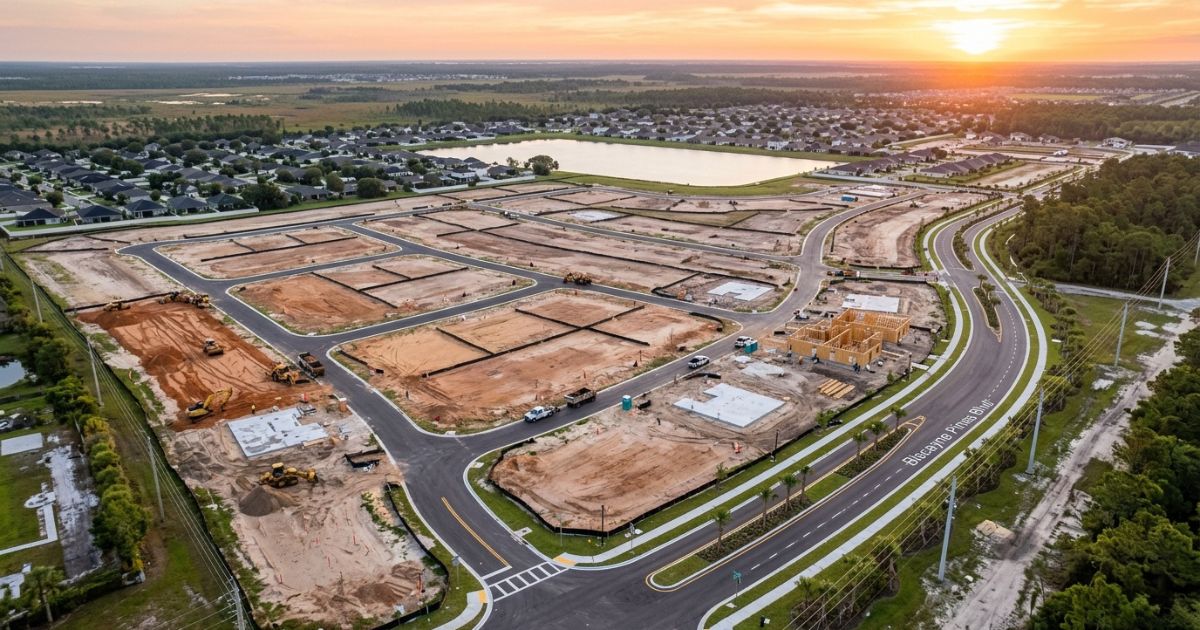
If you’re waiting for the “perfect moment” to buy land in Florida, the problem isn’t the waiting itself — it’s what that wait actually costs. While buyers delay their decision trying to time the bottom of the market, land in growth corridors keeps selling, and the next appreciation cycle usually starts before most people notice it happening.
Most people think of buying land as purely a pricing decision: “I’ll wait until the price drops a little more.” In reality, what matters most over the long run isn’t the entry price in isolation — it’s the combination of financing costs, available supply, and how fast the surrounding area is growing. Those three factors are lining up in a specific way in 2026.
Table of Contents
- Why timing matters as much as price
- What’s different about Florida’s land market in 2026
- Interest rates, financing, and the real cost of waiting
- Population growth and remaining land supply
- Comparison: buying now vs. waiting another cycle
- Common mistakes buyers make chasing “perfect timing”
- Hidden costs of waiting too long to buy
- FAQ — Frequently Asked Questions
- 📚 Glossary
- ✅ Immediate Actions — Start Now
Why timing matters as much as price {#timing-matters}
Short answer: timing matters because the total cost of a piece of land isn't just its list price — it also depends on the financing conditions available at the time of purchase and how quickly the surrounding area is developing, both of which shift from year to year and directly affect the real cost of ownership.
Buying land is different from buying a finished home. There’s no “completed product” whose value adjusts instantly to the market — there’s a parcel of raw ground whose value is tied directly to what gets built around it over the following years: roads, schools, retail, utility infrastructure.
That means the best time to buy usually isn’t the single lowest price point possible. It’s the window where price, financing conditions, and the region’s stage of development still favor the buyer — before demand for available lots starts outpacing supply.
No land purchase should ever be based on a guaranteed appreciation forecast. But understanding the structural factors at play right now helps a buyer make a more informed decision than simply “waiting a little longer.”
What’s different about Florida’s land market in 2026 {#whats-different-2026}
Short answer: in 2026, Florida combines a still-meaningful amount of available land in growth corridors, no state income tax, and continued domestic and international migration — a combination that has historically preceded periods of faster development activity in planned subdivisions.
A few specific factors make 2026 worth watching closely:
- Remaining supply in growth corridors — several inland and suburban-edge regions of Florida still have vacant lots in already-approved subdivisions, ahead of the more intensive occupancy phase
- Continued migration into Florida — the state keeps receiving new residents from other U.S. states and abroad, which sustains demand for housing and, by extension, for residential land
- No state income tax — a structural advantage that doesn’t depend on the economic cycle and continues to make Florida attractive to people relocating or investing
- More stable construction and material costs than during recent inflation spikes — which reduces some of the uncertainty for anyone planning to build on the land later
None of these factors guarantee automatic appreciation. They describe structural conditions that have historically tended to precede periods of higher demand — and higher demand, combined with limited supply, tends to push prices upward over time.
Interest rates, financing, and the real cost of waiting {#rates-financing}
Short answer: even small shifts in financing rates have a meaningful impact on the total cost of a land purchase over time — which means waiting for a "bigger price drop" may not pay off if financing conditions get worse in the meantime.
Many buyers focus all their attention on the land’s price and forget that the real cost of a purchase includes the cost of the money borrowed to finance it. A lower interest rate today can represent bigger savings over ten or twenty years than waiting for an uncertain future price drop.
| Scenario | What the buyer expects | What tends to happen in practice |
|---|---|---|
| Waiting for land prices to drop | Paying less for the lot later | Prices can rise as the region grows, not fall |
| Waiting for rates to drop further | Cheaper financing | Lower rates tend to attract more buyers, pushing land prices up |
| Buying under current conditions | Accepting a "less than ideal" cost | Locks in the land price before a possible surge in demand |
This dynamic doesn’t mean buying immediately is always the right call for everyone — it depends on budget, emergency savings, and plans for the land. But a buyer waiting for “the perfect rate” without factoring in demand’s effect on price can end up paying more on both sides of the equation.
Population growth and remaining land supply {#growth-supply}
Short answer: Florida remains among the states receiving the highest number of new residents per year in the U.S., and much of that demand concentrates in suburban and inland regions where vacant lots in planned subdivisions are still available.
Florida’s sustained population growth isn’t a new phenomenon, but its effect on vacant land is cumulative: every new resident who moves into a growing suburban region marginally reduces the number of available lots in that specific subdivision.
Regions with meaningful supply today tend to be exactly the ones that, in earlier cycles, also had vacant lots for a few years before becoming fully occupied areas. Spotting that stage — neither at the very beginning of development nor already saturated — tends to matter more than trying to predict “the bottom of the price.”
This doesn’t mean every region with available land will appreciate. Zoning, utility availability, and the pace of new subdivision approvals remain decisive factors, lot by lot.
Comparison: buying now vs. waiting another cycle {#buy-now-vs-wait}
Short answer: buying in 2026 locks in today's land price and the financing conditions currently available, while waiting another cycle exposes the buyer to both possible price increases and unpredictable shifts in credit conditions — with no guarantee that either one will improve.
| Factor | Buying in 2026 | Waiting another cycle |
|---|---|---|
| Land price | Locked in at today's conditions | Subject to increase if demand for the region rises |
| Lot supply in the desired region | More options to choose from | Possible reduction in options in already-growing areas |
| Financing conditions | Known and negotiable now | Uncertain — could improve or worsen |
| Timeline to build | Starts immediately | Delayed, pushing back any plans for the land |
This comparison isn’t a promise that buying now will always be more advantageous — markets can behave differently than expected. The key point is that waiting also carries cost and risk, something many buyers underestimate while focusing only on the possibility of a lower future price.
Common mistakes buyers make chasing “perfect timing” {#common-mistakes}
Waiting for the absolute lowest price
Trying to buy at exactly the market’s lowest point is nearly impossible to identify in advance — in practice, this kind of waiting usually just means buying later, and at a higher price.
Ignoring financing cost in the equation
Focusing only on the land’s price and forgetting that the financing rate directly affects the total amount paid over the years.
Not considering region-specific supply
A region can have very few remaining vacant lots even if the statewide market looks stable overall — real availability should be assessed subdivision by subdivision, not at the state level.
Postponing the decision indefinitely out of fear of getting it wrong
The fear of making the wrong decision sometimes leads to the decision not to decide at all — which also has consequences, especially in regions experiencing active growth.
Comparing 2026 to peak market years
Comparing today’s conditions only to recent peak-price years can distort perception — the relevant comparison is the total projected cost over the next ten or twenty years, not a single reference year.
Hidden costs of waiting too long to buy {#hidden-costs}
Beyond the risk of land prices rising, waiting to buy carries costs that aren’t immediately visible:
- Opportunity cost of financing — today’s credit conditions may not be available in the future
- Shrinking lot supply in the desired region — subdivisions fill up gradually, reducing available choices
- Delayed plans for the land — construction, rental, or future resale all start later
- Emotional cost of prolonged indecision — continually chasing “the perfect moment” can create more stress than the decision itself
- Rising construction costs — even if the land price doesn’t immediately increase, materials and labor tend to track inflation over time
Short answer: waiting to buy isn't a neutral decision — it trades the uncertainty of buying now for the uncertainty of a future that could also be more expensive, with no guarantee that conditions will improve.
FAQ — Frequently Asked Questions {#faq}
Is 2026 guaranteed to be the best year to buy land in Florida?
There’s no guarantee of that kind. What can be said is that 2026 brings together structural factors — remaining supply, continued migration, and no state income tax — that have historically favored buyers ahead of periods of higher demand. No article or analysis can promise future appreciation.
Should I wait for interest rates to drop further before buying?
It depends on your financial planning. It’s worth considering that when rates drop, more buyers tend to enter the market, which can push land prices up and offset the benefit gained from a lower rate.
Can foreign buyers purchase land in Florida in 2026 the same way as before?
Yes. There’s no general federal restriction preventing foreign buyers from purchasing land in the United States, and Florida remains one of the most well-established markets for serving international buyers, including bilingual support.
Does land in Florida always appreciate over time?
Not necessarily. Appreciation depends on factors specific to the parcel — zoning, location, utility access, and the pace of development in the region. Population growth sustains demand, but it doesn’t guarantee automatic appreciation for any specific piece of land.
What’s the biggest risk of waiting too long to buy?
The main risk is watching lot supply in the desired region shrink and prices rise as more buyers enter the market, with no guarantee that financing conditions will improve in the meantime.
📚 Glossary {#glossary}
Planned subdivision: a county-approved land development divided into individual lots intended for residential construction.
Homestead exemption: a Florida tax benefit available to residents who declare the property as their primary residence, reducing the taxable base.
Opportunity cost: the value given up by choosing one option (such as waiting) over another (such as buying now).
Zoning: the set of county rules that determines what can be built on a given piece of land.
Utilities: a parcel's basic infrastructure, such as access to water, electricity, sewer, and internet service.
Seller financing: an arrangement in which the seller directly finances the purchase for the buyer, without a bank involved.
✅ Immediate Actions — Start Now {#immediate-actions}
- Set your real budget, including down payment, financing, and land maintenance costs
- Research the available lot supply in the Florida regions that interest you most
- Compare today's financing conditions against what you'd pay by waiting longer
- Verify zoning, utility access, and FEMA flood zone status before making any purchase decision
- List your goals for the land — building, investment, or future resale — to guide your choice of region
- Contact TerraNoble for bilingual guidance on how the 2026 market outlook applies to your investment profile
Conclusion
There’s no formula that guarantees the “perfect moment” to buy land in Florida — and any promise along those lines should be treated with caution. What does exist in 2026 is a specific combination of structural factors: remaining supply in growth corridors, continued migration into the state, and no state income tax, which have historically preceded periods of higher demand for land.
The decision to buy now or wait depends on your budget, your goals, and your tolerance for uncertainty — but it should be made with information, not with the hope of catching an impossible-to-predict minimum price point.
TerraNoble offers bilingual support — in English and Portuguese — to help buyers understand how the current Florida land market applies to their specific situation. Get in touch with our team.