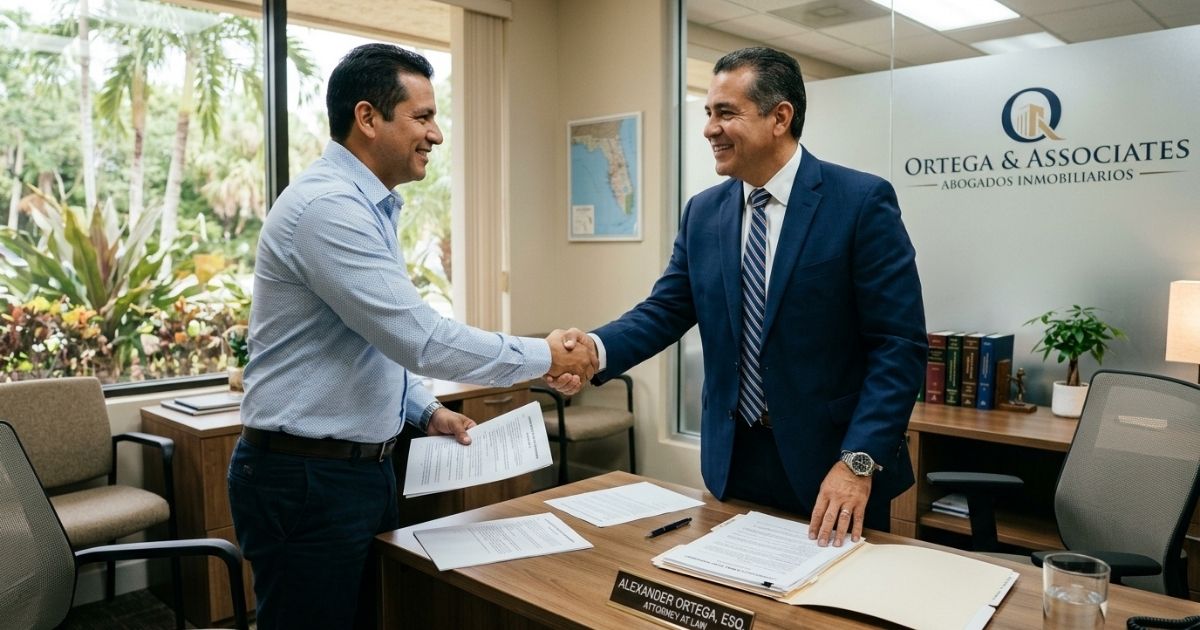
Important notice: this article is for informational and educational purposes only. It does not constitute legal advice. Before buying any land, consult a licensed Florida real estate attorney.
If the land purchase contract is written entirely in English, the visible problem isn’t just the language barrier. The real risk is signing a clause you didn’t fully understand — and only discovering what it meant after closing, when there’s no way back. That’s where a bilingual attorney stops being a convenience and becomes financial protection.
Most foreign buyers assume an attorney’s job is simply to “review the contract.” In practice, a good bilingual real estate attorney verifies title, uncovers hidden restrictions, explains every obligation in the buyer’s own language, and makes sure you understand exactly what you’re signing — before, during, and after closing.
Table of Contents
- Why a bilingual attorney matters when buying land
- What a Florida real estate attorney actually does
- Bilingual attorney vs. real estate agent vs. title company
- How to verify an attorney’s Florida license
- Essential questions to ask before hiring
- Red flags when choosing an attorney
- Common mistakes when hiring legal representation
- Hidden costs of skipping a bilingual attorney
- FAQ — Frequently asked questions
- 📚 Glossary
- ✅ Immediate Actions — Start Now
Why a bilingual attorney matters when buying land {#why-it-matters}
Short answer: a bilingual attorney reduces the risk of misinterpreting contracts, deeds, and title documents — all originally written in legal English — by making sure the buyer understands every obligation before signing, rather than relying on an agent's informal translation.
American real estate contracts use technical terms with no obvious equivalent in other languages — phrases like “contingency,” “earnest money,” “closing disclosure,” or “deed restrictions” carry specific legal implications. An agent can explain the general idea, but only an attorney has the professional responsibility, and the legal training, to confirm that a translation hasn’t changed a clause’s actual meaning.
For a foreign buyer, this extra layer of protection matters even more because:
- The entire purchase process runs in English, from the initial contract through closing.
- Many documents carry short, rigid deadlines that leave no room to “figure it out later.”
- Misreading a financing, title, or restriction clause can lead to direct financial loss.
What a Florida real estate attorney actually does {#what-they-do}
Short answer: in Florida, a real estate attorney can review the purchase contract, run a title search, explain restrictions and clauses, represent the buyer at closing, and in many cases act directly as the closing agent instead of a title company.
The most common responsibilities include:
- Reviewing the purchase contract, flagging contingency clauses, deadlines, penalties, and conditions that need attention before signing.
- Running a title search, confirming the land is free of liens, encumbrances, or restrictions the seller didn’t disclose.
- Explaining deed restrictions and zoning, translating what can and can’t be done on the land into practical terms.
- Handling or overseeing closing, making sure every signed document is accurate and funds transfer securely.
- Advising on purchase structure, including whether to buy personally, through an LLC, or through a trust — always in coordination with an accountant on the tax side.
Bilingual attorney vs. real estate agent vs. title company {#comparison-table}
| Aspect | Bilingual attorney | Real estate agent | Title company |
|---|---|---|---|
| Background | Law degree, licensed in Florida | Real estate brokerage license | Company specialized in title and closing |
| Reviews contract legally | Yes | Cannot give legal advice | Generally no |
| Explains clauses in buyer's language | Yes, if bilingual | Depends on the agent | Rarely |
| Represents buyer's interest | Yes, exclusively | May represent buyer or seller | Neutral — represents the transaction |
| Can handle closing | Yes, in Florida | No | Yes |
How to verify an attorney’s Florida license {#verify-license}
Short answer: the most reliable way to verify an attorney's license is to search their full name on the official Florida Bar website, confirming the license is active, in good standing, and free of relevant disciplinary history.
Before hiring, it’s worth taking these steps:
- Confirm an active license directly on the Florida Bar website, not just the attorney’s own site.
- Check their area of practice, prioritizing attorneys with specific real estate experience — not general practice only.
- Ask about experience with foreign buyers, since international transactions involve extra steps, like verifying an ITIN and understanding FIRPTA on a future sale.
- Confirm who actually speaks the language, since “bilingual” sometimes just means a front-desk staffer speaks it, not the attorney handling your case.
Essential questions to ask before hiring {#essential-questions}
Short answer: before hiring, ask about experience with vacant land specifically, who will actually handle communication in your language, how fees are structured, and whether the attorney has represented foreign or Latin American buyers before.
- “Have you handled vacant land purchases, not just built properties?” — land deals involve different checks, like zoning, utility access, and buildability.
- “Who will communicate with me directly — you or an assistant?” — it matters whether the attorney themselves speaks your language or the communication gets delegated.
- “How are fees structured — flat rate or hourly?” — many real estate attorneys charge a flat fee for contract review and closing, which makes budgeting easier.
- “Have you worked with Brazilian or Latin American buyers before?” — prior experience with foreign buyers usually means familiarity with recurring questions about ITINs, international wire transfers, and purchase structure.
- “What’s included in your service — just contract review, or closing too?” — some attorneys bill separately for each stage.
Red flags when choosing an attorney {#red-flags}
Short answer: be wary of attorneys who guarantee any deal will close, pressure you to sign quickly, can't be verified on the Florida Bar website, or refuse to put the exact scope of their service in writing.
- Excessive urgency to close the deal, without reasonable time to review documents carefully.
- No written fee agreement, leaving costs and scope of service undefined.
- Guaranteed outcome promises, like guaranteed land appreciation — that’s outside an attorney’s role and a clear red flag.
- Trouble confirming the license on the Florida Bar website, or unexplained disciplinary history.
- Communication only through third parties, with no direct access to the attorney actually handling your case.
Common mistakes when hiring legal representation {#common-mistakes}
Short answer: the most frequent mistakes include using the same attorney recommended by the seller, relying only on an agent's informal translation, skipping the license check, and waiting to seek legal representation until after the initial contract is already signed.
- Using the attorney recommended by the seller or developer, which can create a conflict of interest, even unintentionally.
- Trusting an agent’s verbal explanation of contract clauses instead of getting independent legal review.
- Not confirming an active Florida license, assuming that “speaks the language” already means qualified.
- Only looking for an attorney after signing the contract, when the contingency deadline may already be running.
- Not asking specifically about vacant land experience, which differs from transactions involving built properties.
Hidden costs of skipping a bilingual attorney {#hidden-costs}
Short answer: skipping a bilingual attorney can lead to misread clauses, land use restrictions discovered too late, missed contingency deadlines from a misunderstanding, and in extreme cases losing the earnest money deposited at signing.
- Loss of earnest money when a buyer misses a contractual deadline because a clause wasn’t fully understood in time.
- Late discovery of deed restrictions or incompatible zoning for the intended use of the land.
- Poorly handled financing or title search, requiring costly fixes after closing.
- Duplicate legal work, needing to hire another attorney to fix a problem that could have been avoided from the start.
- Ongoing uncertainty throughout the process, from not fully understanding what’s being signed at each stage.
FAQ — Frequently asked questions {#faq}
Is it required to hire an attorney to buy land in Florida?
It’s not legally required — Florida allows closings to be handled by a title company instead. But hiring an attorney, especially a bilingual one, is strongly recommended for foreign buyers, given the extra layer of legal protection and clear communication it provides.
How much does a bilingual attorney cost to review a purchase contract?
Fees vary by firm and by the complexity of the transaction. Many real estate attorneys charge a flat fee for contract review and closing support, which makes it easier for buyers to budget.
Can a real estate agent replace an attorney?
No. Agents aren’t licensed to give legal advice on contract clauses — their role is to facilitate the negotiation. The attorney is who confirms the legal meaning of every obligation in the contract.
How do I know the attorney actually speaks my language, not just office staff?
Ask directly in the first conversation who will handle communication with you, and confirm that the attorney assigned to your case — not just the front desk or an assistant — speaks the language.
Can a bilingual attorney help with an international wire transfer for the purchase?
The attorney doesn’t handle the transfer itself, but can advise on required documentation and coordinate with your bank or currency exchange to keep the process aligned with the contract’s deadlines.
📚 Glossary {#glossary}
Title search — a search of public county records to confirm the land is free of liens, encumbrances, or undisclosed restrictions.
Earnest money — a good-faith deposit made by the buyer at signing, which can be forfeited if certain contract deadlines aren’t met.
Closing agent — the professional or company responsible for handling the final step of the transaction, including document signing and fund transfers.
Contingency clause — a contract clause that makes completing the purchase conditional on meeting certain requirements within a set deadline.
Florida Bar — the official licensing body for attorneys in the state of Florida, where anyone can verify a licensed professional’s standing.
ITIN — an Individual Taxpayer Identification Number used by foreigners who don’t have a Social Security Number, required at several stages of a US property purchase.
✅ Immediate Actions — Start Now {#immediate-actions}
- Verify the attorney’s license directly on the Florida Bar website before hiring anyone
- Ask who exactly will handle communication in your language throughout the process
- Request a written fee agreement covering the full scope of the service
- Confirm the attorney’s prior experience with vacant land and foreign buyers
- Get legal representation before signing the initial contract, not after
- Talk to TerraNoble for referrals to experienced bilingual attorneys for Florida land purchases
Conclusion
Signing a contract you don’t fully understand is a quiet risk — it doesn’t show up right away, but it can cost you months or years later. A qualified bilingual attorney isn’t an extra expense on a Florida land purchase — it’s the assurance that every clause, restriction, and obligation was understood in your own language before you ever signed anything.
TerraNoble offers bilingual support — in English and Portuguese — for Latin American investors, helping connect buyers with experienced professionals and guiding the purchase process with clarity, from the first conversation through closing.