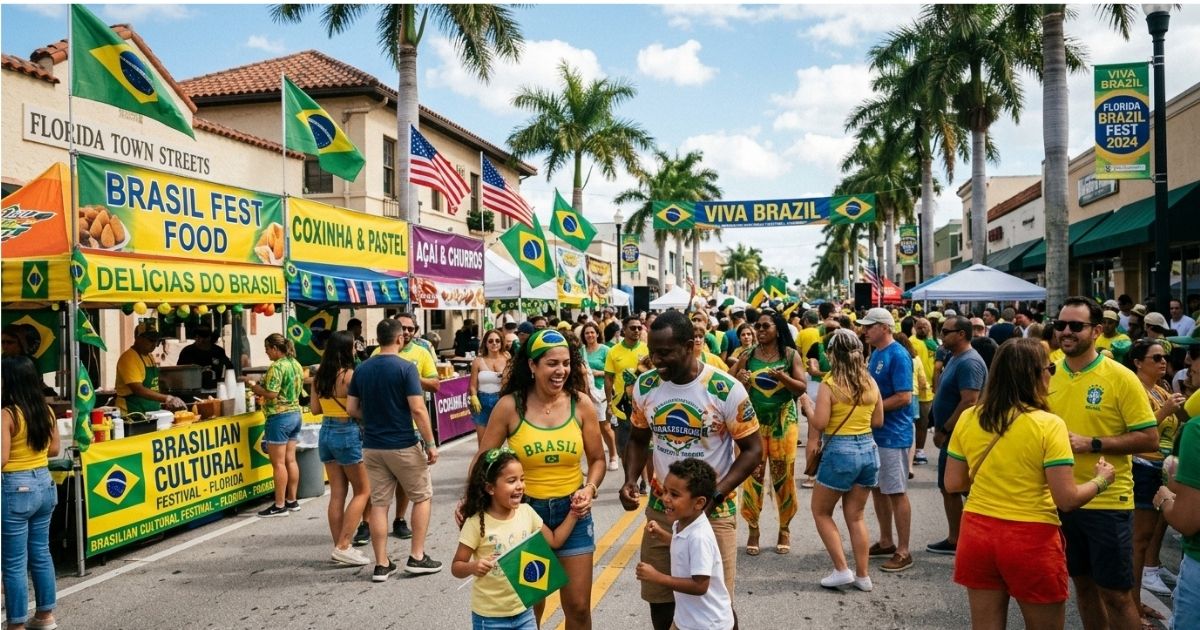
If you’re considering a move to Florida or buying land near other Brazilians, the visible question is picking a city with good weather and a reasonable cost of living. The real risk is assuming that “the Brazilian community in Florida” is a single thing — it isn’t. It’s several distinct communities, each with its own profile, cost structure, and growth story, and picking the wrong one for your situation can cost you real time and money.
Most people start by searching for “where Brazilians live” in Florida. In reality, what determines whether you’ll settle in well is understanding why that specific community grew where it did, and whether the reasons that attracted the Brazilians already living there still apply to your own situation.
Table of Contents
- Why Florida became the top US destination for Brazilians
- Where Florida’s main Brazilian communities are located
- Comparing the leading regions
- Why these communities keep growing
- What an established Brazilian community actually offers
- Common mistakes when choosing where to live near Brazilians
- Hidden costs of living in high-demand Brazilian areas
- FAQ — Frequently Asked Questions
- 📚 Glossary
- ✅ Immediate Actions — Start Now
Why Florida became the top US destination for Brazilians {#why-florida}
Short answer: Florida combines a climate similar to Brazil's, direct flights to several Brazilian capitals, no state income tax, and decades of established communities — a combination no other US state offers at the same level.
Brazilian migration to Florida isn’t a recent phenomenon. It began taking shape in the 1980s and 1990s, especially in the southern part of the state, and accelerated in the following decades as more Brazilians arrived in search of work, education, or a more stable life. Over time, those early communities built the infrastructure that continues to draw new arrivals today: churches with services in Portuguese, markets carrying Brazilian products, salons, accountants, real estate agents, and community associations.
That cycle feeds itself. The more established a community becomes, the easier it is for newcomers to settle in — and that alone keeps attracting new residents even decades after the migration began.
Where Florida’s main Brazilian communities are located {#where-they-are}
Short answer: Florida's largest Brazilian concentrations are in the southern part of the state, spanning Pompano Beach, Deerfield Beach, and Boca Raton, and in central Florida around Orlando and Kissimmee — with more recent growth in Tampa, the Treasure Coast, and Southwest Florida.
South Florida — the historic community
The stretch from Pompano Beach to Deerfield Beach, in Broward County, is widely known as one of the state’s earliest large Brazilian concentrations, alongside pockets of Boca Raton. This is where community infrastructure runs deepest and oldest: Brazilian markets, restaurants, churches, and service offices built specifically around the Brazilian population.
Orlando and Kissimmee — the fastest-growing community
Central Florida, especially around Orlando, Kissimmee, and nearby areas like Lake Nona and Doctor Phillips, has become the state’s newest hub of Brazilian growth. The main driver is the job market tied to tourism, hospitality, and construction, combined with a cost of living that has historically been lower than South Florida — though that gap has been narrowing.
Expanding areas — Tampa, the Treasure Coast, and Southwest Florida
More recently, smaller but fast-growing Brazilian communities have formed in Tampa, along the Treasure Coast (Port St. Lucie and surrounding areas), and in Southwest Florida (Cape Coral and Fort Myers). Much of this movement comes from Brazilians who already lived in South Florida or Orlando and are looking for more affordable land and homes without giving up proximity to other Brazilian families.
Comparing the leading regions {#comparison-table}
| Region | Community profile | Cost of living | Main draw |
|---|---|---|---|
| Pompano Beach / Deerfield Beach / Boca Raton | Historic, highly established community | Medium to high | Full community infrastructure and direct flights via Fort Lauderdale-Hollywood |
| Orlando / Kissimmee / Lake Nona | Large, fast-growing community | Medium | Job market in tourism and construction |
| Tampa | Expanding community, smaller than Orlando | Medium | Competitive cost of living and regional economic growth |
| Treasure Coast (Port St. Lucie area) | Emerging community | Medium-low | More affordable land and homes, proximity to South Florida |
| Cape Coral / Fort Myers | Emerging community | Medium-low | Larger lots at lower prices, accelerating population growth |
Why these communities keep growing {#why-growing}
Short answer: the continued growth of Brazilian communities in Florida comes from three combined factors — economic opportunity, existing family and social networks, and a cost of living that's still competitive compared to other states popular with foreign buyers.
- Network effect — families who already have relatives or acquaintances living in Florida tend to move near them, which reinforces growth in the same regions over time
- Direct flights to Brazil — Orlando, Miami, and Fort Lauderdale offer direct connections to several Brazilian capitals, making visits and moves easier
- No state income tax — Florida doesn’t collect state income tax, which increases purchasing power for anyone working or investing in the state
- A real estate market that’s still accessible outside the core areas — while South Florida has gotten more expensive, regions like the Treasure Coast and Southwest Florida still offer more competitively priced land and homes
- A climate similar to parts of Brazil — Florida’s heat and humidity make the climate adjustment simpler than in northern US states
What an established Brazilian community actually offers {#what-it-offers}
Short answer: beyond language, an established Brazilian community offers a practical support network — bilingual professionals, specialized businesses, and social organizations — that significantly shortens the adjustment curve for newcomers.
In practice, that typically includes:
- Markets and restaurants carrying Brazilian products and dishes
- Churches and religious centers offering services in Portuguese
- Accountants, attorneys, and real estate agents who serve clients in Portuguese
- Community groups, associations, and Brazilian cultural events
- Schools and English courses geared specifically toward newcomers
None of this shows up in a property price search, but it often weighs as heavily as cost of living when deciding where to settle — especially for families with children or people moving for the first time.
Common mistakes when choosing where to live near Brazilians {#common-mistakes}
Choosing a region by reputation alone, without visiting
Many people decide where to live simply because they heard “a lot of Brazilians live there,” without visiting the region in person or researching how it has changed in recent years. Communities grow and shift in profile quickly.
Ignoring the cost-of-living gap between regions
Assuming the cost of living is similar across every area with a Brazilian presence is a common mistake. The gap between South Florida and the Treasure Coast, for example, can be significant.
Not considering the economic driver behind the community
Every region grew for a reason — tourism, construction, more affordable land. Ignoring that driver can lead someone to move to an area without job opportunities that match their background.
Buying land or a home without understanding the region’s appreciation trend
Areas with growing Brazilian communities don’t all appreciate at the same pace. It’s worth researching the price history of the specific region, not just Florida as a whole.
Hidden costs of living in high-demand Brazilian areas {#hidden-costs}
- Higher land and home prices in already-established areas — regions with long-standing Brazilian communities, like parts of South Florida, tend to carry higher prices precisely because of concentrated demand
- Higher hurricane and flood insurance in coastal areas — communities near the coast, even popular ones, carry higher insurance costs than inland areas
- HOA fees in planned neighborhoods — many neighborhoods popular with Brazilians in Orlando and South Florida have an HOA, with monthly dues that need to factor into the budget
- Traffic and commute times — some of the most sought-after areas grew faster than their road infrastructure could keep up with, which increases daily commute times
FAQ — Frequently Asked Questions {#faq}
What is the largest Brazilian community in Florida?
South Florida, especially the area spanning Pompano Beach, Deerfield Beach, and Boca Raton, has one of the state’s oldest and most established Brazilian communities, while the Orlando and Kissimmee area is currently one of the fastest-growing in terms of resident numbers.
Why are so many Brazilians moving to Orlando?
The main driver is the job market tied to tourism, hospitality, and construction, combined with a cost of living that has historically been more competitive than South Florida.
Is it worth buying land near a growing Brazilian community?
It can be a good strategy, but it’s worth researching the appreciation history of that specific region and understanding the concrete reasons behind its population growth before deciding — not just the presence of other Brazilians.
Are there Brazilian communities outside South and Central Florida?
Yes. Tampa, the Treasure Coast, and Southwest Florida (Cape Coral and Fort Myers) have smaller but expanding Brazilian communities, drawing mainly people looking for more affordable land and homes.
Is Florida still the US state with the most Brazilians?
Florida is widely recognized as the US state with the largest concentration of Brazilians, historically ahead of states like Massachusetts and New Jersey, which also have notable communities.
📚 Glossary {#glossary}
Established community: a region with a Brazilian presence built up over decades, with commercial, religious, and social infrastructure geared toward that population.
Emerging community: a region experiencing recent, fast population growth among Brazilians, still developing its community infrastructure.
Network effect: the phenomenon where new families move near relatives and acquaintances already established in a region, reinforcing local population growth.
HOA (Homeowners Association): an association that collects fees and sets usage rules in many of Florida's planned neighborhoods.
Treasure Coast: a coastal region of Florida between South Florida and the Space Coast, including cities like Port St. Lucie and Stuart.
✅ Immediate Actions — Start Now {#immediate-actions}
- List the Florida regions with Brazilian communities that best match your life stage and budget.
- Research the local job market before deciding to move, not just the cost of living.
- Visit the region in person, if possible, before buying land or a home.
- Check the appreciation history of the specific region, not just Florida in general.
- Confirm whether the neighborhood you're considering has an HOA and what the monthly fee is.
- Talk to TerraNoble for bilingual guidance on land available near Florida's Brazilian communities.
Conclusion
The Brazilian presence in Florida has grown from a single neighborhood into a network of communities spread across the state, each with its own history, cost of living, and growth story. Understanding those differences is what separates a successful move from a decision based on nothing more than hearing that “a lot of Brazilians live there.”
Whether it’s South Florida, Orlando, or one of the emerging regions like the Treasure Coast and Southwest Florida, each community offers a different balance of cost, opportunity, and support network. The right choice depends on your own situation — professional, family, and financial — not just proximity to other Brazilians.
TerraNoble offers bilingual support — in English and Portuguese — to help Brazilians find and evaluate land near Florida’s fastest-growing communities. Get in touch with our team to figure out which region makes the most sense for your next step.