You bought a piece of land in Florida. Or you hired a contractor and skipped the permit process to save time. Or you bought a property that already had structures no one bothered to permit. In any of these scenarios, you’re sitting on a problem that tends to surface at the worst possible moment — when you’re trying to sell, refinance, or file an insurance claim.
Florida takes its building permit requirements seriously, and for good reason. The state sits in one of the most hurricane-prone regions in the country. The building code exists to protect lives, not just paperwork. When work is done without permits, no one has verified that it was done safely — and the legal and financial consequences that follow can dwarf the cost of simply getting the permit in the first place.
Most people assume unpermitted work only becomes an issue if a neighbor complains. In reality, there are far more ways for it to surface — and most of them happen at exactly the moment you need the property to perform financially.
Table of Contents
- What is a building permit in Florida?
- When is a building permit required?
- What happens when you build without a permit?
- How does the county find out about unpermitted work?
- How to legalize unpermitted construction in Florida
- Buying a property with unpermitted improvements
- Common myths about building permits in Florida
- Glossary
- Immediate Actions
- FAQ
What is a building permit in Florida? {#what-is}
A building permit is an official authorization issued by your county or municipality that allows specific construction work to proceed. Its purpose is to ensure that the project follows the Florida Building Code — the statewide set of standards governing structural safety, electrical systems, plumbing, mechanical equipment, and public health.
Short answer: A building permit is the county's formal approval to perform construction work. It triggers a series of inspections during and after the project, and ends with a Certificate of Occupancy confirming the work was done correctly. Without it, the construction has no legal record — and can be treated as unauthorized regardless of how well it was built.
The process has three core phases: plan review (for larger projects), permit issuance, and inspections. At the end of a compliant project, the property receives a Certificate of Occupancy (CO) — the official document that says the structure was built to code and is legal to use.
When is a building permit required in Florida? {#when-required}
The general rule: any work that changes the structure, electrical system, plumbing, or mechanical systems of a property requires a permit. Routine maintenance — painting, flooring, minor cosmetic repairs — typically does not. But the gray area between those two categories is where most property owners run into trouble.
| Type of Work | Permit Required? | Notes |
|---|---|---|
| New residential construction | Yes, always | Includes homes, garages, and accessory structures |
| Room additions or expansions | Yes | Any increase in habitable square footage |
| Decks, patios, and covered porches | Yes, in most counties | Depends on size, materials, and attachment |
| Electrical or plumbing work | Yes | Includes panel upgrades and rerouting pipes |
| Roof replacement | Yes, in most counties | Minor repairs may be exempt — verify locally |
| Pool or spa installation | Yes | Also requires barrier and safety inspections |
| Fence or wall installation | Depends on county and height | Always check local code before starting |
| HVAC system replacement | Yes | New installs and full replacements require permits |
| Painting, flooring, cosmetic updates | Generally no | Unless work touches structural or mechanical systems |
Important: Florida counties and municipalities can impose additional requirements beyond the statewide Florida Building Code. Always confirm with your local building department before starting any project.
What happens when you build without a permit in Florida? {#consequences}
Stop-work order
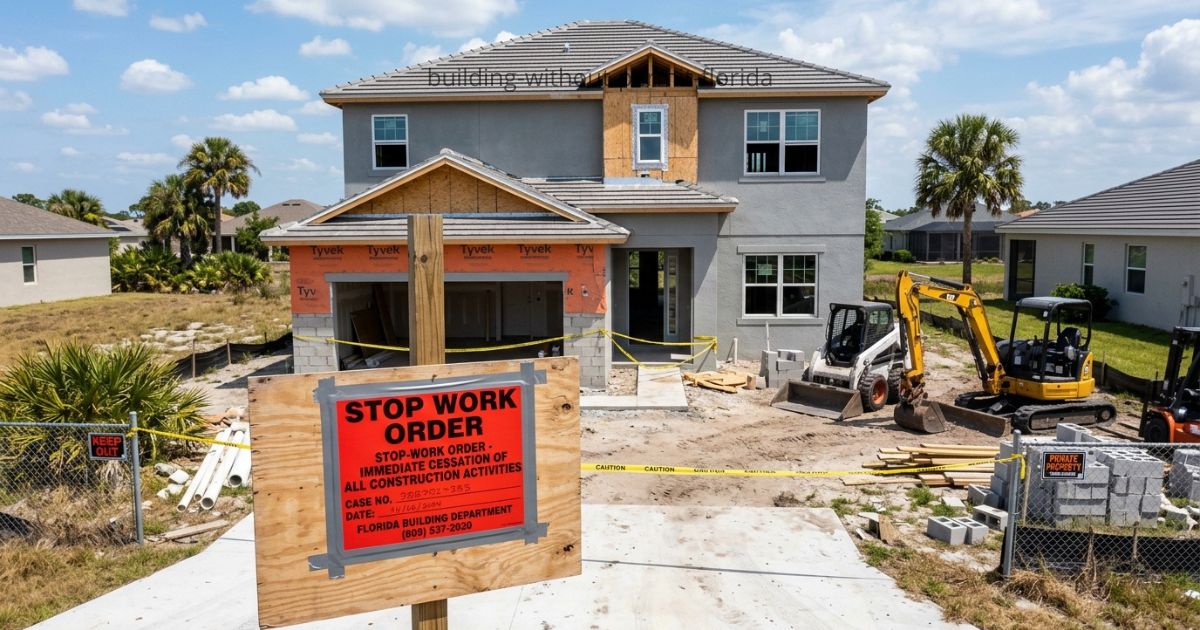
When a county inspector discovers active construction without a permit — or receives a complaint — the immediate response is a stop-work order. All construction must halt at that moment, regardless of how far along the project is.
Violating a stop-work order is a separate offense, compounding the original problem with additional fines and potential legal action.
Fines and financial penalties
Florida law authorizes counties to impose financial penalties for unpermitted construction. The mechanics vary by county, but the pattern is consistent: the retroactive permit fee is assessed with a penalty multiplier — typically two to four times the cost of the original permit.
Short answer: Building without a permit in Florida can cost two to four times the original permit fee in penalties, plus retroactive inspection fees. On larger projects, that can mean thousands of dollars in fines — on top of any costs required to bring the work up to code.
Fines often continue accruing daily until the situation is resolved. The longer a property owner waits to address the issue, the more expensive it becomes.
Forced demolition
In serious cases — particularly when a structure poses a safety risk or the owner refuses to cooperate with the county’s remediation process — the county can order partial or complete demolition of the unpermitted structure.
A deck, room addition, or accessory structure that cost tens of thousands of dollars to build can be ordered removed at the owner’s expense, with no compensation for the lost investment.
Insurance claim denials
Florida’s property insurers treat unpermitted work as unauthorized modifications to the insured structure. If a hurricane, fire, or flood damages a home that contains unpermitted improvements, the insurer can use that fact to:
- Deny the claim outright for the affected portion
- Reduce the payout based on the extent of unauthorized work
- Cancel the policy upon discovery
In a state where insurance disputes after major storms are already common, having unpermitted work on record is a significant liability.
Blocked sales and refinancing
When a property goes to market or enters a refinancing process, the permit history is reviewed. Unpermitted improvements surface as non-permitted work in the county records — and the consequences are immediate:
- Lenders frequently refuse to finance properties with unpermitted structures
- Buyers may require the seller to remediate all unpermitted work before closing
- Title insurance companies may flag or exclude coverage related to unpermitted improvements
- The property’s appraised value may be reduced if improvements cannot be verified as code-compliant
A single unpermitted addition can complicate or kill an otherwise clean transaction.
How does the county find out about unpermitted work? {#how-discovered}
Many property owners operate on the assumption that unpermitted work stays hidden if no one complains. That logic doesn’t hold up in practice. There are multiple vectors through which unpermitted construction is discovered — most of them routine and entirely independent of neighborly disputes.
- Aerial and satellite imagery — Florida counties use aerial photography to compare current property conditions against permit records. Structures that appear without corresponding permits are flagged for inspection
- Neighbor complaints — anyone can file a code enforcement complaint with the county, typically anonymously
- Routine code enforcement sweeps — county inspectors conduct neighborhood surveys in areas with active construction
- Pre-sale inspection — a thorough home inspection ordered by the buyer will often flag improvements that don’t match county records
- Title search — the title process compares the legal description of the property with its recorded improvements
- Insurance inspection — insurers may send inspectors before issuing or renewing a policy, particularly after a storm
- Appraisal for refinancing — appraisers are trained to identify improvements that don’t match permit records
Short answer: There is no reliable way to keep unpermitted work hidden long-term in Florida. The question is not whether it will be discovered, but when — and whether that discovery happens during a routine inspection or at the worst possible moment in a sale or claim.
How to legalize unpermitted construction in Florida {#after-the-fact}
The path forward for most unpermitted structures is an after-the-fact permit — a retroactive application that initiates the inspection and approval process for work that was already completed. The process is more complicated and expensive than getting the permit upfront, but it’s usually the right move.
Step-by-step: after-the-fact permit process
- Hire a licensed professional — a Florida-licensed architect, engineer, or general contractor to assess the existing construction and prepare the required documentation
- Determine code compliance — older unpermitted work may not meet the current Florida Building Code; some modifications may be required before the county will approve the permit
- Submit the after-the-fact permit application — including plans, photos, and technical documentation to the county building department
- Schedule required inspections — the county inspector will visit the property to assess the work; some portions may need to be opened up or exposed for review
- Pay fees and penalties — the retroactive permit fee includes the standard fee plus the penalty multiplier for unauthorized construction
- Receive the Certificate of Occupancy — once all inspections pass, the construction is officially on record and legally recognized
Note: If the unpermitted work cannot be brought into code compliance — which is more common in flood zones, wetland areas, or properties with strict setback requirements — the county may still require demolition even after the after-the-fact permit process begins.
Buying a property with unpermitted improvements {#buying-unpermitted}
One of the most common scenarios isn’t the owner who built without a permit — it’s the buyer who unknowingly purchases a property that already has unpermitted work, either undisclosed or overlooked during due diligence.
Short answer: When you buy a Florida property with unpermitted improvements, you assume legal responsibility for those improvements — regardless of who built them. Remediating the problem becomes your obligation, your cost, and your timeline.
What to check before you buy
- Pull the permit history from the county Property Appraiser or building department website — it’s public, free, and searchable by address
- Compare permit records to physical structures — if there’s a garage conversion, enclosed porch, extra bathroom, or pool that doesn’t appear in the permit history, it’s unpermitted
- Hire a licensed home inspector familiar with local permit requirements — ask specifically whether they cross-reference improvements against county records
- Negotiate before closing — if unpermitted work is discovered, you have leverage to require the seller to obtain the retroactive permit, reduce the purchase price to cover remediation costs, or walk away entirely
Skipping this step is one of the most expensive due diligence oversights a Florida buyer can make.
Common myths about building permits in Florida {#myths}
“It’s a small project — it doesn’t need a permit”
Size is not the determining factor. A single-circuit electrical upgrade, a new water heater installation, or the addition of a half-bath all require permits regardless of how minor they may seem. The relevant question is the type of work, not the square footage.
”My contractor handles the permits”
You can authorize a licensed contractor to pull permits on your behalf — but you, as the property owner, are ultimately responsible for verifying that valid permits exist before work begins. Contractors who charge for permits but never pull them are a known problem in Florida. Before construction starts, ask for the permit number and confirm it directly with the county.
”If it’s been there for years, it’s fine”
Age does not legalize unpermitted construction. Florida’s code enforcement statutes do not include a statute of limitations on unpermitted structures. A deck built a decade ago without a permit is still non-compliant today — and still needs to be addressed when the property changes hands or requires financing.
”I’ll take care of it before I sell”
Retroactive permitting takes time — often several months — especially when structural or systems modifications are required to meet current code. Waiting until you have a buyer under contract creates timeline pressure that dramatically increases costs and stress. Address it proactively.
”The bank approved the loan, so the property is fine”
Lender approval reflects the property’s market value, not its permit compliance. The bank’s appraisal does not include a review of permit records. Compliance verification is the buyer’s responsibility through their own due diligence process.
Glossary {#glossary}
Building Permit: An official authorization issued by a Florida county or municipality to perform specific construction work. It initiates a review and inspection process to ensure compliance with the Florida Building Code.
Certificate of Occupancy (CO): A document issued at the end of a permitted construction project confirming that the work was completed according to the approved permit and may be legally occupied.
Stop-Work Order: A mandatory halt to all construction activity issued by the county when work is found to be proceeding without a valid permit or in violation of an approved permit.
After-the-Fact Permit: A retroactive permit application filed for construction that was already completed without prior authorization. Involves inspections, possible modifications to bring the work into compliance, and penalty fees.
Florida Building Code (FBC): The comprehensive set of construction standards adopted by the state of Florida establishing minimum requirements for structural safety, electrical, plumbing, mechanical, and energy systems.
Non-Permitted Improvement: Any modification or addition to a property completed without a required permit. Appears in county records as unverified work and can affect insurance, financing, and resale.
Code Enforcement: The county department responsible for identifying and resolving violations of local building and zoning codes, including unpermitted construction.
Property Appraiser: The elected county official responsible for assessing property values and maintaining public records, including permit histories for each parcel.
✅ Immediate Actions — Start Now {#immediate-actions}
- Search your county’s Property Appraiser or building department website for the full permit history of your property — it’s free and publicly available
- Walk through the property and compare every structure and system against what’s on record — garage conversions, enclosed porches, room additions, pools, and HVAC replacements are common unpermitted items
- If you find unpermitted work, consult a licensed contractor or real estate attorney before attempting to sell or refinance
- Before starting any renovation project, confirm with your county building department whether a permit is required — don’t rely solely on contractor assurances
- When hiring a contractor, ask for the permit number before work begins and verify it directly with the county
- If you’re buying a property, include a permit history review as a non-negotiable part of your due diligence — and hire an inspector who checks county records, not just physical condition
Building without permits in Florida rarely pays off. What looks like a shortcut — skipping fees, avoiding inspections, saving a few weeks — creates a long-term liability that follows the property through every future transaction. Fines, insurance exposure, financing barriers, and the risk of forced demolition are real outcomes, not worst-case scenarios.
For owners who are already dealing with unpermitted work, the smartest move is to act before the county does. A proactive after-the-fact permit process is almost always less costly, faster, and less stressful than responding to a stop-work order or trying to resolve the issue mid-sale.
TerraNoble provides bilingual guidance in English and Portuguese for buyers and owners navigating Florida real estate — including due diligence, permit compliance, and the full acquisition process. Contact us for a no-pressure conversation about your property situation.
FAQ {#faq}
Who is responsible for unpermitted work — the person who built it or the current owner? The current owner bears legal responsibility for all construction on the property, regardless of who built it or when. If you purchase a property with unpermitted improvements, the obligation to remediate passes to you at closing. This is one of the strongest arguments for a thorough permit review before buying.
How long does an after-the-fact permit take in Florida? Timelines vary by county and the complexity of the project. Simple structures may be resolved in four to eight weeks. Projects that require structural modifications to meet the current Florida Building Code can take several months. Starting the process early — before any planned sale — is strongly advisable.
Can unpermitted work be demolished even years after it was built? Yes. There is no statute of limitations on unpermitted construction in Florida. A structure built without permits ten years ago remains out of compliance today. Code enforcement can require remediation or demolition at any point — most commonly when the property is sold, refinanced, or inspected for insurance purposes.
Is it legal to sell a home with unpermitted work in Florida? Technically yes, but sellers are required to disclose known unpermitted improvements. Concealing this information can create civil liability. In practice, lender financing becomes difficult or impossible for buyers, limiting the buyer pool to cash purchasers — typically at a lower negotiated price.
What does a Florida building permit actually cost? Permit fees vary by county, project type, and value of construction. A straightforward residential permit might cost a few hundred dollars; larger projects can reach into the thousands. Retroactive (after-the-fact) permits add a penalty multiplier — typically two to four times the standard fee — on top of the base cost.
Do foreign nationals and non-citizens have to follow the same permit rules? Yes. Florida’s building permit requirements apply to all property owners regardless of nationality, citizenship status, or immigration status. Local building codes are not federal law — they apply to the property and the activity, not the owner’s background.