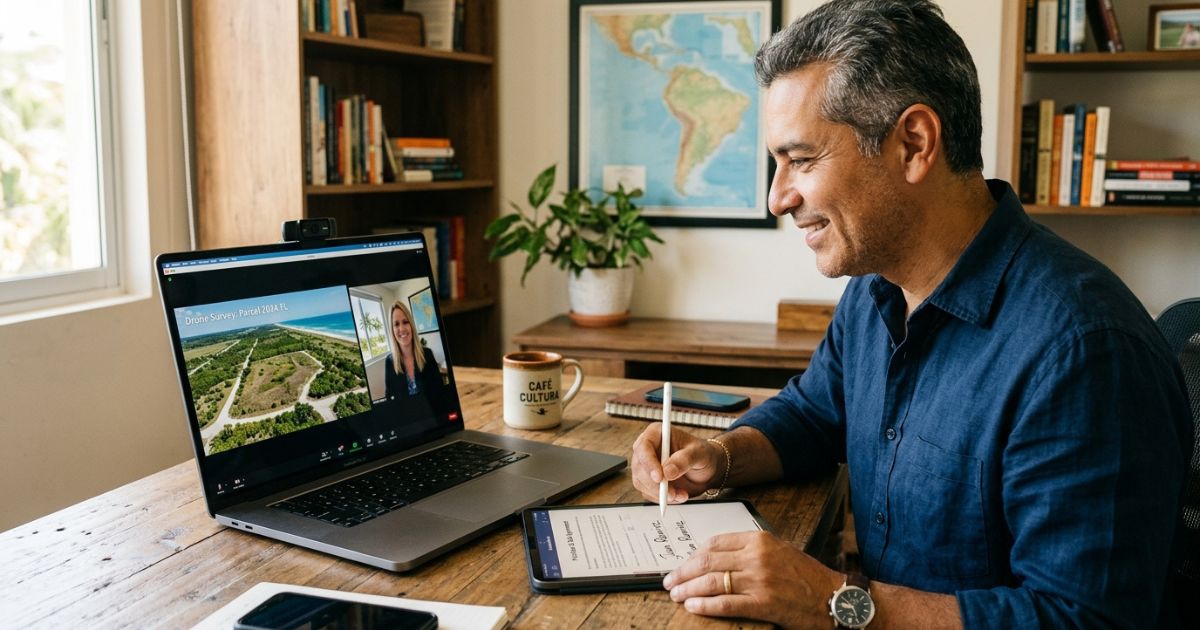
If the only thing holding you back from buying land in Florida is the assumption that you need to visit the state in person before signing anything, the real problem isn’t distance — it’s the time you lose waiting for a trip that may never happen, while the right parcel sells to someone else who researched calmly and bought from a distance.
Most people assume that buying US real estate requires being physically present to “see the land with your own eyes” and sign paperwork at an American notary’s office. In practice, Florida’s vacant land market has operated for years with a structure built for out-of-state and out-of-country buyers — and understanding that structure is what separates buyers who invest with confidence from those who stall at the first paperwork hurdle.
Table of Contents
- Can you buy Florida land without visiting in person?
- How remote land buying actually works
- Documents and tools you’ll need to buy from a distance
- Power of attorney: how to sign without being in the US
- How to run remote due diligence before you buy
- In-person vs. remote purchase: what actually changes
- Common mistakes buyers make when purchasing remotely
- Hidden costs of a remote land purchase
- FAQ — Frequently Asked Questions
- 📚 Glossary
- ✅ Immediate Actions — Start Now
Can you buy Florida land without visiting in person? {#can-you-buy}
Short answer: yes. There is no legal requirement to be physically present to buy land in Florida — the entire process, from research to final signing, can be handled remotely using email, video calls, electronic signatures, and, when needed, a power of attorney notarized in your home country.
International buyers — including Brazilians, Colombians, and other Latin American buyers — close on Florida land deals every month without ever setting foot in the state. That’s possible because the vacant land market relies mostly on processes that are already digital by default:
- Research and parcel selection, done through maps, aerial photos, zoning data, and FEMA flood maps available online
- Due diligence, handled remotely with the county and title companies
- Contract signing, completed through e-signature platforms built for real estate transactions
- Closing, coordinated by a title company, which can send documents for remote signature or local notarization
The most important point: visiting the land in person can feel reassuring, but it isn’t a legal requirement, and it isn’t the only way to confirm the parcel matches what the listing describes. That confirmation comes from documentation, not from a site visit.
How remote land buying actually works {#how-it-works}
Short answer: a remote purchase follows essentially the same steps as an in-person one — research, due diligence, contract, financing (if any), and closing — except each step is handled by email, video call, and e-signature instead of face-to-face meetings.
In practice, the process usually follows this sequence:
- Defining the region and budget, typically with help from a bilingual agent who already knows the local market
- Selecting the parcel, with maps, photos, a zoning report, and flood zone status sent over by the agent or seller
- Signing the purchase agreement, completed electronically through platforms like DocuSign
- Formal due diligence, including a title search, zoning confirmation, and, when needed, a land survey
- Arranging payment, sent by international wire transfer directly into the title company’s escrow account
- Closing, with final documents either signed electronically or notarized in the buyer’s home country
- Recording the deed, handled by the title company with the county, with no need for the buyer to be present
Each of these steps produces its own documentation — and it’s that documentation, not a site visit, that protects the buyer from surprises after closing.
Documents and tools you’ll need to buy from a distance {#documents-needed}
Short answer: buying remotely requires a valid passport, a US taxpayer ID (usually an ITIN), a bank account capable of sending international wire transfers, email and video call access, and, in many cases, a power of attorney to represent the buyer for tasks that would normally require in-person presence.
Before starting the process, it’s worth having ready:
- A valid passport, used for identification on contracts and, when needed, notarization
- An ITIN (Individual Taxpayer Identification Number), required for many transactions and for future tax matters tied to the property
- A bank account capable of international wire transfer, to send funds to the title company’s escrow account
- Reliable email and video call access, used for e-signature and communication with the agent, title company, and attorney
- A power of attorney, when the buyer prefers to name someone to sign specific documents on their behalf in the US
None of these require travel — all of them can be arranged from the buyer’s home country, usually with help from a local American consulate when signature notarization is needed.
Power of attorney: how to sign without being in the US {#power-of-attorney}
Short answer: a power of attorney lets another person — typically an attorney or a title company representative — sign specific documents on the buyer's behalf in the US, and it can be prepared and notarized in the buyer's own country without any travel required.
Power of attorney is one of the most common tools used in remote purchases because it resolves the one part of the process people most often assume needs a “live” signature. In practice:
- A real estate attorney prepares a power of attorney document specific to that transaction
- The buyer signs the document in their home country, with notarization at a local notary
- Depending on the country, an apostille may be required for the document to be accepted in the US
- The person named in the power of attorney then signs the final closing documents on the buyer’s behalf
It’s worth stressing: the power of attorney should be transaction-specific and narrow in scope — avoid overly broad powers of attorney that grant authority beyond what that specific purchase requires.
How to run remote due diligence before you buy {#remote-due-diligence}
Short answer: remote due diligence is done through county public records, official FEMA flood maps, title reports issued by a title company, and, when needed, a land survey ordered locally — none of these checks require the buyer's physical presence.
Before signing any contract, it’s worth confirming remotely:
- Current zoning, checked with the county’s planning department to confirm the permitted use
- Flood zone status, checked against official FEMA maps for the specific address
- Title search, run by a title company to confirm the seller has the legal right to sell the parcel
- Utility access, checking whether the land already has water, sewer, and electricity or depends on a well and septic system
- HOA or deed restrictions, when the parcel sits inside a subdivision with a homeowners association
- Exact lot boundaries, confirmed through a land survey ordered from a licensed local surveying company
Many of these reports can be requested and received entirely by email, and a local real estate attorney can review all the documentation before final signing — acting as the “eyes on the ground” that replace an in-person visit.
In-person vs. remote purchase: what actually changes {#comparison}
Short answer: the difference between buying in person and buying remotely has more to do with how documents are signed and verified than with the outcome — with solid due diligence, a remote purchase can be just as safe as an in-person one.
| Step | In-person purchase | Remote purchase |
|---|---|---|
| Visiting the land | Done in person | Replaced by photos, maps, and, if desired, a third-party site visit |
| Signing the contract | On paper, in person | E-signature (e.g., DocuSign) |
| Due diligence | Same checks, done in person | Handled remotely by the title company and attorney |
| Payment | Bank transfer or local check | International wire transfer to an escrow account |
| Closing | In-person at the title company | Remote documents or a power of attorney notarized locally |
The real difference isn’t in how safe the transaction is, but in documentation discipline — buyers who purchase remotely only face more risk if they skip due diligence steps, not because they bought without visiting.
Common mistakes buyers make when purchasing remotely {#common-mistakes}
Relying only on the seller’s photos
Photos can be outdated or fail to show the entire parcel. It’s worth always cross-checking against official county maps and, when possible, ordering an independent land survey.
Skipping due diligence because “it’s all online anyway”
Buying remotely doesn’t mean buying fast. Zoning, flood zone status, and title history should be verified with the same care as an in-person purchase.
Not hiring a local real estate attorney
An attorney familiar with the specific county can flag restrictions and issues that never show up in a listing or a surface-level search.
Wiring money without confirming the title company’s details
Wire fraud scams often impersonate legitimate title companies. Always confirm banking details by phone, using an independently verified number, before sending any funds.
Signing an overly broad power of attorney
A power of attorney should be limited to the specific transaction. Generic powers of attorney grant unnecessary authority and increase risk if the named person acts in bad faith.
Hidden costs of a remote land purchase {#hidden-costs}
Beyond the price of the land itself, a few expenses specific to the remote process are often left out of the initial budget:
- Real estate attorney fees, for contract review and closing support
- Notarization and apostille fees, when the power of attorney requires notarization and a Hague apostille
- International wire transfer fees, charged by the sending bank and, sometimes, by the receiving bank
- Land survey costs, when the exact lot boundaries aren’t clearly confirmed
- Title insurance, which protects the buyer against problems in the property’s chain of title
- Certified translation fees, when personal documents need to be presented in English
Short answer: remote purchases carry specific added costs — attorney fees, apostille, wire transfer charges, and sometimes certified translation — that should be built into the total budget from the start, not discovered at closing.
FAQ — Frequently Asked Questions {#faq}
Can you buy land in Florida without visiting in person?
Yes. There’s no legal requirement to be physically present to buy land in Florida. The entire process can be handled remotely, with support from an agent, an attorney, and a title company.
Do I need a power of attorney to buy land remotely?
It’s not required in every case, but it’s a common tool when the buyer prefers to name someone to sign specific documents on their behalf during closing.
How do I run due diligence without being on the land?
Through county public records, official FEMA flood maps, a title report issued by a title company, and, when needed, a land survey ordered locally.
Is it safe to wire money to buy land from a distance?
It can be, as long as the title company’s banking details are confirmed by phone before any transfer, since wire fraud scams often impersonate legitimate title companies.
Can foreigners buy land in Florida?
Yes. There’s no general federal restriction preventing foreigners from buying land in the United States, and Florida is one of the most structured markets for serving international buyers, including bilingual support.
📚 Glossary {#glossary}
Power of attorney — a legal document authorizing another person to sign specific documents on the buyer’s behalf.
Wire transfer — an international bank transfer used to send funds to the title company’s escrow account.
Title company — the company responsible for handling closing and issuing title insurance for the transaction.
Title search — verification of a property’s chain of title, confirming the seller has the legal right to sell it.
Apostille — an international certification that validates a notarized document for use in another country party to the Hague Convention.
ITIN (Individual Taxpayer Identification Number) — a US tax ID number used by people who aren’t eligible for a Social Security Number.
Land survey — a technical assessment that confirms the exact boundaries of a parcel before purchase.
✅ Immediate Actions — Start Now {#immediate-actions}
- Check whether you already have, or need to apply for, an ITIN before starting the purchase
- Confirm with your bank whether your account supports international wire transfers
- Find out whether your city has a notary and apostille service available
- Ask the agent for zoning and flood zone maps for the parcel before signing any contract
- Hire a real estate attorney to review the contract and the closing process
- Contact TerraNoble for bilingual guidance on buying Florida land remotely
Conclusion
Buying land in Florida without visiting in person isn’t a risky shortcut — it’s how the vacant land market already operates for thousands of international buyers every year. The safety of the transaction doesn’t depend on standing on the parcel, but on following each due diligence step with the same care you’d use for an in-person purchase: verifying zoning, confirming flood zone status, checking the chain of title, and working with professionals who know the specific county.
Buyers who delay a decision just because they think they need to travel first often lose time — and sometimes the very parcel they were considering — while better-prepared buyers close calmly, from a distance.
TerraNoble offers bilingual support — in English and Portuguese — to help buyers manage the entire Florida land purchase process safely, even from a distance. Get in touch with our team.