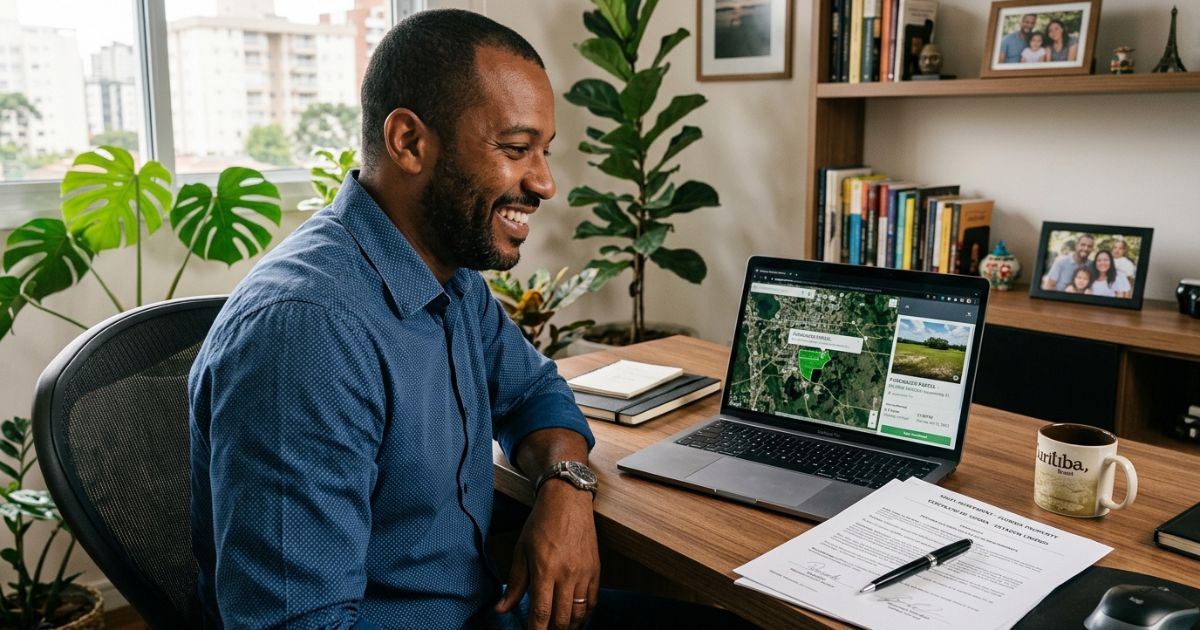
From his home office in Curitiba, Rafael closed on his Florida land purchase entirely online — proof that investing in the US market doesn't require getting on a plane.
If you assume you need to book a flight and walk the property before buying land in Florida, the visible obstacle isn’t the real problem. The real risk is assuming it’s impossible and never looking into it at all. Rafael, a 39-year-old business owner in Curitiba, proved otherwise: he closed on his first Florida land purchase without ever setting foot in the state, using nothing more than a laptop, email, and a notarized power of attorney.
Most people think buying property in the United States requires being physically present to sign documents and “see the land with your own eyes.” In practice, the American vacant land market has operated for years with a structure built for buyers outside the country — and understanding that structure is what separates investors who move forward confidently from those who stall at the first paperwork hurdle.
Table of Contents
- Can you actually buy land in Florida from another country
- Rafael’s story: from online research to a signed deed
- How due diligence works when you never visit the land
- Power of attorney and remote signing: how the closing actually happens
- Table: buying in person vs. buying remotely
- Common mistakes buyers make when purchasing land from abroad
- Hidden costs of a remote land purchase
- What to verify before buying Florida land from abroad
- FAQ — Frequently asked questions
- 📚 Glossary
- ✅ Immediate Actions — Start Now
Can you actually buy land in Florida from another country {#is-it-possible}
Short answer: yes. Foreign nationals can buy land in Florida without a US visa, without being physically present in the country, and without a Social Security number. The entire process — from researching the parcel to signing the closing documents — can be handled remotely, using a power of attorney, remote online notarization (RON), or documents signed and notarized in the buyer's home country.
What makes this possible isn’t a legal loophole — it’s an established structure: US title companies that routinely work with international buyers, apostille certification that makes a foreign notarization valid in the United States, and banks equipped to process international wire transfers for closing. None of these pieces were built specifically for Brazilian buyers, but all of them work seamlessly for anyone who knows how to use them.
What you actually need to buy remotely
- A valid passport — no US visa is required to purchase property
- A bank account capable of sending an international wire transfer — at home or in the US
- A power of attorney, or willingness to sign through remote online notarization
- A title company with experience serving foreign buyers
None of these require ever setting foot in the United States during the process.
Rafael’s story: from online research to a signed deed {#rafael-story}
Rafael spent nearly two years following the Florida land market before deciding to invest. His reasoning was straightforward: diversify part of his wealth into US dollars, in an asset with no tenants, no renovations, and low carrying costs, sitting entirely outside Brazil’s financial system.
The first step wasn’t finding the parcel — it was finding someone who could guide him in Portuguese through the entire process. Without that, he admits, “I would have given up the first time someone used legal English I didn’t fully understand.”
How he evaluated land he never visited
Rafael narrowed a list of a dozen parcels down to three finalists using satellite imagery, county zoning maps, and FEMA flood zone reports. Each finalist was assessed against objective criteria: access to a public road, utility availability, residential zoning, and the parcel’s property tax history through the county property appraiser.
Short answer: it's possible to evaluate a parcel of land safely without visiting it in person by combining up-to-date satellite imagery, FEMA flood zone maps, county property appraiser records, and, when the investment size warrants it, a local inspector hired to confirm the physical condition of the lot.
Why a bilingual team made the final decision easier
What changed the pace of the process, Rafael says, was having someone walk him through every document in Portuguese before he signed anything. “I didn’t need to trust blindly — I needed to understand what I was signing, and that made all the difference in how confident I felt.”
How due diligence works when you never visit the land {#remote-due-diligence}
Short answer: remote due diligence replaces an in-person visit with technical documentation: a land survey, a title search, zoning verification with the county, confirmation of road access and utility availability, and — when the purchase price justifies it — hiring an independent local inspector to photograph and assess the parcel physically.
The documents that stand in for the buyer’s own eyes
- Land survey: establishes exact boundaries, easements, and any encroachments from neighboring property
- Title search: confirms the seller is the legitimate owner and that no liens or debts are attached to the land
- Zoning verification: confirms what can legally be built on the parcel
- Flood zone report: shows whether the parcel sits in a FEMA-designated flood risk area
- Recent photos and video: requested directly from the listing agent or a hired local inspector
Rafael paid a local inspector less than $300 to walk the property, photograph all four marked corners, and confirm there was no debris, dumping, or unauthorized occupation on the lot — a small cost relative to the peace of mind it delivered.
Power of attorney and remote signing: how the closing actually happens {#poa-remote-signing}
Short answer: a deed can be signed without traveling to the United States in two ways: through a power of attorney, notarized in the buyer's home country and authenticated with an apostille, which authorizes a US-based representative to sign on the buyer's behalf, or through Remote Online Notarization (RON), where available in the closing jurisdiction, which lets the buyer sign digitally in front of a notary over video call.
The path Rafael chose
He chose the power of attorney route. He visited a notary’s office in Curitiba, signed the document in the notary’s presence, and the US title company arranged the apostille — an international certification that removes the need for any additional authentication in Florida. His authorized representative signed the deed on his behalf at closing.
Why this is more common than it sounds
Title companies that work with Latin American buyers already have this workflow standardized. The time between notarizing the power of attorney at home and the actual closing typically runs one to three weeks, depending on how quickly the notary’s office and the bank process the wire transfer.
Table: buying in person vs. buying remotely {#comparison-table}
| Step | Buying in person | Buying remotely from abroad |
|---|---|---|
| Visiting the land | In person, by the buyer | Local inspector hired, or recent photos/video |
| Due diligence | In person and document-based | Fully document-based (survey, title search, zoning) |
| Signing the deed | At a title company or attorney's office in the US | Via power of attorney or Remote Online Notarization |
| Payment | Local transfer or cashier's check | International wire transfer |
| Extra cost | Flight, lodging, days of travel | Notary, apostille, and local inspector (usually under $500) |
In practice, the extra cost of buying remotely is usually far lower than the cost of an international trip for the same purpose.
Common mistakes buyers make when purchasing land from abroad {#common-mistakes}
Trusting listing photos alone
Listing photos are made to sell, not to inform. Rafael learned this after requesting extra photos of a parcel that “looked perfect” in the listing, only to discover a flooded low spot the original images conveniently left out.
Skipping due diligence because “it’s only for people who visit”
Being physically absent doesn’t reduce the need for a land survey, title search, and zoning verification — if anything, it makes these documents even more essential, since they stand in for the buyer’s own eyes.
Sending money without verifying the title company’s wire instructions by phone
Wire fraud, where criminals intercept closing emails and swap in fraudulent bank details, is a real risk in international real estate transactions. Confirming wire instructions by phone, directly with the title company, before sending any funds, is non-negotiable.
Signing a power of attorney without understanding exactly what it authorizes
A poorly drafted power of attorney can grant broader authority than necessary. Reading the document with someone who understands the process before signing prevents unpleasant surprises later.
Hidden costs of a remote land purchase {#hidden-costs}
- Apostille and notarization fees: charges for authenticating the power of attorney internationally
- International wire transfer fees: charged by the sending bank and sometimes by the receiving bank as well
- Independent local inspector: an optional cost, but recommended to confirm the parcel’s physical condition
- Certified document translation: required in some cases for use back home or in the US
- Currency exchange movement between quote and closing: can shift the final cost in the buyer’s home currency
None of these costs is large on its own, but leaving them out of the initial budget is a common mistake among first-time remote buyers.
What to verify before buying Florida land from abroad {#before-you-buy}
- Confirm the title company has experience with international buyers and, ideally, bilingual support
- Request a land survey, title search, and zoning report before signing any contract
- Hire a local inspector to photograph and confirm the physical condition of the parcel
- Call the title company directly to verify wire instructions before sending any funds
- Read the power of attorney in full before signing it at a notary's office
- Ask about the parcel's property tax history with the county property appraiser
FAQ — Frequently asked questions {#faq}
Do I need a US visa to buy land in Florida?
No. Foreign nationals can buy property in the United States without a visa, a green card, or US citizenship. What’s required is a valid form of identification, such as a passport, and the ability to complete an international wire transfer.
Is it safe to sign a power of attorney for someone else to sign the deed for me?
Yes, as long as the power of attorney is specific to that transaction, drafted with guidance from someone who understands the process, and notarized with an apostille. It’s a common and legally recognized practice in international real estate purchases.
How do I do due diligence on land I’ve never visited?
By combining a land survey, a title search, zoning verification with the county, a FEMA flood zone report, and, ideally, hiring an independent local inspector to confirm the lot’s physical condition on the ground.
How long does it take to close on a remote land purchase?
Typically two to six weeks, depending on how quickly the notary’s office issues the apostilled power of attorney, how fast the bank processes the wire transfer, and how long the title company takes to complete the title search.
📚 Glossary {#glossary}
Power of Attorney: a legal document authorizing a representative to sign contracts on the buyer's behalf when the buyer cannot be physically present.
Apostille: an international certification that confirms a document notarized in the buyer's home country is valid before US authorities.
Remote Online Notarization (RON): a notarization process conducted over video call, permitted in some US jurisdictions for real estate closings.
Title search: a records review that confirms the seller is the legitimate owner and that no liens or debts are attached to the property.
Land survey: a technical measurement that establishes a parcel's exact boundaries and any easements.
Wire transfer: an international bank transfer used to pay the purchase price and closing costs.
County property appraiser: the county office responsible for assessing a property's value and calculating annual property taxes.
✅ Immediate Actions — Start Now {#immediate-actions}
- Verify that your chosen title company has experience with Brazilian or international buyers and bilingual support
- Request a land survey, title search, and zoning report before signing any offer
- Look into the cost of an apostilled power of attorney at a notary's office near you
- Hire a local inspector to confirm the parcel's physical condition if the investment size justifies it
- Call the title company directly to verify wire instructions before sending any funds
- Budget for notary fees, apostille costs, and international wire transfer fees up front
Conclusion
Rafael’s story shows that the distance between Brazil and Florida isn’t an obstacle to buying land — it’s simply one more step to plan for. With solid document-based due diligence, a properly executed power of attorney, and a title company that understands the needs of an international buyer, it’s entirely possible to close on that purchase without leaving home, and without giving up any measure of safety.
What makes the difference isn’t being physically present at closing — it’s understanding every document before you sign it.
Considering buying your first parcel of land in Florida without leaving home? TerraNoble offers bilingual support — in English and Portuguese — to guide international buyers through every step of the process, from choosing the right parcel to signing the deed remotely. Get in touch with our team.