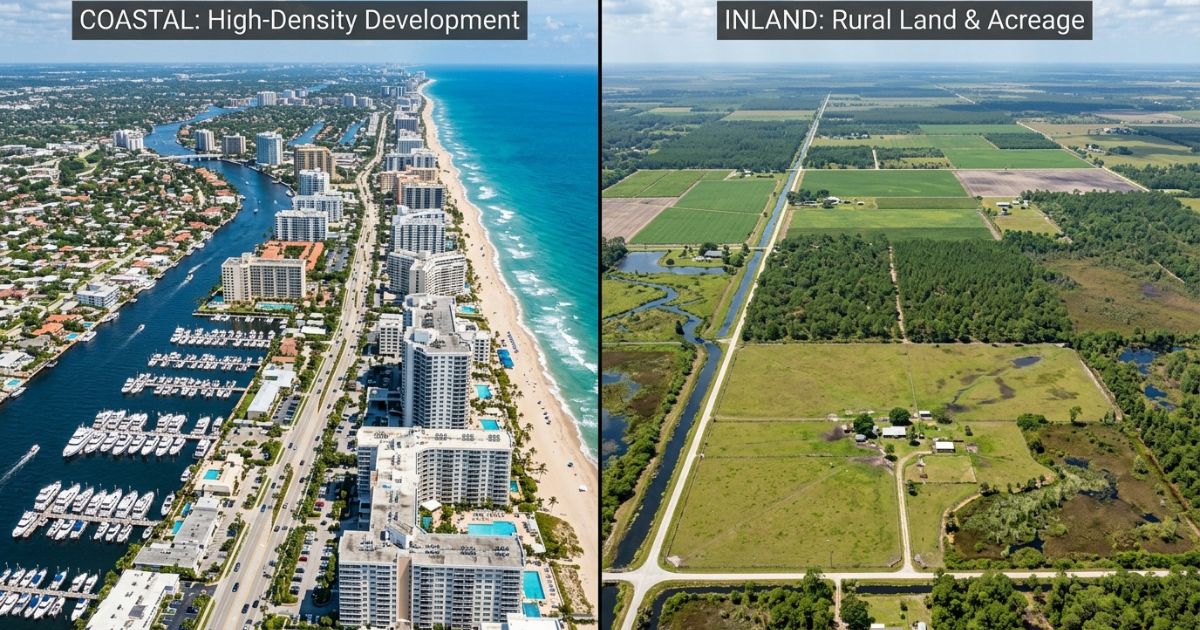
Most people who start researching land in Florida fall for the coast first — the ocean, the canals, the marinas, the promise of fast appreciation. The visible issue is the price per acre, which already discourages a lot of buyers. The real risk shows up afterward: higher hurricane insurance, higher property tax bills, and an appreciation curve that, in many stretches of the coastline, has already been captured by whoever bought decades ago. Here’s how to compare the two regions with numbers, not just the emotional pull of an ocean view.
Most buyers treat coastal versus inland as a lifestyle preference. In practice, it’s a financial decision — and total cost of ownership, not just the purchase price, is what determines which region actually pays off in 2026.
Table of Contents
- Coastal or inland: why this comparison matters in 2026
- How much does coastal land cost compared to inland Florida?
- Insurance and taxes: where the real cost gap shows up
- Appreciation: an established coastline vs an expanding interior
- Lifestyle and infrastructure: what actually changes
- Comparison table: coastal vs inland Florida
- Common mistakes when choosing between coastal and inland
- Hidden costs that affect the final decision
- FAQ — Frequently Asked Questions
- 📚 Glossary
- ✅ Immediate Actions — Start Now
Coastal or inland: why this comparison matters in 2026 {#why-it-matters}
Short answer: in 2026, the price gap between coastal and inland Florida is wider than ever, while insurance and carrying costs along the coastline keep climbing — which means the "best value" region depends on the buyer's goal, not just on which location feels the most desirable.
Two trends have unfolded at the same time over the last several years. Along the coast, land and property prices kept rising in established markets like Miami, Naples, Sarasota, and West Palm Beach, while hurricane and flood insurance premiums rose right alongside them — in many cases outpacing the property’s own appreciation. Inland, counties like Marion, Polk, Lake, Hernando, and Citrus kept attracting population growth and infrastructure investment without the same insurance premium spikes.
That doesn’t mean inland is automatically the right call. It means the question “which region is the better value” can only be answered by comparing real numbers — price per acre, annual carrying cost, and the buyer’s investment time horizon.
How much does coastal land cost compared to inland Florida? {#price-comparison}
Short answer: land along Florida's coastline typically costs three to ten times more per acre than comparable inland property — a gap that reflects decades of established development against a market that's still taking shape.
| Region | Price range per acre (vacant land) | Market stage |
|---|---|---|
| Miami-Dade / Broward / Palm Beach (coastal) | $150,000 – $500,000+ | Established |
| Naples / Sarasota (southwest coast) | $100,000 – $350,000 | Established |
| Tampa / St. Petersburg (west coast) | $80,000 – $250,000 | Established / expanding |
| Polk County (inland) | $20,000 – $70,000 | Early expansion |
| Marion County — Ocala (inland) | $15,000 – $55,000 | Early expansion |
| Hernando / Citrus County (inland) | $10,000 – $40,000 | Early stage |
The difference isn’t just entry price. A $200,000 coastal lot and a $30,000 inland lot represent completely different investment profiles — not just in capital required, but in risk, liquidity, and expected pace of return.
Insurance and taxes: where the real cost gap shows up {#insurance-taxes}
Short answer: annual carrying cost — not the purchase price — is usually what separates coastal from inland Florida the most, since coastal properties face significantly higher windstorm and flood insurance premiums, plus property taxes calculated on a much higher assessed value.
Hurricane and flood insurance
Coastal properties — especially those inside or near FEMA-mapped flood zones — pay substantially higher windstorm insurance and flood insurance premiums than comparable inland properties. That’s because direct exposure to hurricanes, storm surge, and coastal flooding increases the closer a lot sits to the ocean or navigable waterways.
Inland, hurricane exposure still exists — strong wind and heavy rain hit the entire state — but storm surge risk essentially disappears, and most inland lots fall outside high-risk flood zones, reducing the need for additional mandatory coverage.
Property tax
Florida property tax is calculated on the county’s assessed value of the property, applying the local millage rate. Because coastal land tends to carry a much higher assessed value, the annual tax bill in dollar terms is also higher — even when the percentage rate is similar between counties.
A coastal lot assessed at $250,000 can generate an annual tax bill several times higher than an inland lot assessed at $30,000, simply because of the difference in the calculation base.
Appreciation: an established coastline vs an expanding interior {#appreciation}
Short answer: Florida's coastline already prices in a large share of its appreciation potential, while inland Florida still reflects an earlier stage of the growth cycle — a pattern that has historically favored higher percentage returns for early buyers in expanding regions.
That’s not a guarantee of results — neither region has assured appreciation, and real estate cycles can behave differently going forward. But Florida’s historical pattern is consistent: regions like Tampa, Orlando, and Jacksonville, now considered established markets, saw their strongest percentage appreciation back when they were still viewed as “inland” or as the periphery of larger metro areas.
Counties like Marion, Polk, and Lake are showing the same signals today — population growth, highway expansion, incoming distribution centers — that preceded the appreciation of regions now considered expensive.
The coast, by being further along in its market cycle, tends to offer more stable and predictable appreciation, but with smaller percentage margins from today’s prices — the classic trade-off between safety and growth potential.
Lifestyle and infrastructure: what actually changes {#lifestyle}
Short answer: the coast offers immediate beach access, established urban life, and full infrastructure, while inland Florida requires more planning around commuting and, on many lots, upfront investment in a well and septic system — a direct trade-off between immediate convenience and lower total cost.
Living or investing on the coast means proximity to the beach, international airports, top-tier hospitals, and a mature commercial network. The trade-off is traffic, population density, and, during hurricane season, evacuation routes that can get congested.
Inland Florida usually means a longer drive to the beach or an international airport, but it compensates with lower density, more space per dollar invested, and, in many counties, recent commercial growth that reduces the feeling of isolation. For buyers looking for land for personal use — not just investment — the decision should also weigh daily routine, remote work flexibility, and proximity to family.
Comparison table: coastal vs inland Florida {#comparison-table}
| Aspect | Coastal Florida | Inland Florida |
|---|---|---|
| Average price per acre | High to very high | Low to moderate |
| Hurricane and flood insurance | Significantly more expensive | More affordable |
| Annual property tax (dollar amount) | Higher | Lower |
| Appreciation stage | Established, more predictable | Expanding, higher percentage potential |
| Resale liquidity | Generally higher | Can be slower |
| Utility access (water/sewer) | Municipal service on most lots | Well and septic on some lots |
| Storm surge exposure | Relevant near the water | Essentially none |
| Best-fit buyer profile | Personal use, lifestyle, larger capital | Mid/long-term investment, smaller entry |
Common mistakes when choosing between coastal and inland {#common-mistakes}
Comparing only the purchase price
Price per acre is only part of the equation. Ignoring insurance, tax, and infrastructure costs can make a “cheap” inland lot cost more in total, or make an expensive coastal lot look unaffordable when it actually fits the buyer’s budget.
Assuming inland is always the financially safer choice
A lower price doesn’t mean lower risk. Zoning, legal access to the lot, and resale liquidity vary widely between inland counties, and some lots can sit on the market for years before finding a buyer.
Skipping the FEMA flood zone map in either region
Some inland areas carry meaningful flood risk, and some coastal areas fall outside the highest-risk zones. The exact location of the lot — not the region in general terms — is what determines the actual insurance requirement.
Deciding purely on the emotional pull of an ocean view
The view has real value, but it needs to be weighed against a clear picture of total carrying cost over the years, not just the feeling at the moment of purchase.
Not calculating total cost of ownership over the long run
Adding up insurance, tax, and maintenance projected over 10 or 15 years often changes the picture of which region actually pays off more.
Hidden costs that affect the final decision {#hidden-costs}
- Rising coastal insurance premiums — Florida’s hurricane insurance market has a history of meaningful annual rate increases, especially after active storm seasons.
- Well and septic inland — installation can run $8,000 to $20,000 or more, depending on the property and the depth required.
- HOA and association fees — more common in planned coastal developments, adding to fixed monthly costs.
- Electrical line extension — on remote inland lots, this can range from a few hundred dollars to tens of thousands.
- Post-hurricane rebuilding cost differences — material and labor costs rise regionwide after major storms, but the proportional impact tends to be felt more in areas that rebuild more frequently along the coast.
FAQ — Frequently Asked Questions {#faq}
Is it a better value to invest in coastal or inland Florida in 2026?
It depends on the goal. For buyers seeking lower entry cost, lower insurance, and higher percentage appreciation potential, inland Florida usually offers better value. For buyers who prioritize liquidity, immediate personal use, and proximity to the beach and established urban infrastructure, the coast remains the more suitable choice, even at a higher cost.
Is hurricane insurance always more expensive on the coast?
In the vast majority of cases, yes, especially for properties near the ocean or in high-risk flood zones. The exact distance from the water and the FEMA classification for that specific lot determine the final premium.
Does inland Florida land appreciate as much as coastal land?
There’s no guarantee of appreciation in either region. Historically, regions in an earlier stage of expansion — much of inland Florida today — have shown higher percentage appreciation potential than already-established markets, but that depends on structural factors like population growth and infrastructure.
Can foreign buyers purchase land on both the coast and inland Florida?
Yes. Foreign buyers have the same right to purchase land in the United States as U.S. citizens, on both the coast and inland. The purchase process is similar in both regions, though insurance costs, financing, and due diligence requirements vary by specific location.
Which region has the lower total cost of ownership long-term?
In most cases, inland Florida shows a lower total cost once purchase price, insurance, and property tax are added up over the years. The exception is when an inland lot requires significant investment in a well, septic system, or electrical line extension, which can offset part of that advantage.
📚 Glossary {#glossary}
Windstorm insurance — coverage specifically for damage caused by strong wind, including hurricanes, often required separately from a standard homeowners policy in Florida.
Storm surge — an abnormal rise in sea level caused by hurricanes, one of the primary risks for properties located close to the coast.
Flood zone — a risk classification established by FEMA that determines the need for, and cost of, flood insurance for a specific property.
Property tax — an annual tax levied by the county based on a property’s assessed value.
Millage rate — the rate applied to a property’s assessed value to calculate property tax, set by each county and local taxing district in Florida.
Total cost of ownership — the sum of all recurring costs of holding a property — insurance, tax, maintenance, and fees — beyond the purchase price.
HOA (Homeowners Association) — an association that manages rules and fees within certain developments, more common in planned coastal communities.
✅ Immediate Actions — Start Now {#immediate-actions}
- Compare price per acre across at least two coastal regions and two inland regions before deciding
- Request a hurricane and flood insurance quote for the specific lot, not just for the general region
- Check the FEMA flood zone map (msc.fema.gov) for the exact property address
- Ask the county for the estimated property tax based on the lot’s current assessed value
- Project total cost of ownership (purchase + insurance + tax + maintenance) over a 10-year horizon
- Talk to TerraNoble for bilingual guidance on which region fits your specific buying goal
Conclusion
There’s no universal answer to “coastal or inland” — there’s the right answer for each buyer’s specific goal. Florida’s coastline continues to offer lifestyle, liquidity, and established infrastructure, but at a significantly higher entry and carrying cost. Inland Florida offers a lower entry price, more affordable insurance, and an earlier stage of growth that has historically preceded appreciation — with the trade-off of lower liquidity and, on some lots, the added cost of independent infrastructure.
The best value in 2026 isn’t tied to one specific region on the map. It comes from clarity about what you’re actually looking for — personal use or investment, short or long horizon — compared against real numbers for each specific property.
TerraNoble offers bilingual support — in English and Portuguese — to help buyers compare Florida regions based on data, not just first impressions. Reach out to our team to evaluate which region fits your situation best.