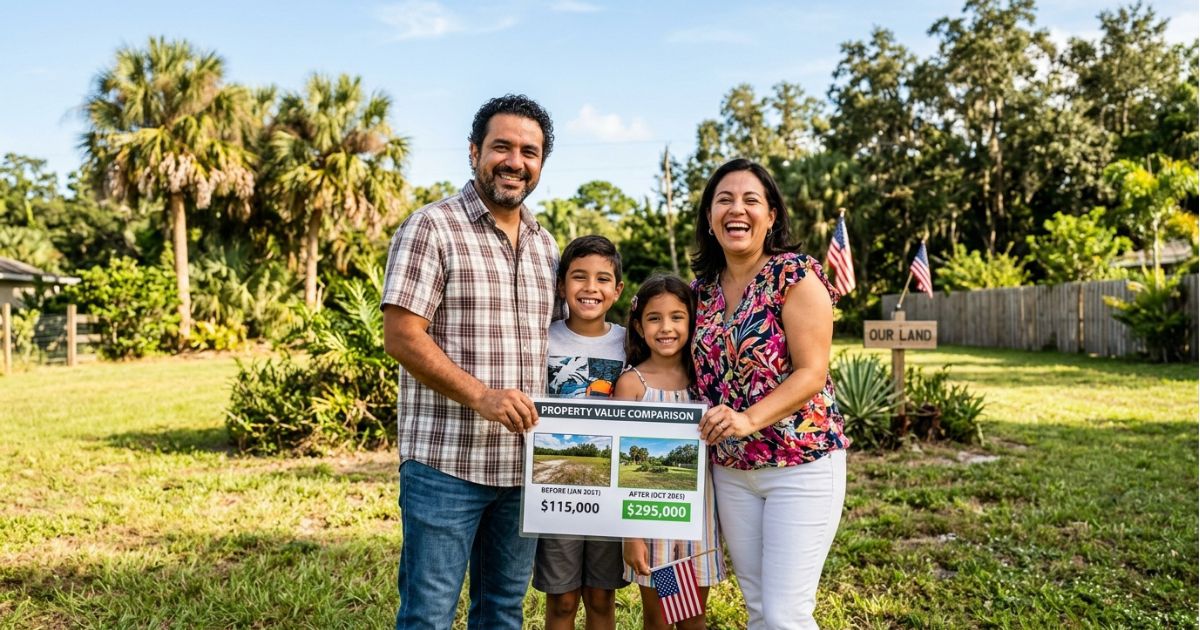
If you assume the biggest risk in buying vacant land is picking the wrong lot, the real problem runs deeper — it’s buying without understanding which factors actually move a parcel’s value over time. The Guzmán family, Colombians based in Bogotá, learned this firsthand. They bought a lot in Florida three years ago without any specific expectations, and a recent appraisal showed a 60% increase over what they paid.
Most people think land appreciation comes down to luck, or simply waiting long enough. In reality, the parcels that appreciate the most tend to share a specific set of characteristics — and understanding them is what separates a successful investment from a lot that sits stagnant for decades.
Table of Contents
- How much can Florida land appreciate in a few years
- The Guzmán family’s story: from purchase to new appraisal
- What actually drove this specific parcel’s 60% gain
- How to spot a parcel with appreciation potential before buying
- Table: a parcel likely to appreciate vs. one likely to stay flat
- Common mistakes buyers make expecting fast appreciation
- Hidden costs that eat into real appreciation gains
- What to verify before buying land for appreciation potential
- FAQ — Frequently asked questions
- 📚 Glossary
- ✅ Immediate Actions — Start Now
How much can Florida land appreciate in a few years {#how-much-appreciation}
Short answer: there's no guaranteed number — land appreciation depends on local factors like county population growth, infrastructure expansion, utility availability, and demand for buildable lots in the area. Cases like the Guzmán family's, with 60% in three years, do happen, but they reflect the right combination of location and timing, not a market-wide rule.
Florida has been one of the fastest-growing states in the country by population, which puts pressure on land demand in counties that still have room to expand. That doesn’t mean every parcel appreciates — it means well-located parcels, with road access and utility availability, tend to benefit more from that growth than isolated lots or parcels in areas with no infrastructure planned.
Why this question doesn’t have a single answer
Every Florida county grows at a different pace. A parcel in an area with recent public investment in roads and utilities tends to behave very differently from a lot in a region with no expansion plans. That’s why individual appreciation stories, like the Guzmáns’, should be read as an example of process — not a promise of outcome.
The Guzmán family’s story: from purchase to new appraisal {#guzman-story}
The Guzmán family — Andrés, his wife Camila, and their two children — began researching Florida land as a way to diversify assets outside of Colombia. The decision didn’t come from a one-off opportunity; it followed months of tracking the market, comparing counties, and understanding where public infrastructure was expanding.
They bought a parcel just over half an acre in a residential area in central Florida, close to a highway that already had expansion work approved by local government. The price they paid was considered fair for the area at the time — not the cheapest lot on the market, but not above average either.
Three years later: what changed in the area
During that period, the county received investment in paving, electrical grid expansion, and new residential developments nearby. A new appraisal of the parcel, requested by the family through a local appraiser, showed a value 60% higher than what they originally paid.
Short answer: the Guzmán family's result didn't come from a single factor — it came from the combination of population growth in the region, expansion of public infrastructure, and choosing a lot already qualified as buildable, with road access and nearby utilities.
What Andrés says about the process
“We didn’t buy expecting a specific number. We chose the parcel because the area had concrete signs of growth — not because someone promised appreciation,” Andrés explains. For him, the most important decision wasn’t finding the cheapest lot, but understanding the county’s context before signing anything.
What actually drove this specific parcel’s 60% gain {#why-it-appreciated}
Short answer: the main drivers were location in a county with above-average population growth, proximity to already-approved public infrastructure projects, confirmed buildable status before the purchase, and the absence of severe zoning restrictions that would have limited the lot's future use.
County population growth
Florida counties with strong population growth tend to see higher demand for residential lots over time, which puts upward pressure on land prices in the area.
Public infrastructure expansion
Paving projects, electrical grid expansion, and sewer improvements increase a parcel’s perceived value because they lower the future cost of building for whoever develops the lot.
Confirmed buildable status
The Guzmán family’s lot already had confirmed residential zoning and road access before the purchase — two factors that significantly widen the pool of buyers interested in the parcel down the road.
Absence of severe restrictions
Parcels with overly rigid deed restrictions or an HOA with excessive rules tend to attract fewer buyers. The lot the family bought carried no such limitations.
How to spot a parcel with appreciation potential before buying {#how-to-spot-potential}
- Research population growth data for the county on its official government site
- Check whether public infrastructure projects are planned for the area in the coming years
- Confirm the lot's buildable status with the local zoning department
- Evaluate proximity to highways, schools, and commercial centers that are expanding
- Review the appreciation history of neighboring parcels through the county property appraiser
None of these steps guarantees appreciation — but together, they significantly reduce the chance of buying a stagnant parcel.
Table: a parcel likely to appreciate vs. one likely to stay flat {#comparison-table}
| Characteristic | Parcel with stronger appreciation potential | Parcel at higher risk of staying flat |
|---|---|---|
| County growth | Above the state average, with public data available | Stable or declining population |
| Infrastructure | Public projects announced or underway | No public investment planned |
| Buildable status | Confirmed, with residential zoning | Unverified or in a restricted-use area |
| Access | Paved public road or road under construction | No clear public road access |
| Utilities | Available or nearby | Distant, requiring costly well and septic systems |
Parcels that match the first column tend to attract more interest from buyers and builders over time, which pushes market value upward.
Common mistakes buyers make expecting fast appreciation {#common-mistakes}
Buying the cheapest lot without checking the county’s context
A cheap lot in a region with no projected growth tends to stay cheap. Price alone, without local market context, doesn’t indicate appreciation potential.
Ignoring the parcel’s buildable status
Parcels without confirmed residential zoning or public road access can take years to appreciate, even in growing counties, because they attract fewer buyers willing to deal with that uncertainty.
Assuming appreciation is guaranteed with time
Some parcels stay stagnant for decades, especially in areas with no public infrastructure planned. Time alone doesn’t create appreciation — the growth context of the region does.
Not tracking appraisals over time
Without a formal new appraisal, it’s hard to know whether a parcel truly appreciated or simply kept pace with general market inflation.
Hidden costs that eat into real appreciation gains {#hidden-costs}
- Annual property tax: charged throughout the entire holding period, even with no use or construction on the land
- Basic lot maintenance: clearing and code compliance to avoid county fines
- Appraisal fees: needed to confirm the parcel's new market value
- Future sale costs: commissions and closing fees reduce the net gain if the parcel is sold
- Currency exchange movement: for buyers converting the gain back into another currency, exchange rates can shift the real return
Accounting for these costs is what separates a real appreciation gain from a purely nominal one.
What to verify before buying land for appreciation potential {#before-you-buy}
- Check population growth data for the county before choosing a region
- Research public infrastructure projects already approved or in planning
- Confirm the lot's buildable status and zoning with the county
- Review the price history of neighboring parcels over the past several years
- Calculate the annual cost of property tax and maintenance before projecting any gain
- Request a formal appraisal periodically to track real appreciation
FAQ — Frequently asked questions {#faq}
Does all Florida land appreciate over time?
No. Appreciation depends on specific factors, such as county population growth, infrastructure expansion, and the parcel’s buildable status. Land in areas with no projected growth can stay stagnant in value for many years.
Can foreigners buy Florida land with appreciation potential?
Yes. Foreign nationals can buy property in the United States without a US visa, a green card, or citizenship. What determines appreciation potential is the parcel’s location and characteristics, not the buyer’s nationality.
How do you know if a parcel actually appreciated?
By requesting a formal appraisal from a local professional, comparing it to the original purchase price, and factoring in the maintenance and property tax costs accumulated over the holding period.
How long does it take for land to show noticeable appreciation?
It varies by region. In counties with strong population growth and expanding infrastructure, noticeable changes can happen within a few years, as in the Guzmán family’s case. In areas without those factors, the process can be much slower or may not happen at all.
📚 Glossary {#glossary}
Buildable land: a parcel with zoning and access that permit construction, free of restrictions that would block residential use.
County property appraiser: the county office responsible for assessing property values and calculating annual property tax.
Zoning: the set of county rules that determines what can legally be built on a parcel.
Deed restrictions: limitations recorded on the deed that restrict a property's future use.
Appraisal: a formal process of estimating a property's market value, performed by a licensed appraiser.
Utilities: basic services like water, sewer, and electricity, whose proximity to a parcel lowers future construction costs.
✅ Immediate Actions — Start Now {#immediate-actions}
- Research population growth data for the county you're considering
- Check whether public infrastructure projects have been approved for the area
- Confirm the lot's buildable status and zoning with the county
- Compare the appreciation history of neighboring parcels over the past several years
- Calculate the annual property tax cost before projecting any future gain
- Request a formal appraisal when considering selling or refinancing the parcel
Conclusion
The Guzmán family’s story shows that Florida land appreciation isn’t a matter of chance — it’s the result of factors that can be researched before the purchase: county population growth, expanding public infrastructure, and a lot with confirmed buildable status. The 60% result in three years isn’t a guarantee for every parcel — it’s a picture of what happens when location is chosen carefully.
That doesn’t mean every parcel will behave the same way. It means understanding the factors that actually move a lot’s value is what allows for safer, better-informed decisions.
Considering buying Florida land with long-term appreciation potential? TerraNoble offers bilingual support — in English, Spanish, and Portuguese — to help Latin American buyers understand the context of each region before investing. Get in touch with our team.