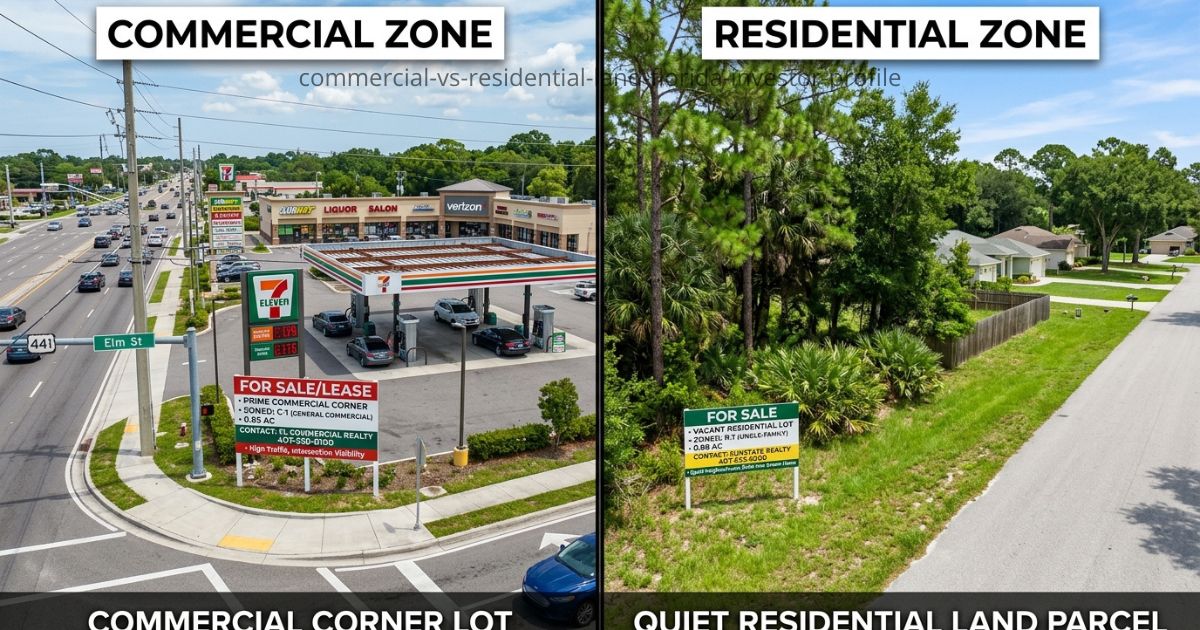
If you’re deciding between commercial and residential land in Florida, the visible question is which one looks cheaper or easier to find. The real risk is buying the wrong type of land for your financial profile and finding out months later that the zoning, the financing, or the expected return doesn’t match what you actually needed.
Most people treat this as a question of location or price per acre. In reality, commercial and residential land answer two different investment logics: one asks “how much capital and risk are you willing to take on in exchange for potentially higher returns,” the other asks “do you want a simpler, more liquid, more predictable asset instead.” Mixing up those two logics is what leads investors to buy the wrong land at the wrong stage of their own financial journey.
Table of Contents
- What Actually Separates Commercial Land From Residential Land in Florida
- Residential Land: Investor Profile and Expected Return
- Commercial Land: Investor Profile and Expected Return
- Commercial vs Residential Land Side by Side
- Zoning: The Difference That Changes Everything
- How to Tell Which Profile Fits You
- Common Mistakes When Choosing Between Commercial and Residential
- Hidden Costs of Each Type of Land
- FAQ — Frequently Asked Questions
- 📚 Glossary
- ✅ Immediate Actions — Start Now
What Actually Separates Commercial Land From Residential Land in Florida {#core-difference}
Short answer: the core difference is zoning and permitted use — residential land is designated for housing (single-family homes, small multifamily projects), while commercial land is designated for business use (retail, offices, warehouses), and that classification directly shapes value, financing, and the pool of future buyers.
Zoning isn’t just a county formality — it determines what can legally be built, who can finance the purchase, and which type of buyer will show up when it’s time to resell. Residential land tends to attract a much larger pool of buyers, made up of families, builders, and small investors. Commercial land attracts a narrower pool, made up of business owners, developers, and investors comfortable with larger-scale projects.
That difference in buyer pool is also what explains why the two land types behave so differently when it comes to price, liquidity, and resale speed — points we break down in the sections below.
Residential Land: Investor Profile and Expected Return {#residential-land}
Short answer: residential land typically requires less upfront capital, is easier to finance and resell, and tends to fit best with investors who prioritize simplicity, lower risk, and a more predictable investment timeline.
Residential land is the most common entry point for people getting started in Florida land investing. Its main characteristics include:
- Lower entry ticket — residential lots in established neighborhoods usually cost less per unit than commercial parcels along high-traffic corridors
- More accessible financing — banks and private lenders generally offer simpler terms for residentially zoned land, since the perceived risk is lower
- A wider buyer pool — families who want to build their own home, small builders, and other individual investors all compete for this type of lot, which tends to make resale easier
- More predictable, but more modest, returns — appreciation tends to track population growth and infrastructure expansion in the area, without the sharp spikes a well-positioned commercial parcel can experience
This profile fits investors who prioritize safety and liquidity over maximum return, or who are in an early stage of building wealth through land.
Commercial Land: Investor Profile and Expected Return {#commercial-land}
Short answer: commercial land requires more capital, more patience, and more risk tolerance, but it offers higher upside when it's well positioned along growth corridors or near new commercial development.
Commercial land fits a more sophisticated, and generally better-capitalized, investor profile. Key characteristics include:
- Higher upfront capital — commercial parcels, especially along high-traffic corridors, typically carry a significantly higher price per acre than residential lots
- More complex financing — lenders typically require larger down payments, shorter terms, and a more detailed review of the intended use before approving financing
- A narrower buyer pool — resale depends on finding a business owner, developer, or institutional investor interested in that specific use, which can extend the time it takes to sell
- Higher potential return, but more volatility — well-located commercial land can see significant appreciation as new businesses move into the area, but it can also sit unsold longer if commercial demand doesn’t develop as expected
This profile fits investors who already have experience, capital they can afford to leave in place through a longer development cycle, and comfort with a potentially slower resale process.
Commercial vs Residential Land Side by Side {#comparison-table}
| Criteria | Residential Land | Commercial Land |
|---|---|---|
| Typical upfront capital | Lower | Higher |
| Ease of financing | Higher, with more lending options | Lower, with stricter requirements |
| Buyer pool at resale | Broad (families, builders, investors) | Narrow (business owners, developers) |
| Liquidity | Generally higher | Generally lower |
| Appreciation potential | More predictable, more moderate | Can be higher, but more volatile |
| Zoning complexity | Lower | Higher, with more municipal requirements |
| Property tax and impact fees | Generally lower | Generally higher |
Zoning: The Difference That Changes Everything {#zoning}
Short answer: zoning legally defines what can be built on a parcel, and buying land without confirming that classification with the county is one of the most expensive mistakes an investor can make, whether the land is commercial or residential.
Every Florida county maintains its own zoning code system, but broadly speaking:
- Residential zoning usually restricts use to single-family or small-scale multifamily housing, with specific rules on building setbacks, maximum height, and density per acre
- Commercial zoning allows uses like retail stores, offices, restaurants, and in some cases light warehousing — but it also comes with additional requirements around parking, road access, and environmental impact
- Mixed-use zoning exists in some areas and allows a combination of residential and commercial use, typically within planned developments
Before buying any parcel, it’s essential to confirm the current zoning with the county planning department — never assume a lot can be used the way you imagine just because the area “looks” commercial or residential. Rezoning is possible in many cases, but it’s a process that takes time, costs money, and carries no guarantee of approval.
How to Tell Which Profile Fits You {#investor-profile}
Short answer: residential land tends to fit investors who want simplicity, lower risk, and more liquidity, while commercial land tends to fit investors with more available capital, more risk tolerance, and a longer investment horizon.
A few questions help guide this decision:
- Do you have enough capital to wait through a longer commercial development cycle, or do you need an asset that’s easier to resell quickly if needed?
- Do you already have experience evaluating market demand for businesses, or would you rather work with a land type that has a more predictable buyer pool?
- Is your goal to eventually build a home, generate income through a business, or simply hold the land as a store of value?
- Are you comfortable navigating the more complex zoning and permitting processes typical of commercial land?
There’s no universal right answer — there’s the right answer for the capital, risk appetite, and financial goals of each individual investor.
Common Mistakes When Choosing Between Commercial and Residential {#common-mistakes}
Assuming Commercial Land Always Appreciates More
Commercial land’s higher appreciation potential comes with more risk and a longer wait. In areas without real commercial growth, a well-located residential lot can appreciate more consistently.
Underestimating How Hard Commercial Land Is to Finance
Many buyers discover too late that financing terms for commercial land are significantly stricter than for residential land, with larger down payments and shorter terms.
Not Verifying Zoning Before Negotiating
Assuming a parcel can be used for a certain purpose without confirming it with the county is one of the most common — and most expensive — mistakes in this type of purchase.
Ignoring the Buyer Pool at Resale
Commercial land in an area without business demand can sit on the market for years, even at a fair asking price, simply because the pool of interested buyers is so much narrower.
Comparing the Two Land Types on Price Per Acre Alone
Price per acre alone doesn’t tell the full story — capital requirements, financing, recurring costs, and resale liquidity matter just as much as the purchase price.
Hidden Costs of Each Type of Land {#hidden-costs}
- Higher impact fees on commercial land — municipalities typically charge higher impact fees for commercial development, reflecting the greater projected demand on public infrastructure
- Proportionally higher property tax on commercial land — the tax assessment on commercial land tends to reflect the parcel’s income-generating potential, resulting in higher annual taxes
- Feasibility study costs — commercial land frequently requires traffic studies, environmental impact assessments, and market feasibility studies before any development, costs that are minimal or nonexistent on residential land
- Extended vacancy periods — both commercial and residential land can sit idle without generating a return, but the average holding period tends to be longer for commercial land given the narrower buyer pool
- Rezoning costs — if a parcel doesn’t already carry the desired zoning, the county application process can take months with no guarantee of approval
FAQ — Frequently Asked Questions {#faq}
Is commercial land always a better investment than residential land in Florida?
Not necessarily. Commercial land can offer higher returns, but it requires more capital, more risk tolerance, and a narrower buyer pool at resale. The “better” option depends on each investor’s financial profile and goals.
Is it harder to finance commercial land than residential land in Florida?
Generally, yes. Lenders typically require larger down payments and shorter terms for commercial land, since the perceived risk is higher and the approval process usually involves a more detailed review of the intended use.
Can I build a house on land zoned commercial?
Generally not, without going through a rezoning process with the county. The permitted use of a parcel is determined by its current zoning, not by the location or appearance of the surrounding area.
Can foreign buyers purchase both commercial and residential land in Florida?
Yes. There’s no federal restriction preventing foreign buyers from purchasing commercial or residential land in Florida, but it’s advisable to seek bilingual guidance to understand the financing, zoning, and tax differences between the two land types.
How do I find out the current zoning of a parcel before buying?
Zoning can be confirmed directly with the planning and zoning department of the county where the land is located, typically using the parcel’s identification number.
📚 Glossary {#glossary}
Zoning — the legal classification that defines the permitted uses for a piece of land, set by the county or municipality.
Rezoning — the formal process of requesting a change to a parcel’s zoning classification through the local government.
Impact Fee — a municipal fee charged when permitting new construction, intended to fund public infrastructure affected by the new development.
Mixed-Use — a zoning classification that allows residential and commercial uses to be combined on the same parcel or development.
Liquidity — how easily and quickly an asset can be converted into cash through a sale.
Parcel ID — the unique identification number assigned to a piece of land, used by the county for tax records and zoning lookups.
Feasibility Study — a technical analysis that evaluates whether a specific commercial use is viable on a given parcel, considering factors like traffic, market demand, and available infrastructure.
✅ Immediate Actions — Start Now {#immediate-actions}
- Confirm the current zoning of the parcel with the county planning department before negotiating
- Decide whether your main goal is simplicity and liquidity, or higher potential returns with more risk
- Assess your available capital and your tolerance for waiting through a longer development cycle if considering commercial land
- Research financing terms available for each zoning type before committing
- Calculate recurring costs for each option — property tax, impact fees, and possible feasibility study fees
- Talk to TerraNoble for bilingual guidance on which land profile fits your investment goals in Florida
Conclusion
Commercial and residential land in Florida aren’t two versions of the same investment — they’re two assets with distinct risk, return, and liquidity profiles. Residential land tends to offer more simplicity, easier financing, and a broader buyer pool. Commercial land can offer higher return potential, but it demands more capital, more patience, and more tolerance for uncertainty.
The question “which land is better” only has an answer once the investor defines their own profile first: how much capital is available, how much risk they’re willing to take on, and what the investment timeline looks like. From there, the decision stops being about which land is objectively superior and becomes about which land actually fits the financial moment of the person buying it.
TerraNoble offers bilingual support — in English and Portuguese — to help Latin American investors understand the real differences between commercial and residential land in Florida, and choose the option best aligned with their profile and financial goals. Reach out to our team to discuss your specific situation.