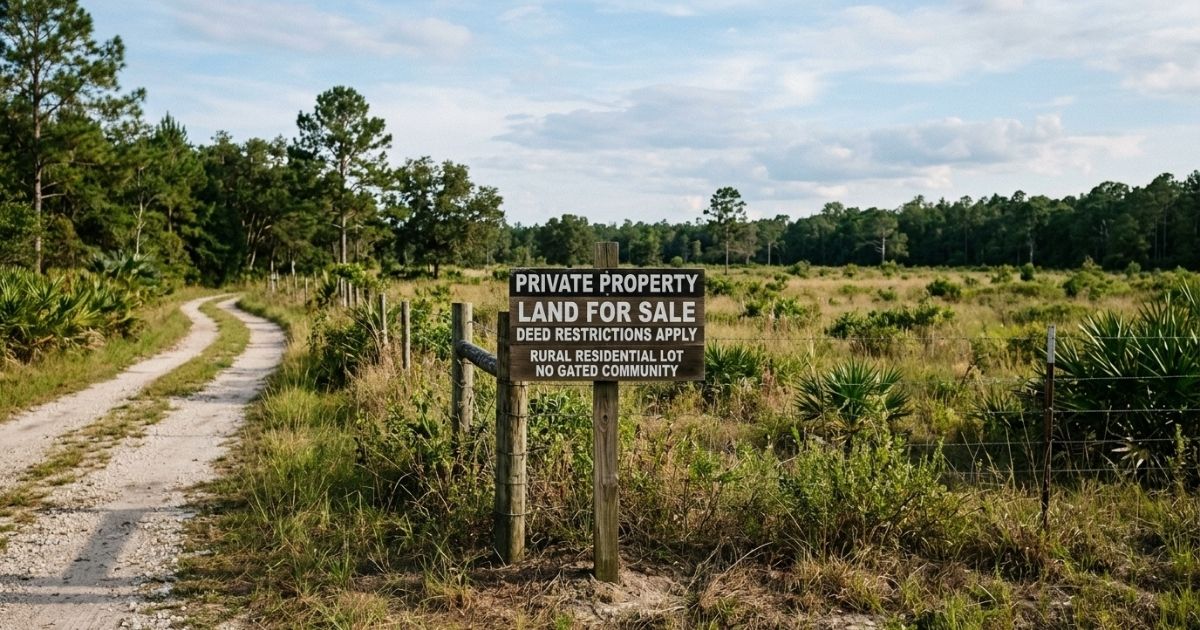
Important notice: this article is for informational and educational purposes only. It does not constitute legal or real estate advice. Before buying any land, consult a licensed Florida real estate attorney and order a full title search.
If a land listing says “no HOA,” the relief you feel isn’t the most important piece of information. The real risk is assuming that no homeowners association means no rules at all about what you can do with the property. Across much of Florida, land is still governed by deed restrictions — private rules recorded directly on the land — that remain fully enforceable even when no HOA exists to manage them.
Most buyers only associate use restrictions with gated communities that charge a monthly fee and send notices about fence color. In reality, a parcel can have zero association whatsoever and still prohibit manufactured homes, require a minimum home size, or block commercial use — because those rules were recorded with the county decades ago and never stopped applying.
Table of Contents
- What deed restrictions are
- Why deed restrictions exist without an HOA
- What deed restrictions typically require or prohibit
- How to check deed restrictions before buying
- Who enforces deed restrictions without an HOA
- Deed restrictions vs. HOA vs. zoning
- Can deed restrictions be removed or changed
- Common mistakes with deed restrictions
- Hidden costs of ignoring deed restrictions
- FAQ — Frequently Asked Questions
- 📚 Glossary
- ✅ Immediate Actions — Start Now
What deed restrictions are {#what-they-are}
Short answer: deed restrictions are clauses recorded with the county — typically in the deed, the subdivision plat, or a separate Declaration of Restrictions — that limit what an owner can do with a parcel of land, regardless of whether an active homeowners association exists.
These restrictions usually originate when a developer subdivides a larger tract into individual lots. Before selling the first parcels, the developer records a set of rules in the county’s public records establishing a use standard that every lot in the subdivision must follow going forward.
Unlike zoning, which is set by county or city government and can change over time, a deed restriction is a private agreement between the original developer and the buyers of each lot. It “runs with the land,” meaning it stays attached to the property through every future sale, even after everyone involved in creating it is long gone.
Why deed restrictions exist without an HOA {#why-no-hoa}
Short answer: many rural and vacant-land subdivisions in Florida were created with recorded deed restrictions but never formed a formal HOA, because there are no shared amenities, gates, or common areas that would justify an association collecting monthly dues.
An HOA typically exists to manage something collective — a pool, a gatehouse, private roads, shared landscaping. When a subdivision consists only of rural or vacant lots with no shared infrastructure, developers often choose to record restrictions directly on the deed to protect the character of the area, without ever building an administrative structure to enforce them day to day.
The result is a situation that trips up plenty of buyers:
- There’s no monthly bill and no dues statement.
- There’s no board, no property manager, no association at all.
- But the rules remain fully valid and carry the weight of a recorded contract.
This combination — “no HOA” paired with active deed restrictions — is common enough in rural Florida that it deserves a specific check during due diligence.
What deed restrictions typically require or prohibit {#what-they-restrict}
Short answer: deed restrictions on Florida land commonly define the type of allowed construction, minimum square footage, prohibitions on mobile or manufactured homes, residential-only use, limits on livestock, and deadlines for starting construction after purchase.
The exact clauses vary by subdivision, but a few patterns show up repeatedly on Florida land:
- Type of construction. Many restrictions allow only single-family residences, blocking duplexes, commercial use, or multiple structures on the same lot.
- No manufactured or mobile homes. This is one of the most common restrictions on rural lots — it blocks manufactured housing or trailers even when county zoning would otherwise allow them.
- Minimum square footage. Some restrictions require the home to have a set minimum number of square feet under roof.
- Minimum acreage per lot. This prevents subdividing the parcel into smaller lots than the subdivision was originally platted for.
- Animals and agricultural use. May limit livestock, horses, or other animals, or prohibit commercial agricultural activity.
- Construction start deadline. Some older restrictions require construction to begin within a set period after the lot is purchased.
How to check deed restrictions before buying {#how-to-check}
Short answer: deed restrictions can be verified through a title search performed by a title company or real estate attorney, who reviews the county's official records for the deed, the subdivision plat, and any recorded Declaration of Restrictions.
The recommended process before closing on any parcel includes:
- Order a full title search, not just a summary — the report should list every recorded restriction, easement, and encumbrance affecting the lot.
- Search the county’s official records site directly, where you can look up the current owner’s name or the parcel ID and locate documents attached to the property.
- Request a full copy of the Declaration of Restrictions, when one exists, and read the entire document rather than relying on a broker’s summary.
- Ask the seller or listing agent directly whether any known restrictions apply, though this should always be confirmed independently.
- Confirm with a real estate attorney whether any restrictions you find are compatible with what you plan to build.
Who enforces deed restrictions without an HOA {#who-enforces}
Short answer: without an HOA, enforcement of deed restrictions typically falls to individual property owners, who can file a lawsuit to compel compliance — the county generally doesn't enforce private restrictions, only public zoning and building codes.
This is one of the biggest differences from a traditional HOA setup. When an association exists, it notifies the owner, issues fines, and, in extreme cases, takes the matter to court on its own. Without an HOA:
- Any lot owner within the same subdivision who feels harmed can sue a neighbor to enforce a recorded restriction.
- The county only steps in if the violation also breaks a public law, such as a building code or zoning ordinance — not because the deed restriction itself was violated.
- In practice, enforcement tends to be more inconsistent than in subdivisions with an active HOA, which doesn’t mean the restriction has stopped being legally valid.
This point creates a false sense of security for many buyers: the absence of immediate enforcement doesn’t mean the restriction can’t be enforced later in court, including by a neighbor who only became bothered by it years after construction was finished.
Deed restrictions vs. HOA vs. zoning {#comparison-table}
| Aspect | Deed restrictions | HOA | Zoning |
|---|---|---|---|
| Who creates it | Original developer, recorded on the deed/plat | Homeowners association, under its own bylaws | County or municipal government |
| Monthly dues | None, by definition | Usually yes | None |
| Who enforces it | Neighbors, through a lawsuit | The association's board | County/municipal agencies |
| Can it change over time | Only through a formal amendment process | Yes, by member vote | Yes, by government decision |
| Where to verify it | County official records | HOA bylaws and financial disclosures | County zoning department |
Can deed restrictions be removed or changed {#removing-changing}
Short answer: deed restrictions can often be amended or removed, but this generally requires formal consent from a significant percentage (or all) of the affected lot owners, or a court ruling based on a substantial change in conditions in the surrounding area.
Some older restrictions include a sunset clause that expires automatically after a set number of years unless owners vote to renew them. Others remain valid indefinitely unless formally amended.
The most common paths to modifying a deed restriction include:
- Owner agreement, when the original restriction includes an amendment process requiring signatures from a qualified majority of lots.
- A changed-conditions lawsuit, when a court recognizes that the surrounding area has changed so much that the restriction has lost its practical purpose — an expensive process with no guaranteed outcome.
- Proven abandonment, in rare cases where it can be shown the restriction was never enforced or followed for decades.
None of these paths are fast or cheap, which reinforces the importance of checking restrictions before buying rather than after discovering a planned project conflicts with them.
Common mistakes with deed restrictions {#common-mistakes}
Short answer: the most frequent mistakes involve assuming "no HOA" means "no restrictions," relying only on a broker's verbal summary, and failing to check deed restrictions before signing a purchase contract.
- Confusing the absence of an HOA with total freedom of use. These are different concepts, and a parcel can carry rigid restrictions even with no association in place.
- Not reading the full Declaration of Restrictions. A broker’s summary can omit important clauses, especially around construction type and commercial use.
- Assuming zoning approval means the deed restriction allows it too. Zoning defines what’s legally permitted; the deed restriction can be even stricter — and both need to be compatible with your plans.
- Buying land already planning a mobile home or modular build without confirming the restriction first. This is one of the most common causes of late-stage discovery and frustration.
- Ignoring restrictions because “nobody’s enforcing them.” The lack of immediate enforcement doesn’t erase a neighbor’s right to sue down the road.
Hidden costs of ignoring deed restrictions {#hidden-costs}
Short answer: ignoring deed restrictions can lead to redesigned building plans, lawsuits filed by neighbors, a forced demolition or modification of an already-completed structure, and resale difficulties once the next buyer's title search flags the same restriction.
- Redesigned building plans when the planned construction doesn’t meet the minimum square footage or allowed structure type.
- Lawsuits filed by neighbors seeking to enforce the restriction, sometimes years after construction is complete.
- Forced demolition or compliance orders, in extreme cases where a violation is taken to court and ruled against the owner.
- Resale difficulties, since the next buyer will also run a title search and may walk away from the deal if an unresolved violation surfaces.
- Legal costs to try removing the restriction later, which are always higher and less certain than simply checking before the purchase.
FAQ — Frequently Asked Questions {#faq}
Can land with no HOA still have deed restrictions?
Yes. An HOA and deed restrictions are two different things. It’s common to find rural and vacant land parcels in Florida with no homeowners association at all, but with restrictions recorded on the deed since the subdivision was first created.
How do I know if my land has deed restrictions?
The most reliable way is to order a full title search through a title company or real estate attorney, who checks the county’s official records for any Declaration of Restrictions tied to the parcel.
Do deed restrictions last forever?
It depends on the original document. Some include an automatic sunset clause after a set number of years unless renewed; others remain valid indefinitely until formally amended.
Can I build a manufactured home if zoning allows it but the deed restriction doesn’t?
No. When a deed restriction is stricter than zoning, it takes precedence as a private contract between the subdivision’s owners, even if county zoning would otherwise permit that type of construction.
Who can I sue if my neighbor violates a deed restriction?
Without an HOA, enforcement falls to the affected property owners within the same subdivision, who can pursue a lawsuit to compel compliance with the recorded restriction.
📚 Glossary {#glossary}
Deed restrictions — clauses recorded on the deed, the subdivision plat, or a separate document, limiting how a parcel of land can be used, and remaining in effect with every future sale.
Declaration of Restrictions — a formal document recorded in the county’s official records detailing all restrictions that apply to the lots within a subdivision.
Runs with the land — the legal principle that a restriction stays attached to the property itself, not the original buyer, and applies to every future owner.
Official records — the county’s public recording system where deeds, restrictions, easements, and other property-related documents are filed and available for search.
Sunset clause — a provision setting an expiration date for a deed restriction, after which it lapses automatically unless formally renewed by the owners.
Changed conditions doctrine — a legal principle courts use to invalidate a deed restriction when conditions in the surrounding area have changed so much that the restriction no longer serves a practical purpose.
✅ Immediate Actions — Start Now {#immediate-actions}
- Order a full title search before signing any land purchase contract
- Request the complete Declaration of Restrictions, if one exists, rather than relying on a verbal summary
- Compare what the deed restriction allows against the building project you’re planning for the land
- Check whether a sunset clause applies or the restriction remains valid indefinitely
- Confirm with a licensed Florida real estate attorney that any restrictions you find are compatible with your plans
- Talk to TerraNoble for bilingual guidance on verifying restrictions before you buy
Conclusion
“No HOA” is real information, but it’s incomplete. It tells you there’s no association collecting monthly dues or policing day-to-day life in the neighborhood — it says nothing about what the deed itself permits or prohibits. Deed restrictions remain valid whether or not an HOA exists, and overlooking them during a purchase is one of the most common ways buyers discover, too late, that their planned project can’t be built the way they imagined.
TerraNoble offers bilingual support — in English and Portuguese — for Latin American investors who want to understand the real documentation behind a piece of Florida land, helping identify restrictions and hidden conditions before they become a problem after closing.