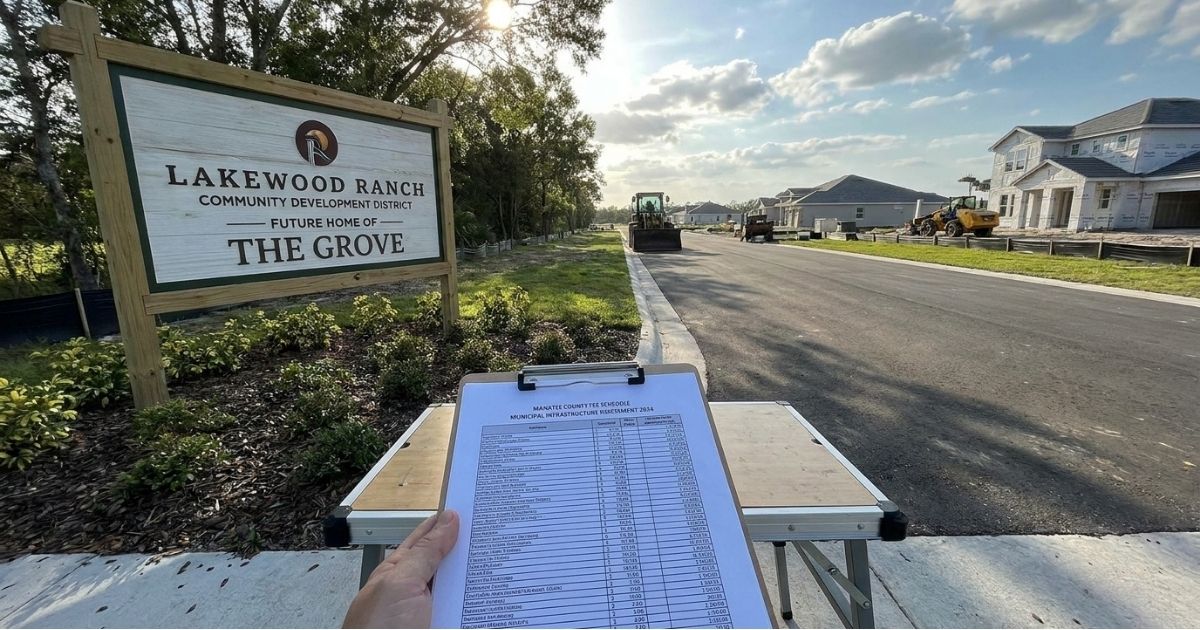
If you’re buying land or a home in a planned Florida community, there’s a good chance a charge called a “CDD fee” is going to show up on your tax bill — and most buyers don’t find out until after closing. The visible problem is an unexpected line item. The real problem is negotiating a price without knowing that the parcel carries a share of infrastructure debt that can take fifteen, twenty, or even thirty years to pay off.
Most people assume the cost of owning property in Florida comes down to property taxes and, in some cases, an HOA fee. In practice, many planned communities — especially newer ones with roads, water systems, drainage, and amenities built from scratch — carry a third, recurring charge tied directly to the parcel, one that can meaningfully change the real annual cost of ownership.
Table of Contents
- What a CDD fee actually is
- Why the CDD fee shows up on your tax bill
- CDD fee vs. HOA fee: what’s the difference
- How to find out if a parcel has a CDD before you buy
- Can you pay off a CDD fee early?
- Comparison: CDD fee vs. HOA fee
- Common mistakes buyers make about CDD fees
- Hidden costs tied to CDD fees
- FAQ — Frequently Asked Questions
- 📚 Glossary
- ✅ Immediate Actions — Start Now
What a CDD fee actually is {#what-is-cdd}
Short answer: CDD stands for Community Development District — a special local government district created to finance a community's infrastructure, such as roads, water and sewer systems, drainage, and amenities. That infrastructure is paid for through bonds, and the cost is passed on to individual property owners as a recurring annual charge known as the CDD fee.
When a developer builds out a large planned community in Florida — a master-planned neighborhood, a land subdivision, or a community with a clubhouse and pool — the core infrastructure has to be built before any homes can go up. Rather than folding that entire cost into the sale price, many developers set up a CDD, issue bonds to finance the construction, and pass that debt on to future property owners in smaller, recurring installments.
That means when you buy a parcel in a community with an active CDD, you’re effectively taking on a share of the debt used to build that community’s infrastructure — even if the work was finished years before you bought the property.
Why the CDD fee shows up on your tax bill {#why-on-tax-bill}
Short answer: a CDD fee isn't a traditional municipal tax — it's billed as a "non-ad valorem assessment," a fixed charge tied to the parcel, included on the same annual bill the county tax collector sends out alongside your regular property tax.
This trips up a lot of buyers, especially those buying from out of state or abroad, because a Florida tax bill combines two very different types of charges: property tax, which is calculated from the assessed value of the property, and fixed assessments like the CDD fee, which have nothing to do with market value and everything to do with the share of infrastructure debt assigned to that specific parcel.
Because both charges land on the same document with the same due date, it’s common for a buyer to only notice the CDD fee when the total bill is higher than what they expected to pay for property tax alone.
CDD fee vs. HOA fee: what’s the difference {#cdd-vs-hoa}
Short answer: a CDD fee is a public charge, tied to local government, used to repay the debt from a community's original infrastructure — and it usually has a defined end date. An HOA fee is a private charge, managed by the homeowners association, used for ongoing maintenance of common areas, and it has no expiration date.
Many buyers treat CDD and HOA fees as interchangeable, but they differ in origin, purpose, and duration. A CDD fee typically has two components: the “debt service” portion, which repays the bonds issued to build the original infrastructure and runs for a set term, and the “operations and maintenance” (O&M) portion, which covers upkeep of specific district assets and can continue indefinitely.
An HOA fee, by contrast, exists to cover the community’s operating expenses — landscaping of common areas, security, clubhouse and pool maintenance — and is set by the homeowners association’s own rules, not by county government.
How to find out if a parcel has a CDD before you buy {#how-to-verify}
Short answer: before signing any contract, check the county property appraiser's and tax collector's websites for the parcel, and ask the seller or developer for the CDD disclosure statement — a document Florida law requires be given to buyers before closing.
Florida Statute 190.048 requires the seller to provide a written disclosure stating that the property is subject to a CDD assessment, including an estimate of the annual amount. Even so, that document can easily get lost among the rest of the closing paperwork — it’s worth asking about directly rather than assuming it will be pointed out to you.
Another practical step is to pull up the most recent tax bill for the parcel (or a comparable lot in the same community) on the county tax collector’s website. If a CDD is active, it will appear as a separate line item, usually identified by the name of the development district.
Can you pay off a CDD fee early? {#prepayment}
Short answer: in many cases, yes. The "debt service" portion of a CDD fee can often be paid off early (prepayment), eliminating that specific charge from the annual bill going forward — but the "operations and maintenance" (O&M) portion typically continues for as long as the district remains active.
The prepayment amount is usually published by the development district itself and reflects the remaining balance of debt assigned to that particular parcel. Some buyers choose to negotiate this prepayment as part of the transaction, especially when they plan to own the property long term and want to lower the recurring cost on their tax bill.
It’s worth remembering that paying off the debt service portion doesn’t eliminate the CDD fee entirely — the O&M charge tends to remain in place, though it’s typically much smaller than the original combined total.
Comparison: CDD fee vs. HOA fee {#comparison-table}
| Feature | CDD fee | HOA fee |
|---|---|---|
| Nature of the charge | Public assessment tied to local government | Private fee set by the homeowners association |
| Purpose | Repay original infrastructure debt (roads, water, drainage) and maintain specific district assets | Ongoing maintenance of common areas, security, and amenities |
| Where it's billed | On the annual county tax bill | Billed directly by the association, outside the tax bill |
| Duration | The debt service portion has a set term (can span decades, but ends) | Ongoing, with no end date |
| Can it be paid off early? | Yes — the debt service portion can often be prepaid in full | No — it's a recurring maintenance fee |
Common mistakes buyers make about CDD fees {#common-mistakes}
Assuming a CDD fee is the same thing as an HOA fee
Since both charges can exist in the same community, buyers often add up the wrong numbers or assume they’re paying twice for the same service. They’re separate charges with different origins and purposes.
Not asking about the CDD before making an offer
Because a CDD fee is a recurring charge tied to the parcel, it directly affects the real cost of owning that property — and should factor into any comparison between properties, right alongside property tax and HOA fees.
Assuming a CDD fee is temporary and will “go away on its own”
The operations and maintenance (O&M) portion of a CDD fee can continue indefinitely, even after the original infrastructure debt is fully repaid. Assuming the charge will simply disappear over time, without confirming it, is a common and costly mistake.
Skipping the CDD disclosure statement at closing
Because it’s just one signature among many closing documents, the CDD disclosure statement sometimes gets signed without much attention. It’s worth setting aside a few minutes to actually read it — ideally with a real estate attorney.
Hidden costs tied to CDD fees {#hidden-costs}
- A recurring annual charge stacked on top of property tax — can add hundreds or thousands of dollars per year, depending on the scale of infrastructure financed
- Rising CDD fees in later phases of a development — communities built in phases can issue new bonds for future phases, changing the total district assessment over time
- A prepayment balance higher than expected — the remaining debt service balance can be larger than buyers anticipate, especially on parcels in newer developments
- The O&M charge outlasting the original debt — the maintenance portion can keep billing indefinitely, even after the infrastructure debt is fully paid off
- Impact on resale — future buyers will also factor the CDD fee into their evaluation of total ownership cost, which can affect how quickly — and for how much — the property sells later
FAQ — Frequently Asked Questions {#faq}
Does every parcel in Florida have a CDD fee?
No. A CDD fee only exists in developments where a Community Development District was formally created to finance infrastructure. Parcels outside those districts don’t carry this charge.
Is a CDD fee the same as property tax?
No. Property tax (ad valorem) is calculated based on the assessed value of the property. A CDD fee is a fixed charge (non-ad valorem), tied to the parcel’s share of infrastructure debt, and it appears as a separate line on the same bill.
Can you buy land in Florida and avoid CDD fees altogether?
Yes, by choosing parcels located outside community development districts. Many older lots, or properties outside newer planned communities, don’t carry a CDD fee — though they also may not come with the same ready-built infrastructure.
Does TerraNoble help identify whether a parcel has a CDD before purchase?
Yes. TerraNoble offers bilingual support, in English and Portuguese, to help buyers verify CDD assessments, tax bills, and disclosure documents before making a purchase decision.
📚 Glossary {#glossary}
CDD (Community Development District): a special district created to finance a community's infrastructure, with the cost passed on to property owners through a recurring annual fee.
Non-ad valorem assessment: a fixed charge tied to a parcel that isn't calculated from the property's market value, as is the case with the CDD fee.
Debt service: the portion of a CDD fee used to repay the bonds issued to finance a development's original infrastructure.
O&M (Operations and Maintenance): the portion of a CDD fee that covers ongoing maintenance of specific district assets, which can continue even after the debt is paid off.
Prepayment: paying off the remaining debt service balance of a CDD in full, which removes that specific charge from the annual bill going forward.
CDD disclosure statement: a document required under Florida law that informs the buyer of a CDD fee's existence and estimated amount before closing.
✅ Immediate Actions — Start Now {#immediate-actions}
- Ask the seller or developer directly whether the parcel is located inside a Community Development District.
- Request the CDD disclosure statement before signing any contract.
- Check the parcel's most recent tax bill on the county tax collector's website to spot a CDD line item, if one exists.
- Ask separately about HOA fees, so you don't confuse the two charges.
- Ask the development district for the current debt service payoff balance if you're considering a prepayment.
- Talk to TerraNoble to understand every recurring cost tied to a Florida parcel before you make an offer.
Conclusion
A CDD fee isn’t, by itself, a reason to walk away from a Florida parcel — plenty of well-planned communities with quality infrastructure finance that work exactly this way. The problem isn’t the charge itself; it’s finding out about it too late, after you’ve already negotiated a price based on an incomplete picture of the annual cost.
Before signing anything, confirm whether the parcel sits inside a development district, ask for the disclosure statement, and understand the difference between the debt service portion and the maintenance portion of the fee. That’s one of the details that separates a well-informed purchase from an unpleasant surprise on your first tax bill.
TerraNoble offers bilingual support — in English and Portuguese — to help you review these costs before you decide. Get in touch with our team to understand exactly what makes up the annual cost of any parcel you’re considering in Florida.