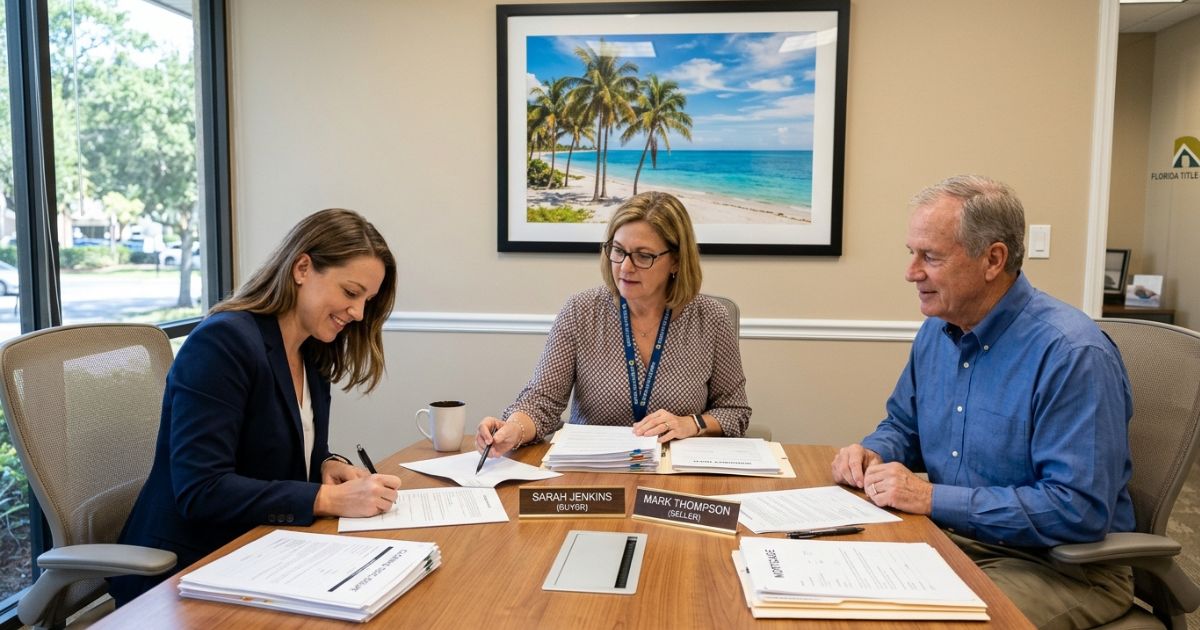
The closing is the final step in a Florida real estate transaction — the moment when all documents are signed, funds are transferred, and the deed officially changes hands to the new owner.
You’ve found the right property. The offer was accepted, the inspection is done, and everyone keeps telling you the closing is just a formality. Then, three days before the scheduled date, the title company sends over a Closing Disclosure — and the numbers don’t match what you expected.
There’s the homeowner’s insurance premium you paid upfront. A flood insurance deposit you didn’t know was required. HOA transfer fees. A property tax proration that’s being charged to you, not the seller. A wire transfer fee. By the time you add it all up, you need several thousand dollars more than you had planned for.
This scenario plays out constantly in Florida closings — not because buyers were misled, but because no one explained how the closing actually works before they got there.
Understanding the Florida real estate closing process before you reach the table changes the entire experience. This guide walks you through every step.
Table of Contents
- What is a real estate closing in Florida?
- Who is at the closing table in Florida?
- What documents do you sign at closing?
- How does the Florida closing process work step by step?
- How long does closing take in Florida?
- What are typical closing costs for buyers in Florida?
- Can foreign buyers close remotely in Florida?
- Common closing mistakes that cost buyers money
- Hidden closing costs most buyers don’t see coming
- 📚 Glossary
- ✅ Immediate Actions
- FAQ
What is a real estate closing in Florida? {#what-is}
Short answer: a real estate closing — also called a settlement — is the final meeting in a property transaction where all legal documents are signed, the purchase funds are transferred, and ownership officially moves from the seller to the buyer. In Florida, the process is coordinated by a title company, which acts as the neutral third party managing both the paperwork and the funds.
In many countries, the final step of a property purchase happens at a government registry or notary office. In Florida, it happens at the title company’s office — or, increasingly, entirely online. The title company handles everything from verifying that the seller actually owns what they’re selling (the title search) to distributing funds to every party owed money on closing day.
The closing finalizes a process that begins when your Purchase and Sale Agreement is signed. Between contract and closing — the due diligence period — you complete inspections, secure financing if needed, review the title search results, and verify the property’s condition and legal status. Closing day is where all of that work comes to its conclusion.
One thing new buyers often misunderstand: signing at the closing table is not what makes you the legal owner. What makes you the legal owner is the deed being recorded in the county’s public records — which usually happens within a few days after closing.
Who is at the closing table in Florida? {#who-is-there}
Short answer: the required participants are the buyer and a representative from the title company. The seller often signs their documents in advance and may not be present. Real estate agents, lenders, and attorneys may attend but are not legally required.
| Participant | Role at Closing | Required to Attend? |
|---|---|---|
| Buyer | Signs all purchase and loan documents; transfers funds | Yes (or by Power of Attorney) |
| Seller | Signs the deed and transfer documents | Often signs in advance — may not attend |
| Closing agent (title company) | Coordinates the entire process; manages escrow funds and document recording | Yes |
| Real estate agents (buyer's and seller's) | Advocate for their respective clients; verify commission details | No — but typically attend |
| Lender representative | Present when a mortgage is involved to oversee loan document signing | Only in financed transactions |
| Real estate attorney | Reviews documents and provides legal guidance | No — but recommended for foreign buyers |
For foreign buyers purchasing Florida real estate, having a real estate attorney present — or at least involved in document review before closing day — is strongly recommended. The combination of FIRPTA implications, ownership structure decisions, and the volume of legal documents signed at closing creates meaningful risk for buyers who arrive without independent legal counsel.
What documents do you sign at closing? {#documents}
Short answer: buyers typically sign the Closing Disclosure (the itemized cost statement), the deed (for cash purchases), loan documents (if financing), title insurance acknowledgments, and various affidavits. In a financed transaction, the document package can exceed 100 pages.
The core documents at a standard Florida closing:
- Closing Disclosure — the official itemized statement of every cost and credit in the transaction, for both buyer and seller. You are legally entitled to receive this at least three business days before closing. Read it carefully and flag anything that doesn’t match the original Loan Estimate or your expectations
- Warranty Deed — the document that transfers legal ownership of the property from seller to buyer. It is signed by the seller, notarized, and submitted to the county recorder for official registration after closing
- Owner’s Title Insurance policy — protects you against defects in the property’s title history that weren’t caught during the title search. Often paid by the seller in Florida by convention, but always confirm this in your purchase contract
- Lender’s Title Insurance policy — protects the mortgage lender; separate from the owner’s policy and required in virtually all financed transactions
- Promissory note and mortgage — in financed purchases, the note is your personal commitment to repay the loan; the mortgage gives the lender a security interest in the property as collateral
- FIRPTA-related documents — if you are buying from a foreign seller, you (as the buyer) may be required to sign FIRPTA acknowledgment documents confirming your obligation to withhold and remit funds to the IRS
- Seller’s affidavit of title — the seller’s sworn declaration that no new liens, judgments, or tenancy arrangements have arisen since the contract was signed
How does the Florida closing process work step by step? {#step-by-step}
Short answer: the process moves from contract acceptance through due diligence, title search, and financing — culminating in the closing meeting where funds are transferred, documents are signed, and the deed is submitted for county recording. The deed's recording date is the legal ownership date.
Here is the full sequence from contract to keys:
- Execute the Purchase and Sale Agreement — both parties sign the contract; the buyer deposits earnest money into escrow, typically within 3 business days
- Complete due diligence — the buyer arranges inspections, reviews HOA documents (if applicable), and evaluates the property’s condition during the inspection period specified in the contract
- Order the title search — the title company searches the county’s public records for liens, judgments, unpaid taxes, easements, and ownership history going back decades; any issues discovered must be cleared before closing
- Secure financing — if financing the purchase, the lender orders an appraisal, underwrites the loan, and issues a Commitment Letter confirming the loan is approved
- Receive and review the Closing Disclosure — you receive this at least three business days before closing; this is your last clear opportunity to identify and question any unexpected costs
- Wire transfer the closing funds — the balance due at closing (down payment plus closing costs, minus your earnest money credit) must be wired to the title company’s escrow account before closing, typically 1 to 2 business days in advance
- Sign documents at closing — at the scheduled closing meeting, you sign all documents with the closing agent; the seller’s documents may already be signed
- Title company distributes funds — once all documents are executed and funds confirmed, the title company pays the seller, pays off any existing mortgage, disburses real estate commissions, and retains its closing fees
- Deed is recorded at the county — the title company submits the deed to the county recorder; once recorded, your name appears in the official public property records as the legal owner
The moment you receive keys does not always equal the moment you become the legal owner. In Florida, legal ownership transfers at deed recording — not at document signing. The recording typically happens within a few days after closing. Confirm with your title company when recording is completed.
How long does closing take in Florida? {#timeline}
Short answer: the closing meeting itself lasts 30 to 90 minutes depending on whether a mortgage is involved. The time between a signed contract and the closing date is typically 30 to 45 days for financed purchases and can be as short as 7 to 14 days for all-cash transactions.
| Purchase Type | Contract-to-Close Timeline | Meeting Duration |
|---|---|---|
| All-cash purchase | 7 to 21 days (negotiable) | 30 to 45 minutes |
| Conventional mortgage | 30 to 45 days | 60 to 90 minutes |
| FHA or VA loan | 45 to 60 days | 60 to 90 minutes |
| Remote closing (RON) | Same as above, by transaction type | Variable — platform-dependent |
Delays are common and not always the buyer’s fault. Lender underwriting, title issues requiring clearance, insurance requirements in high-risk flood zones, and HOA document review processes can all push the closing date back. Build flexibility into your plans — especially when coordinating international wire transfers, which can take several business days to clear.
What are typical closing costs for buyers in Florida? {#closing-costs}
Short answer: Florida buyers typically pay 2% to 5% of the purchase price in closing costs, in addition to the down payment. These costs include title insurance, lender fees (if financing), prepaid insurance and taxes, HOA fees, and documentary stamp taxes on the mortgage. The Closing Disclosure itemizes every charge.
| Cost | Who Typically Pays (FL Convention) | Estimated Amount |
|---|---|---|
| Owner's title insurance | Seller (by Florida convention) | 0.5%–1% of purchase price |
| Lender's title insurance | Buyer (if financing) | 0.4%–0.8% of loan amount |
| Title company closing fee | Buyer and/or seller (negotiable) | $500–$1,500 |
| Doc stamps on deed | Seller (by Florida convention) | 0.7% of purchase price |
| Doc stamps on mortgage | Buyer (if financing) | 0.35% of loan amount |
| Recording fees | Buyer | $10–$100 |
| Homeowner's insurance (prepaid) | Buyer | Full first year paid at closing |
| Property tax proration | Seller pays the portion due through closing day | Depends on closing date |
| Loan origination fee | Buyer (if financing) | 0.5%–1% of loan amount |
| Appraisal fee | Buyer (usually paid before closing) | $350–$600 |
Important clarification: Florida’s cost conventions are not law — they’re customs. The allocation of closing costs between buyer and seller is determined by your Purchase and Sale Agreement. In a competitive market, buyers sometimes agree to absorb seller-side costs. In slower markets, sellers may offer to cover additional buyer costs to close the deal. Know what your contract says before you assume who pays what.
Can foreign buyers close remotely in Florida? {#remote-closing}
Short answer: yes. Florida authorizes Remote Online Notarization (RON), allowing all closing documents to be signed digitally via secure video conference with a licensed Florida notary — from anywhere in the world. Alternatively, a properly prepared Power of Attorney allows a trusted representative to sign in person on the buyer's behalf.
Florida was one of the first states to adopt RON legislation, and the process is now well-established among Florida title companies. Through a RON closing, you:
- Connect via video conference with a licensed Florida notary
- Verify your identity electronically using government-issued ID
- Review and sign documents digitally in real time
- Receive a complete set of recorded closing documents after completion
For international buyers who cannot travel to Florida for closing — or who simply prefer to complete the transaction from home — RON has effectively eliminated the logistical barrier of in-person attendance.
The alternative, a Power of Attorney (POA), designates someone you trust to sign all closing documents on your behalf. The POA document itself must be drafted by a licensed Florida real estate attorney, notarized, and in most cases apostilled for international use. Some title companies require POA documents to be reviewed and approved in advance — coordinate this well before closing day.
Common closing mistakes that cost buyers money {#mistakes}
-
Not reviewing the Closing Disclosure until closing day: you have the legal right to receive this document at least three business days before closing. Use that time to compare every line against your original Loan Estimate and purchase contract. Questions that arise two days before closing are far easier to resolve than ones that surface at the table
-
Sending the wire transfer without verifying bank details by phone: wire fraud targeting real estate transactions is one of the most common financial crimes in the US. Criminals intercept email communications and substitute fraudulent wire instructions that look legitimate. Always call the title company directly — using a phone number you find independently, not from the email — to verbally confirm wire instructions before sending any funds
-
Underestimating the time for international wire transfers: transfers from banks outside the US typically take 2 to 5 business days to clear. Starting the process on the day before closing frequently causes delays. Wire funds at least 3 to 5 business days early
-
Arriving at closing without having read the documents: you will be asked to sign dozens of pages. Asking the closing agent to explain every document in detail during the meeting is not practical — and it won’t be well-received. Review the Closing Disclosure and ask your real estate agent or attorney about anything unclear before you arrive
-
Not confirming who pays which closing costs: the allocation in your Purchase and Sale Agreement governs who pays what. Assuming Florida’s conventional allocations apply without verifying your contract is a common and costly mistake
-
Closing without an owner’s title insurance policy: the lender’s title insurance policy protects the bank — not you. If a title defect surfaces after closing, your lender’s policy offers you no protection. The owner’s policy is your protection. In Florida, it’s typically paid by the seller, but confirm this in writing
-
Choosing ownership structure at the last minute: whether to hold Florida real estate in your personal name, an LLC, or a trust has significant implications for liability, estate tax (especially for foreign buyers), and future FIRPTA withholding when you sell. This decision should be made well before the closing date — changing it afterward involves additional costs, title transfers, and potentially tax consequences
Hidden closing costs most buyers don’t see coming {#hidden-costs}
| Cost | When It Appears | Typical Amount |
|---|---|---|
| Homeowner's insurance premium (full year prepaid) | At closing | $1,500–$8,000+ depending on location and coverage |
| Flood insurance premium (if required) | At closing (lenders require proof before funding) | $500–$4,000/year depending on flood zone |
| Escrow reserves (taxes and insurance) | At closing — in financed transactions | 2–3 months of property taxes + insurance |
| HOA capital contribution | At closing — in HOA communities | $200–$3,000+ depending on the association |
| HOA transfer and processing fees | At closing | $100–$500 |
| International wire transfer fees | Before closing | $25–$75 per transfer (both sending and receiving banks may charge) |
| Title search re-run (if closing is delayed) | If closing is postponed 30–60+ days after title search | $100–$250 |
| Deed correction costs | If name or legal description errors are found post-recording | $200–$500 (scrivener's affidavit) |
📚 Glossary {#glossary}
Closing — the final meeting in a real estate transaction where documents are signed, funds are transferred, and ownership passes from seller to buyer. In Florida, coordinated by a title company.
Closing Disclosure — the official itemized settlement statement showing every cost and credit for both buyer and seller. Lenders are required to provide this at least three business days before closing in financed transactions.
Closing costs — all fees and expenses associated with completing a real estate transaction, beyond the purchase price itself. For Florida buyers, typically 2%–5% of the purchase price.
Title company — the licensed Florida company that manages the closing process: conducting the title search, issuing title insurance, holding funds in escrow, preparing closing documents, and recording the deed with the county.
Title search — a review of the county’s public property records to verify ownership history and identify any liens, judgments, easements, unpaid taxes, or other encumbrances attached to the property.
Title insurance — a policy protecting against financial loss from title defects not discovered in the title search. The owner’s policy protects the buyer; the lender’s policy protects the mortgage lender. In Florida, by convention, the seller typically pays for the owner’s policy.
Deed (Warranty Deed) — the legal document that transfers ownership of real property from seller to buyer. In Florida, most residential transactions use a Warranty Deed, in which the seller guarantees clear title. The deed is signed at closing and recorded at the county courthouse.
Recording — the act of submitting the signed deed to the county recorder (or Clerk of Courts), which creates the official public record of ownership. Legal title transfers at recording, not at the closing meeting itself.
Escrow — a neutral account, managed by the title company, that holds funds during the transaction. The buyer’s earnest money and closing funds are held in escrow until all conditions are met and documents are signed.
Earnest money — a good-faith deposit made by the buyer when signing the Purchase and Sale Agreement, typically 1%–3% of the purchase price. Held in escrow and credited toward the buyer’s closing costs at settlement.
Doc stamps (Documentary Stamp Tax) — a Florida state tax on the transfer of real property. The deed doc stamp is 0.7% of the sale price; the mortgage doc stamp (on the mortgage note) is 0.35% of the loan amount. Miami-Dade County also charges an additional 0.45% surtax on deeds.
Wire transfer — the standard method for sending closing funds to the title company’s escrow account. International wires typically take 2–5 business days. Always verify wire instructions by phone before transferring any funds.
RON (Remote Online Notarization) — Florida’s legal framework for conducting closings entirely online via video conference with a licensed notary, without requiring physical presence. Documents are signed and notarized digitally.
Power of Attorney (POA) — a legal document authorizing a designated person to sign closing documents on the buyer’s behalf. For international buyers, must be drafted by a Florida attorney, notarized, and typically apostilled for use abroad.
FIRPTA — the Foreign Investment in Real Property Tax Act; a federal rule requiring the buyer to withhold up to 15% of the gross sale price when purchasing US real estate from a nonresident alien seller and remit those funds to the IRS.
HOA (Homeowners Association) — a governing body in planned communities and condominiums that sets rules and collects fees. HOA transfer fees, capital contributions, and past-due assessments may appear on the Closing Disclosure.
✅ Immediate Actions — Start Now {#actions}
- Request the Closing Disclosure at least three business days before your scheduled closing date — not the day before — and review every line against your original Loan Estimate and purchase contract
- Call the title company directly (using contact information you verify independently) to confirm wire transfer instructions before sending any funds — never rely solely on instructions received by email
- Initiate your international wire transfer at least 3 to 5 business days before the closing date — international transfers routinely take longer than domestic ones, and a late wire means a delayed closing
- Decide on your ownership structure — personal name, LLC, or trust — before the closing date. Changing the structure afterward involves additional costs, tax filings, and deed re-recording
- If you are purchasing from a foreign seller, verify with the title company whether FIRPTA applies and confirm that IRS Forms 8288 and 8288-A will be filed within 20 days of closing — the legal responsibility for withholding falls on you as the buyer
- Confirm in writing with the title company which closing costs are assigned to the buyer vs. the seller in your specific contract — don’t assume Florida conventions apply automatically
- Make sure your homeowner’s insurance policy is bound (active) before the closing date — lenders require proof of coverage, and some Florida insurers need extra time in hurricane-prone areas or high flood-risk zones
- After closing, request written confirmation from the title company of the date your deed was recorded at the county — then verify your name appears correctly in the county’s public property records
- Contact TerraNoble for bilingual guidance on the Florida closing process — in English or Portuguese, we help buyers understand every step before they reach the table
Conclusion
The Florida real estate closing is not a formality — it is the most document-intensive, fund-intensive, and legally consequential moment in the entire transaction. Most of what can go wrong at a closing doesn’t originate at the closing table: it comes from decisions made — or not made — in the weeks before.
Buyers who review their Closing Disclosure three days in advance, confirm wire instructions by phone, have their ownership structure decided, and understand what they’re signing tend to close in under an hour without stress. Buyers who arrive without that preparation tend to sign things they don’t understand, get surprised by costs they didn’t expect, and sometimes walk away with questions they should have asked before they had keys.
Florida’s market attracts buyers from across the United States and around the world, and the closing process here is designed to be efficient and transparent when participants know how it works. For international buyers especially, the combination of remote closing options, clear title insurance protections, and a well-established legal framework makes Florida one of the more buyer-friendly states to transact in — once you understand the rules.
TerraNoble works with buyers throughout the Florida real estate process and offers bilingual support in English and Portuguese. If you want to understand how the closing process fits into your specific transaction — whether you’re buying land, a home, or an investment property — reach out for a no-pressure conversation.