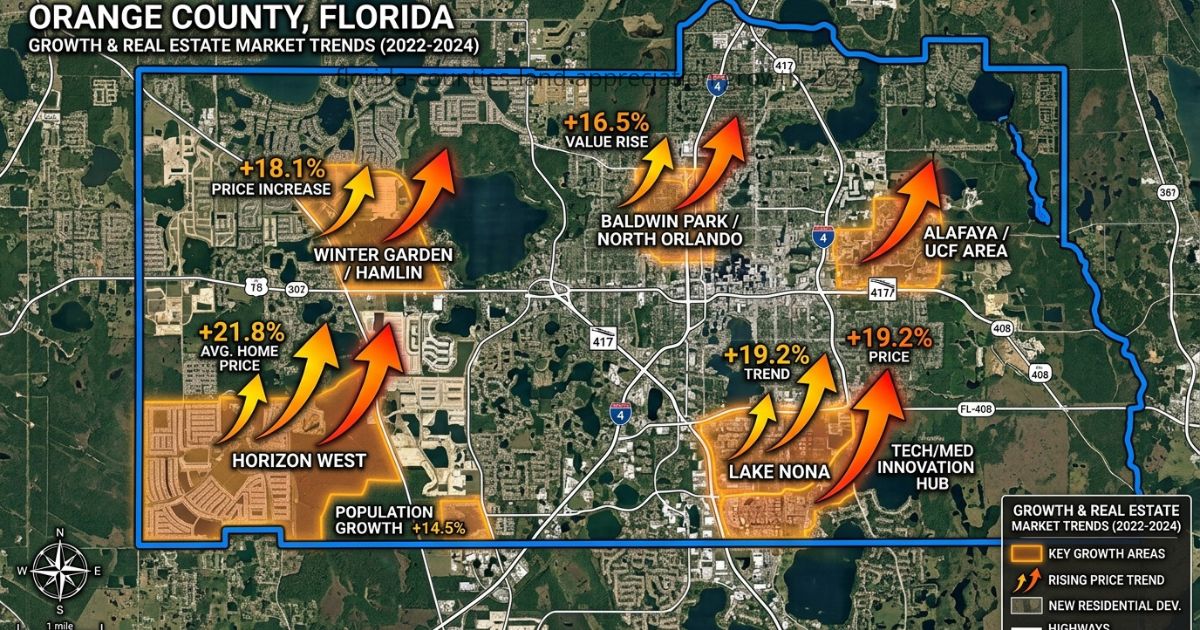
Counties like Nassau, St. Johns, and Osceola are leading Florida's land appreciation surge in 2026, driven by population inflows, infrastructure investment, and internal migration away from high-cost metro areas.
You find a vacant lot in Florida at a price that seems fair. Two years later, you learn that a comparable parcel in the county directly north sold for nearly triple what you paid. The price wasn’t the problem. The county was.
Florida has 67 counties. They do not behave as a single market. Some are in the middle of a growth cycle — absorbing new residents, expanding infrastructure, and generating real demand for buildable land. Others are still waiting for that wave to arrive.
Most buyers focus on price-per-acre. The investors who consistently identify value focus on something different: which county is at the right point in the appreciation curve — and why.
Table of Contents
- Why Florida land appreciation varies so much by county
- The counties leading appreciation in 2026
- What drives growth in each region
- County comparison table
- Mistakes that cost buyers the appreciation they’re looking for
- Hidden costs that affect real returns on vacant land
- 📚 Glossary
- ✅ Immediate Actions
- FAQ
Why Florida land appreciation varies so much by county {#why-it-varies}
Short answer: land appreciation in Florida is driven by three primary variables — population growth in the county, new infrastructure investment, and proximity to expanding employment centers. These factors differ significantly across the state's 67 counties.
Florida’s population surpassed 23 million in 2025, and the state remains one of the most active destinations for domestic migration in the country. But that growth is not evenly distributed.
Counties within or adjacent to the major metros — Miami-Dade, Broward, Pinellas, Orange — already moved through the steepest part of their appreciation curves. Prices are high, available lots are scarce, and entry costs have risen substantially.
The sharpest appreciation in 2026 is happening in growth corridor counties — regions absorbing the overflow of residents priced out of established markets, or positioned along infrastructure lines that are only now being built.
What actually determines the value of a vacant lot?
Vacant land is appraised differently from improved properties. The primary factors are:
- Zoning classification: what the county permits you to build on the parcel
- Utility access: availability of water, sewer, and electrical connections
- Distance to employment centers and services
- County population growth rate: more residents means more demand for buildable lots
- Infrastructure in development: roads, schools, hospitals, and utilities that haven’t arrived yet
When these factors align in a county, vacant land prices tend to respond before the improved-property market does — because buyers of raw land are pricing in what’s coming.
The counties leading appreciation in 2026 {#leading-counties}
Short answer: the Florida counties showing the strongest land appreciation dynamics in 2026 are Nassau, St. Johns, Flagler, Osceola, Polk, Manatee, and Charlotte — each driven by distinct regional growth forces.
Nassau County — North Florida’s Jacksonville corridor
Nassau County has become one of the most active land markets in north Florida. Positioned between Jacksonville and the Georgia state line, the county combines accessibility, natural character, and accelerating residential growth.
Its population grew by more than 35% over the past decade. Communities like Fernandina Beach and Yulee draw families seeking quality of life outside Jacksonville’s urban core, with fast I-95 access. Lot absorption in Nassau remains strong heading into the second half of 2026.
St. Johns County — Premium growth south of Jacksonville
St. Johns County ranks consistently among the fastest-growing counties in the United States. Its public school quality is the primary driver of family migration — the county records some of the highest educational performance scores in Florida.
Ponte Vedra, St. Augustine, and Nocatee concentrate high demand for residential land. Prices per acre in the most developed corridors have risen significantly, but less-dense areas of the county still offer entry points for buyers who know where to look.
Flagler County — The stretch between Daytona and Jacksonville
Flagler holds a strategic position along Florida’s northeast coastal corridor. Palm Coast, its largest city, is one of the most closely watched growth destinations for land investors in the state.
The county offers something increasingly rare in Florida: still-accessible land prices relative to the southern coast, I-95 connectivity, and population growth showing no signs of slowing. That combination has attracted sustained investor attention through 2025 and into 2026.
Osceola County — Orlando’s southern expansion
Osceola County sits directly south of the Orlando metropolitan area and absorbs a significant share of that region’s growth. The county is in active transformation: new road extensions, healthcare system expansion, and logistics projects are generating demand for both commercial and residential land.
The Kissimmee corridor and the St. Cloud area are benchmarks for buyers tracking the SR-417 and SR-528 expansion zones.
Polk County — The I-4 industrial corridor
Polk County anchors the industrial and logistics corridor connecting Tampa to Orlando. The growing presence of distribution centers, food processing operations, and light manufacturing creates consistent demand for commercial-zoned land and residential lots for workforce housing.
Lakeland anchors the market, but smaller municipalities — Haines City, Davenport, Dundee — are where the most significant movement in residential land for new construction is occurring.
Manatee County — Sarasota’s northern extension
Manatee County benefits from the prestige of the Sarasota market to its south and the Tampa Bay expansion to its north. Bradenton and Palmetto are seeing intense residential development activity, and coastal proximity consistently supports land values across the county’s western reaches.
Charlotte County — Southwest Florida’s emerging market
Charlotte County, anchored by Punta Gorda, presents a rare combination: still-accessible land prices, strengthening infrastructure, and a demographic profile that supports sustained appreciation. The county is actively absorbing buyers priced out of Lee and Collier County markets to the south.
What drives growth in each region {#growth-drivers}
Short answer: population migration, job creation, infrastructure expansion, and perceived quality of life are the four pillars that determine which Florida counties appreciate fastest — and at which point each one sits in the cycle.
There’s a recurring pattern in the counties that consistently record the strongest land appreciation:
- Internal migration: residents leaving higher-cost counties (Miami-Dade, Broward, Pinellas, Orange) seeking more space and lower cost of living
- Job creation: logistics hubs, healthcare expansion, and university campuses anchor income in the county and attract families
- New infrastructure: road extensions, utility expansion, and sewer systems make previously undevelopable parcels into buildable lots
- Quality-of-life signals: public school scores, crime rates, and healthcare access are decisive factors for families relocating
When these four variables converge in a county, the land market responds before the built-property market — because land buyers are pricing in what the county will look like in five years, not what it looks like today.
County comparison table {#comparison-table}
| County | Region | Primary Growth Driver | Land Type With Highest Demand |
|---|---|---|---|
| Nassau | North Florida | Jacksonville metro expansion | Suburban residential |
| St. Johns | North Florida | School quality + family migration | Premium residential |
| Flagler | Northeast coast | Palm Coast growth + I-95 access | Residential and smaller lots |
| Osceola | Central (south of Orlando) | Orlando metro overflow | Mixed residential/commercial |
| Polk | Central (I-4 corridor) | Logistics and light industry | Commercial and residential |
| Manatee | Southwest | Tampa Bay expansion + coast | Coastal residential |
| Charlotte | Southwest | Migration from pricier markets | Residential and retirement |
Mistakes that cost buyers the appreciation they’re looking for {#mistakes}
Identifying the right county is step one. Many buyers arrive in the right market and still make decisions that undercut their returns.
Buying at the lowest price without checking zoning
A cheap lot in a growth county can be a genuine opportunity — or a parcel with use restrictions that prevent any residential construction. Reviewing the county zoning code before submitting any offer is not optional. It’s the first verification that should happen.
Underestimating the utility access gap
Lots without access to water, sewer, or electrical infrastructure require additional work that can cost between $15,000 and $60,000 or more, depending on distance to existing networks. That cost turns a “good deal” into an expensive project that erodes the return you were counting on.
Misjudging the holding period
Vacant land is a medium-to-long-term asset. Buyers who enter expecting quick liquidity frequently sell before capturing the appreciation they came for. The land market moves on a different timeline than the built-property market — realistic holding periods of three to seven years are common for meaningful appreciation.
Skipping the FEMA flood map check
Parcels in designated flood zones (AE or VE on FEMA maps) require mandatory flood insurance on any financed construction and can face significant development restrictions. Verifying flood zone classification before making any offer is a step that cannot be skipped regardless of how attractive the price looks.
Hidden costs that affect real returns on vacant land {#hidden-costs}
Beyond the purchase price, vacant land in Florida carries recurring costs that belong in any investor’s return calculation:
- Annual property tax: vacant lots generate tax liability even without a structure. Rates vary by county and the property appraiser’s assessed value
- Lot maintenance: vegetation clearing, erosion control, and periodic inspections
- Vacant land insurance: not required, but advisable for parcels with public access or road frontage
- Title and closing costs: title insurance, recording fees, and title company charges at acquisition
- HOA fees (if applicable): some subdivisions charge monthly or annual fees on unbuilt lots
Total annual carrying costs for a typical residential lot typically range from $500 to $3,000 depending on county, lot size, assessed value, and subdivision type. These figures need to be part of any honest return projection.
📚 Glossary {#glossary}
Vacant land — undeveloped property with no existing structure. Valued, taxed, and regulated differently from improved real estate.
Zoning — county or municipal regulations that specify permitted uses for a given parcel: residential, commercial, agricultural, industrial, or mixed use.
Flood zone — FEMA-designated area with mapped flood risk. Zones AE and VE require flood insurance on financed construction and impose development restrictions.
Title search — review of county public records to verify the complete chain of ownership, existing liens, encumbrances, unpaid taxes, and any legal claims against the property.
Property tax — annual tax assessed on the property’s appraised value. Each county sets its own millage rate; the county property appraiser determines the assessed value.
Holding period — the length of time a buyer holds an asset before selling. Vacant land typically requires three to seven years to capture meaningful appreciation.
Closing — the final step in a real estate transaction, where the deed transfers to the buyer, funds are disbursed, and all documents are executed.
HOA (Homeowners Association) — a community organization that enforces rules and collects fees, sometimes including fees on unbuilt lots within a subdivision.
Property appraiser — the county official responsible for assessing property values for tax purposes. Each of Florida’s 67 counties has its own property appraiser.
✅ Immediate Actions — Start Now {#actions}
- Check population growth data for your target county at the US Census Bureau (census.gov)
- Verify the flood zone classification of any parcel you’re evaluating at the FEMA Flood Map Service Center (msc.fema.gov)
- Review the county zoning code for any lot before making an offer — zoning maps are available on county government websites
- Confirm utility availability — water, sewer, and power — directly with the county or local utility provider
- Calculate annual carrying costs: property tax, maintenance, HOA, and insurance, before projecting returns
- Engage a local title company to review the property’s title history and confirm a clean chain of ownership
- Consider structuring the purchase through a Florida LLC if you plan to hold multiple parcels or want liability separation and estate planning flexibility
FAQ {#faq}
Can foreigners buy land in Florida?
Yes. Foreign nationals have the same right to purchase real property in Florida as US residents. No permanent visa, green card, or US tax residency is required to acquire land. Some buyers choose to structure the purchase through a US LLC for liability and estate planning purposes.
Which Florida county has the most accessible land prices right now?
Counties like Flagler, Charlotte, Hernando, and Pasco continue to offer residential land at lower entry prices relative to the major metro markets. Entry price alone shouldn’t drive the decision — zoning, utility access, and the county’s development trajectory all matter equally.
What is the difference between a flood zone lot and a non-flood-zone lot?
FEMA-designated flood zone parcels (AE or VE) carry higher development risk and mandatory flood insurance requirements on financed construction. Lots classified as Zone X (minimal flood hazard) face fewer restrictions and are generally easier to develop and finance. Flood zone status should be verified before any purchase decision.
Is a title company required when buying land in Florida?
No law mandates using a title company specifically, but the transaction process in Florida almost universally flows through one. Title companies conduct the title search, issue the title insurance policy, hold escrow funds, and coordinate the closing. Buyers who skip proper title protection take on legal and financial risk that can surface years after the transaction.
How long does it typically take to see appreciation on vacant land in Florida?
There is no guarantee of appreciation on any investment. That said, buyers who have successfully captured appreciation in growth corridor counties typically report holding periods of three to seven years. Entry timing, county selection, zoning, and proximity to infrastructure all affect how long a lot takes to increase in value.
Conclusion
Florida is not one market. It’s 67 different markets with distinct fundamentals, different growth cycles, and different moments in the appreciation curve.
The counties showing the strongest land market dynamics in 2026 — Nassau, St. Johns, Flagler, Osceola, Polk, Manatee, and Charlotte — share a common thread: they are in the path of growth, not past it. Population is still arriving. Infrastructure is still being built. Demand for buildable lots is ahead of supply.
Identifying the right county is necessary. So is understanding what’s on the parcel you’re looking at: its zoning, its flood zone status, its utility access, and its real annual carrying cost. That combination of market selection and individual parcel analysis is what separates a well-executed land purchase from a lot that sits idle.
No appreciation is guaranteed. But preparation and market knowledge change the odds significantly.
Ready to explore land opportunities in the right Florida counties? TerraNoble offers bilingual support — in English and Portuguese — for buyers at every stage of the process. Contact our team before making any purchase decision.