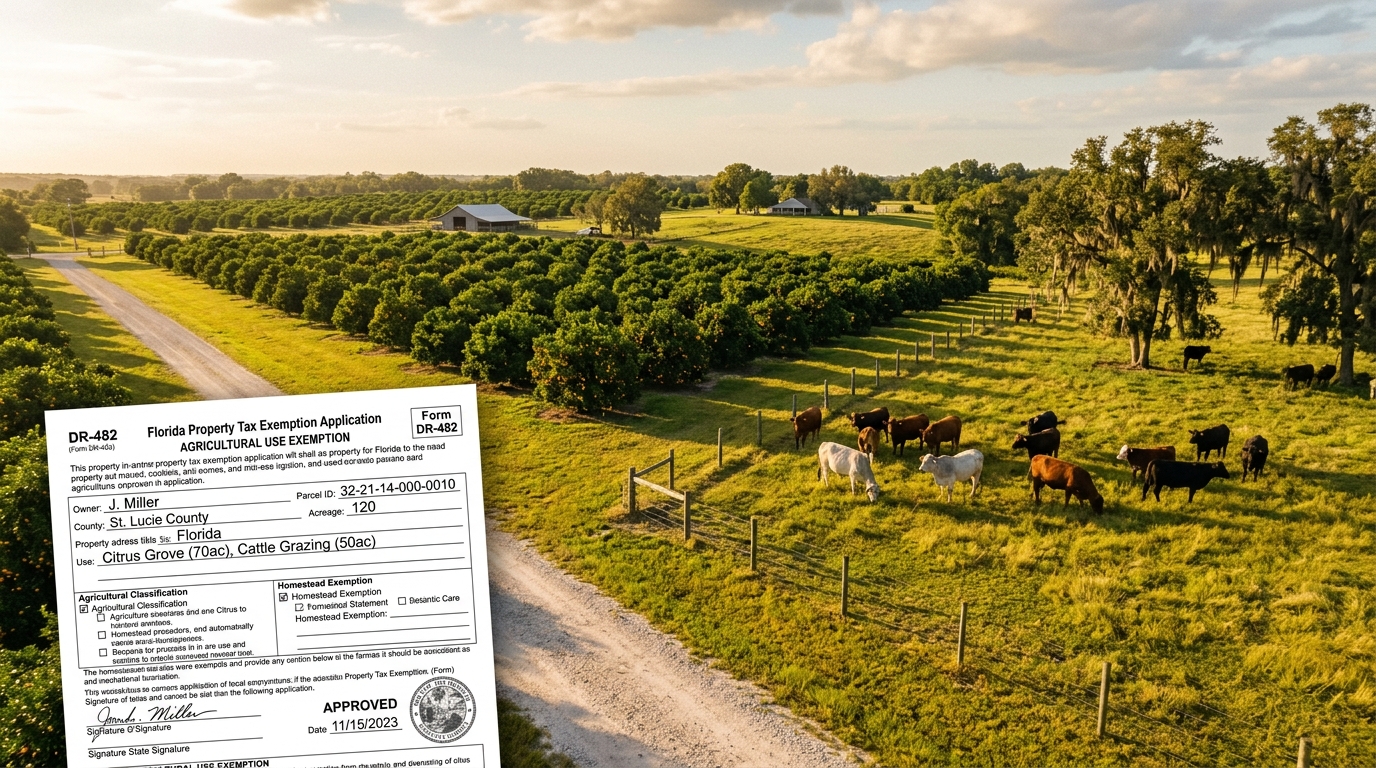
If you’re evaluating a piece of land in Florida with agricultural potential, the number that usually grabs your attention isn’t the purchase price — it’s the property tax bill that shows up afterward. The visible problem is that vacant land in growth areas can get taxed as if it were already primed for development. The real problem is that most buyers have never heard of the Greenbelt exemption, a tax benefit that can cut that bill by as much as 90% when the land carries a qualifying agricultural use.
Most people assume the property tax bill is driven entirely by the land’s market value. In practice, Florida taxes qualifying agricultural land on its use value — not on what it would fetch if sold for development — and that difference can mean thousands of dollars in savings every single year the agricultural use is maintained.
Table of Contents
- What the Greenbelt exemption is in Florida
- How the Agricultural Classification actually works
- Which parcels qualify for the exemption
- How to apply for agricultural classification
- How much you can actually save
- Comparison: land with vs. without Greenbelt classification
- Common mistakes that cost owners the benefit
- Hidden costs and risks of agricultural classification
- FAQ — Frequently Asked Questions
- 📚 Glossary
- ✅ Immediate Actions — Start Now
What the Greenbelt exemption is in Florida {#what-is-greenbelt}
Short answer: the Greenbelt exemption — officially known as the Agricultural Classification — is a tax benefit under Florida Statute 193.461 that lets land with a bona fide agricultural use be assessed at its agricultural use value rather than its market value ("highest and best use"), resulting in a significantly lower property tax bill.
In practice, this means two neighboring parcels of the same size and location can end up with completely different tax bills: one assessed on its potential resale value for residential development, and the other — with cattle, crops, or another qualifying agricultural activity — assessed at a much lower value set annually by Florida’s Department of Revenue based on agricultural use criteria.
The name “Greenbelt” comes from the law’s original purpose: preserving productive, open land around growing cities, so rural landowners aren’t forced to sell to developers before they’re ready simply because the tax bill outpaces what the land actually earns.
How the Agricultural Classification actually works {#how-it-works}
Short answer: the county property appraiser evaluates whether the land has a bona fide commercial agricultural use — not just decorative or occasional activity — and, if approved, applies a per-acre agricultural use value specific to that type of activity, well below the land's market value.
Every Florida county has its own property appraiser responsible for assessing real estate and applying tax classifications. For agricultural classification, the appraiser weighs factors like how long the land has been in agricultural use, the scale and commercial nature of the activity, whether there’s investment in agricultural infrastructure (fencing, irrigation, a cattle pen), and whether the activity generates income or at least demonstrates a genuine profit motive.
The final taxable value isn’t set by the owner or by local market conditions — it follows published “agricultural use value” tables that vary by activity type (cattle pasture, citrus, timber, and others) and by region of the state.
Which parcels qualify for the exemption {#which-parcels-qualify}
Short answer: in general, any land with a bona fide commercial agricultural use can qualify — including cattle grazing, row crops, groves, beekeeping, timber production, and even small-scale horticulture — as long as the use is ongoing, genuine, and not just an attempt to cut taxes without real activity.
There’s no universal minimum acreage set in state law, but each county can apply its own reasonableness standard — for example, questioning whether a very small parcel can credibly support the declared activity. A few acres in commercial beekeeping can qualify just as well as a large cattle pasture, as long as the activity is consistent with a genuine agricultural use.
Recently purchased land can also qualify, but property appraisers tend to look more closely at applications filed right after a sale, especially when the buyer has no prior history of agricultural activity in the area.
How to apply for agricultural classification {#how-to-apply}
Short answer: the application is filed directly with the property appraiser's office in the county where the land is located, generally by March 1 of the relevant tax year, along with documentation proving the land's commercial agricultural use.
The process typically involves completing a specific Agricultural Classification application, attaching evidence of the agricultural use — such as grazing lease agreements, sales receipts for agricultural products, livestock records, or photos documenting the activity — and, in some counties, undergoing a site inspection by the appraiser’s office before approval.
The deadline is strict: applications filed after March 1 are usually only considered for the following tax year, which means missing an entire year of potential savings if the buyer doesn’t plan ahead.
How much you can actually save {#how-much-you-save}
Short answer: the reduction varies by county and type of agricultural use, but it's not unusual to see a parcel's taxable value drop from tens of thousands of dollars per acre to a few hundred dollars per acre, translating into an annual property tax savings of 70% to 90% off the original bill.
For example, land assessed at $40,000 per acre on the open market can be reassessed at just a few hundred dollars per acre under agricultural classification, depending on the activity and the region. Since Florida property tax typically runs around 1% to 2% of taxable value per year, that difference in the assessment base translates directly into a much smaller tax bill — repeated every year the classification stays in place.
It’s worth understanding that the Greenbelt exemption lowers the taxable value for property tax purposes, but it doesn’t change the land’s actual market value, which matters for anyone considering a future resale or using the property as loan collateral.
Comparison: land with vs. without Greenbelt classification {#comparison-table}
| Feature | Without agricultural classification | With Greenbelt classification |
|---|---|---|
| Assessment basis | Market value ("highest and best use") | Agricultural use value, set by state-published tables |
| Estimated annual property tax | High, proportional to development potential | Reduced, often 70–90% lower |
| Requires active use of the land? | Not applicable | Yes — genuine, ongoing commercial agricultural activity |
| Application deadline | Not applicable | Generally March 1 of the tax year |
| Risk of losing the benefit | Not applicable | Yes, if agricultural use stops or no longer qualifies |
Common mistakes that cost owners the benefit {#common-mistakes}
Applying without a real, consistent agricultural use
A property appraiser can deny or revoke the classification if the agricultural use looks purely symbolic — like putting a handful of cattle on the land with no real management just to try to lower the tax bill. The activity needs to have genuine commercial character.
Missing the March 1 application deadline
Many buyers only discover the Greenbelt exemption after already receiving their first full-value property tax bill — and end up losing an entire year of savings simply because they didn’t apply in time.
Stopping agricultural use without notifying the county
If the agricultural activity ends — for example, when construction of a home begins — and the owner doesn’t notify the county, that can lead not only to losing the classification but, in some cases, to retroactive back taxes as well.
Assuming the classification is permanent
Agricultural classification has to be maintained, and in many counties it’s periodically reconfirmed. It isn’t an automatic lifetime benefit — it’s a status tied to continued use, subject to review by the property appraiser.
Hidden costs and risks of agricultural classification {#hidden-costs}
- Cost of maintaining the agricultural activity — fencing, irrigation, livestock management, or planting all carry operating costs that should be weighed against the tax savings gained
- Rollback taxes when the land’s use changes — in many counties, if the land moves out of agricultural classification to be developed, the owner can be billed retroactively for the difference in tax owed over prior years
- Ongoing documentation requirements — sales receipts, lease agreements, and management records need to stay organized in case the appraiser’s office requests renewed evidence
- Impact on future construction plans — anyone planning to build a home on the land within a few years should plan the timing of the transition carefully to avoid an abrupt loss of the benefit or unexpected rollback taxes
- Gap between taxable value and market value — the classification doesn’t lower the land’s sale price, only its tax bill, which matters for appraisals and financing
FAQ — Frequently Asked Questions {#faq}
Can a foreign buyer apply for the Greenbelt exemption?
Yes. The Agricultural Classification is tied to how the land is used, not to the owner’s citizenship or immigration status. Foreign buyers can apply, as long as the land has a qualifying commercial agricultural use.
Do I need to live on the land to qualify for the Greenbelt exemption?
No. Unlike the homestead exemption, agricultural classification doesn’t require the owner to reside on the property — it depends entirely on the commercial agricultural activity taking place on the land.
What happens if I buy land that already has agricultural classification?
The classification generally doesn’t transfer automatically to a new owner. The buyer typically needs to reconfirm the agricultural use with the county property appraiser after the deed transfers.
Does TerraNoble help identify land with Greenbelt exemption potential?
Yes. TerraNoble offers bilingual support, in English and Portuguese, to help buyers understand a parcel’s agricultural classification potential before purchase, always alongside the county property appraiser’s office and qualified tax professionals.
📚 Glossary {#glossary}
Greenbelt exemption / Agricultural Classification: a tax benefit under Florida law that lets land with a proven agricultural use be taxed on its use value rather than its market value.
Property appraiser: the county office responsible for assessing real estate and applying tax classifications, including agricultural classification.
Highest and best use: a real estate appraisal concept describing the most valuable, economically viable use of a parcel, typically the basis for its taxable market value.
Rollback taxes: retroactive back taxes billed when land loses its agricultural classification, recovering the gap between use value and market value from prior years.
Property tax: the annual tax on real estate collected by Florida counties, calculated based on the property's taxable value.
✅ Immediate Actions — Start Now {#immediate-actions}
- Check whether the land you're interested in already has, or would qualify for, Agricultural Classification with the county property appraiser.
- If buying land with agricultural potential, plan the activity (grazing, crops, beekeeping) before closing so you don't miss the application deadline.
- Note the March 1 deadline for filing in the relevant tax year.
- Keep documentation of the agricultural activity — contracts, receipts, management records — from the moment the land is put into use.
- Weigh the risk of rollback taxes if you plan to build on the land within a few years.
- Talk to TerraNoble to understand the agricultural classification potential of available Florida land.
Conclusion
The Greenbelt exemption is one of the most overlooked — and most valuable — tax benefits available to land buyers in Florida. For anyone with a genuine interest in maintaining an agricultural use, even at a small scale, it can turn a steep property tax bill into a far more manageable one, year after year.
The catch is that this benefit isn’t automatic or permanent: it requires real use of the land, organized documentation, and attention to each county’s application deadline. Understanding these rules before buying — not after the first tax bill arrives — is what separates owners who capture this benefit from those who pay full price without needing to.
TerraNoble offers bilingual support — in English and Portuguese — to help you evaluate a parcel’s agricultural classification potential before you buy. Get in touch with our team to talk through your specific situation.