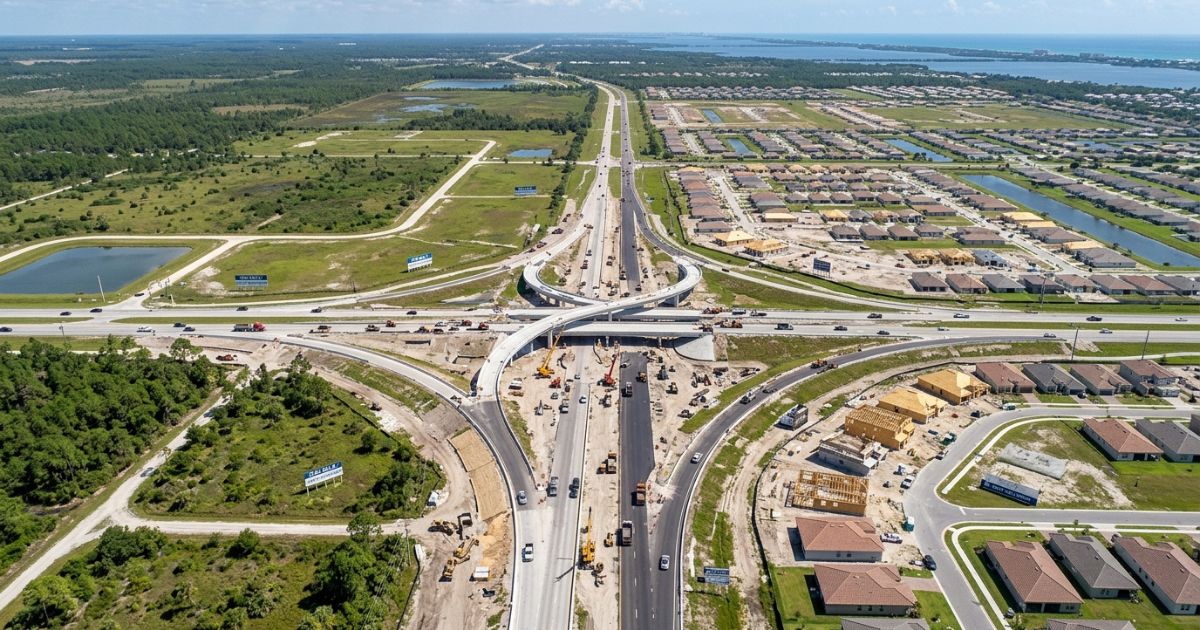
If you see earthmovers grading a new interchange near a lot you’re evaluating, the noise and dust aren’t what matters. What matters is what that construction signals: a new access point that, historically, draws subdivisions, retail, and services around it within a few years — and a land price that tends to climb well before the asphalt is even finished.
Most buyers think of a new highway mainly in terms of traffic. In reality, a new exit, a new stretch of road, or an expressway extension is one of the most reliable signals of where Florida’s next wave of growth — and land appreciation — is about to land.
Table of Contents
- Why new highways redraw the land value map
- What kind of expansion is reshaping Florida right now
- How a highway creates a value zone before it’s even finished
- Comparison: land near a new highway vs. an established area
- How to spot a new value zone before the market prices it in
- Common mistakes buyers make betting on highway growth zones
- Hidden costs and risks of these emerging zones
- FAQ — Frequently Asked Questions
- 📚 Glossary
- ✅ Immediate Actions — Start Now
Why new highways redraw the land value map {#highway-value-map}
Short answer: a new highway shortens commute times to job centers, which makes land once considered "too far out" commercially viable for housing, retail, and services — and that shift in viability typically shows up in land prices before construction is even complete.
Land value, at its core, is a function of access. A lot 40 minutes from an employment center is worth less than the same lot 15 minutes away — not because the land itself changed, but because the number of people willing to live or build there grows as the commute shrinks.
When a new highway, expressway extension, or interchange is approved and built, it reorganizes that access map almost overnight — but the price reaction usually unfolds in stages, starting long before the ribbon-cutting:
- Announcement phase — institutional investors and land developers begin negotiating purchase options along the planned route
- Construction phase — smaller investors and families who track the market closely start buying lots near the future exits
- Opening phase — the general public notices the new access point, and demand for residential and commercial land in the area rises more visibly
- Occupancy phase — the area is already partly developed, and prices fully reflect the access that’s now built in
Buying land is different from buying a finished home for exactly this reason: a vacant lot’s value is tied more to what gets built around it over the next several years than to its current state.
What kind of expansion is reshaping Florida right now {#types-of-expansion}
Short answer: Florida is in an active phase of highway corridor expansion — expressway extensions, new interchanges in suburban growth areas, and regional transit projects — concentrated mainly along the growth edges of Central Florida and the Gulf coast, where population growth keeps outpacing existing infrastructure.
Different types of projects create different effects on the land around them:
- Expressway and turnpike extensions — open direct access to areas previously dependent on slower local roads, usually along expanding suburban edges
- New interchanges on existing highways — create a concentrated access point where there was previously only through-traffic, drawing convenience retail, gas stations, and residential subdivisions around them
- Widening of already congested highways — cuts commute time without creating a new access point, producing more moderate appreciation in an already-established area
- Regional rail and transit projects — concentrate their effect around stations and stops, mainly boosting land value within a short walk or drive of them
Each of these projects has a different radius of influence on land prices. A new interchange tends to lift values mainly in the first few miles around the exit, while a longer expressway extension can reshape land value across several counties along the route, more gradually.
No infrastructure project guarantees automatic appreciation for any specific parcel. What Florida’s development history shows is a recurring pattern: new access tends to precede new demand, and new demand, paired with limited supply, tends to push prices upward on vacant land within the zone of influence.
How a highway creates a value zone before it’s even finished {#how-a-zone-forms}
Short answer: appreciation around a new highway usually begins during the planning and construction phase, not at the ribbon-cutting — because developers, land bankers, and institutional investors buy land options along the route as soon as the project clears county or state approval.
The pattern repeats with enough regularity to be worth watching closely: an infrastructure project gets announced, public capital gets committed, the first subdivisions and retail centers get approved around the future exit — and land prices near it rise before the asphalt is even laid down.
This happens because an approved highway represents a long-term commitment from the state or county — unlike a campaign promise or a market rumor. Once a project enters the work program and the route is finalized, developers can plan subdivisions with reasonable confidence about the area’s future access, and they act well before the general public catches on.
For anyone buying land for personal use or long-term investment, understanding this sequence helps put nearby highway construction in perspective — not as a guarantee of appreciation, but as a structural signal worth paying attention to.
Comparison: land near a new highway vs. an established area {#zone-comparison}
Short answer: land near a highway under construction tends to have a lower entry price and stronger appreciation potential, but also more uncertainty around timeline and supporting infrastructure, while land in an already-established zone costs more but comes with proven access, utilities, and services.
| Factor | Land near a new highway | Land in an established zone |
|---|---|---|
| Entry price | Generally lower, reflecting uncertainty about the construction timeline | Higher, already reflecting proven access and infrastructure |
| Appreciation potential | Higher, but depends on the project being completed as planned | More moderate, already partly priced in |
| Utility availability | May still be expanding along with the area | Typically already installed and tested |
| Timeline predictability | Subject to construction delays, budget shifts, and permitting | Not applicable — the infrastructure already exists |
| Nearby retail and services | Still forming, may take years to mature | Already established and operating |
Neither option is universally “right.” The choice depends on the buyer’s time horizon, tolerance for construction-timeline uncertainty, and the intended use of the land — moving in soon, building later, or holding as a long-term investment.
How to spot a new value zone before the market prices it in {#how-to-spot-it}
Short answer: Florida's road-building plans are public record — the Florida Department of Transportation's (FDOT) work program and the long-range plans of regional MPOs (Metropolitan Planning Organizations) show, years in advance, where new access points are planned.
Contrary to what many buyers assume, spotting these emerging zones doesn’t depend on luck or insider information. A few practical steps help anticipate these areas:
- Check the FDOT work program for the county you’re interested in, which lists approved and planned projects for the next five years
- Review the regional MPO’s long-range transportation plan, which typically projects corridors and extensions ten to twenty years out
- Look at the county’s comprehensive plan, which shows where the land-use map already anticipates residential or commercial growth around future access points
- Check public hearing records on new interchanges, road extensions, or zoning reclassification in the area
- Watch who’s buying land in the region — active purchase options from known developers are usually a sign that the professional market has already identified the area’s potential
None of this replaces full due diligence on a specific parcel — zoning, utility access, and FEMA flood zone status still need to be verified. But it helps a buyer tell the difference between a genuinely expanding zone and an area riding on market hype with no concrete infrastructure plan behind it.
Common mistakes buyers make betting on highway growth zones {#common-mistakes}
Buying based on rumor instead of the official plan
Hearing that “a new highway is supposed to come through here” isn’t the same as confirming the route in the FDOT work program or the MPO plan. Projects change routes, get delayed, or get shelved before final approval.
Ignoring the real construction timeline
An approved highway extension can take five to fifteen years between announcement and completion. Buying land expecting fast appreciation without factoring in that timeline usually leads to frustration.
Overestimating the highway’s radius of influence
Not every lot “in the area” of a new highway benefits equally. The appreciation effect tends to be strongest near specific exits and fades as distance from the access point increases.
Skipping zoning and permitted land use verification
A region can be in the middle of an infrastructure boom without the current zoning on a specific parcel allowing the more valuable commercial or residential use — rezoning is never automatic or guaranteed.
Paying “already developed” pricing for a still-uncertain parcel
Some sellers price land as if the highway were already complete, even when construction is still in its early stages. Comparing the asking price against land already benefiting from similar access helps avoid overpaying for potential that hasn’t materialized yet.
Hidden costs and risks of these emerging zones {#hidden-costs-risks}
Beyond the risk of construction delays or project cancellations, highway growth zones carry costs that aren’t always obvious at first glance:
- Utilities still catching up — water, sewer, and electric service can take time to keep pace with population growth in the area
- Incomplete supporting infrastructure — schools, retail, and healthcare services usually arrive after the road access, not alongside it
- Early-stage price volatility — land in emerging zones can be more unstable in price than in already-established areas
- Temporarily elevated construction costs during the build-out period, driven by concentrated demand for labor and materials in the area
- Risk that rezoning doesn’t happen as expected, limiting the parcel’s more valuable commercial use
Short answer: buying into a highway growth zone can offer stronger appreciation potential, but it also requires tolerance for more uncertainty around timelines, supporting infrastructure, and the area's actual pace of development — risks that should be weighed alongside the upside.
FAQ — Frequently Asked Questions {#faq}
Does a new highway guarantee that nearby land will appreciate?
No. A new highway increases the likelihood of appreciation by improving access to the area, but it doesn’t guarantee it for any specific parcel. Zoning, utilities, and the area’s actual pace of development remain decisive factors.
How long does it take for land near a new highway to appreciate visibly?
It varies significantly by project. Interchanges in already-suburban areas tend to show effects faster, while longer expressway extensions can take several years before the surrounding area develops noticeably.
Where can I check official highway plans in Florida?
The FDOT work program and regional MPO long-range plans are public documents that detail approved and planned projects by county, typically with five- to twenty-year projections.
Is it worth buying land in a zone still under construction?
It can be, depending on the buyer’s time horizon and tolerance for uncertainty. Land at this stage usually comes with a lower entry price, but requires patience and careful verification of the official plan before purchasing.
Can foreigners buy land in these expansion zones in Florida?
Yes. There’s no general federal restriction preventing foreign buyers from purchasing land in the United States, and Florida remains one of the most structured markets for international buyers, including bilingual support.
📚 Glossary {#glossary}
FDOT (Florida Department of Transportation): the state agency responsible for planning, building, and maintaining Florida’s highways.
MPO (Metropolitan Planning Organization): a regional body responsible for long-range transportation planning in metropolitan areas.
Work program: a public FDOT document listing approved and funded highway projects for the coming years.
Comprehensive plan: a county document that defines permitted land use across the area, including regions slated for future expansion.
Zoning: the set of county rules that determines what can be built on a given parcel.
Radius of influence: the approximate distance around a new access point within which the appreciation effect tends to be most noticeable.
✅ Immediate Actions — Start Now {#immediate-actions}
- Check the FDOT work program for the county where you’re considering buying land
- Review the regional MPO’s long-range transportation plan for future projects in the area
- Confirm the parcel’s current zoning and whether it allows your intended use
- Research who else is buying land in the region — active developers are a meaningful signal
- Verify utility availability and FEMA flood zone status before making any purchase decision
- Contact TerraNoble for bilingual guidance on evaluating highway growth zones in Florida
Conclusion
A new highway or urban expansion project isn’t just a temporary construction hassle — it’s historically one of the most reliable signals of where land value is headed in Florida. But that signal needs careful interpretation: not every announced project gets built on schedule, and not every parcel “in the area” of a new highway benefits equally.
Whether to buy into an emerging zone or an already-established area depends on your time horizon, your budget, and your tolerance for uncertainty — but that decision should be based on official infrastructure plans, not rumor or market hype.
TerraNoble offers bilingual support — in English and Portuguese — to help buyers understand how Florida’s highway expansion and urban growth apply to their specific situation. Get in touch with our team.