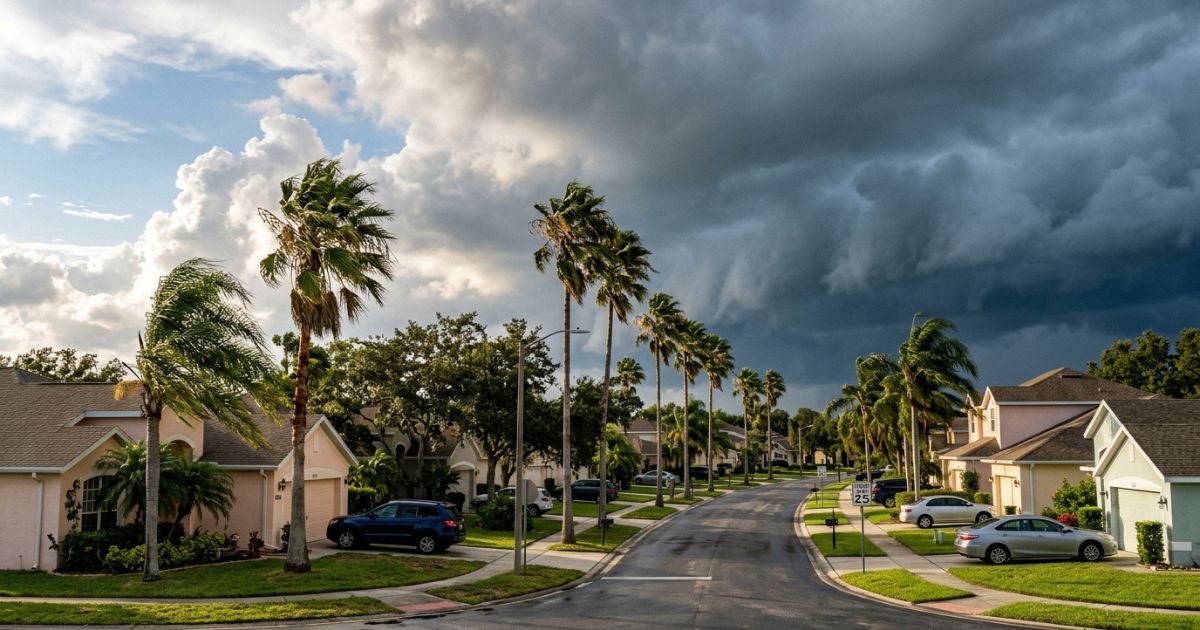
If you’re considering buying land or a home in Florida, the visible problem is picking the right region and the right price. The real risk, one that first-time buyers routinely underestimate, is treating hurricane season as an afterthought instead of a six-month condition that shapes insurance costs, building requirements, and the day-to-day reality of owning property in the state.
Most people picture a hurricane as a single, isolated event — something that either happens or doesn’t in a given year. In reality, hurricane season is a structural part of life in Florida. It influences building codes, insurance premiums, zoning decisions, and the maintenance routine of every property owner in the state, whether or not a storm ever makes landfall near them that year.
Table of Contents
- When does hurricane season start and end in Florida?
- What Florida weather actually looks like during hurricane season
- How the hurricane category scale actually works
- Watch vs. warning: what hurricane alerts really mean
- Comparing hurricane risk across Florida regions
- Common mistakes first-time buyers make about hurricane season
- Hidden costs of hurricane season for property owners
- What to verify before buying with hurricane season in mind
- FAQ — Frequently Asked Questions
- 📚 Glossary
- ✅ Immediate Actions — Start Now
When does hurricane season start and end in Florida? {#when-it-happens}
Short answer: the official Atlantic hurricane season runs from June 1 to November 30, with peak activity statistically concentrated between mid-August and the end of October, when most storms that affect Florida tend to form.
That six-month window doesn’t mean six months of constant, evenly distributed risk. June and July are usually quieter, dominated by the typical subtropical rain pattern rather than organized tropical systems. It’s between August and October that ocean temperatures in the Atlantic and the Gulf of Mexico reach the level needed to fuel stronger storms, which is why the season’s most significant hurricanes tend to cluster in that stretch.
For anyone evaluating Florida property, understanding this calendar helps with practical planning — scheduling a land inspection, a closing date, or even a relocation trip around the season’s quieter months instead of its statistical peak makes the process noticeably smoother and less stressful.
What Florida weather actually looks like during hurricane season {#real-weather}
Short answer: for most of the season, Florida's weather follows its normal tropical pattern — heat, high humidity, and short afternoon downpours — interrupted by brief alert periods when a tropical system is tracking toward the state.
A common misconception among people who’ve never spent time in Florida between June and November is imagining months of continuous storm clouds and downpours. In practice, the day-to-day weather during the season looks closer to this:
- Sunny mornings and rainy afternoons — the classic Florida summer pattern, with fast-moving downpours that typically last thirty minutes to an hour
- Consistently high humidity, usually between 70% and 90%, driven far more by summer heat than by any tropical system
- Short alert windows, generally three to seven days, when a specific system is being tracked and monitored as it approaches — or bypasses — the state
- Long stretches of clear skies and intense heat across most of the calendar, even during the season’s statistical peak
A hurricane that directly hits a specific region is a discrete event, not the season’s default condition. What actually changes during hurricane season is the level of attention — residents and property owners start following National Hurricane Center advisories and adjusting their routine once a system enters the tracking cone.
How the hurricane category scale actually works {#category-scale}
Short answer: the Saffir-Simpson Hurricane Wind Scale rates storms from Category 1 to Category 5 based on sustained wind speed, with Category 3 and above classified as "major hurricanes" carrying the highest potential for structural damage.
Category alone only measures wind strength — it doesn’t capture rainfall volume, storm surge risk, or how fast a system is moving, all of which affect the actual level of damage a property might see:
- Category 1 and 2 — sustained winds between 74 and 110 mph, capable of damaging roofs, trees, and weaker structures
- Category 3 through 5 — sustained winds above 111 mph, with the potential for severe structural damage even to well-built homes
- Storm surge — often the single most dangerous factor in a hurricane, regardless of category, especially in low-lying coastal areas
- Forward speed — a slower-moving storm tends to dump significantly more rainfall on the same area over time
For anyone evaluating land or a home, looking only at the hurricane category is an incomplete picture. It’s just as important to understand a region’s exposure to storm surge and prolonged rainfall flooding, both of which vary considerably between coastal Florida and the state’s interior.
Watch vs. warning: what hurricane alerts really mean {#watch-vs-warning}
Short answer: a hurricane watch means hurricane conditions are possible within 48 hours, a hurricane warning means those conditions are expected within 36 hours, and the "cone of uncertainty" shows the storm's likely track, not the actual width of its winds or rain.
Understanding this distinction prevents both unnecessary panic and dangerous overconfidence when a system starts approaching Florida.
Hurricane watch
A watch is issued when hurricane conditions become possible in a given area within 48 hours. This is the moment to review a preparation plan, not necessarily to take emergency action — it’s an early signal, not a countdown.
Hurricane warning
A warning is issued when hurricane conditions are expected within 36 hours. Local authorities typically release specific guidance at this stage, including evacuation orders for at-risk zones when conditions warrant it.
Cone of uncertainty
The cone graphic shows the probable path of the storm’s center, not the real width of its wind field or rainfall. It’s common for a storm to significantly affect areas well outside the printed cone, which is why tracking updated advisories matters more than glancing at a single map early in the process.
Comparing hurricane risk across Florida regions {#comparison-table}
| Region | Storm Surge Exposure | Primary Risk | Buyer Consideration |
|---|---|---|---|
| Atlantic and Gulf Coasts | High in low-lying areas | Storm surge and coastal erosion | Hurricane and flood insurance tends to run higher |
| Central Florida interior | Low to negligible | High winds and falling trees | Insurance is often more affordable, lower flood exposure |
| Panhandle (northwest FL) | High in coastal areas | Rapid-intensification storms from the Gulf | Preparation window can be shorter than in South Florida |
| Low-lying or riverside areas | Moderate, from rainfall | Prolonged flooding after a storm passes | Check FEMA flood zone maps before buying |
Common mistakes first-time buyers make about hurricane season {#common-mistakes}
Assuming the entire season is dangerous
Confusing six months on the calendar with six months of constant, active risk leads to rushed decisions — some buyers avoid Florida entirely out of fear of an event that, in most years, never directly affects any single given region.
Ignoring the storm history of the specific area
Risk varies enormously within the state itself. Evaluating “Florida” as one uniform block, without looking at the storm history of the exact county or region where a property sits, is one of the most common mistakes among first-time and foreign buyers alike.
Not factoring insurance cost into the purchase decision
The cost of hurricane and flood coverage can differ dramatically between a coastal property and one further inland, and that recurring expense directly affects a property’s long-term return, sometimes more than the purchase price itself.
Assuming vacant land doesn’t need a preparation plan
Even without a structure, a vacant lot can still suffer from fallen trees, erosion, and storm debris, which can mean cleanup costs and, in some cases, a county code notice after a major storm passes through.
Waiting until a storm is close to start learning the basics
Understanding a region’s hurricane history, evacuation zones, and insurance requirements before signing a contract prevents decisions made under pressure, in the middle of an active watch or warning.
Hidden costs of hurricane season for property owners {#hidden-costs}
- Hurricane coverage separate from standard homeowners insurance — in many parts of Florida, wind coverage requires its own policy or a specific endorsement added to the base policy
- Wind mitigation and building code requirements — properties built or retrofitted to current wind mitigation standards can see lower insurance premiums, but that upgrade requires upfront investment
- Post-storm maintenance — removing fallen trees, repairing fencing, and clearing debris after a weather event, even when there’s no significant structural damage
- Rising premiums after an active storm season — insurers adjust pricing based on recent claims history in a given region, sometimes regardless of whether a specific property was ever affected
- Recurring preparation costs — generators, impact shutters, and emergency supplies represent an investment that repeats every season, not a one-time expense
What to verify before buying with hurricane season in mind {#before-you-buy}
Short answer: before buying land or a home in Florida, confirm the property's official evacuation zone, the storm history of that specific area, whether wind and flood insurance are required, and whether any existing structure meets current wind mitigation building codes.
A few questions help estimate a property’s real hurricane exposure before signing anything:
- What is the region’s official evacuation zone, according to the county?
- Is the property located in a storm surge area or a FEMA-designated flood zone?
- What is the recent history of hurricanes that directly affected this specific area?
- Is hurricane and flood coverage available in this area, and what’s the typical cost range?
- For an existing structure, does it meet current wind mitigation requirements under the local building code?
These questions won’t eliminate risk entirely — no part of Florida is completely free of hurricane exposure — but they turn the purchase decision into an informed one instead of a guess.
FAQ — Frequently Asked Questions {#faq}
Is all of Florida equally at risk from hurricanes?
No. Risk varies significantly by region — coastal and low-lying areas face higher storm surge exposure, while interior regions tend to deal mostly with high winds and fallen trees, with considerably lower flood risk.
Is it safe to buy land in Florida during hurricane season?
Yes, buying during the season is common and generally safe, as long as the buyer understands the area’s storm history, the alert system, and the insurance requirements involved. Plenty of transactions close normally between June and November.
Is hurricane insurance required in Florida?
There’s no single statewide mandate, but mortgage lenders typically require wind coverage, and in FEMA-designated flood zones, flood insurance is usually a condition of financing.
How much warning does Florida usually get before a hurricane makes landfall?
It varies by storm. Some systems are tracked a week or more in advance, while others — particularly those forming in the Gulf of Mexico — can intensify rapidly with only a few days of notice, which is why having a preparation plan ready in advance matters.
Do foreign buyers get guidance on hurricane preparedness?
Yes. TerraNoble offers bilingual support in English and Portuguese to help Latin American buyers understand the storm history of a specific region and what to consider around insurance and preparation before closing on a property.
📚 Glossary {#glossary}
Storm surge: the abnormal rise in sea level caused by a hurricane's winds, often the single most dangerous and destructive element of the storm in low-lying coastal areas.
Saffir-Simpson Hurricane Wind Scale: the system used to classify hurricanes into Categories 1 through 5, based on sustained wind speed.
Hurricane watch: an alert issued when hurricane conditions are possible in a region within 48 hours.
Hurricane warning: an alert issued when hurricane conditions are expected in a region within 36 hours.
Cone of uncertainty: the National Hurricane Center's graphic showing a storm's probable track, which does not represent the actual width of its wind or rain field.
Wind mitigation: construction features, such as impact-rated windows and reinforced roofing, that reduce a structure's risk of wind damage and can lower insurance premiums.
Evacuation zone: a county-designated area indicating evacuation priority in the event of a hurricane, based primarily on storm surge risk.
✅ Immediate Actions — Start Now {#immediate-actions}
- Look up the storm history of the last several years for the specific area you're considering.
- Check the property's official evacuation zone with the county.
- Confirm whether the area falls within a FEMA flood zone and what flood coverage would be required.
- Request a hurricane and wind insurance quote before closing, not after.
- For an existing structure, ask about wind mitigation certification and possible insurance discounts.
- Put together a basic preparation plan, even if the purchase is for future use or pure investment.
- Talk to TerraNoble for bilingual guidance on weather, insurance, and preparation for the Florida region you're considering.
Conclusion
Hurricane season isn’t a reason to avoid Florida — it’s a condition of living there that needs to be understood, not feared. For most of its six-month span, the weather follows the state’s normal tropical pattern, with sunny days interrupted by summer downpours, and only specific short windows call for close attention to advisories and alerts.
Buyers who understand the season’s calendar, the difference between a watch and a warning, and the specific risk profile of a chosen region — coastal, interior, or panhandle — are in a far better position to make a safe, financially sound purchase decision.
TerraNoble offers bilingual support, in English and Portuguese, to help Latin American buyers understand the weather patterns, storm history, and insurance requirements of any Florida region before investing. Get in touch with our team for guidance on your specific situation.