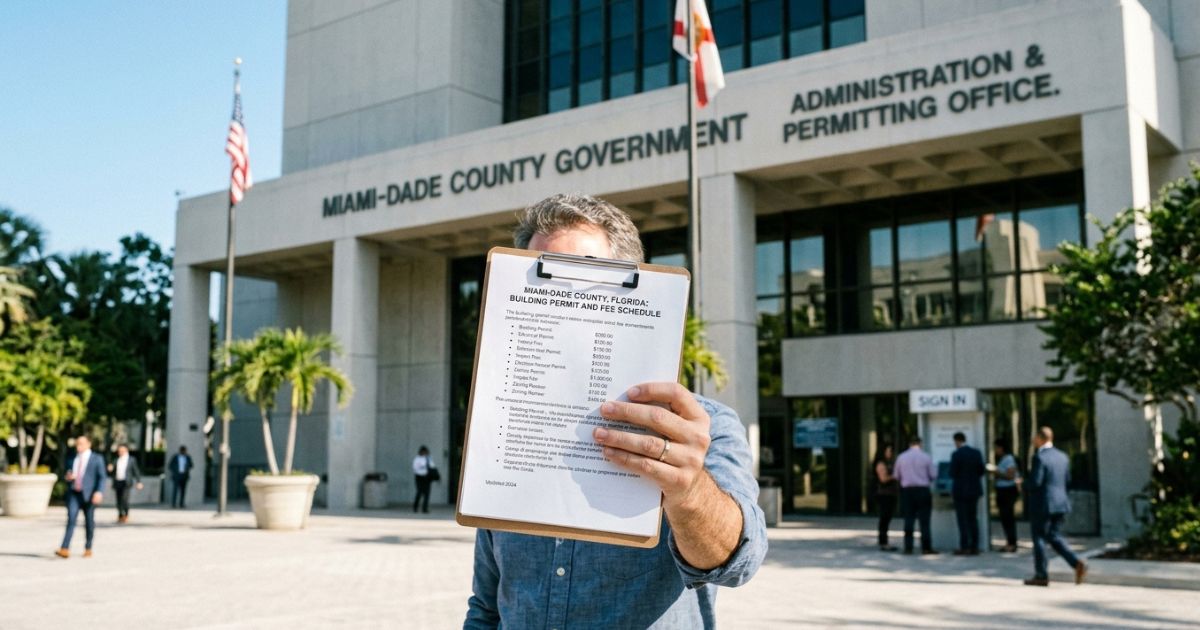
If you’re evaluating a piece of land in Florida to build on, the visible task is negotiating the price of the lot. The real risk shows up later, when you apply for a building permit and discover the county requires impact fees that can add up to $15,000 to more than $30,000 — a cost that rarely comes up in the initial conversation with a real estate agent or seller. This is one of the most common financial surprises among buyers planning to build in Florida.
Most people think of the cost of building as “land price plus construction cost.” In practice, municipal charges like impact fees, utility connection fees, and permit fees can represent a significant share of the total budget — and leaving them out of the initial plan creates a financial problem that only surfaces months later, at the worst possible moment.
Table of Contents
- What impact fees are and why they exist
- Impact fees are not property tax — here’s the difference
- How impact fee amounts are calculated in Florida
- What other municipal charges buyers should expect
- Impact fees by infrastructure category
- Common mistakes when budgeting for municipal charges
- Hidden costs that show up after the impact fee
- How to verify the exact amount before you buy
- FAQ — Frequently Asked Questions
- 📚 Glossary
- ✅ Immediate Actions — Start Now
What impact fees are and why they exist {#what-are-impact-fees}
Short answer: impact fees are one-time charges collected by a county or municipality at the time a new building is permitted, meant to cover the impact that new construction places on public infrastructure — including roads, schools, parks, water and sewer systems, and emergency services.
The logic behind impact fees is straightforward: when a new home is built, it increases demand on roads, public schools, water and sewer systems, parks, and police and fire services. Rather than spreading that cost across every taxpayer in the county through the general property tax, many Florida municipalities charge it directly to whoever is generating the new impact — the new property owner, at the time of permitting.
This model is legal and widely used across the state. Every Florida county sets its own impact fee categories, rates, and calculation formulas, which means the same type of construction can cost noticeably different amounts depending on where the land sits.
Impact fees are not property tax — here’s the difference {#not-property-tax}
Short answer: impact fees are a one-time charge paid at the time of construction, while property tax is a recurring annual charge based on the property's assessed value — the two don't overlap or substitute for each other.
This is a common point of confusion for buyers who already understand how Florida property tax works but assume the impact fee is just “another annual tax.” It isn’t. The table below summarizes the main differences:
| Aspect | Impact Fee | Property Tax |
|---|---|---|
| Frequency | One-time payment, at permitting | Recurring annual charge |
| Calculation basis | Type and size of construction, infrastructure category | Assessed value of the property, set by the county appraiser |
| Who collects it | County or municipality, at permitting | County tax collector, annually |
| When it's paid | Before or during building permit issuance | Every year, due in November |
| What it funds | Expansion of specific infrastructure | General county budget and public services |
How impact fee amounts are calculated in Florida {#how-calculated}
Short answer: amounts are set by formulas specific to each county, generally based on property type (single-family residential, multi-family, commercial), bedroom count, or square footage, multiplied by fixed rates assigned to each impacted infrastructure category.
Every county publishes its own impact fee schedule, periodically revised through “impact fee studies” — technical assessments that recalculate the real cost of expanding public infrastructure. That means the amount charged today may not be the same in two or three years, especially in fast-growing counties.
In practice, the calculation typically adds up separate charges for each category:
- Transportation (roads) — usually the largest category, calculated by the estimated number of trips a property generates
- Schools — mainly applied to residential construction, calculated per housing unit
- Parks and recreation — a per-unit charge for residential properties, directed toward expanding public recreational space
- Water and sewer — charged when a property connects to the public system, often billed separately as a “connection fee”
- Law enforcement and fire/EMS — a smaller charge, but present in most counties
The sum of these categories forms the total impact fee, which varies widely: a single-family residential lot can face charges ranging from $8,000 to more than $30,000, depending on the county, the size of the home, and whether public water and sewer service is available in the area.
What other municipal charges buyers should expect {#other-charges}
Short answer: beyond impact fees, buyers should budget for building permit fees, utility connection fees, inspection fees, and in some cases HOA or special assessment district charges — each billed separately, on its own timeline.
Building permit fees
Charged by the county to review and approve construction plans, typically calculated as a percentage of the estimated construction cost or by square footage.
Utility connection fees
A fee to connect the property to the public water and sewer system, separate from the water/sewer impact fee. In areas without public infrastructure, the cost of installing a well and septic tank replaces this fee — but it doesn’t eliminate the impact fee, which may still apply to other categories.
Inspection fees
Charged throughout different stages of construction — foundation, electrical, plumbing, framing — as part of the mandatory municipal inspection process.
Special assessment districts
In some developments, especially newer ones, a Community Development District (CDD) collects an additional recurring charge to fund infrastructure inside the neighborhood, separate from the county’s impact fees.
Impact fees by infrastructure category {#category-table}
| Category | What it funds | When it applies |
|---|---|---|
| Transportation | Road expansion, maintenance, and signage | Nearly all new construction |
| Schools | Construction and expansion of public schools | Mainly residential construction |
| Parks and Recreation | Parks, trails, and public recreational space | Residential construction, per unit |
| Water and Sewer | Capacity of the public water and sewer network | Properties connected to the municipal system |
| Law Enforcement / Fire-EMS | Police and emergency response capacity | All new construction, typically a smaller amount |
Common mistakes when budgeting for municipal charges {#common-mistakes}
Not including impact fees in the initial budget
The most frequent mistake: planning a budget based only on land price and estimated construction cost, without setting aside a specific reserve for municipal charges.
Assuming the amount is the same statewide
Every county has its own schedule. The same project can cost significantly less in a rural county than in a fast-growing county in a major metro area.
Relying on an outdated quote
Impact fee studies are revised periodically. A number researched a year ago may already be out of date, especially in counties that raised fees to keep up with population growth.
Forgetting about utility connection charges
Many buyers budget for the water/sewer impact fee but overlook that physically connecting to the network — where available — carries a separate charge, billed by the utility provider or the county itself.
Not checking whether a CDD or special assessment applies
In newer planned communities, recurring improvement district charges can stack on top of one-time impact fees, creating an ongoing cost that never shows up in the initial estimate.
Hidden costs that show up after the impact fee {#hidden-costs}
- Impact fee reassessment between land purchase and construction start — if the county updates its schedule in the meantime, the final amount can be higher than originally researched
- Engineering and technical study fees required for permitting — often necessary even before the final impact fee calculation
- Cost of extending infrastructure to the lot — when the public network doesn’t reach the connection point, extension costs can fall on the property owner
- Recurring CDD charges — in developments with an improvement district, the cost doesn’t end with a single impact fee; it becomes an additional annual charge
- Fines for building without proper permitting — trying to save money by skipping steps in the permitting process usually creates costs far higher than the original impact fee
How to verify the exact amount before you buy {#how-to-verify}
Short answer: the exact impact fee amount should be confirmed directly with the planning or building department of the county where the land is located, before purchase — most Florida counties publish impact fee schedules and calculators online, along with direct support for questions about a specific lot.
Before buying, it’s worth taking these steps:
- Contact the county planning and zoning department or building department to request the current impact fee schedule
- Ask specifically about the type of property planned (single-family residential, multi-family, commercial)
- Confirm whether the land sits inside a CDD or special assessment district
- Verify whether public water and sewer service is available on the lot, or whether a well and septic system will be needed
- Request a written estimate whenever possible, since verbally quoted amounts can change
FAQ — Frequently Asked Questions {#faq}
Are impact fees mandatory throughout Florida?
Most Florida counties charge some form of impact fee, but the amounts, categories, and even the existence of certain fees vary by jurisdiction. Always confirm directly with the specific county where the land is located.
Can impact fees be financed as part of construction?
In many cases, yes — the amount can be included in the total financed construction budget, but this depends on the lender and how the financing is structured. Confirm this possibility with the financial institution before assuming the cost will be covered.
Do impact fees change over time?
Yes. Counties periodically revise their schedules through impact fee studies, which can raise amounts to keep pace with population growth and the cost of expanding infrastructure.
Does vacant land with no planned construction pay an impact fee?
No. Impact fees are charged when a construction permit is issued, not at the time the land itself is purchased. A vacant lot with no permit application doesn’t trigger this charge.
Are impact fees the same for renovations and new construction?
Generally not. Most counties apply impact fees mainly to new construction or additions that significantly increase the impact on infrastructure — renovations that don’t add square footage are usually treated differently, but this should be confirmed case by case.
📚 Glossary {#glossary}
Impact fee: a municipal charge collected when a new construction permit is issued, meant to cover the impact on public infrastructure such as roads, schools, and water/sewer systems.
Impact fee study: a periodic technical study used by the county to recalculate and justify the amounts charged in each impact fee category.
Building permit: the authorization required before any construction begins, involving plan review and specific fees.
CDD (Community Development District): a special development district that can charge recurring fees to fund infrastructure inside a planned neighborhood.
Special assessment: an additional charge tied to a specific district or improvement project, separate from general property tax and one-time impact fees.
Utility connection fee: a fee charged to connect a property to the public water or sewer system, separate from the corresponding impact fee.
County planning and zoning department: the municipal department responsible for providing impact fee amounts, zoning rules, and permitting requirements.
✅ Immediate Actions — Start Now {#immediate-actions}
- Don't finalize your construction budget without checking the specific county's impact fee schedule.
- Contact the local building department to confirm current amounts before buying the land.
- Verify whether the lot sits inside a CDD or special assessment district.
- Confirm whether public water and sewer service is available on the property.
- Request written estimates, not just verbal ones, whenever possible.
- Set aside a specific financial buffer for municipal charges, separate from the construction cost.
- Talk to TerraNoble for bilingual guidance on evaluating the total cost of building on land in Florida.
Conclusion
Impact fees and other municipal charges aren’t a minor bureaucratic detail — they’re a real, sometimes substantial, part of the total cost of building in Florida. The difference between a well-prepared buyer and a surprised one usually comes down to a single habit: researching the county’s impact fee schedule before closing, not after.
Understanding what these charges actually fund — roads, schools, parks, water and sewer systems, public safety — makes the cost easier to make sense of, and budgeting for it realistically from the start keeps it from becoming a financial obstacle in the middle of the building process.
TerraNoble offers bilingual support — in English and Portuguese — to help buyers understand the full cost of owning and building on land in Florida, including municipal charges that often go unnoticed. Reach out to our team to get answers specific to your situation.