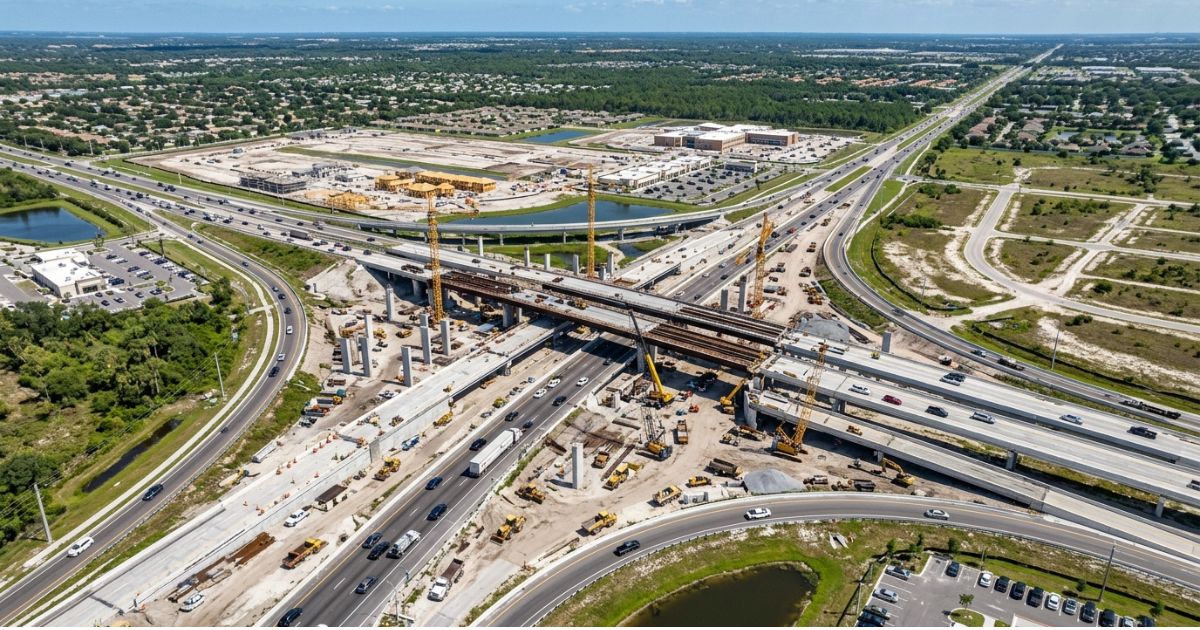
Interchange projects like this one follow a predictable pattern in Florida: the highway expansion is announced, new subdivisions and retail centers rise around it, and land values along the corridor climb well before construction wraps up.
If you see a highway widening near a lot you’re evaluating, the visible disruption — the noise, the dust, the temporary detours — isn’t the biggest factor at play. The real signal is what that construction represents: committed public capital, population growth already projected for the area, and appreciation that typically starts long before the ribbon-cutting. Smart buyers learn to read that signal before it shows up in the asking price.
Most buyers think of infrastructure as a temporary inconvenience during a land purchase. In reality, it’s one of the most reliable indicators of where land value is headed over the next several years.
Table of Contents
- Why infrastructure moves land prices
- Where Florida is investing in infrastructure in 2026
- How to spot a growth corridor before the market does
- Infrastructure type vs. land value impact
- Common mistakes when evaluating land near public projects
- Hidden costs that come with fast-growing corridors
- FAQ — Frequently Asked Questions
- Glossary
- Immediate Actions — Start Now
Why infrastructure moves land prices {#why-infrastructure-matters}
Short answer: new highways, water and sewer expansion, and transit investment lower the cost and shorten the timeline of developing a parcel — which is why the market tends to price in that future gain before construction is even finished.
A vacant lot is worth, in large part, what it can become. And what it can become depends directly on three things that public infrastructure resolves: road access, available utilities, and proximity to job centers.
When a state or county announces a highway expansion, a new sewer interceptor line, or electrical service reaching a previously remote area, the surrounding land goes through a quiet transformation. It stops being raw acreage and becomes a parcel with real development potential — often years before the project is complete.
What sets infrastructure apart from other appreciation drivers
Population growth and new employers also push land values up, but they tend to work on a longer timeline. Infrastructure functions as a more direct trigger:
- Lowers development cost: utility access eliminates the need for a well and septic system, which can add tens of thousands of dollars to a build.
- Expands the buildable footprint: new access roads make it feasible to subdivide and sell lots that were previously unreachable.
- Signals long-term public commitment: large-scale projects are rarely reversed once funded, which lowers the perceived risk for investors.
- Pulls demand forward: developers and builders position themselves near new corridors before construction finishes, increasing competition for available land.
When these factors line up, land prices tend to climb in stages — one bump when the project is announced, another when construction begins, and another once the infrastructure is fully operational.
Where Florida is investing in infrastructure in 2026 {#where-investing}
Short answer: Florida's largest infrastructure investments in 2026 are concentrated along the I-4 corridor between Tampa and Orlando, new segments of I-75 and SR-429, and water and sewer expansion in fast-growing counties like Osceola, Polk, and Pasco.
Florida invests continuously in transportation through the Florida Department of Transportation (FDOT), which publishes an annual Five-Year Work Program — a public document listing every planned highway project and its timeline.
The I-4 corridor — Tampa to Orlando
The I-4 corridor remains one of the state’s most consistently funded investment zones. New interchanges, added lanes, and flyover ramps are under construction to keep pace with population growth between the two metro areas. Land near new interchange access points often sees increased developer interest months before construction is complete.
I-75 expansion in southwest Florida
Widening projects along I-75 in southwest Florida track the growth of counties like Charlotte, Sarasota, and Lee. New exits and interchanges make areas that were once far from urban centers considerably more accessible, expanding the radius of land eligible for residential development.
SR-429 and the expansion of metro Orlando
The SR-429 (Western Beltway) continues extending north and south of the Orlando metro area, opening access to parts of Lake County and Orange County that previously relied entirely on secondary roads. This kind of arterial expansion tends to precede waves of residential platting.
Utility expansion in fast-growing counties
Beyond highways, counties like Osceola, Polk, and Pasco are expanding water and sewer networks to keep pace with new development. When those networks reach an area that previously depended on well water and septic systems, it’s often one of the most direct signals of future appreciation — sometimes more decisive than proximity to a highway.
How to spot a growth corridor before the market does {#spot-corridor}
Short answer: checking FDOT's Five-Year Work Program, following county planning commission meetings, and reviewing utility expansion plans are the most reliable ways to identify an infrastructure corridor before land prices catch up to the growth.
Experienced investors don’t wait until construction is visible to act. They track public sources that announce projects years in advance.
Where to find reliable public information
- FDOT Five-Year Work Program: the official list of planned highway projects, complete with timeline and budget, available on FDOT’s website.
- County Comprehensive Plan: a long-range planning document that designates future growth areas and infrastructure expansion.
- Planning Commission meeting minutes: these record discussions about new projects long before they become public news.
- County or utility provider master plans: indicate where water and sewer networks are scheduled to expand.
What to look for beyond the project itself
A single new highway doesn’t guarantee appreciation on its own. The most consistent pattern shows up when three elements appear together: a new access road, utility expansion, and population growth already documented in the area. Parcels that combine all three tend to appreciate more predictably than land that depends on just one factor.
Infrastructure type vs. land value impact {#table}
| Infrastructure type | Typical value impact | Time horizon | Notes |
|---|---|---|---|
| Highway expansion (added lanes, interchanges) | Moderate to high | 2–5 years | Greatest impact near new exits and interchanges |
| New arterial road (beltway, corridor) | High | 3–7 years | Opens access to previously isolated areas |
| Water/sewer expansion | High | 1–3 years | Directly lowers development cost |
| New electrical service | Moderate | 1–2 years | Usually accompanies other investments |
| New hospital or school campus | Moderate to high | 2–4 years | Attracts families and anchors residential demand |
Common mistakes when evaluating land near public projects {#common-mistakes}
Identifying a growth corridor is only part of the work. Many buyers make mistakes when turning that information into an actual purchase decision.
- Buying based on rumor instead of confirmation: hearing that “a new highway is supposed to go through there” isn’t the same as confirming it in FDOT’s Five-Year Work Program or the county’s comprehensive plan. Projects get delayed, redesigned, or canceled — always verify with the official source before paying a premium for the expectation.
- Ignoring the parcel’s current zoning: land near a new highway may carry zoning that doesn’t permit the intended use, whether residential, commercial, or mixed. Proximity to infrastructure doesn’t automatically change what can legally be built on a lot — that still depends on the county’s zoning code.
- Underestimating how long appreciation takes to materialize: infrastructure projects take years to complete, and full appreciation generally shows up only after the road or utility network is operational. Buyers expecting a quick return can be frustrated by the actual pace of the land market.
- Not checking whether the project is funded and approved: there’s a real difference between a “planned” project and one with an approved budget and confirmed construction timeline. FDOT’s Five-Year Work Program distinguishes between these phases — it’s worth confirming exactly which stage a project is in before deciding.
Hidden costs that come with fast-growing corridors {#hidden-costs}
Short answer: areas experiencing rapid infrastructure growth also come with higher property taxes, impact fees, utility connection costs, and short-term speculative pricing that buyers need to factor into their return calculations.
| Hidden cost | When it shows up |
|---|---|
| Rising property taxes | As the area appreciates, the county property appraiser's valuation — and the annual tax bill — tends to climb with it |
| Impact fees | Charged by the county on new development to help fund the infrastructure itself, often passed through to the final lot cost |
| Utility connection cost | Even when a network is available in the area, connecting an individual lot to water and sewer can run several thousand dollars |
| Construction-phase disruption | Temporary congestion and access issues can affect a lot's appeal while the project is still underway |
| Short-term speculation | Heavily publicized growth areas attract speculative buyers, which can push prices beyond what the infrastructure itself actually justifies |
These costs don’t eliminate the opportunity, but they need to be part of the return calculation before making an offer.
FAQ — Frequently Asked Questions {#faq}
Does new infrastructure always increase the value of nearby land?
Not necessarily. The impact depends on the type of infrastructure, the actual proximity to the parcel, and the current zoning. A highway can even reduce a residential lot’s appeal if the added noise and traffic outweigh the access benefit. Each parcel needs to be evaluated on its own.
How can I confirm whether a Florida highway project is actually funded, not just proposed?
FDOT’s Five-Year Work Program, available on the department’s official website, shows the status of each project, including approved budget and construction timeline. Projects listed in the program’s earlier years carry a much higher probability of execution than those that only appear in long-range planning documents.
Is it worth buying land before the infrastructure is finished?
It can be a sound strategy for buyers with a medium- to long-term investment horizon who confirm the project through official sources. The risk is higher than buying in an already-developed area, but the appreciation potential tends to be higher too — as long as the buyer can afford to wait it out.
Do impact fees apply to every type of land purchase?
No. Impact fees generally apply to new development and construction, not to simply owning a vacant lot. They’re typically assessed when a building permit is issued, and the amount varies by county and proposed land use.
📚 Glossary {#glossary}
FDOT (Florida Department of Transportation): the state agency responsible for planning and executing highway and transportation projects in Florida.
Five-Year Work Program: FDOT's public document listing planned highway infrastructure projects for the next five years, including budget and timeline.
Comprehensive Plan: a county or municipality's long-range planning document that defines future growth areas, land use, and infrastructure expansion.
Impact Fee: a fee charged by the county on new development to help fund the public infrastructure needed to support that growth.
Zoning: a county-level classification that determines the permitted use of a parcel — residential, commercial, agricultural, or mixed use.
Utility Access: a parcel's access to public water, sewer, and electrical networks.
Property Appraiser: the county office responsible for valuing property for annual property tax purposes.
✅ Immediate Actions — Start Now {#immediate-actions}
- Check FDOT's Five-Year Work Program (fdot.gov) for planned highway projects near the land you're evaluating.
- Review the county's Comprehensive Plan to understand which areas are designated for future growth.
- Confirm any planned water or sewer expansion with the local utility provider or county.
- Verify the parcel's current zoning before assuming new infrastructure will allow your intended use.
- Factor in impact fees and utility connection costs before estimating your return.
- Consult a local title company for guidance on the purchase process and title verification.
Conclusion
Infrastructure is one of the most reliable — and most underestimated — signals of land appreciation in Florida. Highways, utility networks, and arterial roads aren’t just conveniences; they’re long-term public investments that lower development costs and expand the buildable footprint of an entire region.
Identifying these projects through official sources, before they become visible on the ground, is what separates an investor who gets ahead of growth from a buyer who pays a price that’s already adjusted for the potential.
Appreciation is never guaranteed. But tracking where public money is actually being invested is one of the most rational ways to understand where Florida’s land market is headed next.
Ready to explore land opportunities along Florida’s growth corridors? TerraNoble offers expert guidance through every step of the buying process, including help identifying parcels positioned near confirmed infrastructure investment. Get in touch for a no-obligation conversation about the best parcels for your goals.
TerraNoble offers bilingual support (English and Portuguese) for buyers evaluating land in Florida’s fastest-growing infrastructure corridors.