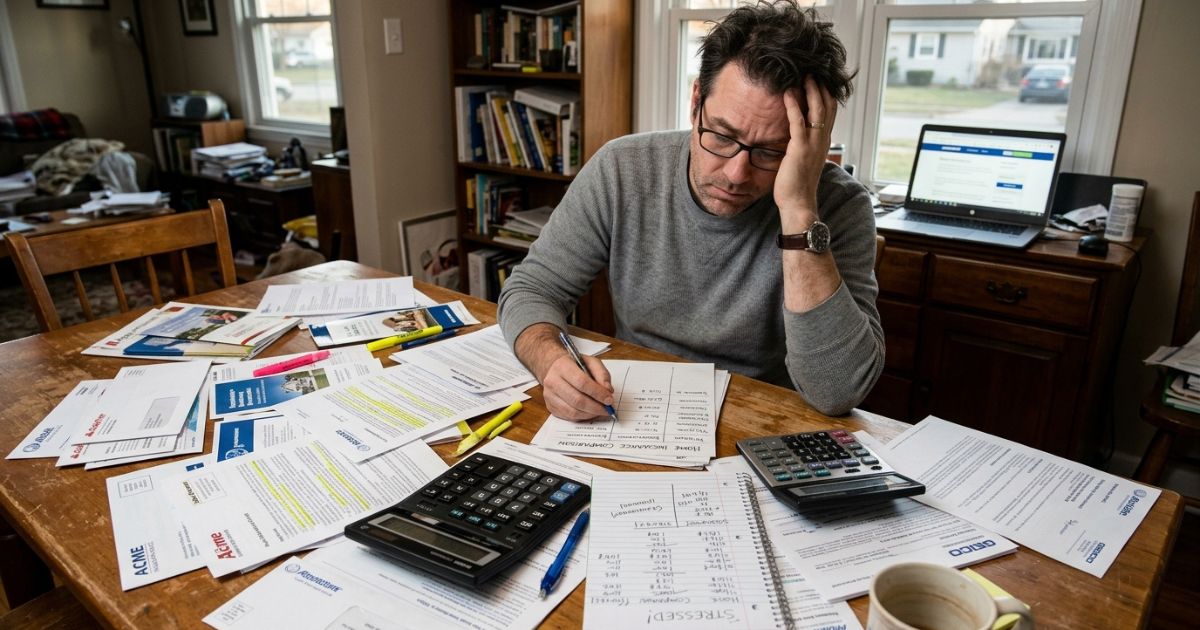
Many Florida homeowners find themselves overwhelmed by competing policies, confusing coverage options, and costs they never anticipated. Understanding the most common insurance mistakes is the first step toward protecting your home and your finances.
The storm passes. The water came in through the garage door, soaked the flooring, and destroyed everything stored at ground level. The homeowner files a claim with confidence — they’ve been paying their insurance premium on time for years. Then the denial letter arrives: flood damage is not covered under their policy.
This scenario plays out more often than most Florida homeowners realize. The state’s insurance system is genuinely different from every other state — fragmented into multiple separate policies, loaded with exclusions specific to hurricane events, and priced based on property-level variables that most buyers never think to check.
The most expensive mistakes aren’t about picking the wrong company. They’re about not understanding what’s covered before you need it.
Why Florida insurance mistakes are more costly than in any other state
Florida combines the country’s most active hurricane corridor with one of the most complex insurance markets in the nation. Private carriers have exited the market, premiums have nearly doubled in parts of the state, and coverage has become increasingly fragmented — split across homeowners, flood, and wind policies that each carry their own deductibles, exclusions, and limits.
Short answer: A coverage gap that would cost a few thousand dollars to fix in most states can mean a six-figure uninsured loss in Florida, where hurricanes, storm surge, and flooding create overlapping risks that no single standard policy covers completely. Understanding the system before you buy — or before the next storm season — is not optional financial knowledge in this state.
The result: the same mistake that creates a manageable problem elsewhere can leave a Florida homeowner without resources to rebuild.
Mistake 1: Assuming homeowners insurance covers flood damage
This is the single most common — and most expensive — misunderstanding in Florida real estate. Standard homeowners insurance does not cover flooding. Not storm surge. Not water that rises from a nearby canal or drainage ditch. Not rainfall accumulation when the ground is saturated.
Homeowners insurance covers:
- Structural damage caused by wind-driven rain that enters through a breach in the structure
- Fire, theft, and vandalism
- Personal liability on the property
- Additional living expenses if the home is uninhabitable
Flood insurance — purchased separately — covers:
- Floodwaters rising from any external body of water
- Storm surge from hurricanes
- Heavy rainfall accumulation where the ground cannot absorb water fast enough
| Type of Damage | Homeowners Insurance | Flood Insurance |
|---|---|---|
| Roof torn off by hurricane winds | Covered | Not covered |
| Rain entering through damaged roof | Covered (if wind caused the opening) | Not covered |
| Storm surge flooding the ground floor | Not covered | Covered |
| Canal overflow into the yard and home | Not covered | Covered |
| Rainfall accumulation through saturated ground | Not covered | Covered |
In FEMA high-risk flood zones (Zones AE and VE), flood insurance is required for federally backed mortgages. But roughly one in four flood insurance claims comes from properties outside of designated high-risk areas. If your property is anywhere near water — a retention pond, a drainage canal, a coastal inlet — the absence of flood coverage is a genuine financial risk.
Mistake 2: Not understanding how the hurricane deductible actually works
Most homeowners understand the concept of a deductible. What many don’t realize is that Florida law requires a separate hurricane deductible that works very differently from the standard deductible on their policy.
The standard deductible is typically a fixed dollar amount — $1,000 or $2,500, for example. The hurricane deductible is calculated as a percentage of the insured value of the home — commonly 2%, 3%, or 5% — and it applies to any loss that is officially classified as a hurricane event by the National Hurricane Center.
On a home insured for $350,000 with a 2% hurricane deductible, that means the first $7,000 of hurricane-related repairs comes out of your pocket before the insurer pays a dollar. At 5%, that same home carries a $17,500 out-of-pocket exposure.
Short answer: The hurricane deductible is a mandatory feature of Florida homeowners insurance, required by state law. It is a percentage of your home's insured value — not a fixed amount — and it resets with each named storm. Before signing any policy, calculate the actual dollar amount of your hurricane deductible and treat that figure as a minimum emergency reserve you should keep accessible.
This deductible also applies per storm. In a year with multiple named hurricanes, you could face it more than once.
Mistake 3: Choosing the lowest premium without reading what’s excluded
With Florida premiums running $4,000 to $6,000 per year for many homes — and significantly more in coastal areas — the pressure to find the cheapest policy is real. But low-cost policies frequently get there by cutting coverage, not by being more efficient.
Common exclusions that appear in lower-priced Florida policies:
- Water damage from internal sources — pipe leaks, appliance failures, slow seepage
- Personal property coverage — the contents of your home: furniture, electronics, clothing
- Other structures — detached garages, sheds, fences
- Loss of use / Additional Living Expenses (ALE) — the cost of a hotel or rental while your home is repaired
- Reduced liability limits — leaving you exposed in the event of an injury on your property
- Actual cash value (ACV) instead of replacement cost (RCV) — meaning the insurer pays depreciated value, not what it actually costs to replace the item or repair the structure
An ACV policy versus an RCV policy on the same roof can mean the difference between receiving $8,000 and $22,000 after a hail or wind event — on the exact same damage, under the exact same circumstances.
Mistake 4: Not getting a wind mitigation inspection before buying or insuring
A wind mitigation inspection is a certified evaluation of a home’s structural resistance to high winds. The inspector documents the roof covering material, roof deck attachment method, roof-to-wall connections, roof shape, and the presence or absence of impact-resistant windows, doors, and garage doors.
Properties with documented wind-resistant features qualify for premium discounts that can reduce the annual homeowners insurance cost by 20% to 40%. The inspection itself costs $75 to $150 and takes an hour or two.
The mistake: thousands of Florida homeowners are paying higher premiums than they need to because they’ve never had this inspection done. If the property you’re buying already has a current wind mitigation report from the existing owner, ask for it — the documented features may qualify your policy for the same credits.
If no report exists, consider ordering one before or shortly after closing. On a $5,000 annual premium, a 30% discount saves $1,500 per year. The inspection pays for itself in the first month.
Mistake 5: Not updating your coverage after renovations
Your insurance policy covers the cost of rebuilding the home as it was described when the policy was written. If the home has changed significantly since then — new additions, high-end kitchen renovation, converted garage, solar panels — the insured value may no longer reflect what rebuilding would actually cost.
This gap is called underinsurance, and it’s more common than most homeowners realize. After a total loss, the insurer pays up to the policy limit. If rebuilding the updated home costs more than that limit, you absorb the difference.
Changes that should trigger a policy review:
- Any addition to the home’s square footage
- A full kitchen or bathroom renovation with upgraded materials
- Finished basement or converted space
- Addition of a pool, screened enclosure, or outdoor kitchen
- Solar panel installation
- Major exterior work: new impact windows throughout, complete roofing system replacement
A quick call to your insurer or agent after any significant renovation is enough to start the conversation. The cost of increasing your coverage limit is typically small relative to the risk of not doing it.
Mistake 6: Buying a home without checking the roof age first
In Florida, the roof is not just a structural feature. It is one of the primary factors that determines whether a private insurance carrier will write a policy on the property — and at what cost.
| Roof Age | Typical Insurance Situation |
|---|---|
| Under 10 years | Full coverage available; standard market rates |
| 10–15 years | Coverage available; some carriers begin applying restrictions |
| 15–20 years | Many carriers require inspection; coverage may shift to ACV only |
| Over 20 years | Frequent refusals from private carriers; likely Citizens-only market |
Buying a home with an aging roof without first confirming your insurance options can mean discovering that the only available coverage is through Citizens Property Insurance — the state’s insurer of last resort — at higher-than-expected rates, or that private carriers will insure the structure but not the roof itself.
Roof replacement in Florida typically runs $12,000 to $25,000 depending on materials and square footage. Factor that potential cost into your offer if the roof is aging.
Mistake 7: Skipping the CLUE report
The CLUE report — Comprehensive Loss Underwriting Exchange — is a seven-year history of insurance claims filed on a specific property. It shows what type of damage occurred, when, and how much was paid out.
Buying a property without pulling the CLUE report can mean:
- Discovering a history of repeated water intrusion after closing
- Inheriting a risk profile that drives your own premiums higher
- Missing evidence of structural repairs done after a major claim — repairs that may have been done improperly
- Being surprised by issues a seller had financial incentive not to disclose
The CLUE report can be requested by the seller or directly by the buyer through LexisNexis. In a Florida real estate transaction, it is one of the most useful due diligence documents available — and one of the most commonly overlooked.
Mistake 8: Treating insurance as an afterthought instead of a buying criterion
The final and most pervasive mistake: calculating whether you can afford a Florida property based on the purchase price and mortgage payment, without factoring in the actual cost of insuring it.
Short answer: In Florida, the annual cost of homeowners insurance, flood insurance, and wind insurance (where required) can add $8,000 to $15,000 or more to the cost of owning a property — on top of the mortgage. That number can meaningfully change whether a home is financially sustainable to hold for 10 or 20 years. Get real insurance quotes with the property's exact address before making any offer.
| Mistake | Potential Consequence | How to Avoid It |
|---|---|---|
| Assuming homeowners covers floods | Total uninsured loss after storm surge or flooding | Purchase flood insurance separately |
| Misunderstanding the hurricane deductible | $7,000–$20,000+ out-of-pocket before insurer pays | Calculate the actual dollar amount; maintain emergency reserve |
| Choosing cheapest policy without reading exclusions | Coverage gaps on the most likely claim scenarios | Compare coverage terms, not just premium amounts |
| Skipping wind mitigation inspection | Overpaying 20–40% annually on homeowners premium | Order the inspection before or shortly after closing |
| Not updating coverage after renovations | Underinsurance gap after a total loss | Review policy after any significant improvement |
| Ignoring roof age before buying | Limited coverage options, higher premiums, or forced Citizens enrollment | Verify roof age and condition before making an offer |
| Not pulling the CLUE report | Unknown claims history; inherited risk profile | Request CLUE report as part of due diligence |
| Treating insurance as an afterthought | Property becomes unaffordable to hold long-term | Get real quotes before any offer; include in affordability math |
What to verify before closing on any Florida property
- Search the property address on the FEMA Flood Map Service Center before making any offer — confirm the flood zone designation and whether flood insurance will be required or strongly recommended
- Request the CLUE report to review the full claims history for the past seven years
- Ask for any existing wind mitigation report — if one exists and documents qualifying features, it may produce immediate discounts on your policy
- Confirm the roof age, material, and condition — and factor potential replacement costs into your offer if the roof is approaching the 15–20 year threshold
- Get at least three real homeowners insurance quotes tied to the property’s exact address, not a zip code estimate
- Separately price flood insurance using the specific flood zone designation for the property
- Price wind coverage if the property is in a coastal county where it may be sold separately from the standard homeowners policy
- Add up the total annual insurance cost across all required and recommended policies before calculating long-term affordability
📚 Glossary
ACV (Actual Cash Value) — A claims settlement method that pays the depreciated value of the damaged property, not its replacement cost. An aging roof insured on an ACV basis will pay out significantly less than what replacement actually costs.
Assignment of Benefits (AOB) — A legal arrangement transferring the right to receive insurance proceeds to a third party, typically a contractor. When abused, AOB was used to file inflated or fraudulent claims, contributing to Florida’s insurance crisis. Reforms passed after 2022 significantly curtailed this practice.
Citizens Property Insurance — Florida’s state-backed insurer of last resort, created for homeowners who cannot obtain coverage in the private market. Being enrolled in Citizens often signals that private carriers have declined to write coverage on the property.
CLUE Report — Comprehensive Loss Underwriting Exchange report. A seven-year record of insurance claims associated with a specific property, maintained by LexisNexis. An essential due diligence document in Florida real estate transactions.
Flood Insurance (NFIP) — Coverage for flood and storm surge damage, administered by the National Flood Insurance Program. Not included in standard homeowners policies — must be purchased as a separate policy.
Hurricane Deductible — A Florida-specific deductible that applies to losses from officially named storms. Calculated as a percentage of the home’s insured value (not a fixed dollar amount), typically 2%–5%. Required by state law on most Florida homeowners policies.
RCV (Replacement Cost Value) — A claims settlement method that pays what it actually costs to repair or replace the damaged item at current prices, without depreciation. Preferable to ACV for homeowners who want full coverage after a loss.
Underinsurance — The condition of having a policy limit that is lower than the actual cost of rebuilding or replacing the property. Commonly occurs when coverage is not updated after renovations or when construction costs rise faster than the policy limit.
Wind Mitigation Report — A certified inspection report documenting the wind-resistance features of a home’s construction. Qualifying features generate mandatory premium credits on Florida homeowners insurance policies.
✅ Immediate Actions — Start Now
- Confirm whether you have a separate flood insurance policy — and if so, verify the coverage limits for structure and contents
- Find your hurricane deductible percentage and calculate the actual dollar amount: multiply the percentage by your home’s insured value and keep that amount in an accessible emergency reserve
- Request a wind mitigation inspection if you don’t have a current report — the discount potential typically covers the inspection cost within the first month of savings
- If you’ve completed any renovations in the past two years, call your insurer to review whether your current coverage limit still reflects the home’s rebuild cost
- If you’re under contract on a Florida property, pull the CLUE report and ask for any existing wind mitigation report before closing
- Request actual homeowners, flood, and wind insurance quotes using the property’s exact address before finalizing your offer — include the full annual cost in your affordability calculation
- Confirm the roof age, material, and any available documentation of past repairs or replacements before committing to purchase
FAQ — Frequently Asked Questions
Does homeowners insurance cover flood damage in Florida? No. Standard homeowners policies explicitly exclude flooding — including storm surge, canal overflow, and heavy rainfall accumulation. Flood coverage must be purchased separately through the National Flood Insurance Program (NFIP) or a private flood carrier. This is the most common and costly misunderstanding among Florida homeowners and buyers.
What is the hurricane deductible and how is it different from my regular deductible? The hurricane deductible is a separate, higher deductible that applies specifically to losses from officially named storms, as declared by the National Hurricane Center. Unlike your standard deductible — which is a fixed dollar amount — the hurricane deductible is a percentage of your home’s insured value, typically 2% to 5%. Florida law requires it on most homeowners policies.
What is a wind mitigation inspection, and is it worth it? A wind mitigation inspection is a certified assessment of how well your home is built to resist high winds. Features like a hip roof, impact windows, reinforced roof-to-wall connections, and hurricane-rated garage doors can qualify your policy for significant premium discounts — typically 20% to 40%. The inspection costs $75 to $150 and usually pays for itself in premium savings within the first year.
What happens if I buy a home with an old roof in Florida? Roofs older than 15 to 20 years can result in refusal of coverage by private insurers, coverage limited to actual cash value only, or substantially higher premiums. In some cases, the only available option becomes Citizens Property Insurance, the state-backed insurer of last resort. Always verify the roof age and condition before making an offer, and factor in potential replacement costs if the roof is aging.
What is the CLUE report and why does it matter before buying a home? The CLUE (Comprehensive Loss Underwriting Exchange) report is a seven-year history of insurance claims filed on a specific property, maintained by LexisNexis. It reveals past water damage, wind claims, fire events, and other losses — including how much was paid out. Reviewing it before closing helps you understand the property’s risk history, anticipate how it may affect your premiums, and identify whether prior damage may have been inadequately repaired.
Is flood insurance required for all Florida homeowners? Only for properties in FEMA-designated high-risk flood zones (Zones AE, VE, and similar) with federally backed mortgage financing. Cash buyers and properties outside those zones are not legally required to carry flood insurance — but given Florida’s exposure to storm surge, heavy rainfall, and rising sea levels, it is strongly recommended across most of the state, not just in designated high-risk areas.
Can I lower my insurance costs without moving or replacing the entire roof? Yes. Several targeted improvements generate documented insurance discounts without a full roof replacement. Installing impact-resistant windows and exterior doors, adding hurricane shutters, getting a certified wind mitigation inspection (even on an older roof, if it has qualifying features), and improving the home’s security system can all reduce your annual premium. The impact of each varies by insurer and property, but the cumulative savings can be substantial.
Conclusion
Florida’s insurance market doesn’t punish you for buying a home — it rewards you for understanding it. The homeowners who pay the most are typically not the ones in the highest-risk locations. They’re the ones who didn’t read their policy exclusions, didn’t get a wind mitigation inspection, didn’t check the roof before closing, or discovered at the worst possible moment that flood damage and storm surge are two things their insurer won’t touch.
None of these are unavoidable surprises. The CLUE report, the wind mitigation report, the FEMA flood map, and real insurance quotes are all available before you sign anything. Used together, they give you the full financial picture that the listing price alone will never show.
Florida is a state where the weather is genuinely extreme, the insurance market is genuinely complicated, and the difference between a well-protected homeowner and an underinsured one can be measured in tens of thousands of dollars. Understanding the system is what separates the two.
TerraNoble offers bilingual guidance in English and Portuguese for buyers and homeowners evaluating property across Florida. If you want a clear picture of what owning a specific property actually costs — insurance included — our team is here to help.