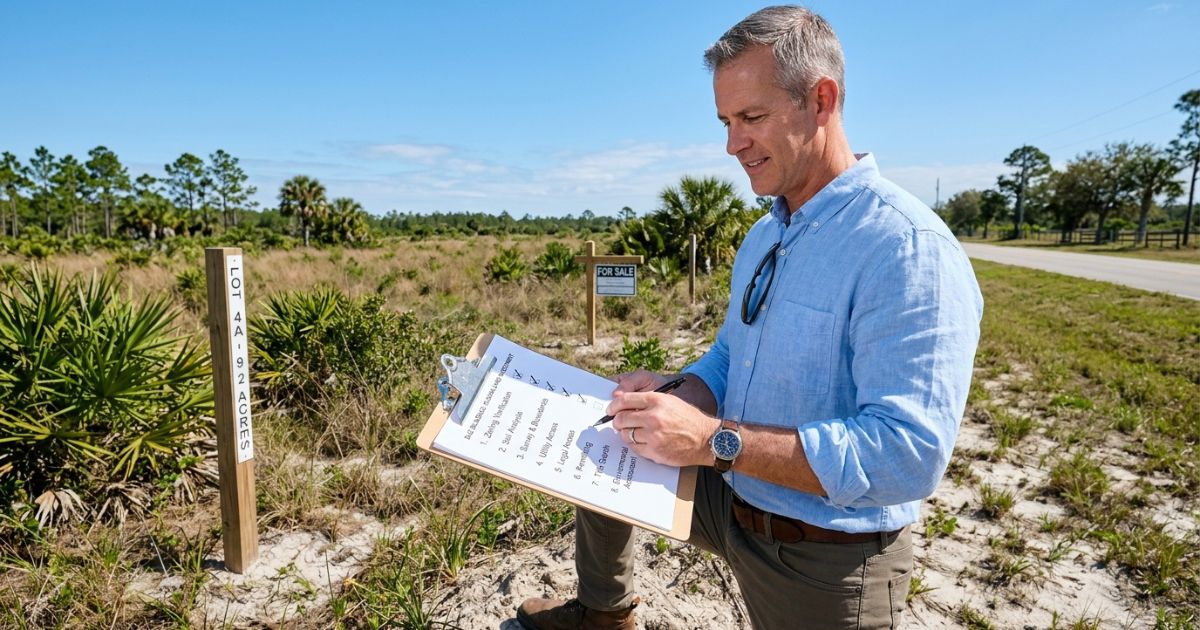
If the only thing standing between you and signing a contract is the excitement of finally finding “the right lot,” the real risk isn’t moving too fast — it’s what gets left unchecked when a decision is made in a hurry. The visible risk is paying a fair price for a nice-looking parcel. The real danger is finding out months after closing that the land can’t be built on the way you planned, or that a title issue nobody caught is now your problem to solve. Here’s the checklist experienced buyers actually follow to avoid exactly that.
Most people assume that buying land is mainly about price and location. In reality, the most expensive problems rarely show up on the listing price — they show up later, in the form of incompatible zoning, an unidentified flood zone, or lot boundaries that turn out to be different from what the listing described.
Table of Contents
- What should be on your checklist before buying land in Florida?
- How to verify zoning before you sign a contract
- How to confirm whether a lot sits in a flood zone
- Land survey: why confirming exact boundaries matters
- Title search and title insurance: confirming the seller can actually sell
- Utility access: water, sewer, and electricity
- Quick checklist vs. full checklist: what changes
- Common mistakes buyers make without a checklist
- Hidden costs that show up after closing
- FAQ — Frequently Asked Questions
- 📚 Glossary
- ✅ Immediate Actions — Start Now
What should be on your checklist before buying land in Florida? {#checklist-overview}
Short answer: a complete Florida land-buying checklist confirms zoning, flood zone status, exact lot boundaries through a land survey, chain of title through a title search, utility access, and any HOA rules or deed restrictions — all before you sign the purchase contract.
A good checklist isn’t about slowing the process down. It’s about turning an emotional decision (“I like this lot”) into a verified one (“I confirmed this lot is what the listing says it is”). Six checks sit at the core of every safe land purchase, and each one protects against a different category of risk:
- Current zoning, to confirm what the parcel is legally allowed to be used for
- Flood zone status, to understand flood risk and insurance requirements
- Land survey, to confirm the exact boundaries of the lot
- Title search, to confirm the seller has the legal right to sell
- Utility access, to know whether water, sewer, and electricity are already available
- HOA rules or deed restrictions, when the lot sits inside a platted subdivision
Each item answers a specific question, and skipping any one of them means signing a contract without that answer in hand.
How to verify zoning before you sign a contract {#zoning}
Short answer: zoning is verified directly with the county planning or zoning department where the land is located, and it confirms whether your intended use — residential, agricultural, commercial — is actually permitted under current law.
A lot can look perfect for building a home and still be zoned for something entirely different. Before signing anything, it’s worth confirming:
- The current zoning code for the parcel and exactly what it permits
- Whether a rezoning process is pending that could change those rules later
- The minimum lot size required for construction, especially if the parcel was subdivided
- Required setbacks from the property lines
This information is usually posted on the county website, but a phone call or email to the zoning department is the safest way to avoid relying on an outdated map.
A parcel that’s zoned agricultural today can require a formal rezoning application — sometimes taking months — before a single-family home can be permitted on it.
How to confirm whether a lot sits in a flood zone {#flood-zone}
Short answer: a lot's flood zone status is confirmed using FEMA's official Flood Insurance Rate Maps for the exact parcel or address, and that classification determines whether flood insurance will be required and roughly how much it will cost.
Florida has an unusually large share of land classified in FEMA-designated flood risk zones, which doesn’t rule out buying — it just changes how you should plan financially:
- Parcels in high-risk zones (such as AE or VE) typically require flood insurance as a condition of any future financing
- Insurance cost varies significantly based on the lot’s elevation relative to FEMA’s base flood elevation
- Some lots have part of the parcel inside a flood zone and part outside, which affects where a home can realistically be built
Confirming this before you buy keeps the cost of flood insurance from becoming a surprise you only discover when it’s time to build or finance.
Land survey: why confirming exact boundaries matters {#land-survey}
Short answer: a land survey is a technical assessment performed by a licensed surveying company that confirms the exact boundaries of a lot, flags any encroachments from neighboring properties, and locates easements that could restrict where you're able to build.
Listing photos and county maps give a reasonable sense of a parcel’s location, but they’re no substitute for a current survey. It’s worth commissioning one when:
- The land has never been surveyed recently, or the available survey is several years old
- Fences, roads, or neighboring structures sit close to the property lines
- The listing mentions access easements or utility easements crossing the lot
The cost of a land survey is small compared to the risk of buying a parcel whose real boundaries turn out to be different from what you assumed.
Title search and title insurance: confirming the seller can actually sell {#title-search}
Short answer: a title search is a review of a parcel's chain of ownership, performed by a title company, that confirms the seller has the legal right to sell the property and identifies any liens, debts, or ownership disputes attached to it.
This step protects buyers from problems that a site visit could never reveal:
- Unpaid property taxes tied to the parcel
- Liens from contractors, builders, or homeowners associations
- Unresolved inheritance or ownership disputes
- Errors in previous deed recordings
Title insurance, purchased alongside the title search, protects you financially if a title problem surfaces after closing — even one the original search didn’t catch.
Title insurance is typically a one-time cost at closing, but it’s one of the few protections that keeps working for you for as long as you own the land.
Utility access: water, sewer, and electricity {#utilities}
Short answer: before buying, confirm whether a lot already has access to public water and sewer or will require a well and septic system, since that difference can add a significant cost before you're able to build.
Vacant lots vary widely on this point, even within the same county:
- Some parcels already have utility connections available at the road, requiring only a hookup fee
- Others require a private well and septic system, with installation cost and county health department approval
- Distance to the nearest power line can also add cost for a utility extension
Confirming this with the local utility provider and county health department before you buy keeps your construction budget from doubling after the purchase is already final.
Quick checklist vs. full checklist: what changes {#comparison}
Short answer: a quick checklist only covers price, location, and appearance, while a full checklist confirms zoning, flood zone, survey, title, and utilities — and that difference is exactly what protects a buyer from unexpected costs after closing.
| Verification | Quick checklist | Full checklist |
|---|---|---|
| Zoning | Assumed from the listing | Confirmed with the county |
| Flood zone | Not verified | Confirmed on FEMA maps |
| Lot boundaries | Based on the listing map | Confirmed by land survey |
| Ownership | Not verified | Confirmed by title search |
| Utilities | Assumed available | Confirmed with the utility provider and county |
The time difference between the two approaches is usually a matter of weeks — a small investment compared to the cost of discovering a problem after the deal has already closed.
Common mistakes buyers make without a checklist {#common-mistakes}
Relying only on listing photos and maps
Photos and online maps give a general sense of a lot, but they don’t confirm exact boundaries or zoning restrictions. It’s always worth cross-checking against official county sources before making an offer.
Skipping the land survey to save money
A current survey costs a small fraction of the land’s price and prevents boundary disputes that can end up costing far more to resolve after the fact.
Not confirming flood zone status before budgeting for construction
Finding out after closing that a lot requires mandatory flood insurance can meaningfully change the total budget for a building project.
Assuming utilities are already available
Vacant lots don’t always have water, sewer, or electricity nearby. Confirming this upfront prevents an underestimated construction budget later.
Skipping title search and title insurance
Skipping this step leaves buyers exposed to liens or ownership disputes that can surface years after the purchase, long after the seller is no longer part of the picture.
Hidden costs that show up after closing {#hidden-costs}
Beyond the price of the land itself, a handful of due-diligence-related costs are commonly left out of the initial budget:
- Land survey, when the lot’s boundaries aren’t clearly confirmed
- Title insurance, which protects against issues in the chain of ownership
- Utility hookup fees, when the lot depends on a well, septic system, or a power line extension
- Flood insurance, when the parcel sits in a higher-risk FEMA flood zone
- Real estate attorney fees, for contract review and closing support
Short answer: the most common hidden costs in a Florida land purchase are the land survey, title insurance, utility hookups, and flood insurance — all predictable expenses when the due diligence checklist is followed before signing.
FAQ — Frequently Asked Questions {#faq}
What are the most important items on a Florida land-buying checklist?
Zoning, flood zone status, land survey, title search, and utility access are the core checks that protect buyers against the most common and most expensive problems.
Is a land survey required before buying land?
It isn’t legally required in every case, but it’s strongly recommended whenever a parcel doesn’t have a recent survey on file or there’s any uncertainty about its exact boundaries.
Is flood insurance mandatory in Florida?
It depends on the parcel’s FEMA flood zone classification. In higher-risk zones, lenders typically require flood insurance as a condition of financing.
How do I know if a lot has water and sewer access?
Confirm directly with the local utility provider and the county health department, which can tell you whether public service is available or whether the lot will require a well and septic system.
Can foreign buyers use this same checklist to buy land in Florida?
Yes. The checklist applies the same way to foreign buyers, and the process can be handled with support from a bilingual agent and a local real estate attorney.
📚 Glossary {#glossary}
Zoning: the set of county rules that determines what a parcel of land is legally allowed to be used for.
Flood Zone: a FEMA-designated area with a specific flood risk classification that affects insurance requirements.
Land Survey: a technical assessment that confirms the exact boundaries of a parcel.
Title Search: a review of a parcel's chain of ownership to confirm the seller's legal right to sell.
Title Insurance: a policy that protects a buyer against ownership issues discovered after closing.
Setback: the minimum required distance between a structure and the property line.
Easement: a third party's legal right to use part of a property, typically for access or utilities.
✅ Immediate Actions — Start Now {#immediate-actions}
- Request the current zoning classification for your target parcel from the county.
- Check FEMA's official flood maps to confirm the lot's flood zone status.
- Request a recent land survey or get a quote for a new one.
- Hire a title company to run a title search and issue title insurance.
- Confirm water, sewer, and electricity access with the local utility provider.
- Contact TerraNoble for bilingual guidance on applying this checklist to your specific purchase.
Conclusion
Buying land in Florida safely isn’t a matter of luck — it comes down to working through a checklist that confirms what actually matters: zoning, flood zone status, lot boundaries, ownership, and utility access. Each item you verify closes off a specific category of risk, and together they turn a decision based on photos and enthusiasm into one based on documentation.
Buyers who skip steps on this checklist to close faster usually pay for it later, either through an unexpected cost or a restriction they discover too late to plan around.
TerraNoble offers bilingual support — in English and Portuguese — to help buyers apply this checklist with confidence at every stage of purchasing land in Florida. Get in touch with our team.