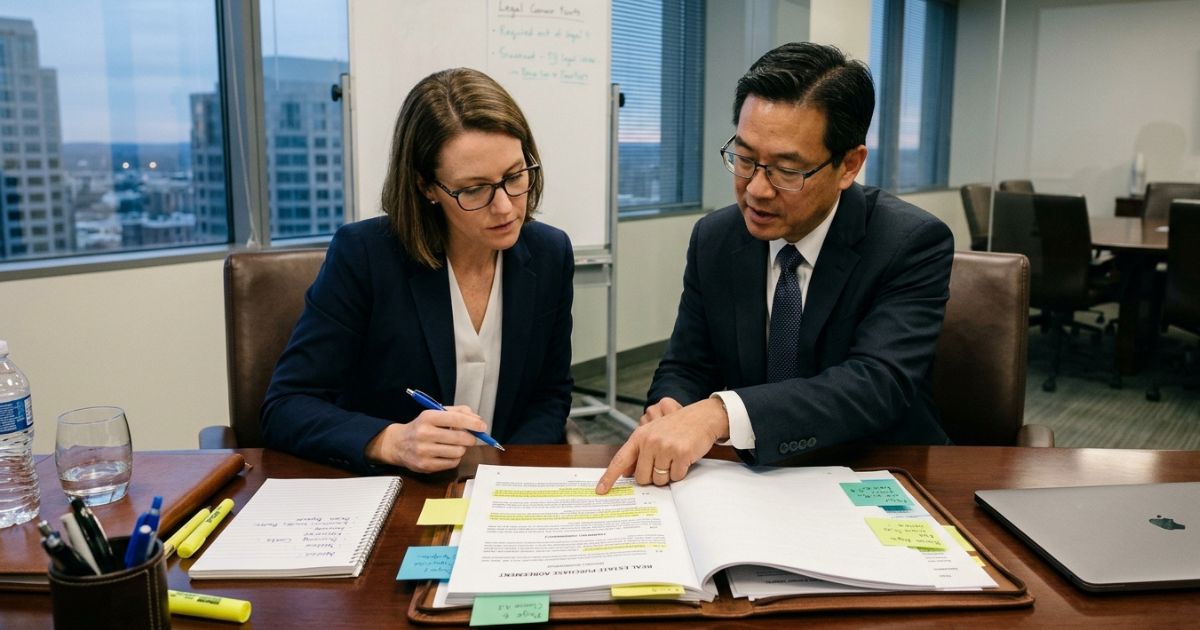
If you’re about to sign the contract on a piece of land in Florida, the visible question is the price, the timeline, and the payment terms. The real risk lives in the questions you never asked — about zoning, title, restrictions, and deadlines — because those are the gaps that turn into unexpected costs and disputes after the signature is already on the page.
Most people treat the contract as a formality that happens after the price has been negotiated. In reality, the contract is the last moment when the buyer still has negotiating power and time to verify information — once it’s signed, fixing a problem discovered late costs far more than asking about it beforehand.
Table of Contents
- Why Asking the Right Questions Avoids the Costliest Mistakes
- Questions About Zoning and Permitted Use
- Questions About Title and Ownership
- Questions About Flood Zones, Insurance, and Utilities
- Questions About HOA and Use Restrictions
- Questions About Deadlines, Financing, and Contract Terms
- When to Ask Each Question — The Purchase Timeline
- Common Mistakes When Signing Without These Answers
- Hidden Costs These Questions Help You Avoid
- FAQ — Frequently Asked Questions
- 📚 Glossary
- ✅ Immediate Actions — Start Now
Why Asking the Right Questions Avoids the Costliest Mistakes {#why-ask}
Short answer: most expensive problems in Florida land purchases don't come from bad faith on the seller's side — they come from information the buyer never asked about, because they assumed it was accurate or that it would surface automatically during the process.
Unlike buying a finished home, vacant land has no structure to inspect. That makes many buyers relax their due diligence, assuming “it’s just land, there isn’t much to check.” In practice, the opposite is true: vacant land hides more invisible variables — zoning, utility access, use restrictions, title issues — precisely because there’s no building forcing that information into the open.
Every question you ask before signing removes one specific unknown. And every unresolved unknown becomes a financial risk that only shows up later, when it’s more expensive and harder to fix.
Questions About Zoning and Permitted Use {#zoning}
Short answer: confirming the current zoning and permitted use of the land with the county, before signing, is the single most important question in the entire negotiation — because it determines whether you'll actually be able to use the land the way you plan to.
Essential questions in this category:
- What is the land’s current zoning designation, according to the county? — don’t rely solely on the listing description or the agent’s word
- Is the use I’m planning actually allowed under the current zoning? — building a home, running a business, or simply holding the land as an investment each carry different requirements
- Are there setback, height, or density restrictions that limit what can be built?
- Is there any rezoning process underway in the area that could affect the parcel?
- Does the parcel ID in the contract match the exact lot being described?
These answers should come directly from the county’s planning and zoning department — not just from the seller or the listing agent.
Questions About Title and Ownership {#title}
Short answer: before signing, buyers should confirm that the land's title is clean, free of liens, ownership disputes, or deed restrictions that could compromise future ownership.
Questions every buyer should bring to the title company or attorney:
- Are there any liens recorded against the property, including unpaid property taxes?
- Is the seller actually the legal owner, with full authority to sell the entire lot?
- Is there any boundary dispute with neighboring parcels?
- Does the contract include title insurance, and who covers that cost?
- Are there deed restrictions that limit the land’s use even within what the zoning otherwise allows?
A title with pending issues doesn’t necessarily block the purchase, but it changes the risk level entirely — and should be resolved, or reflected in the price, before the final signature.
Questions About Flood Zones, Insurance, and Utilities {#flood-utilities}
Short answer: land sitting in a high-risk flood zone or lacking easy access to water, sewer, and electricity can significantly change the property's real cost — which is why these questions need to be asked before signing, not after.
- Which FEMA flood zone is the parcel classified under?
- Will flood insurance be required, and what’s the estimated annual cost?
- Does the land have access to public water and sewer, or will it depend on a well and septic tank?
- How far is the nearest electrical connection point, and who covers the cost of extending it?
- Has a soil or percolation study already been done, in case the land will depend on a septic system?
These answers directly affect the buyer’s long-term budget, even if the land is never built on.
Questions About HOA and Use Restrictions {#hoa-restrictions}
Short answer: if the land sits inside a community with an HOA, the buyer needs to understand the rules, fees, and restrictions before signing — because those obligations keep existing even if the land stays vacant for years.
- Does the property belong to a homeowners association or a landowners association?
- What is the monthly or annual fee, and how often can it increase?
- Are there specific rules about the type of construction allowed, a deadline to build, or how the land can be used while vacant?
- Has the association recently imposed, or is it planning, any special assessment?
Skipping these questions is one of the most common mistakes among buyers who focus only on the land’s price and forget about the recurring costs of holding the property.
Questions About Deadlines, Financing, and Contract Terms {#contract-terms}
Short answer: the contract itself contains clauses about earnest money, the inspection period, and contingencies that determine how much real protection the buyer has — and those terms need to be understood, not just signed.
- What is the earnest money deposit amount, and under what conditions is it refundable?
- How long is the due diligence period, and what happens if I need more time?
- Does the contract include financing, title, or zoning contingencies that let me walk away without losing the deposit?
- Who pays the closing costs — buyer, seller, or a split between both?
- What is the expected closing date, and is there flexibility if due diligence runs into delays?
- Does the contract clearly specify the type of deed that will be used to transfer ownership?
Land purchase contracts tend to be leaner than contracts for finished homes — which means every clause carries more weight, and missing clauses can represent protections that simply don’t exist.
When to Ask Each Question — The Purchase Timeline {#timeline-table}
| Purchase Stage | Priority Questions | Who to Confirm With |
|---|---|---|
| Before making the offer | Zoning, permitted use, flood zone | County zoning department, FEMA flood maps |
| While drafting the contract | Earnest money, inspection period, contingencies | Listing agent, real estate attorney |
| During the due diligence period | Title, liens, deed restrictions, HOA | Title company, homeowners association |
| Before closing | Utilities, closing costs, deed type | Title company, local utility providers |
Common Mistakes When Signing Without These Answers {#common-mistakes}
Assuming the agent already checked everything
The agent facilitates the transaction, but final due diligence is the buyer’s responsibility. Blindly trusting the listing information is one of the most frequent mistakes.
Not using the full inspection period
Many buyers sign the contract and let the due diligence period pass without doing any further verification, losing the one window in which they could walk away without penalty.
Ignoring missing contingency clauses
A contract without title or zoning contingencies might look simpler, but it leaves the buyer unprotected if a problem surfaces after signing.
Not confirming the deed type in writing
Assuming the transfer will use a warranty deed without confirming it in the contract can result in a transfer with fewer legal guarantees than the buyer expected.
Leaving HOA questions for after closing
Discovering an association’s fees or restrictions only after the purchase is an avoidable mistake, since this information is usually available publicly before signing.
Hidden Costs These Questions Help You Avoid {#hidden-costs}
- Unexpected rezoning needs — buying land while assuming a use that actually requires rezoning can lead to months of delay and additional legal costs
- Retroactive property taxes or undiscovered liens — prior debts on the land can become the new owner’s responsibility if they aren’t identified before closing
- Utility extension costs — bringing water, sewer, or electricity to the lot can cost thousands of dollars if it isn’t budgeted for in advance
- Flood insurance more expensive than expected — land in high-risk flood zones can carry significantly higher annual premiums
- Loss of earnest money — signing a contract without understanding the deposit’s refund conditions can result in losing that money if the deal doesn’t move forward
FAQ — Frequently Asked Questions {#faq}
What are the most important questions to ask before signing a Florida land contract?
The most important ones cover zoning and permitted use, title status (liens and disputes), flood zone classification, utility access, and the contract’s earnest money and inspection period terms.
Do I need to hire an attorney to review the contract before signing?
It’s not legally required in most cases, but it’s highly recommended, especially for foreign buyers or out-of-state buyers who may not be familiar with Florida’s contract practices.
What is the due diligence period and why does it matter?
It’s the period defined in the contract during which the buyer can investigate the land — zoning, title, physical condition — and walk away from the deal without penalty, typically with the earnest money refunded, if a significant problem is found.
Is earnest money always refundable if I decide not to buy?
Not always. Refundability depends on the contingencies included in the contract. Without those clauses, the buyer can lose the deposit by backing out of the deal.
Do foreign buyers need to ask different questions before signing in Florida?
The core questions are the same, but foreign buyers usually benefit from additional bilingual guidance on financing, required documentation, and remote closing processes.
📚 Glossary {#glossary}
Earnest money — a good-faith deposit paid by the buyer when signing the contract, showing commitment to the purchase, which may be refundable depending on the contract’s terms.
Due diligence period — the contractual window during which the buyer can investigate the land and decide whether to move forward with the purchase.
Contract contingency — a clause allowing the buyer to walk away from the deal without penalty if a specific condition isn’t met, such as financing approval or zoning confirmation.
Deed restriction — a use restriction recorded on the property’s deed that can limit what can be built or how the land can be used.
Lien — a debt or claim recorded against a property that must be resolved before a clean title transfer can occur.
Title company — the company responsible for verifying a property’s title history and issuing title insurance during closing.
Parcel ID — the unique identification number assigned to a piece of land, used by the county for tax records and zoning lookups.
✅ Immediate Actions — Start Now {#immediate-actions}
- Confirm the land’s current zoning and permitted use directly with the county
- Request a title search before signing the final contract
- Check the property’s flood zone classification on official FEMA maps
- Ask about water, sewer, and electrical access, and estimate extension costs if needed
- Review the earnest money, contingency, and inspection period clauses carefully
- Talk to TerraNoble for bilingual guidance before signing the contract on your Florida land
Conclusion
Signing the contract on a piece of Florida land shouldn’t be the end of due diligence — it should be the result of it. The right questions about zoning, title, utilities, and contract terms are what separate a safe purchase from an expensive surprise discovered months after closing.
None of these questions are complicated to ask. What’s usually missing isn’t access to the information, but the habit of asking before signing, instead of after. A buyer who brings these questions into the negotiation arrives at the contract with more clarity — and far more protection — than one who relies solely on the seller’s or agent’s word.
TerraNoble offers bilingual support — in English and Portuguese — to help buyers understand every clause in the contract and ask the right questions before signing. Get in touch with our team to review your specific situation before closing the deal.