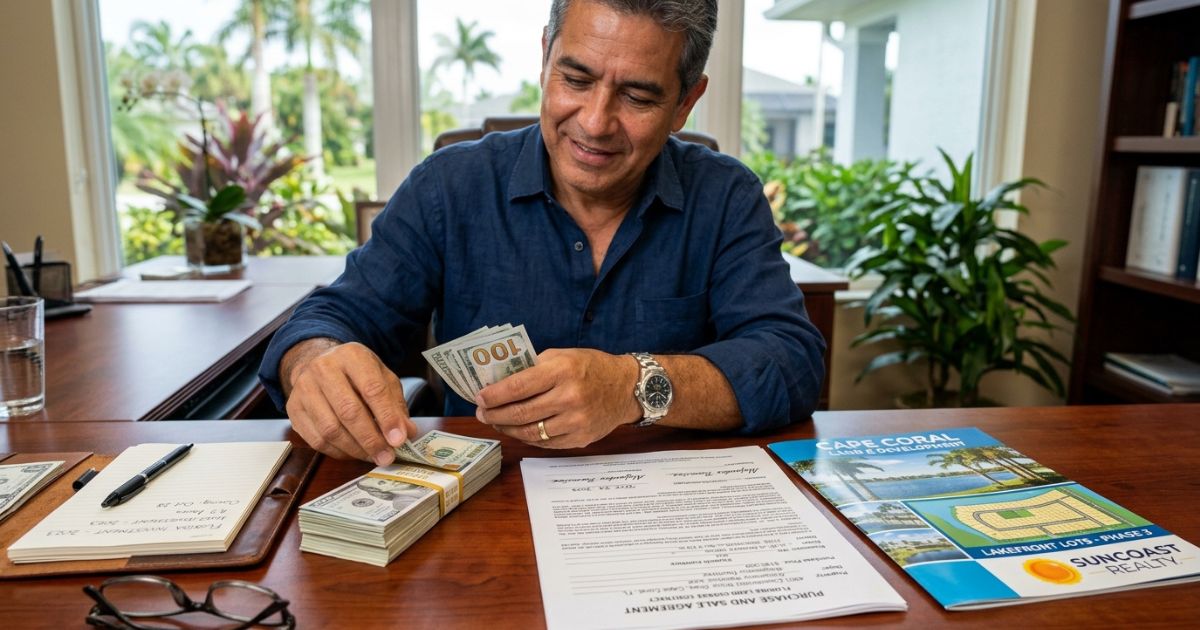
If you think the biggest challenge to buying land in Florida is simply saving up “a down payment,” the real problem is something else. It’s discovering, late in the process, that the percentage you planned for isn’t the one the bank, credit union, or seller actually requires. Raw land doesn’t follow the same rules as a finished home, and that gap can delay a purchase by months or force a last-minute renegotiation.
Most buyers assume land follows the same 10% to 20% down payment pattern common with home mortgages. In reality, the required amount depends on the type of land, whether utilities are already in place, the buyer’s credit history, and who is financing the purchase. Understanding these variables ahead of time is what separates a realistic financial plan from an unpleasant surprise midway through closing.
Table of Contents
- What counts as a down payment when buying land
- How much do banks require to finance raw land
- Down payment varies by type of land
- Seller financing: an alternative with a lower down payment
- What increases or reduces the down payment required
- Common mistakes when planning your down payment
- Hidden costs beyond the down payment
- FAQ — Frequently Asked Questions
- 📚 Glossary
- ✅ Immediate Actions — Start Now
What counts as a down payment when buying land {#what-is-down-payment}
Short answer: a down payment is the portion of the land's purchase price paid directly by the buyer at closing, without financing. The larger the down payment, the smaller the amount financed — and for land, a higher down payment is often a condition of loan approval, not just a buyer's preference.
Unlike a finished home, where the property itself serves as solid, liquid collateral for the lender, vacant land is viewed as a higher-risk asset. It doesn’t generate income, it’s harder to resell quickly, and in many cases it still lacks basic infrastructure. That’s why lenders require proportionally higher down payments than they would for a completed property.
The down payment serves two purposes in this context: it reduces the lender’s risk, and it demonstrates the buyer’s financial commitment to the project — whether that means holding the land as an investment, building a home down the road, or simply diversifying assets outside their home country.
How much do banks require to finance raw land {#bank-requirements}
Short answer: banks and credit unions in the US typically require between 20% and 50% down to finance raw or vacant land in Florida, well above the 10% to 20% common for financing a finished home.
That wide range exists because every lender evaluates risk differently, weighing factors such as:
- Whether the land is rural or urban — parcels inside developed areas, close to existing infrastructure, tend to qualify for lower down payments
- Whether utilities are already available — water, sewer, and electricity already installed reduce the risk the lender perceives
- The buyer’s credit history — a strong FICO score can lower the down payment required, while the absence of US credit history tends to push it higher
- The declared purpose of the land — lots intended for immediate home construction often get more favorable terms than land purchased purely as speculative investment
For foreign buyers without a US credit history, it’s common for traditional banks to require down payments at the higher end of this range, when they agree to finance the land at all. Many simply don’t offer this type of loan to non-residents, which leads a large share of international investors toward cash purchases or seller financing instead.
Down payment varies by type of land {#down-payment-by-type}
Short answer: the closer a parcel is to "build-ready" — with utilities, paved access, and defined zoning — the lower the down payment a lender typically requires. Rural land, unimproved parcels, or land with undefined use tends to carry the highest down payment requirements.
| Type of Land | Typical Down Payment | Why It Varies |
|---|---|---|
| Build-ready urban lot (with utilities) | 15% to 25% | Lower risk, infrastructure already installed, easier resale |
| Lot in a planned subdivision | 20% to 30% | Zoning already defined, but no construction yet |
| Rural land with limited access | 30% to 50% | Harder to appraise, slower resale, minimal infrastructure |
| Raw land with no utilities or paved road | 35% to 50%+ | Higher perceived risk, few lenders willing to finance it |
| Cash purchase | 100% | Eliminates the down payment and loan approval process entirely |
These ranges are general market references — every lender sets its own criteria, and actual figures can vary by region of Florida, total land value, and prevailing credit conditions at the time of purchase.
Seller financing: an alternative with a lower down payment {#seller-financing}
Short answer: when the landowner finances the purchase directly (seller financing), the down payment usually falls between 10% and 30% of the purchase price — often more accessible than bank requirements, especially for foreign buyers without US credit.
In seller financing, the seller sets the approval criteria, not a bank. That tends to make the down payment more negotiable, tailored to the buyer’s profile and how much confidence the seller has in the deal. Even so, a lower down payment doesn’t mean less diligence is needed: the contract still needs a properly drafted promissory note and a recorded security instrument (a mortgage or security deed), along with a title search and title insurance, to protect the buyer the same way a traditional bank loan would.
It’s worth keeping in mind that a lower down payment in seller financing usually comes with higher monthly payments or a higher interest rate — the reduction upfront gets offset somewhere else in the contract, and it shouldn’t be treated as “free money.”
What increases or reduces the down payment required {#factors}
Several factors, beyond the type of land itself, directly influence the down payment percentage a lender or seller will ask for:
- US credit history (FICO score) — buyers without a US credit history tend to receive offers with higher down payment requirements, when they get approved at all
- Income verified in foreign currency — can limit traditional financing options and push buyers toward larger down payments or cash purchases
- Loan-to-value ratio (LTV) — the lower the LTV a lender wants, the higher the down payment required from the buyer
- FEMA flood zone designation — land located in higher-risk flood zones can come with more restrictive lending conditions
- Zoning and intended use — parcels with defined residential zoning tend to have better terms than land with agricultural or undefined use
- Loan term — the shorter terms common with land loans are often paired with higher down payments than the longer terms typical of home mortgages
Common mistakes when planning your down payment {#common-mistakes}
Using a home mortgage percentage as the benchmark
Assuming that 10% or 20% will be enough, the way it would be for a traditional home loan, is one of the most frequent mistakes among first-time land buyers in Florida.
Not accounting for the difference between raw land and a developed lot
Comparing two very different parcels — a rural lot with no utilities and one inside a planned subdivision — leads to unrealistic down payment expectations.
Overlooking the impact of not having US credit
Foreign buyers who don’t research this ahead of time often discover, well into negotiations, that the required down payment is much higher than they had planned for.
Not setting aside reserves for costs beyond the down payment
Focusing only on the down payment amount and forgetting to budget for due diligence, title insurance, and closing costs is a mistake that throws off the entire purchase budget.
Assuming every lower down payment is automatically a good deal
A smaller down payment, whether through seller financing or a specific loan program, is almost always offset by higher interest or larger monthly payments — buyers need to evaluate the total cost, not just the upfront number.
Hidden costs beyond the down payment {#hidden-costs}
The down payment is only part of what’s needed at closing. Other common costs include:
- Title search and title insurance — confirm the land is free of liens and protect the buyer against ownership disputes
- Closing costs — typically between 2% and 5% of the land’s value, including recording fees and professional fees
- Land survey — confirms boundaries, easements, and any restrictions on the parcel
- Prorated property tax — the portion of the property tax owed between closing and the end of the tax year
- HOA fees, when applicable — for land located inside a planned community with a homeowners association
Short answer: beyond the down payment, it's common to set aside an additional 3% to 7% of the land's value to cover title search, title insurance, land survey, and closing costs — planning ahead avoids surprises on closing day.
FAQ — Frequently Asked Questions {#faq}
What’s the minimum down payment to buy land in Florida?
There’s no fixed number. In general, banks and credit unions require between 20% and 50% of the land’s value, depending on the type of parcel, utility access, and the buyer’s credit history.
Can foreign buyers finance Florida land with a lower down payment?
It’s possible, but less common through traditional banks. Many foreign buyers turn to seller financing instead, which typically requires a down payment between 10% and 30%, with terms set directly by the seller.
Is it possible to buy land in Florida with no down payment at all?
Certain programs, such as some rural development loans, allow for reduced or zero down payment in very specific situations, but they come with strict eligibility, use, and location requirements. For most buyers, especially foreign buyers, some down payment should be expected.
Is the down payment the same for land as for a finished home?
No. Raw land is considered a higher-risk asset by lenders, which typically results in higher down payment requirements than financing an already-built home.
Does paying cash eliminate the down payment requirement?
Yes. When the purchase is made entirely in cash, there’s no financing involved, so no down payment requirement applies — the full purchase price is paid directly at closing.
📚 Glossary {#glossary}
Down payment: the amount paid directly by the buyer at closing, without financing, which reduces the total amount that needs to be borrowed.
Raw land / vacant land: a parcel with no construction on it, which may or may not have basic infrastructure installed.
Utilities: water, sewer, and electrical infrastructure available for connection at the property.
LTV (Loan-to-Value): the ratio between the loan amount and the total value of the property, used by lenders to calculate risk.
FICO score: the credit score used by US financial institutions to evaluate a buyer's risk profile.
Seller financing: an arrangement where the landowner finances the purchase directly for the buyer, without a bank involved.
Land survey: a professional measurement that confirms boundaries, easements, and physical characteristics of a parcel.
Closing costs: the fees and expenses paid at closing, in addition to the purchase price and the down payment.
✅ Immediate Actions — Start Now {#immediate-actions}
- Identify the type of land you're planning to buy (urban, rural, with or without utilities)
- Check whether the parcel sits in a FEMA flood zone before negotiating loan terms
- Get pre-approval or a loan estimate from at least two different lenders to compare down payment percentages
- Consider seller financing as an alternative if you don't have US credit history
- Set aside an additional 3% to 7% of the land's value for title search, title insurance, survey, and closing costs
- Contact TerraNoble for bilingual guidance on down payments, financing, and structuring a safe purchase
Conclusion
There’s no universal down payment percentage for buying land in Florida — the actual number depends on the type of parcel, available infrastructure, the buyer’s credit history, and who is financing the transaction. Treating raw land with the same expectations as a finished home is one of the most common planning mistakes, and one of the easiest to avoid with the right research upfront.
Whether through bank financing, seller financing, or a cash purchase, understanding these variables in advance makes it possible to negotiate with more confidence and avoid financial surprises at closing.
TerraNoble offers bilingual support — in English and Portuguese — to help foreign investors understand exactly how much down payment to expect and how to structure a safe land purchase in Florida. Get in touch with our team.