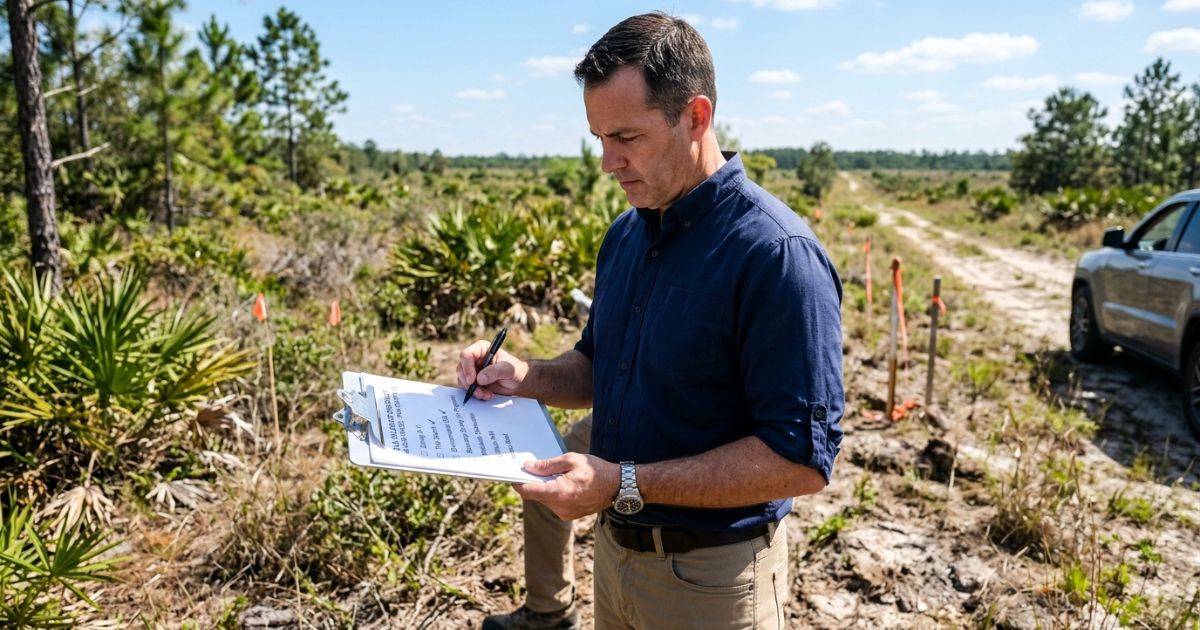
Before any offer becomes a closing, a careful buyer verifies zoning, flood zone status, survey boundaries, title history, and utility access. That verification process — due diligence — is what reveals whether a cheap lot is a real opportunity or a problem waiting to surface.
If a Florida lot looks cheap for its size and location, the price is rarely the biggest issue. The real risk is what doesn’t show up in the listing photos — a zoning restriction that blocks the use you had planned, a flood zone designation that forces mandatory insurance, an easement buried in the title history that nobody mentioned. Experienced buyers avoid these surprises by completing due diligence before they sign anything.
Most buyers think land purchases are mainly about price and location. In reality, what determines whether a purchase was a good decision is what got verified — or skipped — before closing.
Due diligence isn’t optional paperwork. It’s the process that turns an emotional decision into an informed one. This guide walks through exactly what to check before buying land in Florida, which documents to request, which professionals to involve, and which mistakes cost buyers the most after closing.
Table of Contents
- What due diligence means and why Florida is different
- How to verify zoning and permitted land use
- Checking the FEMA flood zone map before you buy
- Why you need a land survey before closing
- Running a complete title search
- Confirming utility access before you buy vacant land
- Checking for wetlands and environmental restrictions
- Due diligence checklist: verified vs. unverified buyers
- Common mistakes first-time land buyers make
- Hidden costs that show up after closing
- FAQ — Frequently Asked Questions
- Glossary
- Immediate Actions — Start Now
What due diligence means and why Florida is different {#what-it-means}
Short answer: due diligence is the process of verifying a property's legal and physical status before purchase — zoning, flood zone, survey, title, and utilities. In Florida, this matters more than in many other states because of the combination of high natural-risk exposure, strict environmental regulation, and a large share of lots sold remotely to buyers who never walk the parcel themselves.
Florida has a particular mix of factors that make due diligence essential: extensive protected wetlands, flood zone maps that get revised periodically, county-by-county zoning rules that vary widely, and a high volume of land sold to out-of-state and international buyers — including many Brazilian buyers — who purchase without ever visiting the lot in person.
That doesn’t make buying land in Florida risky. It makes the process more straightforward than most people expect, as long as it’s done in the right order. Due diligence is that order: a set of verifications any buyer, domestic or foreign, can and should complete before signing a contract.
How to verify zoning and permitted land use {#zoning}
Short answer: zoning determines what can legally be built on a parcel — residential, agricultural, commercial, or mixed use. Checking the county's zoning code before buying prevents you from purchasing a lot that doesn't allow the use you had in mind.
Zoning is set at the county level, not the state level, which means two neighboring lots in different counties can carry completely different rules. Before making any offer, confirm the following:
- The current zoning classification through the county property appraiser’s office or zoning department website.
- Whether the zoning allows your intended use — single-family residential, multi-unit, agricultural, or commercial.
- The minimum lot size required for building, which varies by zone and can prevent future subdivision of the parcel.
- Whether any rezoning is planned for the area, which could change both the value and the allowed use of the lot.
Land marketed as “residential” doesn’t always have confirmed residential zoning — sometimes a seller describes the intended use rather than the legally permitted one. That distinction only becomes clear when the buyer verifies directly with the county.
Checking the FEMA flood zone map before you buy {#flood-zone}
Short answer: nearly every parcel in Florida carries a FEMA flood zone classification. The question isn't whether flood risk exists — it's which zone applies and what that means for insurance, financing, and construction requirements.
The official map is available free at msc.fema.gov, and checking it should be one of the first steps in due diligence — before you even schedule a visit to the lot.
- Zone X: minimal to moderate risk. Flood insurance isn’t required for financing, though it may still be worth carrying depending on local drainage patterns.
- Zone AE: high-frequency (100-year) flood area. Flood insurance is mandatory for any financed purchase, and construction often requires elevated foundations.
- Zone VE: coastal zones subject to wave action. Higher insurance costs and stricter building restrictions apply.
Beyond the official designation, it’s worth talking to neighbors or the county about the area’s actual flooding history — in some cases, local topography creates drainage problems that don’t show up clearly on the FEMA map.
Why you need a land survey before closing {#survey}
Short answer: a professional land survey confirms the exact boundaries of a parcel and identifies easements, encroachments, and non-buildable areas. Without a survey, a buyer is relying only on the legal description in the deed, which doesn't always match the physical reality of the lot.
There are a few survey types worth understanding:
- Boundary survey: confirms the exact property lines and flags any encroachment from neighboring structures.
- Topographic survey: maps elevation and drainage patterns, especially important for lots near water or in low-lying areas.
- Wetland delineation: identifies protected wetland areas within the parcel, which reduce the buildable footprint.
An up-to-date survey — completed recently, not an old document handed over by the seller — is the only reliable way to know exactly what you’re buying, including whether fences, access roads, or neighboring structures encroach on the lot’s boundaries.
Running a complete title search {#title-search}
Short answer: a title search reveals a parcel's legal history — liens, easements, inheritance disputes, and recorded restrictions. Conducted by a licensed title company, this process is what ensures the title transfers clean and that the buyer qualifies for title insurance.
A thorough title search should uncover:
- Unpaid liens or mortgages attached to the property.
- Easements for access, utilities, or public use that limit how the lot can be used.
- Unresolved inheritance disputes or shared ownership claims.
- Deed restrictions — recorded limitations on use, often tied to an HOA or an older subdivision plan.
Title insurance, issued based on this search, protects the buyer against title problems that surface after closing — including issues the initial search failed to catch. Skipping this step to save time or money is one of the most expensive mistakes a land buyer can make.
Confirming utility access before you buy vacant land {#utilities}
Short answer: the availability of water, sewer, and electricity directly affects both the cost and feasibility of building. Lots without access to public utilities may require a well and septic system, which changes the construction budget significantly.
Before buying, check with the local utility provider and the county health department to confirm:
- Whether the lot has access to public water and sewer, or whether it will require a well and septic system.
- The distance to the nearest electrical connection point, since extending power lines can carry a meaningful cost.
- Whether the soil has passed a percolation test, required by the county before a septic system can be installed.
A lot without existing infrastructure isn’t necessarily a bad deal — but the cost of bringing water, sewer, and power to the property needs to be part of the budget before you buy, not after.
Checking for wetlands and environmental restrictions {#wetlands}
Short answer: Florida enforces strict regulation around wetlands — protected areas that can sit within a parcel without being obvious from a map. Building on or altering those areas requires approval from the Florida Department of Environmental Protection (DEP) and, in some cases, the US Army Corps of Engineers.
Lots with dense vegetation, proximity to water, or a history of standing water deserve extra attention. A wetland delineation survey, performed by a qualified professional, shows exactly how much of the parcel is actually buildable — information that often reduces the usable area well below what the listing implies.
Due diligence checklist: verified vs. unverified buyers {#checklist-comparison}
| Step verified | Buyer who completes due diligence | Buyer who skips due diligence |
|---|---|---|
| Zoning | Confirms permitted use before buying | Discovers a use restriction after closing |
| Flood zone | Knows the insurance cost before signing | Gets surprised by mandatory insurance at financing |
| Survey | Knows exact boundaries and non-buildable areas | Finds an encroachment or wetland after purchase |
| Title search | Closes with a clean title and title insurance | Inherits undisclosed easements or disputes |
| Utilities | Builds the utility cost into the construction budget | Discovers a costly well, septic, or power extension later |
Common mistakes first-time land buyers make {#common-mistakes}
- Trusting listing photos and descriptions alone: aerial photos can hide wetlands, uneven topography, or nearby industrial use.
- Buying without ever visiting the lot in person: when a visit isn’t possible, hiring a trusted local professional to inspect the parcel is the minimum recommended step.
- Taking the seller’s word over the zoning code: the intended use described by a seller doesn’t replace official confirmation from the county.
- Skipping the area’s flood and drainage history: a lot can sit in Zone X today and still have a local history of standing water after heavy rain.
- Skipping the title search to speed up closing: cutting this step is the most expensive mistake on this list, because the problem only surfaces once the buyer already owns the property.
- Leaving utility costs out of the total budget: a cheaper lot with no utility access can end up costing more overall than a pricier lot that’s already served.
Hidden costs that show up after closing {#hidden-costs}
Short answer: the costs buyers most often discover too late include well and septic installation, electrical line extension, mandatory flood insurance, HOA fees, and the cost of resolving title problems that weren't caught before closing.
| Hidden cost | Estimate | When it appears |
|---|---|---|
| Well + septic system | $8,000 – $25,000 | When the lot has no access to public utilities |
| Electrical line extension | $5,000 – $30,000+ | When the nearest utility pole is far from the lot |
| Mandatory flood insurance | $1,200 – $6,000/year | When the lot sits in Zone AE or VE |
| Title problem resolution | Variable, can be significant | When the title search was skipped or incomplete |
| HOA fees and deed restrictions | $300 – $3,000/year | When the subdivision has a homeowners association |
FAQ — Frequently Asked Questions {#faq}
Do foreign buyers need to do due diligence differently than US buyers?
No. The verification process — zoning, flood zone, survey, title, and utilities — is the same for every buyer. What changes for foreign buyers are additional considerations, like purchase structure (personal name vs. LLC) and tax obligations on a future sale.
How long does the due diligence process take?
Typically two to four weeks, depending on how quickly documents come back, how responsive the county is, and the availability of the professionals involved — surveyor, title company, and, when needed, an environmental consultant.
Can due diligence be completed remotely, without visiting the lot?
Most of the process can be done remotely: checking the zoning code, the FEMA map, and running a title search. A physical inspection of the lot is still recommended — either in person or through a trusted local professional acting on the buyer’s behalf.
Is due diligence legally required before buying land in Florida?
There’s no legal requirement to complete due diligence before buying land. But title search, survey, and flood zone verification are typically required by lenders for any financed purchase, and they’re recommended best practice even for cash buyers.
How much does complete due diligence typically cost?
Costs vary by county and lot complexity, but a full package — survey, title search, and zoning verification — usually runs between $800 and $2,500, a small amount relative to the risk of buying a parcel with undisclosed problems.
📚 Glossary {#glossary}
Due Diligence: the process of verifying a property's legal and physical status before purchase, including zoning, flood zone, survey, title, and utilities.
Zoning: a county-level classification that determines the permitted use of a parcel — residential, commercial, agricultural, or mixed use.
Flood Zone: a FEMA-designated classification indicating a property's flood risk level, used to determine whether flood insurance is mandatory.
Land Survey: a professional assessment that confirms the exact boundaries of a parcel and identifies easements, encroachments, and non-buildable areas.
Title Search: a complete review of a property's ownership history and any liens, conducted by a title company before closing.
Title Insurance: insurance that protects the buyer against title problems not caught during the title search.
Wetlands: protected wetland areas regulated under state and federal law, with strict limits on use and alteration.
Percolation Test: a county-required soil test used to approve septic system installation on lots without public sewer access.
Deed Restrictions: recorded limitations on how a property can be used, often tied to a homeowners association (HOA).
✅ Immediate Actions — Start Now {#immediate-actions}
- Check the county zoning code to confirm the permitted use of the lot before making any offer.
- Verify the flood zone classification on the official FEMA map (msc.fema.gov).
- Request or commission an up-to-date land survey before signing the contract.
- Hire a licensed title company to run a complete title search.
- Confirm water, sewer, and electrical availability with the local utility provider and county health department.
- Ask directly whether wetlands or environmental restrictions apply to the parcel.
- Add every identified cost — insurance, utilities, HOA fees — to a single budget before deciding.
- Consult a bilingual professional experienced with Florida land purchases to review the documentation before closing.
Conclusion
Due diligence isn’t a bureaucratic hurdle between a buyer and the land they want — it’s exactly what separates a safe purchase from a mistake that only surfaces after the money has changed hands. Zoning, flood zone, survey, title, and utilities form a relatively simple set of checks, and any legitimate seller should have no problem supporting them.
A buyer who spends a few weeks and a few thousand dollars on due diligence typically avoids problems that would cost tens of thousands of dollars to fix afterward. In Florida, where the land market attracts both local and international buyers, that care matters even more.
Buying land can — and should — be a simple, transparent process when it’s done in the right order.
Ready to explore land opportunities in Florida? TerraNoble offers expert guidance through every step of the buying process, including full due diligence support. Get in touch for a no-obligation conversation about the best parcels for your goals.
TerraNoble offers bilingual support (English and Portuguese) for buyers evaluating land in Florida, with practical guidance at every stage of due diligence.