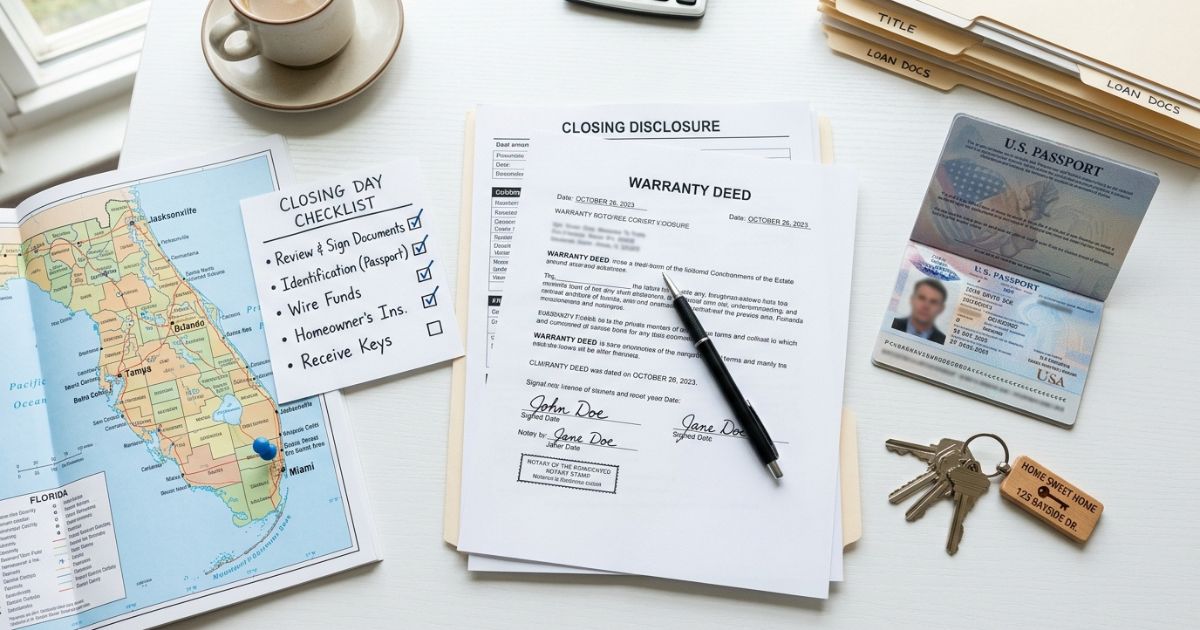
Foreign nationals purchase Florida land with the same legal rights as US citizens — but a smooth transaction depends on following the right steps in the right order, from zoning verification and due diligence to closing with a licensed title company.
Most foreign buyers approach Florida land with the same assumption: this must be complicated for someone outside the US. The paperwork, the laws, the currency exchange — it sounds like a process designed to keep outsiders out.
It isn’t. There is no federal law restricting foreign ownership of US real estate. No special visa, no US bank account, no American partner required. What the process does require is understanding each step before you start — because the mistakes that cost buyers the most are rarely about the money. They’re about skipping verification steps that seem optional but aren’t.
This guide walks you through the entire process, from initial goal-setting to receiving the recorded deed in your name.
Table of Contents
- Define your purpose before you start searching
- Understand how payment works for foreign buyers
- Choose the right Florida region
- Find available land listings
- Verify zoning, utilities, and restrictions before making an offer
- Make an offer and sign the purchase contract
- Conduct due diligence — the most important phase
- Close the transaction with a title company
- Post-closing: ITIN, property taxes, and FIRPTA
- Mistakes most foreign buyers make
- Hidden ownership costs to plan for
- FAQ
- Glossary
- Immediate Actions
Step 1: Define your purpose before you start searching {#purpose}
Short answer: the intended use of the land — building soon, holding long-term, or reselling — determines which region, zoning classification, and property type makes sense. Searching without that clarity wastes time and leads to the wrong purchase.
Before opening Zillow or calling an agent, answer one question with specificity: what is this land actually for?
- Building in the near term → prioritize lots with approved residential zoning, confirmed utility connections at the property line, and no wetland or setback issues that would delay permitting
- Holding as a dollar-denominated asset → land in high-growth corridors can work even without immediate infrastructure, as long as the carrying costs (property taxes, flood insurance if applicable) fit your budget
- Reselling within a few years → focus on markets with proven liquidity: areas near job growth, population centers, or tourism infrastructure where buyers are consistently active
The answer shapes every decision that follows — region, price range, the questions you ask before making an offer.
Step 2: Understand how payment works for foreign buyers {#payment}
Short answer: most foreign buyers purchase Florida land with an all-cash wire transfer in US dollars. Traditional US bank financing for non-resident foreigners is limited. Seller financing — where the seller acts as the lender — is a practical alternative that's common in vacant land transactions.
Three realistic payment paths:
- All-cash purchase — the most straightforward option. You wire US dollars directly to the title company’s escrow account at closing. Cash buyers also have more negotiating leverage, particularly with motivated sellers
- Seller financing — the seller finances the purchase directly, accepting installment payments over an agreed period. Common with private landowners selling vacant lots. Review the contract terms carefully, including interest rate, balloon payment clauses, and default provisions
- US bank financing — technically available but practically difficult for non-resident foreign buyers without a US credit history. If you have a US Social Security Number, existing banking history, or a US entity, options broaden. Otherwise, cash or seller financing are more realistic paths
For international wire transfers, your bank will likely request documentation showing the source of funds. Prepare bank statements, proof of income, or asset documentation in advance to avoid delays.
Step 3: Choose the right Florida region {#region}
Florida is large and internally diverse. The region you choose affects purchase price, resale liquidity, annual carrying costs, flood risk, and the type of development that’s legally permitted on the land.
| Region | Profile | Key consideration |
|---|---|---|
| Central Florida (Orlando, Kissimmee, Polk County) | High growth, strong tourism and employment base, active resale market | Some areas have flood exposure; prices have risen sharply in recent years |
| Southwest Coast (Cape Coral, Fort Myers, Sarasota) | High liquidity, coastal appeal, strong demand from retirees and seasonal residents | Elevated hurricane risk; flood insurance costs are significant in many zones |
| Central Interior (Sebring, Ocala, Lake Placid) | Lower entry prices, less competition, larger parcels available | Lower immediate liquidity; infrastructure availability varies by parcel |
| North Florida (Gainesville, Tallahassee, Jacksonville suburbs) | University-driven growth, lower cost of living, emerging markets | Less familiar to international buyers; market dynamics differ from South Florida |
Step 4: Find available land listings {#search}
Florida’s real estate market is broadly accessible online. Public platforms — Zillow, Realtor.com, LandWatch, and Lands of America — list thousands of vacant lots with filters for county, acreage, price, and zoning type.
Working with a licensed Florida real estate agent gives you access to the MLS (Multiple Listing Service), which includes properties not yet visible on public aggregators. An experienced agent also brings practical knowledge of local market conditions, pricing norms, and county-specific quirks that aren’t obvious from listing data alone.
At TerraNoble, all client communication is available in both English and Portuguese — which matters when transaction details need to be understood precisely, not approximately.
Step 5: Verify zoning, utilities, and restrictions before making an offer {#verify}
Short answer: before submitting any offer, confirm four things at the county level: the lot's zoning classification, its FEMA flood zone designation, access to basic utilities, and the existence of any deed restrictions or HOA obligations. These checks are free, public, and take less than an hour. Skipping them costs far more later.
What to verify before making an offer:
- Zoning classification — look up the parcel in the county’s property appraiser or GIS portal. Zoning determines what can be built, at what density, and with what setbacks. A lot zoned agricultural cannot receive a residential building permit without a rezoning process, which is neither quick nor guaranteed
- FEMA Flood Zone — go to msc.fema.gov and enter the address or parcel coordinates. Flood Zone AE and VE designations require mandatory flood insurance if a mortgage is involved and impose stricter construction standards. Even for cash buyers, this affects annual cost and future resale value
- Utility access — confirm whether water, sewer, electricity, and internet connections reach the property boundary. If utilities must be extended from the nearest connection point, that cost falls to you as the buyer — and it can run from a few thousand to tens of thousands of dollars depending on distance
- Deed restrictions and HOA — some subdivisions carry recorded restrictions (deed restrictions) limiting what can be built, what vehicles can be parked, and what the land can be used for — entirely separate from county zoning. HOA membership may also be mandatory, with annual fees and enforcement authority
Step 6: Make an offer and sign the purchase contract {#contract}
Once a property clears your initial verification, you submit a written offer. If accepted, both parties sign a Purchase and Sale Agreement — the binding contract that governs the transaction.
This document defines the purchase price, the length of the due diligence period, the earnest money deposit amount, financing contingencies (if any), and the conditions under which either party can exit without penalty.
Read every clause before signing. If you’re purchasing remotely and working through translation, confirm that the contingency deadlines are clearly understood — missing the due diligence window removes your right to exit without forfeiting the deposit.
The earnest money — typically 1% to 3% of the purchase price — is deposited into an escrow account held by the title company. If you withdraw within the due diligence period, you generally receive the deposit back. If you exit after the period ends without a valid contractual reason, the seller may keep it.
Step 7: Conduct due diligence — the most important phase {#due-diligence}
Short answer: due diligence is your contractual window — usually 10 to 30 days — to investigate every aspect of the property before confirming the purchase. Problems found now cost hundreds of dollars to resolve or walk away from. The same problems discovered after closing cost significantly more.
Use the full due diligence period. The core items to commission:
- Title search — the title company reviews the full ownership history of the parcel to identify any liens, encumbrances, unpaid taxes, unresolved inheritance disputes, or easements that could affect your ownership rights
- Land survey — a licensed Florida surveyor confirms the exact legal boundaries of the lot, identifies any encroachments (structures from neighboring parcels that cross the boundary line), and locates recorded easements such as utility or drainage rights-of-way
- Soil and environmental assessment — particularly important if you plan to build. Inadequate soil bearing capacity, high water tables, or environmental contamination can render a lot unbuildable or require expensive remediation before a permit can be issued
- Wetlands verification — Florida has significant wetland areas protected under state and federal law. A parcel that shows dry land on satellite imagery may still contain jurisdictional wetlands that legally cannot be filled or built upon
None of these checks are legally required to close. But each one protects you from a category of problem that cannot be undone after closing.
Step 8: Close the transaction with a title company {#closing}
In Florida, real estate closings are handled by a title company or a real estate attorney — not a government notary as in many other countries. The title company acts as a neutral third party: it holds the escrow funds, coordinates the document exchange, pays off any encumbrances on the property, and records the deed at the county clerk’s office.
Foreign buyers close remotely all the time. The process supports electronic signature platforms and power of attorney arrangements, meaning you are not required to be physically present in Florida to complete the transaction.
What happens at closing:
- You wire the remaining balance (purchase price minus the earnest money already deposited)
- The title company disburses payment to the seller after clearing any existing liens or prorated tax obligations
- The deed is executed and sent to the county for recording — a process that typically completes within a few business days
- You receive a title insurance policy — a one-time premium that protects your ownership rights against any title defects that surface after the closing date
Once recorded, the deed is public record. Your ownership is official and searchable in the county property records.
Step 9: Post-closing — ITIN, property taxes, and FIRPTA {#post-closing}
Short answer: after closing, foreign owners have three ongoing obligations: obtaining an ITIN for US tax purposes, paying annual property taxes to the county, and understanding the FIRPTA withholding rule that applies at the time of future resale.
- ITIN (Individual Taxpayer Identification Number) — the IRS equivalent of a tax ID for non-US persons. Not required to purchase land, but necessary for any US tax filings. If the property generates rental income, ITIN is mandatory. Apply through the IRS directly or through a certified acceptance agent
- Property taxes — assessed annually by the county and based on the property’s assessed value. For vacant land, the rate typically falls between 0.8% and 1.5% of assessed value per year. Tax bills arrive in November and must be paid by March 31 of the following year. Early payment (November) often qualifies for a discount
- FIRPTA withholding — the Foreign Investment in Real Property Tax Act requires the buyer to withhold 15% of the gross sale price when a foreign seller disposes of US real property. When you eventually sell, the buyer’s agent will withhold and remit this amount to the IRS. You can recover any excess withheld beyond your actual tax liability by filing a US tax return. Working with a US CPA experienced in international clients is strongly recommended before any resale
Mistakes most foreign buyers make {#mistakes}
- Skipping the FEMA flood map check — a lot in a high-risk flood zone carries mandatory flood insurance requirements that add hundreds or thousands of dollars annually. This changes the financial calculus significantly
- Not ordering a land survey — boundary lines on county maps are not always precise. Survey discrepancies have created property disputes in condados throughout Florida, and no title company can guarantee what a survey hasn’t confirmed
- Missing the due diligence deadline — the contractual window is finite and firm. Buyers who don’t actively manage the clock lose their right to exit without penalty
- Ignoring deed restrictions — a county zoning permit doesn’t override a deed restriction. Buyers have purchased lots zoned for residential use and later discovered recorded subdivision restrictions prohibiting the type of structure they planned to build
- Purchasing without title insurance — the one-time premium is small relative to the property value. Title defects discovered after closing — missing heirs, forged prior deeds, unresolved liens — can be expensive or legally complex to untangle without coverage
Hidden ownership costs to plan for {#hidden-costs}
| Cost | Timing | Estimated Range |
|---|---|---|
| Annual property tax | Every year, due by March 31 | 0.8%–1.5% of assessed value |
| Flood insurance (if required) | Annual | $500–$4,000/year depending on flood zone |
| HOA fees (if applicable) | Monthly or annual | $50–$300/month |
| Lot maintenance and clearing | As needed | $100–$500 per visit |
| Title insurance (one-time) | At closing | 0.5%–1% of purchase price |
| Land survey | During due diligence | $400–$1,200 |
| ITIN application | Post-closing, one-time | $0 (direct) to ~$250 (via agent) |
📚 Glossary {#glossary}
Title company — a licensed Florida business that manages the closing process: holds escrow funds, conducts the title search, records the deed at the county, and issues the title insurance policy.
Closing — the final step in the transaction where the deed transfers, funds are disbursed, and the purchase is recorded with the county. Can be completed remotely by foreign buyers.
Due diligence period — the contractual window after signing the purchase agreement during which the buyer investigates the property and may withdraw with full deposit refund.
Earnest money — a good-faith deposit made by the buyer upon signing the contract. Held in escrow until closing or contract termination.
Deed — the legal document that transfers ownership of the property. Recorded at the county clerk’s office to make the transfer part of the public record.
ITIN — Individual Taxpayer Identification Number. Issued by the IRS to non-US persons who have US tax obligations but are not eligible for a Social Security Number.
FIRPTA — Foreign Investment in Real Property Tax Act. Federal rule requiring 15% withholding from the sale price when a non-resident foreign person sells US real property.
Deed restrictions — private limitations on land use recorded in the property’s title chain, separate from and independent of county zoning. Can restrict building types, lot usage, signage, parking, and more.
Easement — a recorded right allowing a third party (utility company, government, neighboring property) to access or use a portion of the land for a specific purpose.
Land survey — a licensed professional measurement confirming the exact legal boundaries of the parcel, identifying encroachments, and locating any recorded easements.
Flood Zone AE / VE — FEMA flood zone designations indicating high-risk areas with a 1% annual chance of flooding. Mandatory flood insurance applies when financing is involved.
✅ Immediate Actions — Start Now {#actions}
- Define your purpose with specificity: building timeline, hold period, or resale target
- Research the county-level zoning system for your target region before evaluating any specific parcel
- Look up any parcel of interest on msc.fema.gov before making an offer — flood zone designation is non-negotiable to verify early
- Search LandWatch, Zillow, or Realtor.com using county and acreage filters; compare at least five parcels before narrowing down
- Contact a Florida real estate agent with documented experience working with international buyers for MLS access
- Prepare documentation showing the source of your funds before initiating an international wire transfer
- Budget explicitly for due diligence costs: title search, land survey, and any environmental or soil assessments
- Apply for an ITIN through the IRS or a certified acceptance agent promptly after closing
- Consult a US CPA familiar with foreign property owners about annual property tax filing and FIRPTA planning before you eventually sell
Conclusion
The Florida land buying process is more straightforward for foreign buyers than most people expect — but it’s not forgiving of shortcuts. The steps that seem bureaucratic or optional are the ones that protect you from the problems that can’t be fixed after the deed is recorded.
Done in the right order — verified zoning, complete due diligence, a licensed title company managing the close — the process is clean, legally clear, and fully achievable from abroad.
If you’re evaluating land in Florida and want guidance from professionals who understand both the US real estate process and the specific questions foreign buyers face, TerraNoble offers bilingual support in English and Portuguese at every stage of the transaction.