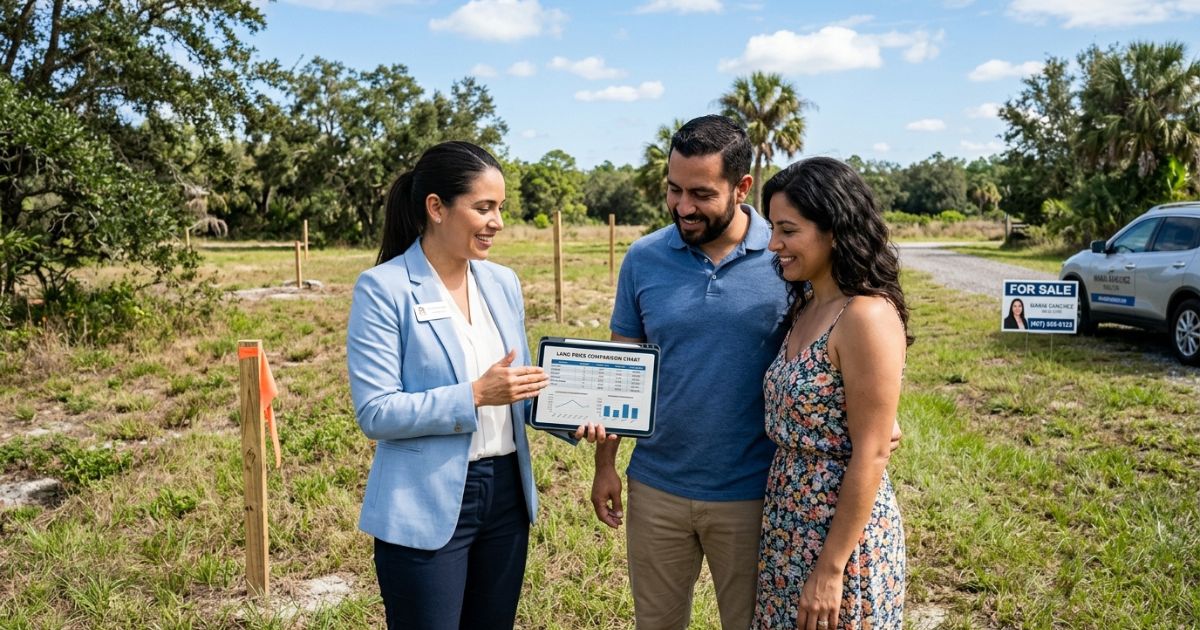
If you’re pricing out land in Florida right now, you’ve probably noticed something strange: two similarly sized lots a few miles apart can carry wildly different price tags. The listing price itself isn’t the problem — the real risk is not understanding why it varies so much, and buying without knowing whether you’re paying a fair price for the region, or paying for potential that doesn’t exist yet.
Most buyers think of land price mainly in terms of lot size: bigger parcel, bigger number. In reality, location, zoning, utility access, and proximity to growth corridors carry far more weight than acreage alone — and those factors are what separate a genuinely good deal from an expensive lot dressed up as a bargain.
Table of Contents
- How much does Florida land cost in 2026
- Why land prices vary so much across Florida
- Price comparison by region type
- Where to find the best Florida land deals today
- Common mistakes buyers make chasing “cheap” land
- Hidden costs that change the real price of land
- FAQ — Frequently Asked Questions
- 📚 Glossary
- ✅ Immediate Actions — Start Now
How much does Florida land cost in 2026 {#price-2026}
Short answer: in 2026, vacant land in Florida ranges broadly from a few thousand dollars for an entry-level rural lot to several hundred thousand dollars per acre in coastal or fast-growing suburban areas — the price range depends far more on region and access than on lot size alone.
There is no single “average price” that accurately describes Florida’s land market, because the state combines very different realities within the same borders: rural inland counties, rapidly expanding suburban corridors, and high-demand coastal strips.
As a general reference point — always subject to confirmation with current data for the specific region — buyers typically encounter:
- Rural inland lots, far from urban centers, with the most accessible entry prices, often still relying on well and septic systems
- Suburban land in growth counties, priced in the middle range, reflecting growing proximity to infrastructure and services
- Lots in already-established areas, close to well-developed cities, priced higher because utilities, access, and residential zoning are already in place
- Coastal or waterfront parcels, at the top of the price range, due to scarce available land and demand for water access and views
The most important thing to understand when comparing prices right now: price per acre can differ several times over between one region and another within the same state. Comparing land prices without factoring in region is like comparing rent prices without considering the city.
Why land prices vary so much across Florida {#why-prices-vary}
Short answer: Florida land prices mainly reflect infrastructure access, permitted zoning, proximity to growth areas, and flood zone risk — not just lot size or distance to the beach.
A handful of factors explain most of the price gap between regions:
- Utility access — lots already connected to water, sewer, and electricity tend to cost more than parcels still relying on well water and septic systems
- Zoning and permitted use — land zoned for residential or commercial use typically carries a higher price than an equivalent agricultural-zoned lot
- Proximity to growth infrastructure — areas near new highways, schools, and retail development tend to appreciate faster than regions with no expansion plans
- Flood zone status — land outside FEMA-mapped flood risk areas usually comes with cheaper insurance, which affects total cost of ownership and, in turn, resale price
- Distance from urban centers — the closer to employment hubs and services, the higher the price per acre tends to be
None of these factors work in isolation. A parcel might sit outside a flood zone but lack approved residential zoning — which also caps the price it can command on the market.
Price comparison by region type {#region-comparison}
Short answer: rural inland land tends to be the most affordable entry point in Florida, while coastal and waterfront lots sit at the top of the range — the gap in price per acre between those two ends can be significant, and the suburban growth-corridor middle ground often offers the best balance between cost and appreciation potential.
| Region type | Relative price range | Utilities | Appreciation potential |
|---|---|---|---|
| Rural inland | Most affordable | Usually well and septic | Moderate, depends on future expansion |
| Suburban growth corridor | Mid-range | Partial or in progress | High, tied to regional growth |
| Established urban area | Higher | Complete and tested | More moderate, already priced in |
| Coastal / waterfront | Highest | Complete | High, but with a steep entry price |
This table is a relative comparison, not a fixed pricing chart — every county and micro-region has its own dynamics, and figures should always be confirmed against current market data before any decision.
Where to find the best Florida land deals today {#best-deals}
Short answer: the best Florida land deals right now tend to sit on the edges of growth corridors — areas that aren't fully built out yet, but already show concrete infrastructure signals, such as approved highway plans or utility expansion in progress.
Finding a good deal doesn’t necessarily mean finding the lowest price in the market — it means finding the best balance between price paid and the region’s real potential. A few practical approaches help in that search:
- Watch counties adjacent to already-established metro areas, where population growth tends to spill over in the coming years
- Check the FDOT (Florida Department of Transportation) work program to identify where new highways and interchanges are planned
- Consider slightly larger lots in rural areas near growth corridors, rather than small lots already inside fully built-out, expensive areas
- Track land auctions and for-sale-by-owner (FSBO) listings, which sometimes carry below-market prices by skipping major listing portals
- Work with someone who knows the specific region, since “sticker” prices on national portals don’t always reflect the local reality of a given county
Keep in mind: a genuinely good deal also has to pass due diligence — confirmed zoning, verified flood zone status, and checked utility access. A low price that hides a zoning problem or an access issue isn’t a good deal — it’s a disguised risk.
Common mistakes buyers make chasing “cheap” land {#common-mistakes}
Comparing price per acre without factoring in the region
A low price per acre in a region with no growth prospects isn’t necessarily a bargain — it may simply reflect a lack of demand for the area.
Ignoring the cost of bringing utilities to the lot
A cheaper lot without water and sewer access can end up costing more overall once you add well drilling, septic installation, and electrical hookup.
Skipping flood zone verification before comparing prices
Two similarly priced lots can carry very different insurance costs if one sits inside a FEMA-mapped flood risk area and the other doesn’t.
Confusing asking price with market price
A seller’s listed price doesn’t always reflect what buyers are actually paying in the area. Comparing against recent comparable sales helps reveal the real market price.
Buying into a “hot” region without checking zoning
An area can be genuinely expanding, and a specific parcel within it can still carry zoning that doesn’t permit the intended residential or commercial use — zoning reclassification is never automatic or guaranteed.
Hidden costs that change the real price of land {#hidden-costs}
The listing price is only the starting point. Before comparing lots, it’s worth factoring in costs that don’t always show up in the advertised number:
- Property taxes, which vary by county and affect the annual cost of holding the land
- Flood insurance, when the parcel sits inside a FEMA-mapped flood zone
- Land survey costs, needed to confirm exact lot boundaries before purchase
- Title insurance, which protects the buyer against issues in the property’s chain of title
- HOA fees, when the lot sits inside a subdivision with a homeowners association
- Utility installation costs, when the parcel still depends on well water and a septic system
- Building permit fees, required before any construction can begin
Short answer: comparing only the listed price between two parcels can lead to the wrong decision — real ownership costs, including taxes, insurance, utilities, and permitting fees, often weigh as heavily as the purchase price in the final decision.
FAQ — Frequently Asked Questions {#faq}
What is the average price of land in Florida?
There is no single average price, because value varies widely based on region, zoning, and utility access. Rural inland lots tend to be the most affordable, while coastal parcels and established urban areas sit at the higher end.
Where is the cheapest place to buy land in Florida?
Generally, rural inland areas and counties still in the early stages of growth tend to have the most accessible entry prices, though that also means less ready infrastructure and a longer wait before appreciation materializes.
Is cheaper land always a good deal?
Not necessarily. A low price can reflect a lack of utility access, flood zone risk, restrictive zoning, or distance from any growing area. A good deal is one that balances price, region, and real ownership costs.
Can foreigners buy land in Florida?
Yes. There is no general federal restriction preventing foreigners from buying land in the United States, and Florida remains one of the most structured markets for international buyers, including bilingual support.
When is the best time to buy land in Florida?
There is no universal perfect timing, but buying before a region fully builds out its infrastructure — once concrete growth signals already exist, such as approved highway plans — tends to offer the best balance between price and potential.
📚 Glossary {#glossary}
Flood zone — an area mapped by FEMA as subject to flood risk, which typically requires specific insurance and affects the cost of owning the land.
Zoning — the set of county rules that determines what can be built on a given parcel.
Utilities — basic water, sewer, and electricity infrastructure available to a parcel.
Title insurance — insurance that protects the buyer against issues in a property’s chain of ownership.
Land survey — a technical assessment that confirms the exact boundaries of a parcel before purchase.
FSBO (For Sale By Owner) — a land sale handled directly by the owner, without a listing agent.
Homestead exemption — a tax benefit available to residents who use the property as their primary Florida residence.
✅ Immediate Actions — Start Now {#immediate-actions}
- Define your target region and research recent comparable land sales, not just listed asking prices
- Check the parcel’s flood zone status on official FEMA maps
- Confirm current zoning and whether it permits your intended use for the land
- Calculate the real cost of utilities if the lot still depends on well water and septic
- Request a land survey before closing
- Contact TerraNoble for bilingual guidance on Florida land prices and regions
Conclusion
Understanding how much Florida land actually costs today means looking past the number on the listing. Region, zoning, utility access, and flood zone status carry as much weight as the purchase price — and those factors, not price per acre alone, are what separate a genuinely good deal from an expensive lot dressed up as a bargain.
The best opportunities tend to sit on the edges of growth corridors, where infrastructure is still catching up but concrete growth signals already exist. Finding them takes research, patience, and careful verification — not just comparing numbers across listing portals.
TerraNoble offers bilingual support — in English and Portuguese — to help buyers understand prices, regions, and real opportunities in Florida’s land market. Get in touch with our team.