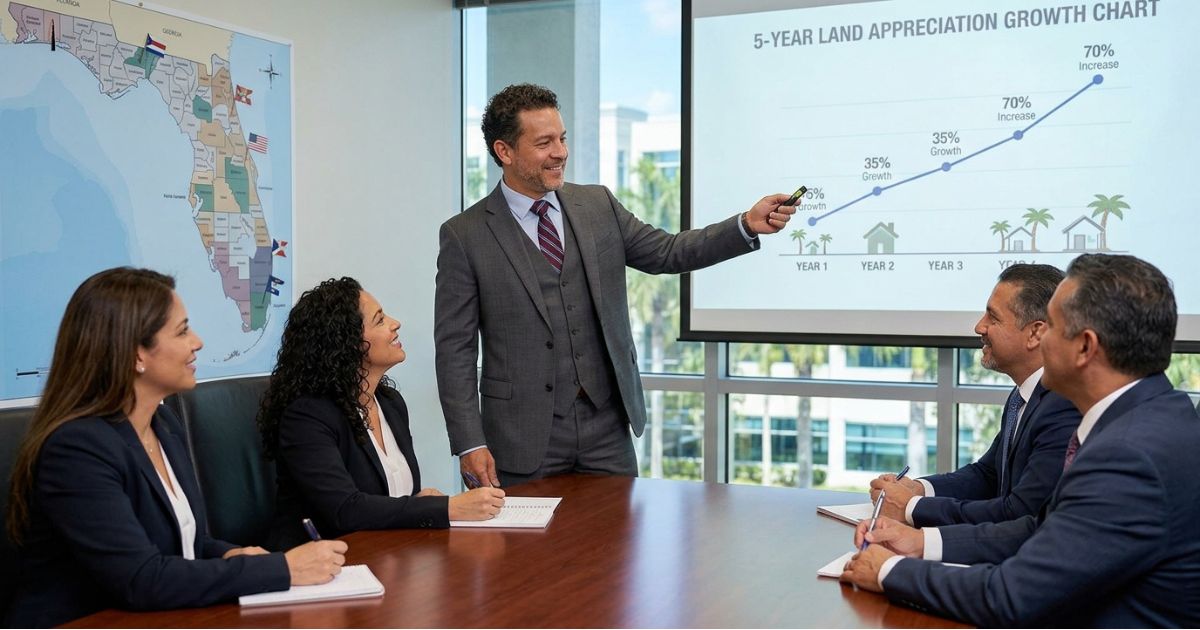
Florida vacant land ROI over five years is driven by county population growth, zoning classification, and available infrastructure — not by broad state-level optimism. High-growth corridors like Osceola, Polk, and Flagler recorded nominal appreciation between 40% and 90% from 2019 to 2024, while areas without clear development drivers remained nearly flat over the same period.
A lot of people buy Florida land expecting the state to do the work for them. Sunshine, population growth, a strong dollar — it sounds like a formula that practically guarantees a return. And sometimes it does work out that way. But when it doesn’t, investors are left with a lot that doesn’t appreciate, costs money every year to hold, and takes months to sell.
The difference between those two outcomes rarely comes down to luck. It comes down to how well the land was chosen in the first place.
Florida is, genuinely, one of the fastest-growing states in the country. By 2025, the population surpassed 23.4 million, and the state continues to attract more net in-migration than any other destination in the U.S. That creates real demand for land. But broad demand doesn’t mean every parcel benefits equally.
Most buyers assume “investing in Florida” is the decision. In reality, which specific parcel you buy — and where — determines almost everything about your return.
This article examines vacant land ROI in Florida using real market data, lays out conservative and optimistic five-year scenarios, explains what actually drives appreciation, and is honest about what can go wrong.
Table of Contents
- What actually determines ROI on Florida vacant land
- Historical data: how much has Florida land appreciated?
- Three realistic 5-year investment scenarios
- Real holding costs that reduce your actual return
- How Florida land compares to other 5-year investments
- What can go wrong — and how much it matters
- How to identify land with stronger appreciation potential
- Mistakes investors make when calculating land ROI
- 📚 Glossary
- ✅ Immediate Actions
- FAQ
What actually determines ROI on Florida vacant land {#what-determines-roi}
Short answer: Florida vacant land ROI is driven by four factors: county-level population growth, current zoning classification, access to utilities (water, sewer, power), and proximity to expanding employment centers. Parcels where all four align have a documented history of strong appreciation. Parcels that lack one or more of these factors tend to stagnate for years.
Unlike stocks or REITs, vacant land is a physical asset with specific local characteristics that directly affect its market value. There is no reliable index for “Florida land” as a category — the market is profoundly local, and treating it otherwise is one of the most expensive mistakes an investor can make.
The primary appreciation drivers for vacant land include:
- County population growth: Counties growing at more than 2% annually generate continuous demand for residential and commercial lots. That demand creates upward pricing pressure even when no individual project is announced.
- Current zoning: Land zoned for residential, commercial, or mixed use has a clear buyer pool. Agricultural or unclassified land in areas without a development timeline can sit at the same price for years.
- Available infrastructure: Access to electric service, municipal water, and sewer dramatically reduces future construction costs and increases perceived value to end buyers and developers.
- Planned infrastructure: Announced county projects — new roads, water line extensions, hospital expansions, school construction — tend to get priced into nearby land before those projects are completed. Buyers who enter before the announcement capture the most upside.
- Distance to employment centers: Land within 30 to 60 minutes of major employers becomes more viable as remote and hybrid work expands the zone where people are willing to live.
Why timing in the growth cycle matters
Buying in the early phase of a growth corridor — before infrastructure arrives — is where the majority of outsized returns are concentrated. Buying after the market has already priced in the growth means you’re paying for appreciation that already happened, not appreciation still ahead.
This doesn’t mean land in already-developed areas can’t appreciate further. It means your entry point is one of the most significant variables in your five-year ROI calculation.
Historical data: how much has Florida land appreciated? {#historical-data}
Short answer: Between 2019 and 2024, vacant land in Florida's growth corridors appreciated between 40% and 90% in nominal terms — equivalent to roughly 7% to 14% per year. Counties without active growth drivers saw between 5% and 20% over the same five years. The spread between those two outcomes came almost entirely from location and zoning, not from statewide market conditions.
Looking at actual county-level data from 2019 to 2024:
- Osceola County: Population grew 18% over the period. Residential land parcels near the US-192 corridor appreciated between 60% and 90% in nominal terms.
- Flagler County: Driven by Palm Coast expansion and significant in-migration from other states. Residential lots recorded average nominal appreciation of 55% to 75%.
- Polk County: Positioned between Orlando and Tampa along the I-4 corridor, one of the most active development zones in the Southeast. Land near new residential projects appreciated 45% to 70%.
- Marion County: Slower, more gradual growth. Well-located parcels with clear zoning and road access appreciated 30% to 50% over the five-year window.
By contrast, rural counties in central and north Florida without major infrastructure investment recorded appreciation of 5% to 20% over the same period — or remained essentially flat.
One important caveat: these are nominal figures. They don’t account for U.S. inflation, which ran above 4% annually between 2021 and 2023. Real (inflation-adjusted) returns are meaningfully lower than nominal returns. Any serious ROI calculation needs to include this adjustment.
Three realistic 5-year investment scenarios {#three-scenarios}
No analyst can predict with precision what will happen to Florida’s land market between now and 2031. What’s useful — and honest — is modeling scenarios based on historical performance and structural market drivers.
| Scenario | Market Conditions | Estimated Annual Appreciation | Total Return Over 5 Years |
|---|---|---|---|
| Conservative | Growth slowdown, sustained high interest rates, lateral market | 2%–4% per year | 10%–22% |
| Moderate | Continued in-migration, steady infrastructure expansion | 5%–8% per year | 28%–47% |
| Optimistic | Active growth corridor, favorable zoning, anchor development nearby | 10%–15% per year | 61%–100%+ |
What makes the conservative scenario realistic
A slowdown in net migration to Florida, persistently high interest rates (which reduce the pool of buyers who can finance), or a broader real estate correction would likely suppress land appreciation — particularly in areas where demand depends heavily on financed buyers. Land purchased in this environment still preserves capital in a dollar-denominated asset, but real returns above inflation would be modest.
Why the moderate scenario applies to well-chosen parcels
A parcel in a county with consistent population growth, clear residential zoning, and at least partial utility access has historically delivered 5% to 8% annually in Florida without requiring a boom. That performance doesn’t depend on exceptional market conditions — it reflects steady structural demand from people who need buildable lots.
What creates the optimistic scenario
When a growth corridor experiences an anchor event — a major employer announcement, a highway extension, a hospital opening, or a large residential development groundbreaking — surrounding land tends to price in that growth before the project is complete. Investors who enter during the announcement phase and hold through completion capture most of the gain. This scenario is real and well-documented in Florida’s growth corridors, but it requires specific county-level research and accurate market timing.
Real holding costs that reduce your actual return {#holding-costs}
Short answer: The main annual costs to hold a vacant lot in Florida typically total between $500 and $1,800 per year — far below what a built property requires, but enough to reduce your net ROI if they're not included in the calculation from the start.
The gross return on land — what it appreciates — is not the same as the net return. To calculate real ROI, you need to subtract all holding and transaction costs over the five-year period:
| Cost | Estimated Amount / Year | Total Over 5 Years |
|---|---|---|
| Property taxes | $300–$1,200 | $1,500–$6,000 |
| Vegetation clearing (if required by county) | $0–$500 | $0–$2,500 |
| HOA fees (if applicable) | $0–$1,200 | $0–$6,000 |
| Title insurance (one-time, at purchase) | — | $300–$800 |
| Closing costs at purchase | — | 1%–3% of purchase price |
| Selling costs (commission, transfer fees) | — | 3%–6% of sale price |
On a $40,000 parcel, total holding and transaction costs over five years can range from $5,000 to $12,000 — equivalent to 12% to 30% of the original purchase price. A parcel that appreciates 25% in gross terms may deliver a net return of only 5% to 15% depending on what was spent along the way.
This math is straightforward, but it’s consistently overlooked by investors who focus only on the buy price and an imagined future sale price.
How Florida land compares to other 5-year investments {#comparison}
| Asset | Historical 5-Year Return (nominal) | Holding Costs | Liquidity | Dollar-Denominated |
|---|---|---|---|---|
| Florida land (growth corridor) | 30%–80% | Low ($500–$1,800/yr) | Low (months to sell) | Yes |
| Florida residential property | 20%–50% | High ($8,000–$20,000/yr) | Medium (weeks to months) | Yes |
| S&P 500 (10-yr historical avg) | ~50%–80% | None | High (daily) | Yes |
| U.S. Treasury bonds (5-yr, 2024–2026) | ~20%–25% total | None | High | Yes |
Florida vacant land doesn’t compete with equities on liquidity. Its core advantage is a combination of low maintenance overhead, a tangible dollar-denominated asset, and structural demand in a growing market. It’s not the right investment for anyone who needs returns within 12 months or requires quick access to capital — it’s designed for investors with a 3- to 7-year horizon who want real asset exposure without the operational burden of a built property.
What can go wrong — and how much it matters {#risks}
Any honest ROI analysis gives risks the same weight as upside scenarios. Here are the main factors that can materially reduce your return on a Florida land investment:
Zoning that doesn’t change as expected
Many buyers purchase land anticipating a rezoning that will allow residential or commercial development. That change requires a county vote and may not happen within the expected timeline — or at all. Parcels with favorable current zoning carry more predictable return profiles than bets on future reclassification.
FEMA flood map reclassification
FEMA periodically updates its Flood Insurance Rate Maps. A parcel that currently sits outside a high-risk zone can be reclassified into a Special Flood Hazard Area (Zone AE), which affects insurability, buildability, and market value. Before purchasing, it’s worth reviewing the FEMA map amendment history for the specific area.
Real estate market correction
Florida’s housing market experienced a meaningful price correction between late 2022 and 2023, driven by the Federal Reserve’s rate hikes. Vacant land in areas where buyer demand is concentrated among financed purchasers is more vulnerable to rate cycles. Cash buyers have significantly less exposure to these corrections.
Infrastructure that doesn’t arrive on schedule
A county-announced road extension, water line expansion, or utility project can be delayed by years. Land purchased on the basis of promised-but-incomplete infrastructure may sit longer than planned before the market responds to those improvements.
Slower-than-expected sale timeline
Vacant land has a narrower buyer pool than built properties. In lower-activity counties, closing a sale at reasonable terms can take 6 to 18 months. Paper-based ROI projections that don’t account for a longer hold period can significantly overstate actual annualized returns.
FIRPTA withholding at sale (for foreign buyers)
When a foreign national sells U.S. real property, the buyer is legally required to withhold 15% of the gross sale price for the IRS under FIRPTA. This amount may be partially recovered through a tax return, depending on the realized gain — but it affects cash flow at the time of sale and must be factored into any ROI calculation before you buy.
How to identify land with stronger appreciation potential {#how-to-identify}
Short answer: Vacant land with stronger five-year appreciation potential is typically located in counties growing faster than 1.5% annually, carries residential or mixed-use zoning, has access to at least two utility types, and sits within 45 minutes of an expanding employment center. These aren't guarantees — they're the conditions that have historically produced above-average returns.
A basic due diligence process before any purchase should include:
- County GIS zoning check: most Florida counties publish an online GIS portal that lets you verify the specific zoning of any parcel before making an offer.
- FEMA flood map review: the FEMA Flood Map Service Center (msc.fema.gov) shows whether the parcel sits in a Special Flood Hazard Area and whether that classification has changed recently.
- Utility availability confirmation: request documentation from the seller showing electric access, water, and sewer connections — or confirm with the county when those utilities are projected to reach the area.
- County Comprehensive Plan review: this public document outlines the county’s planned development priorities for the next 10 to 20 years. Parcels in areas designated for growth are far more likely to see infrastructure investment than those outside those zones.
- Comparable sales history: reviewing actual closed transactions for similar parcels in the same area over the past 3 to 5 years gives you a realistic baseline for what appreciation looks like locally — as opposed to what sellers claim.
Mistakes investors make when calculating land ROI {#common-mistakes}
- Using gross appreciation instead of net return: the ROI on a land investment isn’t the spread between buy and sell price — it’s that spread minus all holding, transaction, and tax costs.
- Assuming the whole state appreciates at the same rate: Florida grows, but not every county and not every parcel within a growing county performs the same way.
- Ignoring the realistic sale timeline: if it takes 12 to 18 months longer to sell than projected, that additional holding cost and opportunity cost needs to be included in the annualized return calculation.
- Confusing list price with transaction price: what nearby parcels are listed for is not what they sell for. Actual closed-sale prices from county property records are the only reliable reference.
- Not accounting for capital gains tax: profit from a land sale is subject to federal capital gains tax. For investors who held the parcel longer than one year, the long-term capital gains rate applies — but it still reduces the net return. Foreign sellers also need to account for FIRPTA withholding at the time of sale.
- Skipping professional due diligence to save money: a title search, survey, and consultation with a real estate attorney typically cost less than $2,000 combined. Skipping those steps to save a few hundred dollars is a common and expensive mistake in land transactions.
📚 Glossary {#glossary}
ROI (Return on Investment): the percentage gain or loss relative to the capital invested, calculated after deducting all associated costs.
Property Tax: an annual tax on real property in the U.S., assessed by the county based on the appraised value of the parcel.
Zoning: a county-level classification that defines the permitted use of a parcel — residential, commercial, agricultural, industrial. Determines what can legally be built on the land.
FIRPTA: Foreign Investment in Real Property Tax Act. A federal law requiring buyers to withhold 15% of the gross sale price when purchasing U.S. real property from a foreign seller.
Comprehensive Plan: a county’s public planning document outlining development priorities and growth areas for the next 10 to 20 years. Useful for identifying which regions are slated for infrastructure investment.
Vacant Land: a parcel with no existing structures. The asset class discussed throughout this article.
Due Diligence: the process of thoroughly verifying a property before purchase — including title history, zoning, flood zone classification, utility access, and deed restrictions.
Flood Zone: a FEMA classification indicating the level of flood risk for a given parcel. Zone AE indicates high risk; Zone X indicates minimal risk.
HOA (Homeowners Association): an association that enforces community rules and charges fees in planned developments. Can apply to vacant lots within subdivisions even before any home is built.
Special Flood Hazard Area (SFHA): the FEMA designation for land with a significant flood risk, typically Zone AE. Properties in SFHAs face additional restrictions and insurance requirements.
✅ Immediate Actions — Start Now {#immediate-actions}
- Define your investment horizon clearly — 3, 5, or 7 years. The timeline directly affects which type of parcel makes sense to buy.
- Research Florida counties with population growth above 1.5% annually over the past three years. Start your search in those markets.
- Pull up the Comprehensive Plan for any county you’re seriously considering and identify the areas designated for future development.
- Check every parcel you evaluate against the FEMA Flood Map Service Center (msc.fema.gov) before making any offer.
- Verify current zoning on the county GIS portal — don’t rely solely on what a listing says.
- Build a net ROI model: projected sale price minus holding costs, purchase closing costs, selling commissions, and applicable capital gains tax.
- If you’re a foreign buyer, consult a CPA experienced with FIRPTA and non-resident tax obligations before finalizing your exit strategy.
- Talk to a bilingual land specialist who knows Florida’s vacant land market specifically — not just residential real estate in general.
Conclusion
Florida vacant land can be an excellent five-year investment — or a parcel that sits flat for years, generating annual costs with no meaningful return. The difference between those two outcomes doesn’t come from the state, the sunshine, or the dollar. It comes from where the parcel is located, what zoning it carries, what’s driving growth in that specific county, and what you paid at entry.
Historical data from the last five years shows that well-selected parcels in high-growth corridors delivered nominal appreciation between 40% and 90%. Land in areas without structural growth drivers saw 5% to 20% over the same period. That’s an enormous spread — and it exists because “investing in Florida” is a broad statement, while the market rewards specificity.
For investors with a five-year horizon, the capital to buy outright, and the discipline to conduct proper due diligence, Florida vacant land continues to offer a low-overhead, dollar-denominated alternative that most built-property investments can’t match on a net basis. The key is selecting the right parcel — not just any parcel that’s available.
TerraNoble offers bilingual support in English and Portuguese for investors exploring Florida land opportunities. Our properties are focused on regions with solid, data-backed growth fundamentals — not on speculative promises.
If you’d like to discuss available opportunities and understand how to calculate real ROI on a specific parcel, get in touch with our team for a no-pressure conversation.