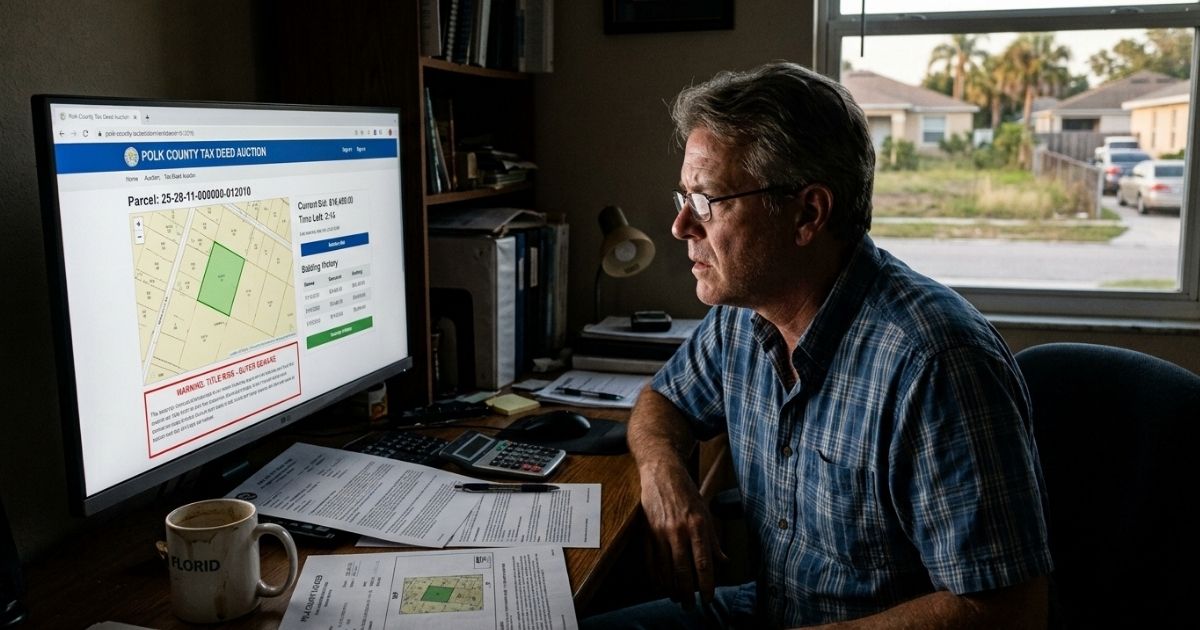
If a parcel of Florida land shows up at auction for 10% or 20% of market value, the visible problem is deciding whether it’s worth bidding on. The real problem is that most first-time buyers don’t understand what’s behind that low price — and can end up winning a parcel with back debt, restrictions, or title problems that cost far more than what they saved on the bid.
Most people assume a land auction is basically a guaranteed bargain. In reality, tax deed and tax lien auctions in Florida are legitimate investment tools, but they come with specific rules, strict deadlines, and risks that only become clear to buyers who research before bidding — not after.
Table of Contents
- What Florida land auctions actually are
- Tax lien vs. tax deed: what’s the difference
- Why auctioned land looks so cheap
- The hidden risks most buyers overlook
- Tax Lien vs. Tax Deed: a practical comparison
- How to do due diligence before bidding
- Common mistakes buyers make at auction
- Hidden costs after winning the parcel
- FAQ
- 📚 Glossary
- ✅ Immediate Actions — Start Now
What Florida land auctions actually are {#what-they-are}
Short answer: Florida land auctions typically happen because the previous owner stopped paying property taxes for a set period, and the county auctions off either the debt (tax lien) or the property itself (tax deed) to recover the unpaid amount.
Every Florida county relies on property tax revenue to fund schools, roads, and public services. When an owner doesn’t pay those taxes for two years or more, the county has the right to auction the property to recover the amount owed. This process is public, governed by state law, and usually run online through each county’s tax collector.
It’s important to understand that bidding at auction is not the same as buying land through a traditional sale with a real estate agent. Payment rules, redemption periods for the original owner, and buyer responsibilities are all different — and not knowing these rules is where most of the problems investors run into after winning a bid actually start.
Tax lien vs. tax deed: what’s the difference {#tax-lien-tax-deed}
Short answer: in a tax lien auction, the investor buys the right to the unpaid tax debt and earns interest once the owner pays it off, without becoming the landowner; in a tax deed auction, the investor wins the property itself, but also inherits any title issues and restrictions attached to it.
With a tax lien certificate, the county sells the certificate for the unpaid debt, not the land itself. The winning bidder pays the amount owed and gains the right to be repaid, plus interest, once the original owner settles the debt. If the owner never pays, after a period set by Florida law (generally two years), the certificate holder can request that a tax deed sale be opened on the property.
With a tax deed sale, the property itself is what’s up for auction. The winning bidder can become the new legal owner of the land — but along with the land, they take on any zoning restriction, easement, or unresolved title issue attached to it. That’s why tax deed sales draw far more attention from buyers looking for physical land, and also why prior due diligence becomes non-negotiable.
Why auctioned land looks so cheap {#why-so-cheap}
Short answer: the opening bid at auction usually reflects only the total back taxes and fees owed — not the parcel's actual market value — which makes the starting price look far lower than it really is once additional costs and assumed risks are factored in.
The minimum bid at a tax deed sale is generally calculated from the tax debt, administrative fees, and processing costs — not from the property’s market value. That’s why it’s common to see parcels open at just a few thousand dollars, even when the real market value would be much higher.
That gap is what draws in first-time investors, but it’s also what draws experienced investors to the same auction — which is why the final price, after competitive bidding, usually climbs well above the opening bid. When that doesn’t happen and a parcel stays at a low bid until the end, it’s worth asking why: it could be a real opportunity, or it could be a sign that other investors already spotted a problem with the parcel and decided not to compete for it.
The hidden risks most buyers overlook {#hidden-risks}
Short answer: the main risks of buying Florida land at auction include parcels with no legal road access, zoning restrictions that block construction, title problems that require legal action to clear, and additional liens that don't automatically disappear with the sale.
The first risk is lack of legal access. Some auctioned parcels have no direct access to a public road, which can make any future use impossible without purchasing an easement from a neighboring landowner — a process that can be expensive and slow.
The second risk is zoning and use restrictions. A parcel may look cheap, but sit in an area zoned in a way that doesn’t allow residential construction, or be subject to environmental restrictions — like protected wetlands under FEMA and state agency rules — that limit almost any practical use.
The third risk is the property’s title. Unlike a traditional purchase backed by title insurance, land acquired through a tax deed sale often doesn’t come with a “clean” title right away. Clearing old or conflicting claims may require a quiet title action in court before the new owner can sell or finance the parcel down the line.
The fourth risk is liens that survive the sale. Not every debt tied to a parcel disappears automatically at auction — HOA fees, certain municipal obligations, and specific government liens can remain attached to the property even after the winning bid.
Tax Lien vs. Tax Deed: a practical comparison {#comparison-table}
| Factor | Tax Lien Certificate | Tax Deed Sale |
|---|---|---|
| What you acquire | The right to the tax debt, plus interest | Ownership of the land itself |
| Do you become the owner? | No, unless the debt is never repaid | Yes, immediately after the sale |
| Expected return | Interest rate set by state law | Land appreciation (and its risks) |
| Title risk | Low, since no ownership transfers | High, requires due diligence and possible quiet title |
| Complexity level | Simpler, closer to a financial investment | More complex, closer to buying real property |
How to do due diligence before bidding {#due-diligence}
Short answer: before bidding on a Florida land auction, verify zoning with the county, confirm the parcel has legal access to a public road, research its title and lien history, and check whether it sits in a flood zone according to FEMA maps.
Each Florida county’s tax collector and property appraiser websites usually list tax history, current zoning, and, in many cases, parcel maps. That’s the first place to research before placing any bid — and it’s free.
Checking legal access to the property is another essential step: county GIS (geographic information system) maps show whether a parcel fronts a public road or is landlocked, depending on neighboring properties for any access at all.
It’s also worth checking FEMA flood zone maps for the specific parcel, since flood-risk areas can require mandatory insurance and limit the type of construction allowed later on.
Finally, a search of the county recorder or clerk of court’s property records helps flag liens, old mortgages, or disputes that may be tied to the parcel — information that’s public, but takes time and familiarity with the system to interpret correctly.
Common mistakes buyers make at auction {#common-mistakes}
Bidding without ever researching or seeing the parcel
Buying “blind,” relying only on the auction listing description, is the fastest way to win a parcel that turns out to be unusable.
Ignoring zoning and land-use restrictions
A cheap parcel that can’t be used for its intended purpose isn’t a bargain — it’s a problem disguised as an opportunity.
Not pricing in the cost of clearing the title
Quiet title actions involve legal fees and can take months, a cost many investors forget to add to the bid price.
Getting caught up in the bidding and overpaying
It’s common for the competitive dynamic of an auction to push investors to pay more than they would in a direct negotiation — the opposite of what drew them to the auction in the first place.
Hidden costs after winning the parcel {#hidden-costs}
- Quiet title action — a court process often needed to clear the title before reselling or financing the parcel
- Remaining liens — HOA fees or specific municipal obligations that may not be wiped out by the sale
- Access costs — purchasing an easement when the parcel has no direct legal access to a public road
- Back taxes and administrative fees — additional amounts that can be charged after the winning bid, depending on the county
- Insurance and maintenance — even vacant land requires basic upkeep and, in risk-prone areas, specific insurance coverage
FAQ {#faq}
Can foreigners bid at Florida land auctions?
Yes. There’s no U.S. citizenship or residency requirement to participate in tax deed or tax lien auctions in Florida, but each county has its own registration and payment process, usually handled online.
What happens if the original owner tries to reclaim the land after the auction?
In tax deed sales, there’s a legal window during which certain claims can still be contested in court. That’s another reason why due diligence — and, in some cases, a quiet title action — is recommended before reselling or building on the parcel.
Is it safe to buy land at auction without visiting it in person?
It’s not impossible, but it raises the risk. Researching county GIS maps, zoning, flood zone status, and title history cuts down on a lot of the uncertainty, but an on-the-ground check — done in person or by a trusted professional — remains the safest way to confirm the parcel’s actual condition.
Does TerraNoble help investors evaluate auction land?
Yes. TerraNoble offers bilingual support, in Portuguese and English, to help investors understand risk, review available documentation, and compare auction opportunities against land available through the traditional Florida market.
📚 Glossary {#glossary}
Tax lien certificate — a certificate representing the right to a property’s unpaid tax debt, sold at auction by the county.
Tax deed sale — an auction in which the property itself is sold to recover unpaid taxes, transferring ownership to the winning bidder.
Quiet title action — a court process used to remove old or conflicting claims on a property’s title.
Easement — a legal right to access or use part of a property, granted to a third party, often necessary when a parcel has no direct access to a public road.
FEMA flood maps — official maps that classify flood-risk areas across the United States, used to determine insurance requirements and construction restrictions.
✅ Immediate Actions — Start Now {#immediate-actions}
- Research the parcel’s zoning on the county property appraiser’s website before placing any bid
- Check the county GIS system for legal access to a public road
- Review FEMA flood zone maps for the parcel’s exact location
- Search the county recorder’s records for title history and possible liens
- Set a maximum bid before the auction and stick to it, no matter how the bidding heats up
- Talk to TerraNoble for a bilingual evaluation before bidding on a Florida land auction
Conclusion
Florida land auctions can be a real opportunity — but only for buyers who understand the rules, research before bidding, and are prepared for costs and risks that never show up in the listing. The low opening price isn’t the parcel’s real price; it’s just the starting point of a process that demands more caution than a traditional purchase.
There’s no guaranteed formula for success at auction, but there is a clear difference between buyers who check zoning, access, and title before bidding, and those who decide based only on an eye-catching minimum bid. That difference usually determines whether the parcel turns into a solid investment or an expensive problem to untangle later.
TerraNoble offers bilingual support — in Portuguese and English — to help investors evaluate auction land and compare it against options available through Florida’s traditional market. Talk to our team before you place your next bid.