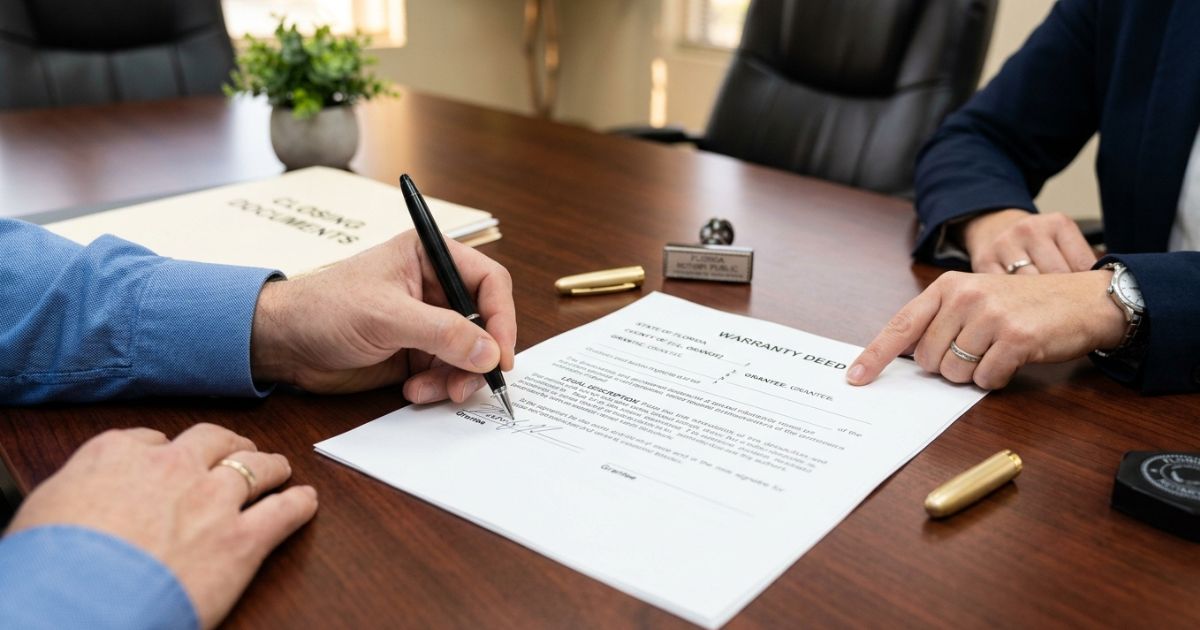
A property deed is the legal document that transfers real estate ownership in the US — its type, structure, and proper recording directly affect your legal standing and tax obligations as a foreign buyer in Florida.
You close on a Florida property. You wire the funds, sign the paperwork, and receive confirmation that the transaction is complete. Then, three months later, you discover the deed was recorded with an error in the legal description — and the parcel boundaries the county recognizes don’t match what you thought you purchased.
Or: you buy the land, receive a deed, and everything looks right — until a family member of the prior owner surfaces with an inheritance claim that was never resolved. The deed you received doesn’t protect you from that, because you accepted the wrong deed type for the transaction.
These aren’t edge cases. For foreign buyers navigating a system that works very differently from what they know at home, the property deed — which type it is, how it’s structured, and whether it’s properly recorded — is the foundation of everything. Get it right, and the transaction is solid for as long as you hold the property. Get it wrong, and the consequences surface long after the closing table is cleared.
Most international buyers focus on price negotiation and the wire transfer. But the type of deed you receive, how the property is titled in your name, and whether it’s recorded correctly will determine your legal standing for every year you own it.
Table of Contents
- What is a property deed in the US?
- What are the different types of property deeds in Florida?
- Can foreign nationals hold a property deed in the US?
- How does the deed recording process work in Florida?
- How is a US deed different from property documents in other countries?
- What does recording a deed actually do for you legally?
- How much does it cost to record a deed in Florida?
- Common mistakes foreign buyers make with property deeds
- Hidden costs related to the deed and ownership structure
- 📚 Glossary
- ✅ Immediate Actions
- FAQ
What is a property deed in the US? {#what-is}
Short answer: a property deed in the US is the legal instrument that transfers real estate ownership from the seller (grantor) to the buyer (grantee). It must be signed by the seller, notarized, and recorded with the county to create the official public record of the transfer. The deed type determines what guarantees — if any — the seller is making about the property's legal history.
In the United States, the document that transfers real estate ownership is called a deed. It is not the same as the title — the title is the legal concept of your right to own and use the property, while the deed is the written instrument that creates and evidences that right.
For a deed to be legally valid in Florida, it must contain:
- Full legal names of both the grantor (seller) and grantee (buyer)
- A precise legal description of the property — not just the street address, but the technical description as it appears in county records
- Clear language of conveyance explicitly transferring ownership
- The grantor’s signature, acknowledged before a notary public and two witnesses
- Consideration — the price paid, or a nominal amount such as $10 in transactions where privacy is preferred
The deed is prepared by the title company or a real estate attorney, signed at closing, and then submitted to the county recorder’s office. Once recorded, it creates the permanent public record that you own the property.
What are the different types of property deeds in Florida? {#deed-types}
Short answer: the most important deed types in Florida are the General Warranty Deed (full title guarantees from the seller covering the entire ownership history), the Special Warranty Deed (limited guarantees covering only the seller's ownership period), and the Quitclaim Deed (no guarantees at all). In a standard purchase from a seller you don't personally know, always request a General Warranty Deed.
General Warranty Deed
This is the strongest deed for buyers. The grantor guarantees the title is free and clear of all encumbrances — not just during their period of ownership, but going back through the entire chain of title. If a problem surfaces later that predates the seller’s ownership period, they remain legally responsible for defending the title.
For standard arm’s-length purchases of Florida real estate — including vacant land and residential properties — the General Warranty Deed is the appropriate and expected instrument.
Special Warranty Deed
The grantor only warrants the title against claims arising during their specific ownership period. Problems that originated before they acquired the property are not their responsibility under this deed type.
Special Warranty Deeds are common in bank-owned (REO) sales, commercial transactions, and institutional sellers. If you’re receiving this type of deed, title insurance becomes even more essential, since the seller’s guarantees don’t extend to the full ownership history.
Quitclaim Deed
No warranties at all. The grantor transfers only whatever interest they may have — without representing that the title is clean, free of encumbrances, or even that they are the actual owner. Never accept a Quitclaim Deed in a standard purchase from a seller you don’t know.
Legitimate uses for Quitclaim Deeds include: transfers between family members, correcting errors in previously recorded deeds, adding or removing a spouse from title, and transferring property into an LLC or trust.
| Deed Type | Seller Guarantees | Best Used For | Buyer Risk Level |
|---|---|---|---|
| General Warranty Deed | Full title history — all periods | Standard purchase from any seller | Low (with title insurance) |
| Special Warranty Deed | Seller's ownership period only | Bank-owned, institutional, commercial | Moderate — title insurance critical |
| Quitclaim Deed | None | Family transfers, LLC/trust titling, corrections | High — never use in standard purchases |
| Trustee's Deed | Limited to trust terms | Sale of trust-held property | Moderate — verify trust validity |
| Tax Deed | None | County auction for unpaid property taxes | High — buyer assumes all prior risks |
Can foreign nationals hold a property deed in the US? {#foreigners}
Short answer: yes. Federal law does not prohibit foreign nationals from purchasing US real estate or holding a property deed in their name. Florida imposes no additional restrictions on foreign buyers for residential, commercial, or vacant land purchases. However, how the ownership is structured — personal name, US LLC, or trust — creates significant differences in tax exposure and estate planning outcomes.
You don’t need a US visa, a Social Security Number, or US residency to purchase Florida real estate and hold a deed. Millions of international buyers own Florida properties without any of these. What changes based on your residency and ownership structure are the tax implications.
The deed can be registered in several ways:
- In your personal name — simplest to execute, but exposes non-resident foreign nationals to a federal estate tax with only a $60,000 exemption at death (compared to $13.6 million for US citizens). On a $300,000 property, that exposure can be significant
- In the name of a US LLC — the most common structure for foreign investors; provides liability protection, can simplify inheritance planning, and in some configurations reduces federal estate tax exposure
- In a US trust — effective for privacy, estate planning, and avoiding probate proceedings in US courts at death
- In a US corporation — less common for individual buyers; introduces additional tax filing complexity
The structure of the ownership should be decided before the deed is drafted, not after. Changing the title post-closing requires executing and recording a new deed — which triggers additional documentary stamp taxes and recording fees on the full property value.
Foreign buyers also need to understand three federal obligations that attach to US real estate ownership:
- FIRPTA: when you eventually sell the property, the buyer is required by federal law to withhold 15% of the gross sale price and remit it to the IRS. Proper filing can recover any overpayment, but the cash flow impact at sale is real
- ITIN: if the property generates rental income or is sold, a US Individual Taxpayer Identification Number is required for IRS reporting
- Federal estate tax: US real property held in a foreign national’s personal name is subject to federal estate tax at death with minimal exemption — a risk that proper ownership structure eliminates
How does the deed recording process work in Florida? {#recording-process}
Short answer: after closing, the title company submits the signed and notarized deed to the county recorder's office (the Clerk of Courts in Florida). The county reviews, stamps, and registers the document, creating the permanent public record of the ownership transfer. This typically takes a few business days.
The recording sequence unfolds as follows:
- Deed preparation: the title company drafts the deed based on the terms of the purchase contract
- Execution: the seller signs the deed before a notary public and two witnesses — required in Florida for deeds to be valid
- Closing: buyer funds are confirmed in escrow and all closing conditions are satisfied
- Submission to county: the title company sends the executed deed to the county recorder with payment for doc stamps and recording fees
- County recording: the county reviews the deed, assigns a recording instrument number, and creates the permanent public record
- Return to buyer: the recorded deed — stamped with the instrument number and recording date — is returned to the title company and delivered to the buyer
- Public record updated: the new owner appears in the county’s searchable public property records
Florida fully supports Remote Online Notarization (RON) — the entire closing, including deed execution, can be completed via video conference with a licensed Florida notary. No physical presence in Florida or the US is required. Foreign buyers regularly close Florida transactions this way, with payment sent via international wire transfer.
How is a US deed different from property documents in other countries? {#differences}
Short answer: in many countries, a government notary verifies the chain of title and formally witnesses the deed transfer. In the US, that verification is done privately by the title company through a title search — and title insurance covers any gaps the search missed. The protection is comparable, but the mechanism is private rather than government-supervised, which surprises buyers expecting more official oversight.
| Aspect | US System (Florida) | Many International Systems |
|---|---|---|
| Who prepares the deed | Title company or real estate attorney | Government notary (notário, notario público, notaire) |
| Where it's registered | County Recorder / Clerk of Courts | National or regional property registry |
| Physical presence | Remote closing available via RON | Usually in-person at a notary office |
| Time to record | Days after closing | Weeks to months in many countries |
| Title verification | Private title company; title insurance covers gaps | Government registry verifies the chain of title |
| Transfer tax cost | 0.7% doc stamps + minor recording fee | Typically higher — varies by country |
| Ongoing registration fees | None after recording | Varies — some countries charge annual registration fees |
The lack of a government-supervised notarial process doesn’t mean the US system is less secure — it means the protections are delivered differently. The title search and title insurance combination provides comparable protection to a government registry, with the added benefit that title insurance continues covering you against undiscovered historical problems for as long as you own the property.
What does recording a deed actually do for you legally? {#why-record}
Short answer: recording your deed with the county creates legal notice — called constructive notice — to the entire world that you own the property. Under this doctrine, anyone who acquires an interest in the property after your deed is recorded is considered legally notified of your ownership, whether or not they personally checked. Recording must happen promptly after closing to eliminate the window of risk between transaction and public record.
The practical protections recording creates:
- Blocks duplicate sales: once your deed is recorded, the seller cannot legally transfer the same property to a second buyer without a recorded instrument that extinguishes your ownership
- Extinguishes post-closing creditor claims: most claims against the seller that arise after your deed is recorded cannot attach to the property you now own
- Establishes your ownership chain: for any future title search on the property — when you refinance or sell — your recorded deed is the starting point
- Protects heirs and successors: the recorded deed creates the clear documentation trail that transfers seamlessly to beneficiaries
- Creates the public record for tax records: the county property appraiser uses the deed to update ownership for property tax purposes
The title company handles the recording automatically as part of the closing process. But you should confirm in writing when recording is completed, and request a certified copy of the recorded deed — with the instrument number and official county stamp — as your permanent proof of title.
How much does it cost to record a deed in Florida? {#cost}
Short answer: the main cost of a deed transfer in Florida is the documentary stamp tax at 0.7% of the purchase price. Miami-Dade County adds a 0.45% surtax. The county recording fee is minor — typically under $50. By Florida convention, the seller pays the doc stamps — but all closing cost allocations are negotiable and determined by the purchase contract.
| Cost | Rate | Who Typically Pays | Notes |
|---|---|---|---|
| Documentary stamp tax (doc stamps) | 0.7% of sale price | Seller (Florida convention) | Applies statewide; negotiable in contract |
| Miami-Dade surtax | 0.45% of sale price | Seller (Florida convention) | Miami-Dade County only |
| Recording fee | ~$10–$50 per document | Buyer | Charged per page of the recorded document |
| Deed preparation | $100–$250 | Negotiable | Often included in title company closing fee |
On a $250,000 purchase in most Florida counties, the doc stamps would be $1,750 (by convention, the seller’s cost) and the recording fee approximately $18–$40. These are defaults set by Florida convention — not legal requirements. Confirm who pays what in your specific purchase contract before signing.
Common mistakes foreign buyers make with property deeds {#mistakes}
-
Accepting a Quitclaim Deed in an arm’s-length purchase: if a seller you don’t personally know offers a Quitclaim Deed for a standard sale, ask why. No seller with clean title should need to offer zero warranties. Push for a General Warranty Deed — and if they won’t provide one, understand why before proceeding
-
Not verifying the legal description before closing: the street address tells you where to find the property. The legal description tells the county what you own. Compare the legal description in the deed against the property survey to confirm they match exactly before signing
-
Taking personal title without analyzing the estate tax exposure: US real property held in a non-resident foreign national’s personal name is subject to federal estate tax at death with only a $60,000 exemption. On any property worth more than that — which covers nearly every Florida real estate purchase — this creates real exposure. Address it with proper ownership structure before the deed is executed
-
Assuming closing and recording are the same event: closing transfers possession; recording creates the legal public record. These happen days apart. Your ownership isn’t fully protected in the public record until recording is complete
-
Not keeping a certified copy of the recorded deed: the recorded deed — stamped with the county’s instrument number and recording date — is your proof of legal title. Request it, store it securely in both digital and physical format
-
Skipping title insurance because “the price was low”: the purchase price has no relationship to the risks hidden in a property’s title history. A $40,000 vacant lot can carry an unresolved lien or easement dispute that exceeds its purchase price. Title insurance is priced relative to the property value, not the risk level
-
Failing to plan for FIRPTA before selling: when you eventually sell as a non-resident foreign national, 15% of the gross sale price will be withheld by the buyer. On a $300,000 sale, that’s $45,000 held back at closing. Proper IRS filing can recover overpayments — but the cash flow timing requires planning
Hidden costs related to the deed and ownership structure {#hidden-costs}
| Cost | When It Occurs | Estimated Range |
|---|---|---|
| FIRPTA withholding at future sale | When you sell as a non-resident foreign seller | 15% of gross sale price withheld at closing |
| US federal estate tax | At death (if property held in personal name) | Up to 40% above $60,000 exemption for foreign nationals |
| US LLC formation and annual fees | If titling property in an LLC | $125–$500 formation + $138/yr Florida renewal |
| Second deed transfer (if changing to LLC post-closing) | If ownership structure changes after purchase | Doc stamps on full value + recording fees |
| ITIN application | Before rental income or sale proceeds received | No fee (IRS Form W-7) — time and documentation intensive |
| Certified document translation | Before or during closing for foreign buyers | $100–$300 per document |
| Title re-examination (delayed closing) | If closing extends beyond 30–60 days from title search | $100–$200 additional fee |
| Probate proceedings (personal name, death) | At death, if property held in personal name | $3,000–$15,000+ in legal and court costs |
📚 Glossary {#glossary}
Deed — the legal document that transfers real property ownership from one party to another. Must be signed by the grantor, notarized, and recorded with the county recorder to be legally effective.
Grantor — the seller; the party transferring ownership of the property in the deed.
Grantee — the buyer; the party receiving ownership of the property in the deed.
General Warranty Deed — a deed in which the grantor guarantees the title is free and clear of all encumbrances for the entire ownership history, not just their period of ownership. The strongest deed type for buyers in a standard purchase transaction.
Special Warranty Deed — a deed in which the grantor only warrants the title against claims arising during their specific period of ownership. Common in bank-owned and institutional sales.
Quitclaim Deed — a deed transferring only whatever interest the grantor may have, with no warranties about the condition of the title. Not appropriate for standard purchase transactions with unknown sellers.
Recording — the act of filing the signed deed with the county recorder’s office to create the official, permanent public record of the ownership transfer. Recording triggers constructive notice of ownership.
Constructive notice — the legal principle that once a deed is recorded, any party acquiring an interest in the property afterward is considered legally notified of the recorded ownership, whether or not they personally reviewed the records.
County Recorder / Clerk of Courts — the Florida county office responsible for maintaining public records of property deeds, mortgages, liens, and other instruments affecting real estate title.
Doc stamps (documentary stamp tax) — a Florida state tax applied to real property transfers at $0.70 per $100 of the purchase price (0.7%). By Florida convention, paid by the seller — but allocation is set by the purchase contract.
Legal description — the precise technical description of a property as recorded in county records, specifying boundaries, lot numbers, and subdivision information. The legal description in the deed must match the property survey exactly.
FIRPTA (Foreign Investment in Real Property Tax Act) — a federal law requiring the buyer to withhold 15% of the gross sale price when the seller is a non-resident foreign national and remit it to the IRS. Applies when you eventually sell the property.
ITIN (Individual Taxpayer Identification Number) — a US tax processing number issued by the IRS for individuals ineligible for a Social Security Number. Required for foreign nationals reporting US property income or filing a tax return related to a US property sale.
RON (Remote Online Notarization) — a Florida-authorized process allowing deed execution and closing to be completed entirely via video conference with a licensed notary. No physical presence in Florida is required.
Probate — the US court-supervised process for transferring a deceased person’s assets to heirs. Real property held in a foreign national’s personal name in Florida is subject to US probate at death — avoidable through LLC or trust ownership structures.
✅ Immediate Actions — Start Now {#actions}
- Before signing any purchase contract, confirm which type of deed will be issued — request a General Warranty Deed for any standard purchase from an unknown seller
- Decide on your ownership structure before the deed is drafted — personal name, US LLC, or trust — and consult a Florida real estate attorney to evaluate estate tax and FIRPTA implications for your specific situation
- Verify the legal description in the deed draft against the property survey to confirm they match exactly before closing
- If you’re a non-resident foreign national taking personal title, assess your US federal estate tax exposure with a tax advisor before closing
- Request confirmation from your title company in writing when the recording is completed, and obtain a certified copy of the recorded deed with the county instrument number
- Verify your name appears correctly in the county’s public property records after recording — most Florida counties offer free online access to search by owner name
- If the property will generate rental income, apply for a US ITIN before the first rental payment is received
- Factor FIRPTA withholding into your financial planning for any future sale — 15% of the gross price will be held at closing pending IRS review
- Contact TerraNoble for bilingual guidance on Florida property purchases and ownership structure planning for international buyers
Conclusion
The property deed is the foundation of real estate ownership in the United States. It determines what legal guarantees you have about the property’s history, how your ownership is recognized in public records, and how that ownership is treated under US tax law for as long as you hold the asset.
For foreign buyers, the deed is also the document that creates a US property interest subject to US regulations — from the FIRPTA withholding that applies at sale to the federal estate tax exposure that depends on how the property is titled. These aren’t complications unique to foreign ownership; they’re knowable, manageable decisions. But they have to be made before the deed is signed, not discovered afterward.
Most buyers who get this wrong weren’t uninformed — they just didn’t know which questions to ask before closing. Understanding how property deeds work in the US puts you in a position to ask those questions, choose the right structure, and close with confidence.
TerraNoble works with international buyers throughout the Florida property acquisition process and offers bilingual support in English and Portuguese. If you want to understand how the deed fits into your specific buying situation — or need guidance on how to structure ownership appropriately before closing — get in touch for a no-pressure conversation.