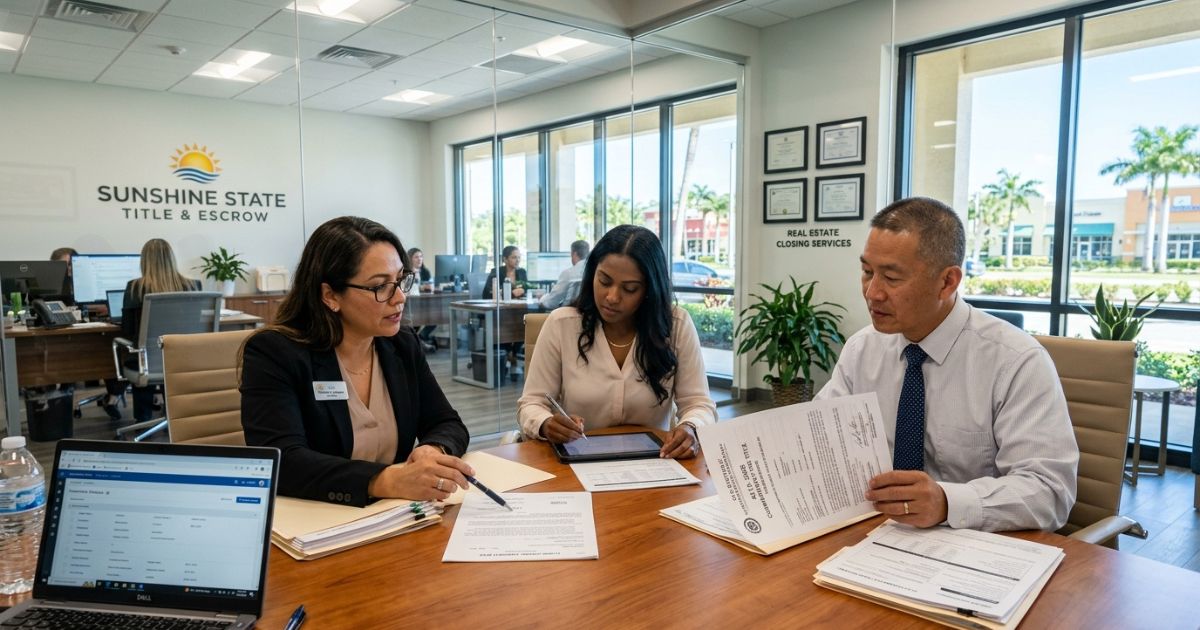
A title company verifies the legal history of the property, issues the title insurance policy, and manages every step of the closing — protecting your investment before, during, and after the transaction.
You find the right parcel of Florida land, negotiate a fair price, wire the funds, and receive the deed. Everything looks clean. Then, two years later, a court notice arrives: the previous owner had an unpaid lien on the property that was never properly discharged. Now it’s your problem.
This isn’t a hypothetical. It’s one of the most common ways land buyers lose money on transactions that appeared perfectly straightforward. And it’s exactly what a title company exists to prevent.
Most first-time buyers treat the title company as a procedural box to check — something that just happens in the background while they focus on price and closing dates. In reality, the title company is the entity doing the most important legal and financial verification work in the entire transaction.
Table of Contents
- What is a title company?
- What does a title company actually do?
- What is title insurance and why do you need it?
- Title company vs. real estate attorney: what’s the difference?
- How the closing process works with a title company
- How much does a title company cost in Florida?
- How to choose a reliable title company
- Common mistakes buyers make with title companies
- Hidden costs to know before closing
- 📚 Glossary
- ✅ Immediate Actions
- FAQ
What is a title company? {#what-is}
Short answer: a title company is a licensed business that researches the legal history of a property's ownership, issues title insurance, and manages the financial and document logistics of a real estate closing. In Florida, most property transactions close through a title company.
When a property changes hands, someone needs to verify that the seller actually has the legal right to sell — and that no unresolved claims, debts, or legal encumbrances are attached to the property. That’s the core function of the title company.
The title company conducts a title search: a systematic review of public records at the county level to trace the complete chain of ownership. This means going back through every recorded deed, mortgage, lien, court judgment, tax record, and easement associated with the property to confirm the title is clean and that ownership can transfer without complications.
After the title search, the title company issues title insurance — a policy protecting the buyer and, separately, the lender against defects in the title that existed before the purchase but were only discovered afterward.
Finally, the title company coordinates the closing: the formal process where documents are signed, money changes hands, and the property officially transfers to the new owner.
There’s no direct equivalent in many other countries. The title company combines the functions of a property registry office, title insurer, and escrow agent into a single entity managing the transaction from contract to deed.
What does a title company actually do? {#what-does}
Short answer: a title company searches ownership records, resolves title defects before closing, holds buyer funds in escrow, coordinates the signing and distribution of closing documents, disburses all funds to the appropriate parties, and records the new deed with the county after closing.
Broken down by phase, here’s what a title company manages throughout a typical Florida land transaction:
During the due diligence period:
- Conducts the title search across county public records
- Issues a title commitment (the preliminary title report showing what the insurance will and won’t cover)
- Identifies any defects, liens, judgments, or encumbrances requiring resolution before closing
- Works with the seller to clear any issues found
Approaching closing:
- Prepares the deed, Closing Disclosure, and all closing documents
- Holds the buyer’s earnest money deposit in a segregated escrow account
- Coordinates the closing date and logistics with all parties
At closing:
- Conducts or supervises the signing of all documents
- Receives the buyer’s wire transfer into escrow
- Verifies all conditions are met before disbursing funds
After closing:
- Pays the seller, satisfies any outstanding mortgages or liens, and distributes commissions and fees
- Records the new deed with the county recorder, creating the official public record of the ownership transfer
- Issues the final title insurance policy
For a foreign buyer or a first-time land purchaser unfamiliar with the US real estate system, the title company is the operational center of the entire transaction — the entity coordinating every moving part between contract execution and recorded ownership.
What is title insurance and why do you need it? {#title-insurance}
Short answer: title insurance protects the buyer against financial loss from title defects that existed before the purchase but were discovered afterward — including unknown liens, ownership disputes, recording errors, or fraud in prior transactions. Unlike other insurance policies, the premium is paid once at closing, with no annual renewals.
Title insurance is fundamentally different from homeowner’s insurance or flood insurance. Those policies protect against future events. Title insurance protects against the past.
Problems that title insurance covers include:
- Unpaid property taxes from prior ownership periods
- Unreleased mortgages or deeds of trust from previous transactions
- Forged signatures or fraudulent transfers anywhere in the ownership chain
- Errors in deed descriptions, lot measurements, or legal descriptions recorded with the county
- Claims from heirs or family members asserting ownership rights that weren’t resolved in prior estates
- Undisclosed easements or deed restrictions affecting how you can use the property
- Mechanic’s liens from contractors who worked on the property but weren’t paid
Owner’s policy vs. lender’s policy
| Policy type | Who it protects | When it's required | How long it lasts |
|---|---|---|---|
| Owner's policy | The buyer | Recommended — not legally required | As long as you or your heirs hold an interest in the property |
| Lender's policy | The mortgage lender | Required whenever financing is involved | Until the loan is paid off |
The owner’s policy is not legally mandatory in Florida — but skipping it to save on closing costs is one of the more expensive decisions a buyer can make. The premium is a one-time payment, typically 0.5% to 1% of the purchase price, and the coverage is permanent. A single undiscovered lien from a previous owner’s unpaid contractor can easily exceed the entire cost of the policy.
Title company vs. real estate attorney: what’s the difference? {#vs-attorney}
Short answer: Florida is not an attorney-closing state — title companies can legally conduct closings without an attorney. A title company handles the transactional and insurance side. A real estate attorney handles legal interpretation, contract negotiation, and complex ownership structures. For most straightforward purchases, a title company alone is sufficient. For LLC formations, estate planning, or unusual contract terms, adding an attorney is worth it.
| Function | Title Company | Real Estate Attorney |
|---|---|---|
| Title search | Yes | Can perform, usually delegates |
| Issue title insurance | Yes | No |
| Conduct closing | Yes | Yes (in attorney-closing states; optional in Florida) |
| Legal contract review | Limited | Yes — core function |
| LLC formation and structure | No | Yes |
| Estate planning and inheritance | No | Yes |
| Tax strategy | No | Yes (with tax specialization) |
| Dispute representation | No | Yes |
For a straightforward cash purchase of vacant land between two parties with a clean contract, a title company handles everything you need. For purchases involving an LLC, foreign ownership structures, inheritance planning, or complex seller financing arrangements, working with a Florida real estate attorney alongside your title company adds a meaningful layer of protection.
How the closing process works with a title company {#closing}
The closing is the transaction’s final step. Here’s how it unfolds when a title company is managing the process:
- Escrow opened: after both parties sign the purchase contract, the buyer sends the earnest money deposit to the title company’s escrow account
- Title search conducted: the title company reviews public records and delivers the title commitment — the document identifying what the insurance will cover and what conditions must be met before closing
- Issues resolved: if the title search uncovers liens, judgments, or other encumbrances, the seller must clear them before the closing date proceeds
- Closing documents prepared: the title company drafts the deed, Closing Disclosure, and all transfer documents
- Closing day: buyer and seller sign all documents — either in person at the title company’s office or via Remote Online Notarization (RON) if the buyer is not present in Florida
- Funds disbursed: the title company receives the buyer’s final wire transfer, confirms all conditions are satisfied, and distributes funds — paying the seller, satisfying any outstanding liens, and covering all closing costs and commissions
- Deed recorded: within days of closing, the new deed is recorded with the county property records, creating the official public record of the ownership change
Florida is one of the states that fully allows Remote Online Notarization (RON) — meaning the entire closing can be completed via video conference with a licensed notary, without either party traveling to the title company’s office. Foreign buyers and out-of-state purchasers use this regularly.
How much does a title company cost in Florida? {#cost}
Short answer: the total cost of title company services in a Florida transaction — including the title search, owner's title insurance, and closing fee — typically ranges from 0.5% to 1.5% of the purchase price, depending on the property value and which costs are negotiated into the seller's responsibility.
| Service | Estimated cost | Who typically pays |
|---|---|---|
| Title search | $150–$400 | Negotiable — buyer or seller |
| Owner's title insurance | 0.5%–1% of purchase price | Seller (Florida convention) |
| Lender's title insurance | $200–$500 | Buyer (when financing is involved) |
| Closing fee (title company service charge) | $300–$700 | Negotiable — buyer or seller |
| Recording fee (county deed registration) | $10–$100 | Buyer |
| Documentary stamp tax (doc stamps) | 0.7% of sale price | Seller (Florida convention) |
In most Florida counties, the convention is that the seller pays the owner’s title insurance and the buyer pays the closing fee and lender’s policy (if applicable). But these allocations are negotiable — the purchase contract specifies who pays what. Review the contract carefully before signing, and verify the Closing Disclosure against those agreed terms before the closing date.
How to choose a reliable title company {#how-to-choose}
Not all title companies operate at the same standard. When evaluating options, look for:
- Florida state licensure: verify the company is licensed by the Florida Department of Financial Services at myfloridacfo.com — never wire funds to an unlicensed entity
- Experience with your buyer profile: if you’re a foreign buyer, an out-of-state purchaser, or buying through an LLC, look for a company that handles these regularly and has established procedures for international wire transfers, foreign ID documentation, and RON closings
- Segregated escrow accounts: the title company should maintain client funds in accounts completely separate from its operating funds — ask directly if you’re uncertain
- Clear communication before closing: the best title companies explain what you’re signing before you sign it. If a company is vague about fees or timing, that’s a red flag
- Verifiable reviews and references: check Google reviews, ask your agent for references, and — if you’re a foreign buyer — ask specifically whether other international clients have had good experiences with the company
You have the right to choose your own title company regardless of which one the seller or agent recommends. The seller often suggests a title company because they pay the owner’s policy and have an existing relationship — that’s not a conflict of interest, but it’s also not a reason to accept the recommendation without doing your own verification.
Common mistakes buyers make with title companies {#mistakes}
- Accepting the seller’s title company without any due diligence: you have the right to choose your own. Exercise it — or at minimum verify the recommended company’s license and reputation before agreeing
- Not reviewing the title commitment before closing day: the title commitment is issued well before closing. Read it — particularly the exceptions list, which shows what the insurance won’t cover
- Skipping the owner’s title insurance on a vacant land purchase: land has no visible structure to reassure you of its history. The title problems that surface on vacant lots — unresolved easements, prior owner tax debts, disputed lot lines — are exactly the kind the policy protects against
- Wiring funds without verbally confirming account details: wire fraud targeting real estate transactions is a documented and growing problem. Always call the title company directly — using a number you verified independently, not from an email — to confirm wire instructions before sending any transfer
- Not requesting the Closing Disclosure in advance: you’re entitled to receive this document at least three business days before closing. Don’t sign anything without having read and understood every line item
- Misunderstanding who pays the doc stamps: the 0.7% documentary stamp tax is typically the seller’s responsibility in Florida — but only if your contract says so. Verify this before closing, not after
- Assuming a clean title search means no future problems: the title search covers what’s in the public record. Title insurance covers what isn’t — the undisclosed heir, the forged signature, the unrecorded lien. Both matter.
Hidden costs to know before closing {#hidden-costs}
| Cost | When it occurs | Estimated range |
|---|---|---|
| International wire transfer fee (your bank) | When sending closing funds from abroad | $30–$80 per transfer |
| Currency conversion spread | When converting foreign currency to USD | 1%–4% of amount converted |
| FIRPTA withholding (if seller is a foreign person) | At closing — withheld by buyer and remitted to IRS | 15% of gross sale price |
| Remote Online Notarization fee | If closing remotely | $25–$150 |
| Property tax proration | At closing — adjusted for partial year | Depends on closing date and assessed value |
| Certified document translation | Before or during closing (for foreign buyers) | $100–$300 per document |
| Annual property tax (ongoing) | Every year after purchase | 0.8%–1.5% of assessed value in most FL counties |
📚 Glossary {#glossary}
Title company — a licensed business that researches a property’s legal ownership history, issues title insurance, holds escrow funds, and manages the closing process in a real estate transaction.
Title search — a review of county public records to trace the complete chain of ownership and identify any liens, judgments, easements, or other encumbrances attached to a property.
Title insurance — a one-time premium policy issued at closing that protects the buyer (owner’s policy) and the lender (lender’s policy) against financial loss from title defects that existed before the purchase but were discovered afterward.
Owner’s policy — the title insurance policy that protects the buyer. Coverage is permanent — it remains in effect as long as you or your heirs have an interest in the property.
Lender’s policy — the title insurance policy that protects the mortgage lender. Required whenever financing is used; coverage ends when the loan is paid off.
Title commitment — the preliminary document issued by the title company before closing, specifying the conditions under which the title insurance will be issued and listing any exceptions to coverage. Reading the exceptions is critical before proceeding to closing.
Closing — the final step of a real estate transaction, where all documents are signed, funds are transferred, and the property officially changes ownership.
Escrow — a segregated account managed by the title company that holds the buyer’s funds during the period between contract execution and closing. Funds are only released when all closing conditions are satisfied.
Earnest money — a good-faith deposit made by the buyer at contract signing, held in the title company’s escrow account. Typically 1%–3% of the purchase price.
Deed — the legal document that transfers ownership of real property from seller to buyer. Prepared by the title company and recorded with the county after closing.
Doc stamps (documentary stamp tax) — a Florida state tax imposed on the transfer of real property, calculated at 0.7% of the sale price. By convention, paid by the seller — but this is negotiable and must be specified in the purchase contract.
FIRPTA — Foreign Investment in Real Property Tax Act. A federal rule requiring the buyer to withhold 15% of the gross sale price when the seller is a non-resident foreign person and remit it to the IRS. Applies when you eventually sell the property if you’re a foreign national.
RON (Remote Online Notarization) — a Florida-authorized process allowing real estate closings to be completed entirely via video conference with a licensed notary, without any party needing to be physically present at the title company’s office.
Recording fee — the fee paid to the county to officially record the new deed in the public property records after closing.
✅ Immediate Actions — Start Now {#actions}
- Before signing any purchase contract, identify which title company will handle the closing and verify their Florida license at myfloridacfo.com
- Review the title commitment as soon as it’s issued — pay particular attention to the exceptions section, which lists what the insurance will not cover
- Confirm in the purchase contract who is responsible for each closing cost — owner’s title insurance, closing fee, and doc stamps are all negotiable
- Request the Closing Disclosure at least three business days before your scheduled closing date to review every line item before signing
- If you’re closing remotely, confirm the title company offers Remote Online Notarization and understand the technical requirements before closing day
- Call the title company directly — using a phone number you verified independently — to confirm wire instructions before sending any transfer
- If you’re a foreign buyer, prepare source of funds documentation well in advance of the wire transfer date
- If your purchase involves an LLC, inheritance planning, or seller financing, engage a Florida real estate attorney to work alongside the title company
- Contact TerraNoble for referrals to title companies with experience in foreign buyer transactions and bilingual support in English and Portuguese
Conclusion
A title company isn’t a formality in a Florida land purchase — it’s the entity doing the most consequential verification work in the transaction. The title search determines whether the property you’re buying is actually free of legal encumbrances. The title insurance protects you if something was missed. The closing coordination ensures the transfer is executed correctly and recorded properly.
Most buyers only realize how much the title company does when something goes wrong and they wish they’d paid more attention to the process. Understanding it before you get to the closing table puts you in a much better position — to ask the right questions, to read the documents you’re given, and to know what protections you’re entitled to.
For foreign buyers and first-time purchasers especially, choosing a title company with genuine experience handling international transactions makes a practical difference. The process involves international wire transfers, foreign identification documents, cross-border source of funds verification, and often a remote closing — none of which are unusual for an experienced title company, and all of which require careful coordination.
TerraNoble works with Florida land buyers at every stage of the acquisition process and offers bilingual support in English and Portuguese. If you want guidance on finding the right title company for your specific situation — or want to understand how the closing process works for the property you’re considering — get in touch for a no-pressure conversation.