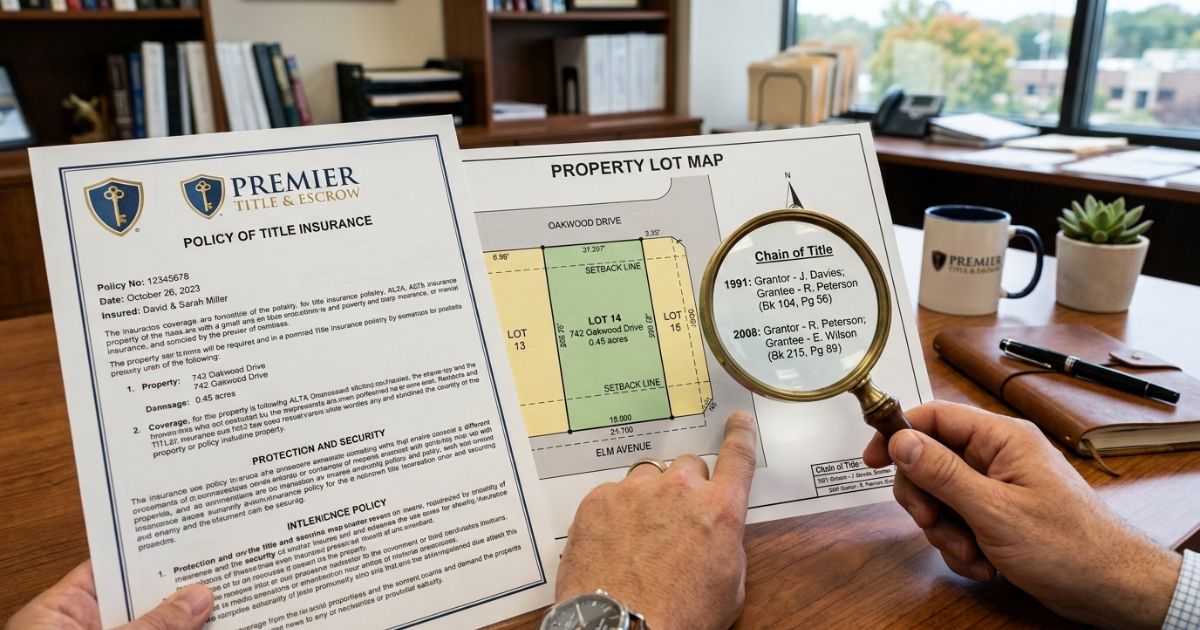
Title insurance protects Florida property buyers against hidden defects in a property's legal history — past liens, unresolved ownership disputes, and recording errors that can surface months or years after closing.
You’ve closed on a Florida property. The deed is in your name, the funds have transferred, and you’ve started making plans. Then, eight months later, a letter arrives from a court. A creditor of the previous owner is claiming a lien was placed on the property before the sale — a lien that was never properly discharged. The debt wasn’t yours. But the property is now legally encumbered, and resolving it will cost more than you expected.
This isn’t a worst-case hypothetical. It’s a scenario that plays out in Florida real estate more often than buyers realize — and it’s exactly what title insurance is designed to prevent from becoming your financial problem.
Most buyers think the risk ends when the deal closes. In reality, some of the most serious threats to property ownership are rooted in events that happened long before you ever made an offer.
Table of Contents
- What is title insurance in Florida?
- What does title insurance actually cover?
- What title insurance does NOT cover
- Owner’s policy vs. lender’s policy: what’s the difference?
- How much does title insurance cost in Florida?
- Why title insurance matters especially for foreign buyers
- Common title insurance mistakes buyers make
- Hidden costs tied to the title process
- 📚 Glossary
- ✅ Immediate Actions
- FAQ
What is title insurance in Florida? {#what-is}
Short answer: title insurance is a one-time policy that protects a property buyer — and any lender involved — against legal defects in the property's ownership history that were not discovered before closing. Unlike other insurance types, it covers problems that already exist in the past, not risks that might occur in the future.
Every piece of real estate in Florida carries a legal history. That history includes every prior owner, every mortgage taken out and discharged, every lien, every court judgment, every deed transfer — going back decades or longer. Before a property can legally change hands, someone needs to verify that the seller has a clean, uncontested right to sell.
That verification process is called a title search. A title company examines county public records to trace the chain of ownership and identify anything that could cloud the title — unpaid property taxes, undischarged mortgages, unresolved estate claims, easements, or recording errors made by previous attorneys or clerks.
Once the search is complete and the title is declared insurable, the title company issues a title insurance policy. If something from the past surfaces after closing that wasn’t caught — or couldn’t reasonably have been caught — the insurance covers the legal defense costs and potential financial loss.
What does title insurance actually cover? {#what-it-covers}
Short answer: a standard owner's policy covers defects in the title that existed before the policy was issued and were not revealed in the title search — including undisclosed liens, forgeries, heir disputes, recording errors, and fraud.
Here’s what a Florida owner’s title insurance policy typically protects against:
| Type of Defect | Real-World Example |
|---|---|
| Undisclosed liens | A contractor who did work on the property and was never paid files a mechanics lien that wasn't found during the search |
| Unpaid property taxes | A prior owner had delinquent taxes that were not cleared before sale — the obligation follows the property |
| Heir or estate disputes | A deceased prior owner's heir emerges claiming they never signed off on a transfer |
| Forged or invalid documents | A deed in the chain of title was signed by someone without legal authority, invalidating subsequent transfers |
| Recording errors | A county clerk entered the wrong parcel number, creating conflicting ownership records |
| Fraud and identity theft | The seller impersonated the true owner, conveying a property they had no right to sell |
| Undisclosed easements or restrictions | A utility easement that restricts building is found in older records that weren't included in the initial search |
When any of these issues emerge, the title insurance company steps in to cover attorney fees, court costs, and — if the title cannot be defended — financial compensation up to the insured value of the property.
What title insurance does NOT cover {#what-it-doesnt-cover}
Short answer: title insurance does not cover problems created after the policy is issued, physical defects in the property, zoning restrictions, or issues the buyer knew about at the time of purchase.
Understanding the exclusions is just as important as understanding the coverage:
- Liens created by the new owner — mortgages you take out, court judgments against you, contractor disputes arising from your own renovations
- Zoning and land-use restrictions — county regulations that affect how you can use or develop the land are not title issues
- Physical condition of the property — structural damage, environmental contamination, mold, or flooding are outside the scope of title coverage
- Known issues — if you were aware of a problem at closing and accepted it, the insurer is not obligated to cover it
- Boundary disputes visible in a survey — if a survey was available and showed an encroachment, the insurer may exclude that specific issue
This is why experienced buyers combine title insurance with a current land survey, a thorough property inspection, and a zoning verification with the county. Each tool covers different risks — none of them replaces the others.
Owner’s policy vs. lender’s policy: what’s the difference? {#policy-types}
Short answer: an owner's policy protects the buyer; a lender's policy protects the bank. When financing is involved, both are typically required. When buying with cash, only the owner's policy is needed — and it's still strongly recommended.
| Policy Type | Who It Protects | When Required | Duration |
|---|---|---|---|
| Owner's Policy | The buyer / property owner | Recommended on all purchases | As long as the owner (or heirs) holds the property |
| Lender's Policy | The mortgage lender or bank | Required when financing is used | Until the mortgage is paid off |
A critical distinction: if only the lender’s policy is in place and a title defect surfaces, the bank’s loss is covered — but yours may not be. The lender collects the insurance payout; you could still lose the property without recovering what you paid. The owner’s policy is what protects your equity directly.
The owner’s policy is issued for the purchase price and remains in force for as long as you own the property — even if you decide to sell decades later and a pre-closing issue comes to light.
How much does title insurance cost in Florida? {#cost}
Short answer: in Florida, title insurance premiums are state-regulated and calculated as a percentage of the purchase price. For a $100,000 property, the premium is roughly $575. For $300,000, approximately $1,575. It's a one-time payment made at closing — no renewals, no annual fees.
Florida is one of the few states where title insurance rates are set by the Department of Financial Services — meaning you’ll pay roughly the same no matter which title company you choose. The premium scales progressively with property value:
| Purchase Price | Approximate Owner's Policy Premium |
|---|---|
| $50,000 | ~$350 |
| $100,000 | ~$575 |
| $200,000 | ~$1,075 |
| $300,000 | ~$1,575 |
| $500,000 | ~$2,575 |
In most Florida transactions, the seller pays the owner’s policy premium as part of their closing costs. This is the common practice, but it’s negotiable — particularly in investor-to-investor transactions or land sales. Always confirm who is covering this cost before signing the purchase agreement.
The lender’s policy, when required, carries a separate premium based on the loan amount — typically lower than the owner’s policy.
Why title insurance matters especially for foreign buyers {#foreign-buyers}
For international buyers purchasing Florida property from abroad, the risks addressed by title insurance are amplified. You’re relying entirely on third parties to verify the property’s legal history without the ability to walk into a county office yourself, review paper records, or spot red flags in the local market.
Transactions involving inherited land, investor resales, estate sales, or properties with long ownership histories carry a higher likelihood of title complications. Older deeds, gaps in recorded transfers, and liens from decades-old creditors are more common than most buyers expect.
If you’re purchasing through an LLC — a common structure for foreign buyers managing US real estate — make sure the policy is issued in the name of the LLC and that your operating agreement is properly documented before the closing date.
Title insurance doesn’t eliminate the need to work with a reputable title company, but it does give you a financial backstop if the due diligence process misses something. In a market where you’re working across time zones and languages, that backstop is worth more than its premium suggests.
Common title insurance mistakes buyers make {#mistakes}
- Assuming the lender’s policy covers them. It covers the bank. Without an owner’s policy, your equity is unprotected — the lender gets paid, you absorb the loss.
- Believing the title search is infallible. A thorough search reduces risk significantly, but it can’t catch forged documents, unrecorded claims, or defects buried in older county records. That’s exactly why insurance exists.
- Not confirming who pays the premium. In standard Florida residential transactions the seller typically pays. In land deals and investor sales, it varies. Confirm it in writing before closing.
- Skipping the owner’s policy on a cash purchase. Without a lender requiring it, some buyers opt out to save money. Given the permanent nature of the protection and the one-time cost, this is rarely the right call.
- Choosing a title company without checking for foreign buyer experience. If you need bilingual support, document translation, or remote closing assistance, not all title companies are equally equipped.
Hidden costs tied to the title process {#hidden-costs}
Beyond the insurance premium itself, the closing statement will include several title-related fees that buyers sometimes overlook:
- Title search fee — the cost of pulling and reviewing county records, typically $150–$350
- Title examination fee — legal review of the search results, priced by complexity
- Closing or settlement fee — the title company’s charge for coordinating the closing, usually $300–$700
- Recording fees — county charges to officially record the new deed, typically $10–$30 per page
- Wire transfer fee — charged by the title company for receiving and disbursing funds electronically
These line items appear in the Closing Disclosure the title company sends a few days before closing. Read it carefully. Every number should be explainable before you sit down at the table.
📚 Glossary {#glossary}
Title insurance: a one-time policy that protects a property buyer against legal defects in the property’s ownership history that were not discovered before closing.
Title search: an examination of county public records to trace the full chain of ownership of a property and identify any liens, claims, or encumbrances that could affect the buyer’s legal rights.
Owner’s policy: the title insurance policy issued in the buyer’s name, protecting their ownership interest for as long as they hold the property.
Lender’s policy: title insurance issued in favor of the mortgage lender, covering the outstanding loan balance in the event of a title defect. Does not protect the buyer.
Lien: a legal claim against a property that secures payment of a debt. Unpaid liens attach to the property — not just the owner — and can survive a sale.
Closing Disclosure: a standardized document provided by the title company before closing that itemizes all costs, credits, and fees associated with the transaction.
Deed: the legal document that formally transfers ownership of a property from seller to buyer.
Recording: the formal filing of the deed with the county clerk, making the ownership transfer part of the public record.
Chain of title: the historical sequence of ownership transfers for a property, from its earliest recorded owner to the present.
✅ Immediate Actions {#actions}
- Confirm that your purchase agreement includes an owner’s title insurance policy — and verify who is paying the premium
- If using financing, confirm that both the owner’s policy and lender’s policy are included in your closing costs
- Request a copy of the Closing Disclosure at least three business days before closing and review every line item
- Ask your title company whether the title search turned up any liens, open permits, or ownership gaps
- If purchasing through an LLC, confirm the policy will be issued in the LLC’s name and that your entity documents are complete
- Verify that the title company has experience with your buyer profile — foreign buyer, cash purchase, land transaction, or remote closing
- Do not waive the owner’s policy to reduce closing costs — the long-term risk is disproportionate to the one-time savings
Conclusion
Title insurance is one of the quieter line items in a Florida closing — which is exactly why it tends to be underestimated. It doesn’t protect against future risks, it doesn’t cover the physical condition of the property, and it doesn’t replace a proper survey or inspection. What it does is provide permanent financial protection against something a buyer can’t fully control: the legal history of a piece of property that changed hands multiple times before you ever entered the picture.
For a one-time premium at closing, that protection stays in place for as long as you own the property. For buyers purchasing from abroad, through an LLC, or in markets with a high proportion of investor or estate resales, the value of that coverage is difficult to overstate.
If you have questions about how title insurance fits into the Florida buying process — or want guidance from a team with bilingual support and experience with international buyers — TerraNoble is here to help. Reach out for a straightforward conversation about your next property purchase in Florida.