If you’re comparing Florida, Texas, and North Carolina purely by the list price of the land, the sticker price isn’t your biggest risk. The real danger is discovering, years after closing, that property taxes, insurance premiums, and buyer-support infrastructure are so different between these three states that the “cheaper” parcel ends up being the more expensive one to actually own.
Most buyers researching these three states focus on headline growth numbers and price per acre. In reality, the smarter comparison weighs a combination of factors: tax structure, climate risk, insurance cost, market liquidity, and how easy the buying process actually is for someone who isn’t a local resident. Understanding these variables before choosing where to invest is what separates a well-informed decision from a financial surprise a few years down the road.
Table of Contents
- Why Compare Florida, Texas, and North Carolina Before Buying Land
- Which State Has Higher Property Taxes: Florida, Texas, or North Carolina?
- Population Growth and Land Demand in Each State
- Hurricane Risk and Insurance Costs Compared
- How Easy Is It for Foreign Buyers to Purchase Land in Each State?
- Appreciation Trends: What the Data Actually Shows
- Common Mistakes When Comparing States for Land Investment
- Hidden Costs That Change the Comparison
- FAQ — Frequently Asked Questions
- 📚 Glossary
- ✅ Immediate Actions — Start Now
Why Compare Florida, Texas, and North Carolina Before Buying Land {#why-compare}
Short answer: all three states rank among the most popular destinations for land buyers in the US because they combine above-average population growth with no or relatively low state income tax and still-expanding real estate markets — but each one distributes cost and risk very differently.
Florida, Texas, and North Carolina share one thing in common: every year, they each absorb a large share of people relocating from other US states and from abroad. That steady inflow supports demand for land, both for individual home construction and for expansion of planned subdivisions across dozens of counties.
Where they differ is in how each state balances that growth against cost. Florida offers no state income tax and a mature land market, but it also carries meaningful hurricane risk and some of the highest insurance costs in the country. Texas also skips state income tax, but it makes up for that with one of the highest property tax burdens in the nation. North Carolina does charge a state income tax, yet it tends to offer more predictable property tax rates and insurance costs, with lower overall exposure to severe weather events.
None of the three is the objectively “best” state in every case. The right answer depends on the buyer’s profile, time horizon, and tolerance for climate risk and regulatory complexity.
Which State Has Higher Property Taxes: Florida, Texas, or North Carolina? {#property-taxes}
Short answer: Florida and Texas don't charge state income tax, but Texas offsets that with one of the highest property tax burdens in the country. North Carolina charges state income tax, yet its property tax rates tend to run lower and more predictable than either Florida's or Texas's.
The cost of owning land isn’t just the purchase price — it includes recurring property tax, and that bill looks very different across these three states.
| State | State Income Tax | Average Effective Property Tax | Notes |
|---|---|---|---|
| Florida | None | Close to the national average | Homestead exemption available for primary residences |
| Texas | None | Among the highest in the US | No state income tax is offset by higher property tax |
| North Carolina | Flat state rate | Below the national average | Tax burden is spread more evenly between income and property |
These figures shift by county and by year, so exact numbers should always be confirmed with the county property appraiser before closing on a parcel. The structural point still holds: buyers who focus only on the absence of state income tax can be caught off guard by Texas’s property tax bill, while North Carolina tends to offer more predictable long-term carrying costs for buyers planning to hold land for many years.
Population Growth and Land Demand in Each State {#population-growth}
Short answer: all three states rank among the fastest-growing in the country by net new residents each year, which supports land demand — but the type of growth differs sharply: suburban expansion in Florida, tech-driven relocation in Texas, and research and education-anchored growth in North Carolina.
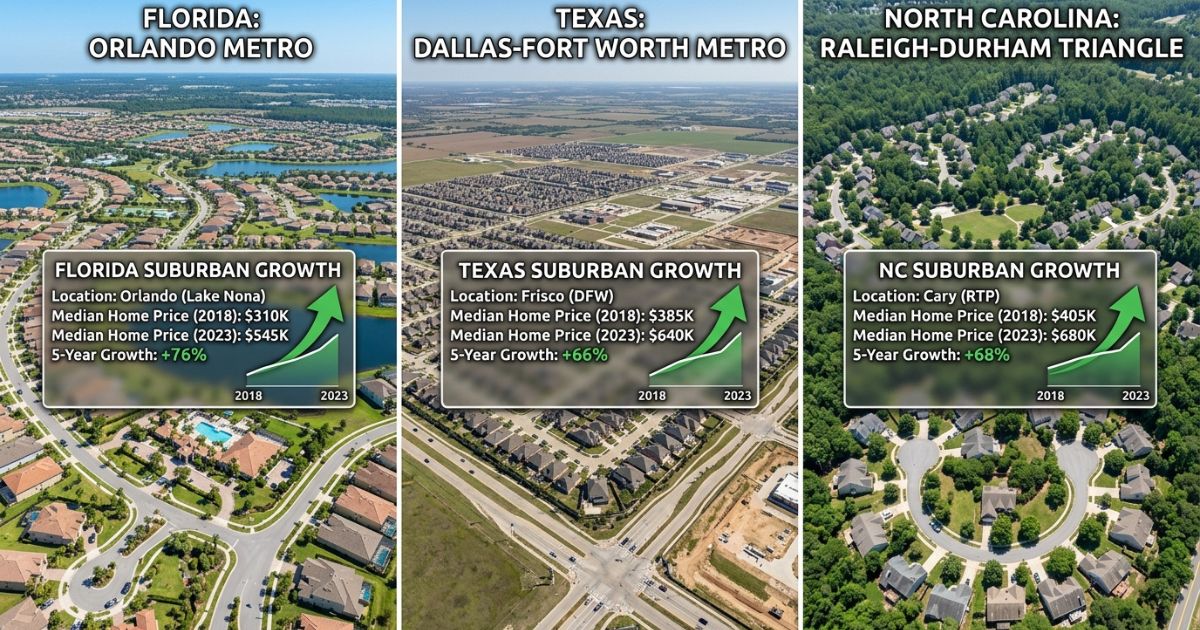
Metro areas like Orlando, Dallas-Fort Worth, and Raleigh-Durham concentrate much of that demand, each powered by a different economic engine:
- Florida (Orlando metro, including Lake Nona) — growth driven by domestic migration, retirees, tourism, and continued suburban expansion, with strong demand for residential lots inside planned communities
- Texas (Dallas-Fort Worth metro, including Frisco) — driven by corporate relocations, a large influx of tech and finance employers, and no personal income tax, fueling rapid job growth
- North Carolina (Raleigh-Durham metro, including Cary) — steadier growth tied to universities, research institutions, and the Research Triangle tech and biotech corridor
Population growth supports demand, but it doesn’t automatically guarantee that a specific parcel will appreciate. Real liquidity also depends on local zoning, utility availability, and how quickly a given county approves new subdivisions.
Hurricane Risk and Insurance Costs Compared {#climate-risk}
Short answer: Florida carries the highest hurricane exposure of the three states, which typically drives up insurance costs. Texas has meaningful risk along the Gulf Coast but less inland. North Carolina's hurricane exposure is concentrated mostly along the coast, with much of the state outside the highest-risk zones.
Climate risk isn’t just a safety consideration — it directly affects homeowners insurance premiums and, in some cases, whether flood insurance becomes a lender requirement.
| State | Primary Climate Risk | Effect on Insurance Cost |
|---|---|---|
| Florida | Hurricanes and flooding in coastal areas | Among the highest insurance costs in the country |
| Texas | Gulf Coast hurricanes, inland tornado risk | High along the coast, more moderate inland |
| North Carolina | Hurricanes concentrated along the coastline | Moderate across most of the state |
Land located inside a FEMA flood zone can trigger mandatory flood insurance in any of the three states, regardless of that state’s overall reputation for climate risk. Checking the specific flood zone designation for a parcel is always more useful than relying on a state’s general climate profile.
How Easy Is It for Foreign Buyers to Purchase Land in Each State? {#foreign-buyers}
Short answer: Florida has historically the most developed market for foreign buyers among the three states, with title companies, agents, and some lenders already experienced in handling international transactions — which often makes the buying process simpler than most people expect.
Buying land as a foreign national is legal in all three states — there’s no general federal restriction preventing non-residents from purchasing US land. The difference lies in how experienced the local market is with these transactions:
- Florida — a long track record of Latin American and European buyers, with title companies, agents, and some lenders already structured to serve international investors, including bilingual support
- Texas — receptive to foreign investment, especially tied to business relocation and corporate ownership, but with fewer bilingual services aimed specifically at Latin American buyers
- North Carolina — a growing market, but with less history of specialized service for international buyers compared to the other two states
For investors without US credit history, financing structure also plays into the decision. Seller financing is more common in Florida land transactions, which widens the options for buyers who can’t secure traditional bank financing.
Appreciation Trends: What the Data Actually Shows {#appreciation}
Short answer: all three markets have seen strong suburban growth in recent years, driven by population inflow and subdivision expansion — but past performance is not a guarantee of future results, and growth rates can shift with economic conditions and land availability.
Fast-growing suburban corridors around Orlando, Dallas-Fort Worth, and Raleigh-Durham have each attracted homebuilders and individual investors, sustaining demand for land that hasn’t been subdivided yet. Even so, each market follows a different logic:
- In Florida, growth is driven by steady housing demand and tourism, with solid resale liquidity in already-established areas
- In Texas, growth is more concentrated around tech and corporate hubs, which can produce faster appreciation during economic expansions — and more sensitivity during slowdowns
- In North Carolina, growth tends to be steadier and less volatile, anchored by universities and research institutions that sustain long-term demand
Short answer: none of these growth patterns guarantee future appreciation for a specific parcel — they only indicate the historical direction of demand. Every investor should treat these trends as context, not as a promise of return.
Common Mistakes When Comparing States for Land Investment {#common-mistakes}
Comparing only the price per acre
A cheaper parcel in one state can end up costing more overall once property tax, insurance, and HOA fees are added up year after year.
Confusing income tax with overall tax burden
Assuming “no income tax” automatically means lower overall taxes is a common mistake — Texas is proof that skipping one tax can mean a much higher bill on another.
Relying only on a state’s climate reputation
Every state has areas with very different risk profiles within its own borders. A parcel in North Carolina can sit in a higher-risk flood zone, just as a parcel in inland Florida can carry far less exposure than the coast.
Ignoring the support available for foreign buyers
Choosing a state purely on appreciation potential, without considering the local infrastructure for international buyers, can make the purchase and long-distance ownership process far more complicated than it needs to be.
Treating population growth as a guaranteed return
Growth supports demand, but zoning, utility access, and the pace of new subdivision approvals also determine whether that growth actually translates into appreciation for the specific parcel purchased.
Hidden Costs That Change the Comparison {#hidden-costs}
Beyond the purchase price, several recurring costs weigh differently in each state and should factor into the comparison:
- Annual property tax — varies by county and state, and should be projected several years out, not just checked for the year of purchase
- Homeowners and flood insurance — especially significant in Florida and in coastal parts of Texas and North Carolina
- HOA fees — common in planned subdivisions across all three states, and vary widely by community
- Title search and title insurance costs — required in any transaction, regardless of state
- Basic land maintenance — mowing, access control, and county code compliance, required even on vacant, unbuilt parcels
Short answer: comparing only the purchase price between Florida, Texas, and North Carolina hides real differences in annual cost — property tax, insurance, and HOA fees can significantly change the net return on a parcel of land over ten or twenty years.
FAQ — Frequently Asked Questions {#faq}
Which state is best for buying land: Florida, Texas, or North Carolina?
There’s no single answer. Florida tends to offer the most established market for foreign buyers and no state income tax, Texas pairs no income tax with a higher property tax burden, and North Carolina tends to offer more predictable taxes and lower climate exposure. The right choice depends on the buyer’s profile and goals.
Can foreign buyers purchase land in all three states without restriction?
Yes. There’s no general federal restriction preventing foreign nationals from buying land in the United States. The differences lie in local support — agents, title companies, and financing options — which tends to be more developed in Florida for Latin American buyers.
Does Texas really have higher taxes than Florida?
Not when it comes to income tax — neither state charges one. But Texas typically carries one of the highest property tax burdens in the country, which can make the total cost of ownership higher than in Florida, depending on the county.
Does Florida really carry more hurricane risk than Texas and North Carolina?
Generally, yes — Florida has the highest proportional hurricane exposure of the three states. Texas carries meaningful risk along the Gulf Coast, and North Carolina’s exposure is concentrated mostly along its coastline, with far less risk inland.
Does population growth guarantee land will appreciate?
No. Population growth supports demand, but the actual appreciation of a specific parcel also depends on zoning, utility access, and local market dynamics — factors that need to be evaluated parcel by parcel.
📚 Glossary {#glossary}
Property tax: an annual tax on the assessed value of a property, collected by the county, which varies by location and land valuation.
Homestead exemption: a Florida tax benefit available to residents who declare a property as their primary residence, reducing the taxable value.
Flood insurance: insurance against flood damage, required for parcels located inside certain FEMA flood zones.
HOA (Homeowners Association): an association present in many planned subdivisions, responsible for community rules and fees.
Seller financing: an arrangement where the landowner finances the purchase directly for the buyer, without a bank involved.
Research Triangle: a region of North Carolina anchored by major universities and research institutions, associated with tech- and education-driven economic growth.
Title insurance: insurance that protects the buyer against ownership disputes discovered after closing.
✅ Immediate Actions — Start Now {#immediate-actions}
- List your real decision criteria: time horizon, tolerance for climate risk, and need for bilingual support
- Compare the effective property tax rate for the specific county, not just the statewide average
- Check whether the parcel sits inside a FEMA flood zone before comparing insurance costs across states
- Research whether agents, title companies, and lenders in the target region have experience with foreign buyers
- Project the total cost of ownership over ten years — not just the purchase price — before choosing between Florida, Texas, or North Carolina
- Contact TerraNoble for bilingual guidance on how this comparison applies to your specific investment profile
Conclusion
Florida, Texas, and North Carolina each offer a different path for buyers looking to invest in US land — and none of them is universally superior to the others. Florida pairs no state income tax with a mature market for foreign investors, Texas trades that same benefit for a higher property tax burden, and North Carolina prioritizes tax predictability and lower climate exposure in exchange for a less developed international buyer market.
The right decision depends less on which state is “growing the fastest” and more on how each factor — taxes, insurance, foreign buyer support, and local liquidity — fits an individual investor’s profile and time horizon.
TerraNoble offers bilingual support — in English and Portuguese — to help investors understand how this state-by-state comparison applies to their specific situation and to structure a land purchase with confidence. Get in touch with our team.