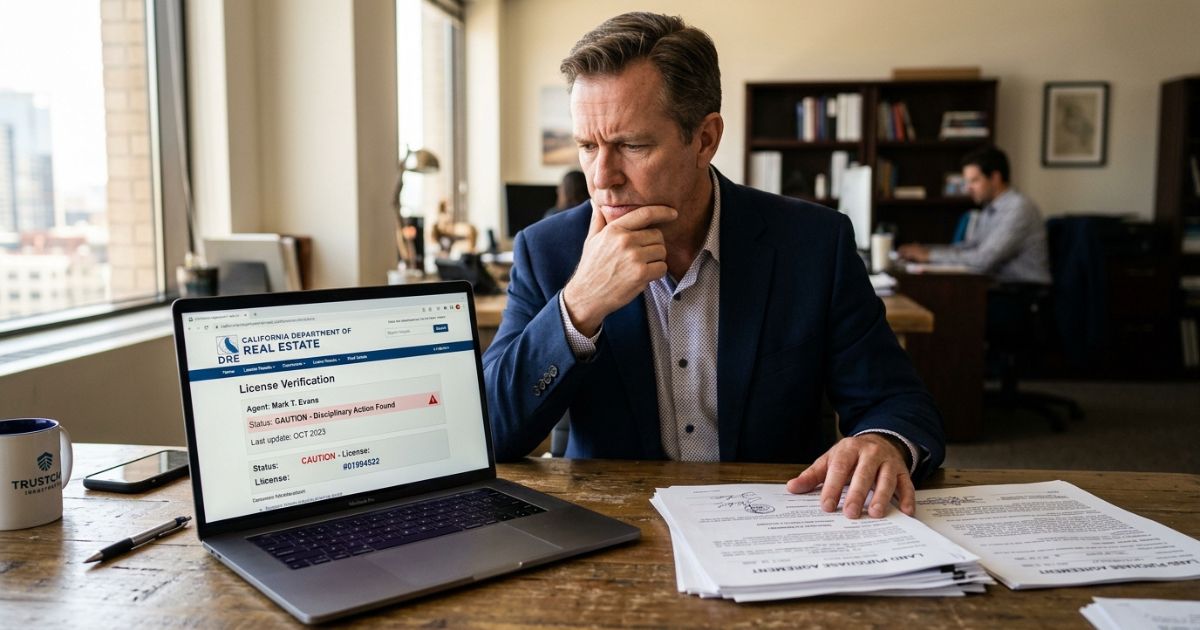
Finding the right parcel in Florida already takes time and research. But before any conversation about price even starts, there’s a more basic question most buyers never ask: does the person selling you this land actually have legal authority to do so? The visible issue is the below-market price or the “exclusive opportunity.” The real risk is signing a contract brokered by someone with no license, no professional insurance, and no legal duty to act in your interest — and only finding out once the deal has already gone wrong.
Most buyers assume the risk lives in the parcel itself: zoning, flood zone, access. In practice, the first safety filter is much simpler — and it comes before any site visit: knowing exactly who you’re dealing with.
Table of Contents
- Why a broker’s license matters as much as the parcel itself
- Agent, broker, or “wholesaler”? Who can legally sell land in Florida
- How to verify a Florida real estate license in minutes
- Red flags of an unlicensed or non-compliant broker
- Licensed broker vs unlicensed seller: what actually changes
- Common mistakes buyers make trusting the wrong person
- Hidden costs of dealing with an unlicensed broker
- FAQ — Frequently Asked Questions
- 📚 Glossary
- ✅ Immediate Actions — Start Now
Why a broker’s license matters as much as the parcel itself {#why-it-matters}
Short answer: a licensed Florida broker answers to the state, typically carries errors and omissions (E&O) insurance, and has legal disclosure obligations — protections that simply don't exist when a buyer negotiates with someone who isn't registered with the DBPR (Department of Business and Professional Regulation).
In Florida, anyone who professionally negotiates, advertises, or earns a commission on the sale of real estate on behalf of someone else needs a license issued by the Florida Real Estate Commission (FREC), a division of the DBPR. This requirement isn’t red tape — it exists because a licensed broker has passed a state exam, is subject to oversight, can face disciplinary action, and in most cases carries professional insurance that covers errors made during the transaction.
When a buyer negotiates instead with someone outside that system — even if that person calls themselves a “land consultant,” “investment partner,” or “land specialist” — none of those protections apply. If the deal falls apart, there’s no regulator to file a complaint with, no insurance to claim against, and in many cases the underlying contract itself can be challenged in court.
Agent, broker, or “wholesaler”? Who can legally sell land in Florida {#who-can-sell}
Short answer: Florida recognizes two main license types — sales associate (works under a broker) and broker (can operate independently) — and anyone negotiating the sale of someone else's land for compensation needs to hold one of them, aside from narrow exceptions like an owner selling directly or an attorney acting within their legal practice.
The two license types the state recognizes
- Sales associate — a licensed agent who can only work under the supervision of a registered broker. Can’t operate independently or collect commission directly from a client.
- Broker — the higher-level license, allowing independent operation, running a brokerage, and supervising other agents.
Who does NOT need a license — and where the confusion starts
Florida law carves out legitimate exceptions: an owner selling their own parcel directly (for sale by owner), attorneys acting within legal proceedings, and licensed auctioneers in specific auction settings. The problem is that many “wholesalers” operate in a gray zone: they sign a purchase contract with the original owner, then assign that contract to a final buyer for a fee. This can be legal under certain conditions — but once the same person starts advertising multiple third-party parcels, negotiating on behalf of other sellers, or collecting commission disguised as a “consulting fee,” they’re engaging in activity that requires a license, whether they have one or not.
For Brazilian and Latin American buyers specifically, this distinction matters a lot: groups advertising “exclusive” land deals on social media and WhatsApp, targeting the diaspora directly, frequently operate in this gray zone or entirely outside the law.
How to verify a Florida real estate license in minutes {#how-to-verify}
Short answer: the official DBPR license lookup at myfloridalicense.com lets anyone search a broker or agent by name or license number and confirm within seconds whether the registration is active, suspended, expired, or never existed at all — a free check that should happen before any conversation goes further.
The process takes no technical knowledge:
- Go to the DBPR’s official license verification site (myfloridalicense.com)
- Search by the professional’s full name or the license number they provided
- Confirm the status: Active, Inactive (can’t legally practice), Suspended, or Null and Void (revoked)
- Check that the supervising broker listed (for sales associates) matches the brokerage the person mentioned
- Review any disciplinary history shown in the same record
Short answer: if a professional hesitates to provide a license number, or their name doesn't show up in the DBPR system at all, that's reason enough to pause the negotiation until it's resolved.
Beyond the individual license, it’s worth confirming the brokerage itself is registered as an active entity with Sunbiz — Florida’s official business registry. A broker can hold a valid personal license while operating through a company that doesn’t formally exist or is no longer active.
Red flags of an unlicensed or non-compliant broker {#red-flags}
- Hesitates or refuses to share a license number — a licensed professional shares this without hesitation, since it’s public information
- Only communicates through WhatsApp or social media, with no corporate email, brokerage website, or verifiable physical address
- Asks for deposits or payments to be sent directly to a personal account, rather than through a title company or escrow account
- Pushes for a fast close, discouraging you from hiring a real estate attorney or ordering an independent title search
- Doesn’t show up as a listing agent in the MLS (Multiple Listing Service) — a system only licensed brokers and agents can access
- Offers “exclusive” land well below market price, with no clear explanation for the discount
- Presents themselves as a “consultant,” “investment partner,” or “specialist” without ever explicitly stating they’re a licensed broker
- Represents several different third-party properties at once, but claims they “don’t need a license because it’s just a referral”
Licensed broker vs unlicensed seller: what actually changes {#comparison-table}
| Aspect | Licensed Broker (DBPR/FREC) | Unlicensed Person |
|---|---|---|
| State oversight | Yes — subject to FREC and DBPR | None |
| Professional insurance (E&O) | Typically required by the brokerage | Doesn't exist |
| MLS access | Yes | No |
| Legal disclosure obligations | Yes, defined by state law | No formal obligation |
| Recourse for misconduct | Formal FREC complaint, possible recovery fund claim | Practically none |
| Use of escrow / title company | Standard, expected practice | Often avoided or skipped |
| Legal standing of the brokered contract | Solidly recognized | Can be challenged in court |
Common mistakes buyers make trusting the wrong person {#common-mistakes}
Trusting what the person says about themselves
A business card or social media profile doesn’t prove a license. Only a direct lookup on the DBPR site confirms it.
Assuming “someone I know already bought through this person” is enough
Informal references don’t replace formal verification — partly because fraudulent schemes often run smoothly for a while before something goes wrong.
Sending a deposit directly to an individual
Any funds tied to the purchase should move through a title company or a regulated escrow account — never straight into the personal account of whoever is brokering the deal.
Not confirming the supervising broker actually exists
Many scams borrow the name of a real brokerage for credibility, but the “agent” involved never had a formal relationship with it.
Signing a contract without a real estate attorney’s review
Even when the broker is properly licensed, having an attorney review the purchase contract adds a layer of protection — especially for foreign buyers.
Hidden costs of dealing with an unlicensed broker {#hidden-costs}
- Losing a deposit with no practical legal recourse — without a license, E&O insurance, or often even a formal business entity behind the deal, recovering funds can mean years of uncertain litigation
- A legally fragile contract — agreements brokered by someone with no authority to represent the sale can be contested by either party
- No basic due diligence — unlicensed brokers rarely check liens, zoning, or flood zone status before pushing the deal forward
- Attorney fees to try to unwind the deal — fixing a bad transaction usually costs far more than the due diligence would have upfront
- Wasted time on a deal that may never legally close — months of negotiation can end with no valid transfer of ownership at all
FAQ — Frequently Asked Questions {#faq}
Do I have to use a licensed broker to buy land in Florida?
No. Buying directly from an owner (for sale by owner) with no broker involved is completely legal. The issue isn’t the absence of a broker — it’s the presence of someone who acts like a broker, collecting a commission and negotiating on behalf of others, without holding the license the law requires for that role.
How do I know if a broker’s license number is real?
Look it up directly on the DBPR’s official verification site (myfloridalicense.com). The system shows the full name, license status, and the associated supervising broker. If the details don’t match what you were told, treat it as a serious red flag.
Do Brazilian or Latin American brokers operating in Florida also need a license?
Yes. Nationality is irrelevant — anyone brokering the sale of Florida real estate for compensation needs a state-issued license, regardless of whether they speak Portuguese, Spanish, or specifically serve Latin American buyers.
What should I do if I already bought land through someone unlicensed?
Contact a Florida-licensed real estate attorney right away to review the contract’s validity and any possible recourse. The earlier the problem is identified, the better the chance of resolving it before further complications with the title or the ownership transfer.
Is a wholesaler the same thing as an unlicensed broker?
Not necessarily. Assigning a single purchase contract can be legal without a license, depending on how it’s structured. The problem starts when that same person repeatedly advertises multiple third-party properties and collects a commission — at that point, the activity looks like brokerage and requires a license.
📚 Glossary {#glossary}
DBPR (Department of Business and Professional Regulation): the Florida agency responsible for licensing and overseeing a range of professions, including real estate brokers.
FREC (Florida Real Estate Commission): the commission under the DBPR that specifically regulates real estate broker and agent licensing in the state.
Sales associate: a licensed agent who can only operate under the direct supervision of a registered broker.
Broker: the highest tier of Florida real estate license, allowing independent operation and supervision of other agents.
MLS (Multiple Listing Service): a property listing system accessible only to licensed brokers and agents, used to officially advertise real estate for sale.
E&O Insurance (Errors and Omissions): professional liability insurance that protects clients against mistakes or omissions made by a licensed broker during a transaction.
Wholesaling: the practice of signing a purchase contract and then assigning it to a final buyer for a fee, without necessarily requiring a license — as long as it doesn’t amount to recurring brokerage activity.
Escrow: an account held by a neutral third party (typically a title company) where transaction funds are safely held until closing.
✅ Immediate Actions — Start Now {#immediate-actions}
- Ask for the broker or agent’s full license number before any negotiation moves forward
- Verify that number on the official DBPR site (myfloridalicense.com) and confirm it shows “Active”
- Confirm the supervising broker named actually exists and is tied to the brokerage mentioned
- Look up the brokerage on Sunbiz to confirm it’s an active, registered entity
- Never wire a deposit or payment to a personal account — insist on an escrow account or title company
- Hire a real estate attorney to review any contract before signing
- Talk to TerraNoble for bilingual guidance on how to safely vet whoever is brokering your purchase
Conclusion
Before any conversation about price, location, or appreciation potential, there’s a question that should come first: does the person on the other side of this negotiation have legal authority to be there at all? The check takes a few minutes, it’s free, and it’s publicly available on the DBPR’s website — yet most buyers skip it because it feels like a bureaucratic detail next to the excitement of closing a deal.
Licensed brokers and agents in Florida answer to the state, carry professional insurance, and have clear legal disclosure obligations. Anyone operating without that license carries none of those responsibilities — and buyers usually only discover what they’ve lost once it’s too late to reverse.
TerraNoble offers bilingual support — in English and Portuguese — to help Latin American buyers safely vet whoever is brokering a Florida land purchase, before any money changes hands. Get in touch with our team to clear up any questions about the professional involved in your deal.