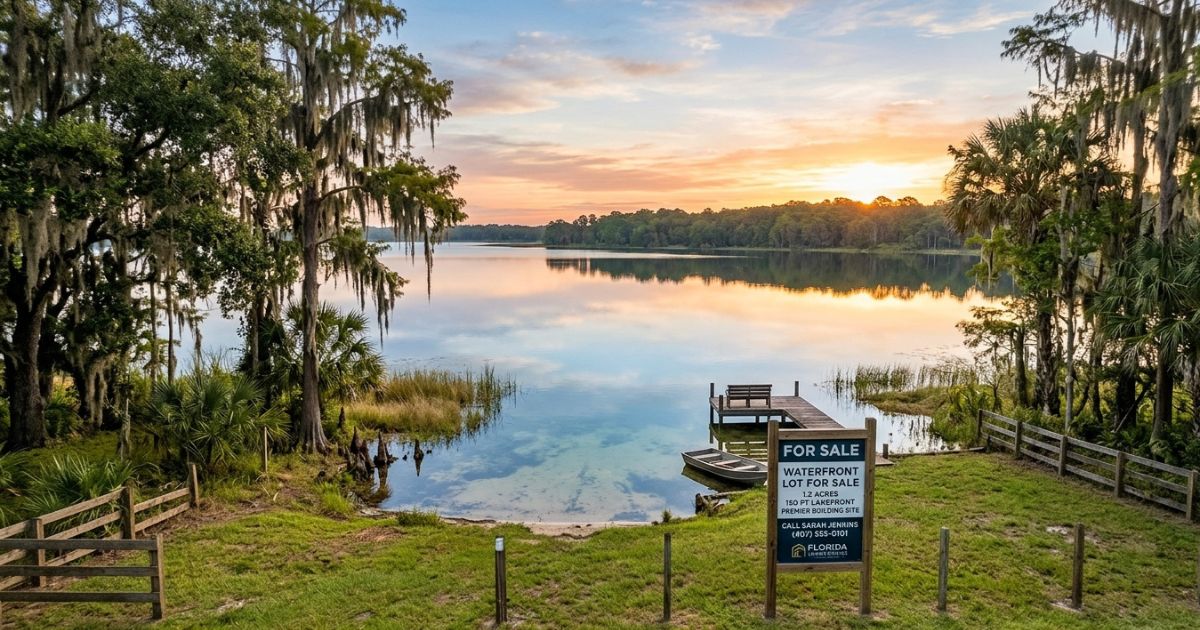
Waterfront land in Florida — lakefront, riverfront, or ocean-facing — consistently commands some of the highest per-acre prices in the state. That premium reflects real scarcity: Florida has over 7,700 lakes and 12,000 miles of navigable waterways, but developable lots with direct water access and legal use rights are finite. Buying without understanding flood zone classifications, riparian rights, DEP restrictions, and elevated insurance costs can turn a trophy parcel into a costly problem.
Waterfront land in Florida has a reputation for being a safe, prestigious investment — and most of the time, that reputation is earned. The combination of limited supply, strong lifestyle demand, and Florida’s continued population growth creates real, structural support for waterfront lot prices across the state.
But that reputation also attracts buyers who skip the due diligence that every waterfront purchase requires. Flood zone requirements, mandatory insurance costs, construction setbacks from the water’s edge, wetland restrictions, and riparian use limitations are not minor details — they directly affect what you can do with the land, what it will cost to own, and what it will be worth when you decide to sell.
Most buyers think choosing a waterfront lot is mainly about the view. In reality, the legal rights attached to that lot — what you can build, how close to the water, and what you can do with the water itself — determine most of the value.
This guide breaks down why waterfront land commands a premium, which factors drive that premium most reliably, what to verify before any offer, and the costs that don’t show up on a listing page.
Table of Contents
- Why waterfront land holds premium prices in Florida
- What types of waterfront land are available in Florida?
- How much more does waterfront land cost compared to inland lots?
- What actually determines the value of a waterfront parcel?
- What to verify before buying waterfront land in Florida
- Hidden costs of owning waterfront land that most buyers miss
- Common mistakes waterfront land buyers make in Florida
- 📚 Glossary
- ✅ Immediate Actions
- FAQ
Why waterfront land holds premium prices in Florida {#why-premium}
Short answer: Waterfront land in Florida commands premium prices because direct water access is physically finite, demand from retirees, families, and investors grows consistently, and waterfront lots have historically maintained value better through market downturns than comparable inland parcels. The scarcity is structural — no new waterways are created, and developable waterfront inventory only changes hands.
Florida is the only contiguous U.S. state surrounded by water on three sides. It has more than 1,350 miles of coastline, over 7,700 lakes, approximately 12,000 miles of rivers and streams, and tens of thousands of canal-front lots created during mid-20th century land development. That sounds like a lot of waterfront — and it is. But lots with direct water frontage, navigable access, and the legal right to build on or near the water represent a fraction of the total land available.
Several structural forces sustain waterfront land prices in Florida regardless of short-term market cycles:
- Finite supply: unlike inland land, which can be subdivided almost indefinitely, water frontage is fixed. Each waterfront lot that sells simply changes owners — the total inventory doesn’t grow.
- Retiree and relocator demand: Florida is the top destination for U.S. retirees and remote-work relocators. Both groups consistently prioritize proximity to water in their property searches.
- Lifestyle premium: waterfront lots command a premium not just for what can be built, but for the access itself — fishing, kayaking, boating, nature — which sustains demand even from buyers with no immediate construction plans.
- Inflation hedge: tangible waterfront real estate in a supply-constrained market has historically tracked or outpaced inflation over multi-year periods, even during short-term corrections.
What types of waterfront land are available in Florida? {#types}
Short answer: Florida waterfront land falls into four main categories — oceanfront or Gulf-front, lakefront, riverfront, and canal-front. Each type carries different price premiums, use restrictions, insurance requirements, and risk profiles. Lakefront parcels represent the largest share of available waterfront inventory and the widest range of price points.
| Waterfront Type | Characteristics | Estimated Price Premium vs. Inland | Primary Risk |
|---|---|---|---|
| Oceanfront / Gulf-front | Open water views, beach access, highest visibility and prestige | 200%–500%+ | Hurricane zone, coastal erosion, very high insurance costs |
| Lakefront | Freshwater access, navigable or non-navigable, quieter setting | 80%–200% | Flood zone classification, water quality, use restrictions |
| Riverfront | River access, potential navigation, natural surroundings | 60%–150% | Seasonal flooding, riparian rights complexity, DEP setbacks |
| Canal-front | Man-made canal access, common in planned subdivisions | 40%–100% | Canal maintenance obligations, HOA restrictions, salinity issues |
Lakefront parcels are the most commonly available category for buyers seeking a waterfront lot at a realistic entry price. They’re less exposed to hurricane risk than coastal properties, carry lower baseline insurance costs, and exist across dozens of Florida counties — from high-demand areas like Lake County and Polk County to emerging markets farther from the coasts.
How much more does waterfront land cost compared to inland lots? {#price-comparison}
Short answer: Depending on the county and the body of water, waterfront lots in Florida cost anywhere from 50% to 400% more than comparable inland parcels in the same area. The gap is widest for navigable lakefront and Gulf-front properties, and narrowest for canal-front lots in older subdivisions.
To put this in concrete terms:
- In Polk County (central Florida), a half-acre inland lot can be found for $25,000 to $60,000. A similar-sized lot on a navigable lake in the same county typically runs between $80,000 and $200,000.
- In Lake County, lakefront residential lots with private dock rights routinely list between $150,000 and $400,000, while comparable inland lots in the same area sell for $40,000 to $90,000.
- In Marion County, riverfront and spring-fed lake parcels carry premiums of 60% to 120% over inland lots, driven by strong demand from nature-oriented buyers and retirees.
- On the Gulf coast in Charlotte County or Sarasota County, direct water-facing lots start around $400,000 and can easily exceed $2 million depending on frontage length and navigability.
These price gaps don’t exist because buyers are being irrational. They reflect real differences in usability, lifestyle value, and long-term demand — but they also mean that errors in due diligence cost proportionally more in waterfront transactions than in inland ones.
What actually determines the value of a waterfront parcel? {#value-drivers}
Two lots listed as “waterfront” on the same lake can have dramatically different values. Understanding why requires looking past the listing description at the specific legal and physical characteristics of each parcel.
Navigability of the water body
A navigable lake — deep enough for motorized watercraft — commands a significantly higher premium than a decorative pond or a shallow water feature. Navigability is one of the most important pricing variables in lakefront real estate and is something a buyer should confirm, not assume.
Linear feet of water frontage
The number of linear feet a parcel shares with the water is a primary pricing metric. A lot with 100 feet of lake frontage is worth meaningfully more than one with 50 feet, even if the total square footage is similar. More frontage means better views, greater privacy, and more options for docks and waterside amenities.
Private dock rights and boat lift eligibility
Some parcels explicitly permit a private dock, boat lift, or floating platform. Others are subject to restrictions that prohibit any permanent structure at the water’s edge. That distinction — which must be confirmed in the deed and through the local permitting authority — significantly affects market value and the practical use of the lot.
Setback requirements from the waterline
Florida county codes and state regulations establish mandatory setbacks — the minimum distance from the waterline where any structure can begin. A 150-foot-deep lot with a 50-foot waterfront setback has only 100 usable feet of depth. On a small lot, setbacks can consume a substantial portion of the buildable area, which directly reduces the lot’s functional value.
DEP restrictions and protected shoreline classifications
The Florida Department of Environmental Protection (DEP) regulates activity along and within state waterways. Certain shorelines carry additional environmental protections that restrict clearing, grading, dock construction, or any modification to the immediate water’s edge. A parcel can be legally “waterfront” while still having limited ability to use the water frontage it advertises.
What to verify before buying waterfront land in Florida {#what-to-verify}
Short answer: Before making any offer on a waterfront parcel in Florida, verify the FEMA flood zone classification, riparian rights attached to the deed, required setbacks from the water's edge, the presence of protected wetlands on or adjacent to the lot, and any deed restrictions or easements limiting shoreline access. Skipping any one of these can produce expensive surprises after closing.
FEMA flood zone classification
Nearly every waterfront parcel in Florida falls within a FEMA flood zone designation. The relevant question isn’t whether there’s a classification — it’s which zone, and what that means for insurance, financing, and what you can build.
- Zone AE (high risk): annual flood insurance is mandatory for any financed purchase. Building requires elevation above the Base Flood Elevation (BFE), increasing construction costs.
- Zone VE (coastal high risk): strictest construction requirements and highest insurance costs. Common in Gulf and Atlantic coastal lots.
- Zone X (minimal to moderate risk): insurance not required for financing, but still advisable for waterfront parcels where conditions can change.
Verify the current flood zone at msc.fema.gov and review any recent map revision history for the area before proceeding.
Riparian rights
Riparian rights are the legal entitlements that come with owning land adjacent to a water body — the right to access the water, fish, build docks, and in some cases use the water itself. These rights vary by state law and county regulation, and they don’t automatically transfer in every sale the way you might expect. Confirm what’s included in the title before closing.
Wetland delineation
Florida’s wetland regulations are among the most protective in the country. Wetland areas within or adjacent to a parcel can appear as ordinary vegetation from the road — but any modification to those areas (grading, filling, clearing) requires DEP and potentially federal Army Corps of Engineers approval. A professional wetland delineation survey before purchase is the only reliable way to know how much of the lot is actually buildable.
Setbacks and county shoreline regulations
Request the applicable county zoning code and confirm the minimum setback distance from the waterline before running any build calculations. In some Florida counties, the setback from the ordinary high-water line is 25 feet; in others, it’s 50 feet or more. In counties with additional riparian buffer requirements, the constraint can be even larger.
Title search and shoreline easements
Waterfront lots sometimes carry public access easements along the shoreline — legal rights of way that allow general public access along the water’s edge even on privately owned land. A title search will surface these, as well as utility easements, shared access agreements, and any deed restrictions specific to water use. Use a licensed Florida title company to conduct this review.
Hidden costs of owning waterfront land that most buyers miss {#hidden-costs}
Short answer: The additional annual costs of a waterfront lot over a comparable inland parcel typically include mandatory flood insurance, higher property tax assessments, HOA waterfront surcharges in some communities, dock permitting and construction costs, and ongoing shoreline maintenance. Combined, these can add $2,000 to $8,000 or more per year above what an inland lot would cost to hold.
| Additional Cost | Estimated Range | Notes |
|---|---|---|
| Flood insurance | $1,200–$6,000/year | Mandatory in Zone AE; cost varies with risk level and structure value |
| Higher property taxes | 30%–80% above comparable inland | County assessors apply a premium to waterfront-assessed value |
| HOA waterfront surcharge | $600–$3,000/year | Some planned communities charge extra for waterfront access or maintenance |
| Dock construction and permitting (one-time) | $15,000–$80,000 | Includes county permit, DEP review if required, materials, and labor |
| Shoreline maintenance and erosion control | $500–$2,500/year | Vegetation trimming, riprap installation, and bank stabilization over time |
| Hurricane or windstorm insurance (coastal zones) | $3,000–$15,000+/year | Mandatory for most coastal properties with financing; cost rises sharply closer to the coast |
On a $120,000 lakefront parcel, annual ownership costs including flood insurance, property taxes, and basic maintenance can easily reach $4,000 to $8,000 per year — before any construction. Over a five-year hold, that’s $20,000 to $40,000 in carrying costs that need to be part of any honest ROI calculation.
Florida has no state income tax, which benefits property owners generally, but it doesn’t offset the waterfront-specific cost premium that comes with these lots.
Common mistakes waterfront land buyers make in Florida {#common-mistakes}
-
Buying the view without confirming the rights: a beautiful lake view does not automatically mean you can build a dock, fish from the shoreline, or use a boat on that water. Confirm riparian rights before making any offer.
-
Skipping the FEMA flood map until after the contract: flood zone classification directly affects insurance requirements, construction costs, and resale value. This should be one of the first three things you check, not something reviewed at closing.
-
Assuming “waterfront” means the water is navigable: many parcels marketed as waterfront adjoin ponds, shallow decorative lakes, or water bodies with motorized vessel restrictions. Navigability and use rights need to be explicitly confirmed.
-
Not commissioning a wetland delineation survey: wetland areas within a parcel dramatically reduce buildable square footage and constrain what you can do near the water’s edge. Discovering this after closing is expensive and sometimes irreversible.
-
Miscalculating the buildable area due to setbacks: a lot that looks generously sized on paper can have significantly less usable depth once county setbacks, DEP buffer requirements, and any HOA restrictions are applied. Run the math before closing, not after.
-
Underestimating flood insurance costs in Zone AE: FEMA’s National Flood Insurance Program (NFIP) premiums for higher-risk properties can be substantially higher than initial quotes suggest, particularly after properties are re-evaluated at higher replacement value. Get multiple insurance quotes before finalizing your purchase decision.
-
Ignoring shoreline easements in the title search: public access easements along a waterfront property’s edge can limit your ability to use and improve that shoreline. A thorough title search is the only way to identify these before they become your problem.
📚 Glossary {#glossary}
Waterfront: a property designation indicating direct frontage on a body of water — lake, river, canal, ocean, or Gulf. The term covers a wide range of water types with very different legal and practical implications.
Riparian Rights: legal entitlements belonging to landowners whose property borders a waterway — including the right to access, fish, and in some cases build structures in or over the water. These rights vary by state and county, and they must be confirmed in the deed.
Flood Zone: a FEMA classification indicating the relative flood risk of a parcel. Zone AE denotes high annual flood risk; Zone X indicates minimal risk. Properties in high-risk zones face mandatory insurance and construction requirements.
Setback: a mandatory buffer distance established by county code, measured from a specific boundary — such as the ordinary high-water line — within which no structure may be built. Waterfront setbacks can significantly reduce a parcel’s usable area.
Wetlands: protected areas of saturated or seasonally flooded land regulated by the Florida DEP and, in some cases, the U.S. Army Corps of Engineers. Any modification to wetland areas within a parcel requires specific permits and approvals.
DEP (Florida Department of Environmental Protection): the state agency responsible for environmental permitting, including the regulation of activities adjacent to or within Florida’s waterways, wetlands, and shorelines.
Water Frontage: the linear footage of a parcel that directly borders a body of water. One of the primary pricing variables in waterfront real estate — more frontage typically means higher value.
Base Flood Elevation (BFE): the FEMA-calculated height to which floodwaters are expected to rise during a 100-year flood event. Construction in Zone AE must meet or exceed BFE requirements, which increases building costs.
Flood Insurance (NFIP): coverage against flood damage, frequently mandatory for waterfront properties in high-risk zones when financing is involved. Available through FEMA’s National Flood Insurance Program and some private insurers.
Dock Permit: a local and sometimes state-level permit required before constructing any fixed structure in or over navigable water, including private docks, boat lifts, and floating platforms. Permit requirements vary by county and water body type.
Title Search: a comprehensive review of a property’s ownership history and recorded encumbrances, conducted by a licensed title company prior to closing. Identifies easements, liens, deed restrictions, and any cloud on the title.
✅ Immediate Actions — Start Now {#immediate-actions}
- Decide which waterfront type fits your goals: lakefront, riverfront, canal-front, or coastal. Each category has different cost structures, legal requirements, and risk profiles — don’t treat them interchangeably.
- Check the FEMA flood zone for any lot you’re seriously considering at msc.fema.gov before submitting any offer.
- Confirm whether the water body adjacent to the lot is legally navigable and what watercraft use is permitted.
- Order a wetland delineation survey for any parcel with dense vegetation along the water’s edge before going under contract.
- Request the county zoning code and calculate the actual buildable area of the lot after applying all applicable waterfront setbacks.
- Have a licensed Florida title company conduct a full title search that specifically looks for shoreline easements, riparian right limitations, and HOA deed restrictions.
- Get at least two flood insurance quotes before closing — not after. The cost can vary significantly between NFIP and private market options.
- Confirm dock permitting feasibility with the county and, if required, with the Florida DEP, before assuming you’ll be able to build a dock.
- Speak with a bilingual land specialist experienced in Florida waterfront transactions — the due diligence process differs materially from standard vacant land purchases.
FAQ {#faq}
Can foreigners buy waterfront land in Florida?
Yes. There are no legal restrictions preventing foreign nationals from purchasing waterfront property in Florida, including vacant lots. The purchase process is the same as for any U.S. buyer. The key differences for foreign buyers involve tax obligations at the time of sale — specifically the FIRPTA withholding requirement — and decisions about ownership structure (individual purchase vs. LLC). Consulting a U.S.-licensed attorney and a CPA experienced with non-resident real estate transactions is advisable before closing.
Is flood insurance mandatory for waterfront land in Florida?
It depends on the parcel’s FEMA flood zone classification and whether financing is involved. For lots in Zone AE or Zone VE, flood insurance is required as a condition of any federally backed mortgage. For cash buyers, insurance isn’t legally required — but the risk exposure for waterfront properties in high-risk zones makes it a practical necessity in most cases.
Can I build a private dock on a Florida lakefront lot?
Not automatically. Dock construction requires a permit from the county, and in many cases a separate environmental permit from the Florida DEP. The permitting outcome depends on the depth and type of the water body, the presence of protected aquatic vegetation, the lot’s shoreline classification, and applicable county codes. Some lots explicitly include dock rights; others don’t. This needs to be verified before purchase.
How do I verify the flood zone of a specific waterfront parcel?
Go to msc.fema.gov and enter the property address or parcel number. The FEMA Flood Map Service Center will show the current flood zone designation and the effective date of the most recent flood insurance rate map for the area. Also check whether any Letters of Map Amendment (LOMA) or Letters of Map Revision (LOMR) have been issued for the property or surrounding area.
What are riparian rights and do they always come with a waterfront lot?
Riparian rights are the legal rights a landowner has to use the water adjacent to their property — fishing, dock construction, water access, and in some cases withdrawing water for use. In Florida, these rights are recognized by state law but are not unlimited, and they can be restricted by deed language, county regulations, or prior easements. They do not always transfer automatically or completely with a property sale. Verifying what specific rights are included in the deed you’re receiving is an essential step before closing on any waterfront parcel.
Conclusion
Waterfront land in Florida offers something that inland lots simply cannot replicate — finite supply, real lifestyle premium, and a market that has consistently demonstrated stronger price resilience through downturns. For investors and buyers thinking in years rather than months, a well-chosen waterfront parcel in a growing Florida county remains one of the more compelling ways to own a tangible, dollar-denominated asset with structural demand behind it.
But the “waterfront” label covers an enormous range of actual situations. A lot with deed-confirmed riparian rights on a navigable lake in a high-growth county is fundamentally different from a lot technically adjacent to water that carries DEP restrictions, a mandatory 50-foot setback, and a FEMA Zone AE designation that requires expensive flood insurance before a single foundation is poured.
The buyers who come out ahead in the Florida waterfront market are the ones who do the due diligence before the contract — not after. Flood zone, riparian rights, wetland delineation, setbacks, and title search are not optional extras. They’re the work that separates a sound waterfront investment from a costly mistake with a beautiful view.
TerraNoble offers bilingual support in English and Portuguese for buyers exploring waterfront and vacant land opportunities in Florida. Our focus is on parcels with solid, verifiable fundamentals — not listings that look good on a map but don’t hold up under scrutiny.
If you’re evaluating a lakefront or riverfront parcel and want guidance on what to verify before moving forward, reach out to our team for a straightforward, no-pressure conversation.