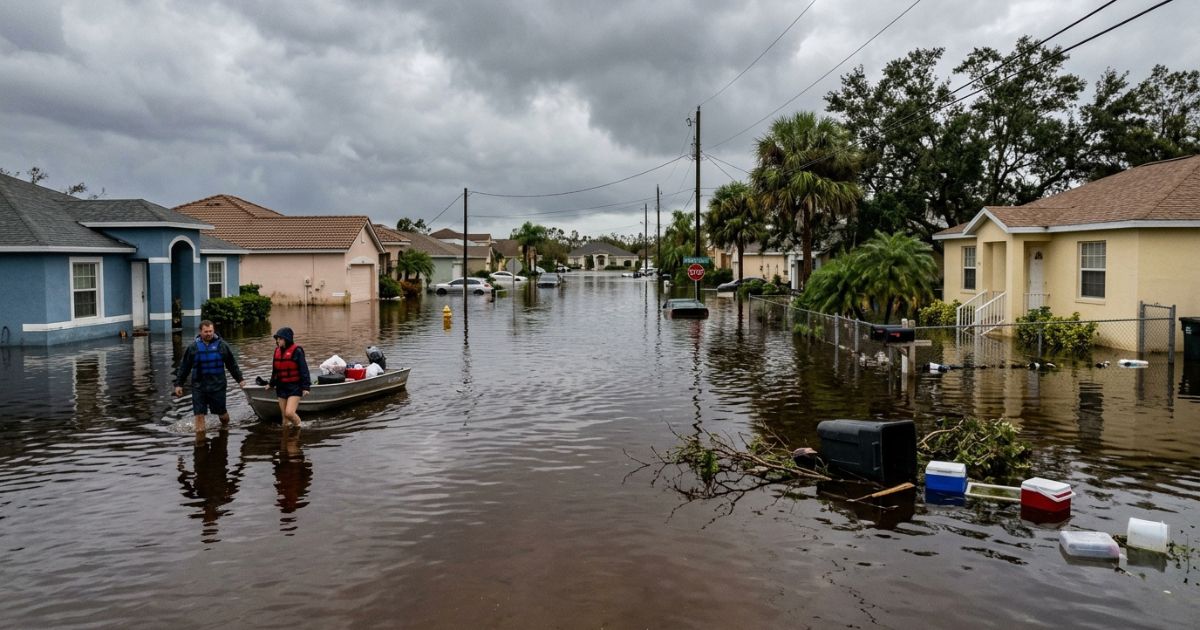
You bought a home in Florida. You have homeowners insurance. You assume you’re covered. Then heavy rains flood your neighborhood — and when you call your insurer, you find out your policy doesn’t cover a single dollar of water damage from flooding.
This isn’t an edge case. It’s one of the most common and expensive surprises in Florida real estate. Flood damage is explicitly excluded from standard homeowners insurance, and more than half of the properties in the state’s highest-risk flood zones have no separate flood coverage. When the water rises, so does the financial exposure — and there’s no policy to absorb it.
This article explains when flood insurance is legally required, when it makes sense even without a mandate, what it actually costs, and what happens to homeowners who decide to go without it.
Why standard homeowners insurance doesn’t cover floods
This is the detail that catches buyers off guard more than almost anything else in Florida real estate. Homeowners insurance — the policy that covers fire, lightning, wind, and theft — does not cover flood damage. It never has.
Short answer: Damage caused by water rising from the ground up — accumulated rainfall, river or canal overflow, storm surge, and street flooding — is excluded from every standard homeowners insurance policy in the United States. Flood insurance is an entirely separate product and must be purchased separately.
In Florida, this distinction is critical. The state has flat terrain, a high water table, aging stormwater infrastructure, and exposure to both tropical storms and hurricanes. Flooding happens across the entire state — not just on the coast. A slow-moving tropical storm can dump 20 inches of rain on an inland neighborhood and cause the same water intrusion as a coastal surge event. None of it is covered without a dedicated flood policy.
The most dangerous version of this gap is storm surge — the wall of ocean water pushed inland by hurricane winds and pressure. In major coastal hurricanes, storm surge is responsible for more deaths and structural damage than wind. It is legally classified as flooding and is not covered by homeowners insurance regardless of what caused it.
How flood insurance works in Florida: NFIP vs. private coverage
Most flood insurance in the United States is issued through the National Flood Insurance Program (NFIP), a federal program managed by FEMA. Private flood insurers have also grown significantly in Florida over the past decade and are now a meaningful alternative for many homeowners.
Short answer: NFIP policies cover up to $250,000 for the building structure and up to $100,000 for personal contents. Properties needing higher coverage limits must supplement with a private excess flood policy. Private flood insurers can offer faster claims processing, higher limits, and sometimes lower premiums — but availability varies by risk zone and property type.
What NFIP flood insurance covers:
- Building structure — foundation, walls, floors, electrical and plumbing systems, HVAC, built-in appliances, permanently installed cabinets
- Personal contents (must be purchased as a separate coverage) — furniture, clothing, electronics, portable appliances
- Basement and below-grade items — limited to essential systems only: electrical panels, HVAC, water heaters, sump pumps
What NFIP flood insurance does NOT cover:
- Damage from moisture, mold, or mildew that the owner could have prevented
- Temporary housing or loss-of-use expenses during repairs
- Vehicles (covered under comprehensive auto insurance, not flood)
- Landscaping, patios, decks, fences, septic systems, or pools
- Financial losses from business interruption on a residential policy
- Cash, precious metals, or important papers
| Coverage Feature | NFIP Policy | Private Flood Policy |
|---|---|---|
| Maximum building coverage | $250,000 | Varies — often $500,000+ |
| Maximum contents coverage | $100,000 | Varies |
| Waiting period (new policy) | 30 days | Often 10–14 days |
| Loss of use / temporary housing | Not covered | Often available |
| Accepted by federal mortgage lenders | Yes | Yes (approved carriers) |
| Premium flexibility | Federally set rates | Market-based, can be lower |
When is flood insurance legally required in Florida?
The legal requirement depends on two factors: the property’s flood zone designation and whether the purchase is financed through a federally regulated lender.
Short answer: Flood insurance is federally mandated for properties in high-risk flood zones (FEMA Zone A or V) that carry a mortgage from a federally backed or regulated lender. If you buy in cash or the property is in a lower-risk zone, there's no legal requirement — but the flood risk doesn't disappear with the paperwork.
| Property Situation | Flood Insurance Required? | Recommended? |
|---|---|---|
| High-risk zone (A or V) + federally backed mortgage | Yes — federal law | Yes |
| High-risk zone (A or V) + cash purchase | No | Strongly recommended |
| Moderate-risk zone (B, C, X) | No | Yes — especially near water |
| Low-risk zone (X500 or unmapped) | No | Optional — check local history |
| Vacant land, any zone | No | Verify BFE before building |
One important detail: if a property is remapped into a higher-risk zone after purchase, the lender will require flood insurance within a defined period. Homeowners who ignore that notice risk having force-placed insurance applied — a policy selected and charged by the lender, typically more expensive and with less favorable coverage terms than one you’d choose yourself.
How to find out what flood zone your Florida property is in
FEMA maintains the Flood Map Service Center at msc.fema.gov, where anyone can search any U.S. address and pull its current flood zone designation. The map shows which FEMA flood zone applies and what the Base Flood Elevation (BFE) is for that location.
The main flood zone designations and what they mean:
- Zone V — coastal high-hazard area with wave action risk; highest premiums and strictest building requirements
- Zone A — high-risk inland zone; includes subzones AE (detailed mapping), AH (shallow flooding), AO (sheet-flow flooding), and others
- Zone B, C, and X — moderate and minimal risk; not subject to mandatory purchase requirements
- Zone X (shaded) — moderate risk, between the 100-year and 500-year floodplain boundaries
One important caveat: FEMA flood maps are not fully up to date. Maps are revised periodically, and a property that currently sits in Zone X may be reclassified into Zone A in a future map revision. When that happens, mandatory flood insurance requirements apply going forward. Checking the map before purchase tells you the current designation, but it doesn’t guarantee that designation won’t change.
How much does flood insurance cost in Florida?
Flood insurance premiums in Florida vary significantly based on flood zone, property elevation, building characteristics, and which program you use. Since FEMA implemented Risk Rating 2.0 in 2021, premiums are no longer based solely on the generic flood zone — they’re calculated using the specific risk profile of each property, including distance from water sources, replacement cost value, and first-floor height above ground.
General premium ranges for residential properties in Florida:
| Property Risk Profile | Estimated Annual Premium |
|---|---|
| Low-risk zone (X), elevated structure | $500 – $900/year |
| Moderate-risk zone (A), elevated structure | $1,200 – $3,000/year |
| High-risk zone (A), structure at grade level | $3,000 – $6,000+/year |
| Coastal zone (V), wave action exposure | $5,000 – $12,000+/year |
These are estimates. Your actual premium depends on your property’s Elevation Certificate, claims history, square footage, and the deductible you choose. A higher deductible lowers the annual premium but increases your out-of-pocket exposure after a flood event.
What is an Elevation Certificate and why does it matter?
An Elevation Certificate is a technical document prepared by a licensed surveyor or engineer that records the elevation of your property in relation to the BFE (Base Flood Elevation) — the projected water level during a 100-year flood event in that specific location.
Properties built above the BFE pay lower premiums. Every foot of elevation above the BFE can reduce your annual premium by a meaningful amount. Properties built below the BFE pay significantly more — and may face limits on insurable coverage amounts.
If you’re buying a property in a flood zone, ask the seller for a current Elevation Certificate. If one doesn’t exist, budget $300–$600 to have a licensed surveyor prepare one. The savings on annual premiums often pay back the cost within one or two policy years.
What happens if you don’t have flood insurance and flooding occurs?
Homeowners without flood insurance who experience flood damage have limited options, and none of them are as simple as filing a claim.
Federal disaster assistance — If the President issues a federal disaster declaration for your area, FEMA can provide emergency assistance grants. But these grants are limited (typically capped around $40,000), not guaranteed, and only available when a disaster is formally declared. They are not a substitute for insurance.
SBA Disaster Loans — The Small Business Administration offers low-interest recovery loans to homeowners after declared disasters. These are real money — but they’re debt, not compensation. You pay them back with interest over time.
Out-of-pocket repair costs — Without insurance, the full cost of flood repair falls on the homeowner. In moderate flooding events, repairs routinely run $30,000–$80,000. In severe events or coastal surge, that number can exceed $200,000.
The FEMA trap — A little-known rule: if your property receives federal disaster assistance twice in 10 years and you haven’t maintained flood insurance, you lose eligibility for future federal disaster grants. The program is designed to encourage insurance adoption, not replace it.
The “low-risk zone” misconception — why it still matters
Roughly 25% of all NFIP flood claims in the United States come from properties outside high-risk flood zones. In Florida, with its flat terrain, high water table, and intense rainfall patterns, flooding outside of Zone A is common — it’s simply less predictable than the flood plain boundaries suggest.
Factors that increase flood risk even in low-risk zones:
- Proximity to canals, drainage ditches, rivers, or retention ponds
- Heavy surrounding pavement or development that reduces water absorption
- Low-lying lot elevation relative to the street
- Local stormwater infrastructure that was built for conditions that no longer reflect current rainfall patterns
- Upstream development that increases runoff to your area
If you’re buying property in Florida, don’t stop your flood risk assessment at the zone designation. Look at the lot’s elevation relative to the surrounding neighborhood, ask about local flooding history, and talk to neighbors about what they’ve seen in major rain events.
Common mistakes Florida property owners make with flood insurance
Assuming homeowners insurance covers flood: Still the most expensive misunderstanding in Florida real estate. It doesn’t. Not any part of it.
Waiting too long to buy: NFIP policies have a 30-day waiting period before coverage takes effect. Private flood policies often require 10–14 days. You cannot purchase flood insurance when a storm is already in the forecast. The policy must be in place well in advance.
Skipping contents coverage: A standard NFIP building policy covers the structure only. Contents — furniture, electronics, clothing, appliances — require a separate contents coverage policy. Many homeowners skip this and discover the gap when they’re replacing everything they own.
Ignoring the Elevation Certificate: Without one, NFIP may use conservative default assumptions that result in a higher premium than your actual elevation warrants. Getting the certificate prepared can immediately lower your cost.
Not reviewing coverage limits for higher-value homes: The NFIP cap of $250,000 for structure and $100,000 for contents is insufficient for many Florida properties. Owners of higher-value homes who rely solely on NFIP may be significantly underinsured after a major flood event.
Not comparing private flood options: Private flood insurers in Florida have expanded their offerings significantly since 2016. For some property profiles, private coverage offers higher limits, shorter waiting periods, and lower premiums than NFIP.
📚 Glossary
Flood Insurance: A separate insurance policy — distinct from homeowners insurance — that covers structural and contents damage caused by flooding, storm surge, and water rising from the ground. Available through NFIP or private insurers.
NFIP (National Flood Insurance Program): A federal program managed by FEMA that provides flood insurance to U.S. property owners. Offers up to $250,000 for building coverage and $100,000 for contents.
FEMA (Federal Emergency Management Agency): The federal agency that manages U.S. disaster response, maintains flood zone maps, and administers the NFIP.
Flood Zone: A FEMA classification that defines the level of flood risk for a specific geographic area. High-risk zones (A, V) trigger mandatory purchase requirements for federally backed mortgages.
BFE (Base Flood Elevation): The projected water surface elevation during a 100-year flood event in a specific location. Properties built above the BFE pay lower flood insurance premiums.
Elevation Certificate: A surveyor-prepared document that records a property’s elevation relative to the BFE. Used to accurately calculate flood insurance premiums.
Storm Surge: The abnormal rise in coastal water levels caused by a hurricane’s winds and low-pressure system. The leading cause of flood-related deaths in coastal hurricanes — and explicitly excluded from standard homeowners insurance.
Risk Rating 2.0: FEMA’s updated pricing methodology for NFIP policies, implemented in 2021. Calculates premiums based on each property’s specific risk profile rather than just its flood zone.
Force-Placed Insurance: A flood or hazard policy that a mortgage lender purchases on behalf of a borrower who has failed to maintain required coverage. Typically more expensive and less comprehensive than an owner-selected policy.
Waiting Period: The delay between when a flood insurance policy is purchased and when it takes effect. NFIP policies require 30 days; many private policies require 10–14 days.
✅ Immediate Actions — Start Now
- Look up your property’s flood zone designation at msc.fema.gov using the property address
- Confirm with your insurance agent whether your current policy includes or excludes flood coverage — if they say “included,” get it in writing and verify it applies to ground-up water intrusion
- Request the Elevation Certificate from the seller before closing on any property in a flood zone
- If no Elevation Certificate exists, budget $300–$600 to have one prepared before purchasing flood insurance
- Compare NFIP rates with at least one private flood insurer — premiums vary meaningfully
- Verify that your coverage limits ($250,000 building / $100,000 contents for NFIP) are adequate for your property’s replacement value
- If buying a property that has previously received federal flood disaster assistance, confirm it has maintained flood insurance coverage — gaps may affect future eligibility
- If planning to build on vacant land in Florida, check the BFE for the lot before finalizing your floor plan — building above the BFE from the start reduces flood insurance costs significantly
Conclusion
Flood insurance in Florida is not a bureaucratic formality — it’s a practical response to a real and common risk. Standard homeowners insurance explicitly excludes flood damage, and the state’s flat terrain, high water table, and storm exposure mean that flooding can affect properties well beyond the boundaries drawn on FEMA’s maps.
Knowing your flood zone, understanding when coverage is legally required versus simply prudent, and confirming that your policy limits actually reflect your property’s replacement value are steps that matter before the water rises — not after.
This article is for educational purposes and does not replace the advice of a licensed insurance professional. Every property has unique characteristics, and the right flood coverage depends on your specific location, elevation, construction type, and risk tolerance.
If you’re evaluating a property purchase in Florida and want to understand how flood insurance, homeowners insurance, and other ownership costs affect the real economics of the investment, TerraNoble offers bilingual support in English and Portuguese to help you make informed decisions — without pressure.