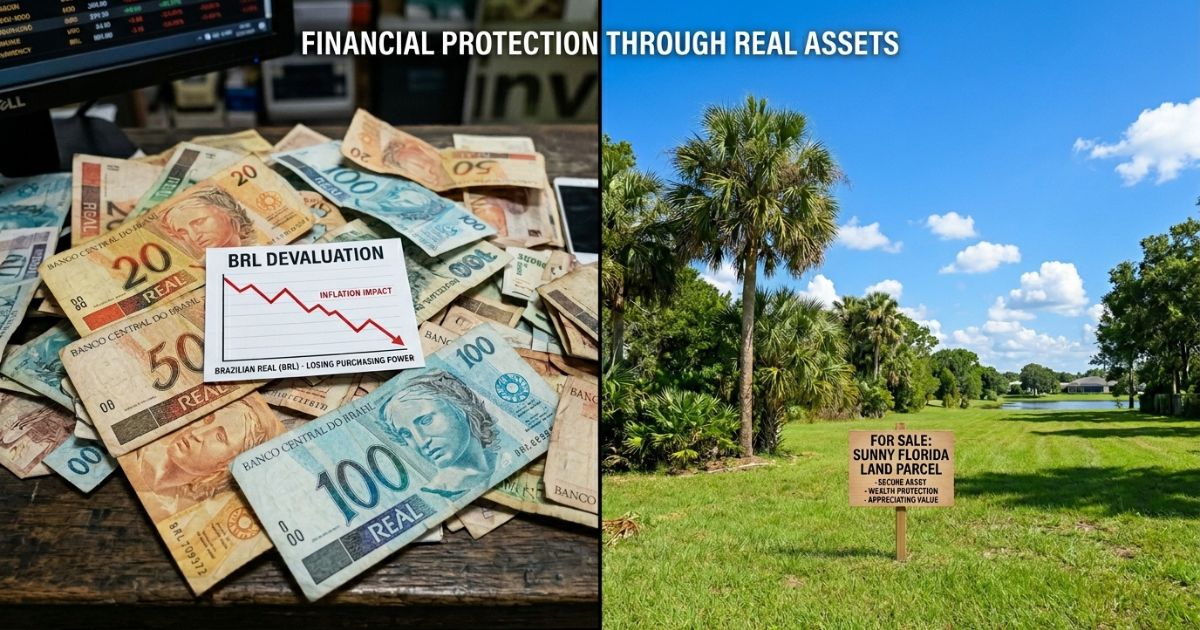
For investors across Latin America, Florida vacant land has become one of the most accessible ways to hold a portion of wealth in US dollars — a tangible, low-maintenance asset that sits entirely outside the reach of domestic monetary instability.
Currency devaluation isn’t a distant financial theory for most Latin Americans. It’s something that has happened — sometimes gradually, sometimes overnight — in Brazil, Argentina, Colombia, Mexico, Venezuela, and throughout the region. The financial consequences are felt directly: purchasing power erodes, imported goods become unaffordable, and savings that looked solid on paper lose real value without a single bad investment decision.
The logical response is diversification. But for many investors across the region, the options they’re aware of — foreign exchange accounts, stock markets, cryptocurrency — carry their own complexity, volatility, or regulatory friction. Florida vacant land has quietly become one of the most practical alternatives: a USD-denominated hard asset with low annual carrying costs, clear legal protections, and no active management requirement.
This article explains how the hedge works, why Florida specifically attracts Latin American capital, and what buyers need to understand before acting on this strategy.
Table of Contents
- Why do Latin American currencies lose value — and what does that mean for your savings?
- How does Florida land actually work as a currency hedge?
- Why is Florida the right location for this strategy?
- How much does it cost to hold a vacant lot in Florida each year?
- Florida land vs other currency hedges: an honest comparison
- Common mistakes Latin American buyers make when purchasing US land
- What to verify before closing on a Florida lot
- 📚 Glossary
- ✅ Immediate Actions
- FAQ
Why do Latin American currencies lose value — and what does that mean for your savings? {#currency-risk}
The structural factors are well-documented: commodity export dependence, persistent inflation, fiscal deficits, and political cycles that generate uncertainty for markets and investors alike. The result is that over any meaningful time horizon, most Latin American currencies have lost significant ground against the US dollar.
The Brazilian real has depreciated from under BRL 1.00 to the dollar in the early 1990s to rates above BRL 6.00 in recent years. The Argentine peso has experienced multiple severe devaluation events over the same period. The Colombian peso, Mexican peso, and Chilean peso have all shown high volatility against the dollar across different economic cycles.
For someone holding savings entirely in their home currency, the math is unforgiving. A 30% devaluation against the dollar means that every international purchase, every foreign-denominated obligation, and every asset priced in hard currency now costs 30% more in local terms. No interest rate or domestic investment return typically offsets a devaluation of that magnitude within the same timeframe.
The risk isn’t just theoretical. It materializes in the form of:
- Reduced purchasing power for internationally priced goods, travel, and education
- Erosion of estate value when heirs need to use assets internationally
- Vulnerability to policy shifts — currency controls, capital restrictions, or sudden tax changes affecting financial assets
Short answer: Latin American currencies have historically lost value against the US dollar over medium and long time horizons, driven by structural economic factors that recur across political cycles. Savings held exclusively in local currency are fully exposed to that loss — and no domestic investment return can reliably offset a sharp devaluation event.
How does Florida land actually work as a currency hedge? {#how-hedge-works}
The mechanism is straightforward. When you purchase a parcel of land in Florida, you are buying a USD-denominated asset. Its value is established in dollars, recorded in dollars in the county property records, and will be realized in dollars when you sell.
That means when your home currency falls against the dollar — which has happened to virtually every Latin American currency in recent decades — the local-currency value of your land rises proportionally. If you buy a lot for $40,000 when the exchange rate is 5:1, that lot represents 200,000 units of your local currency. If the exchange rate moves to 7:1, the same lot — without appreciating a single dollar in market value — now represents 280,000 local units. The protection is automatic.
This is what financial strategists call a natural hedge: you hold an asset in the currency that your local currency tends to weaken against. You’re not speculating on land appreciation. You’re separating a portion of your net worth from the monetary policy of your home country.
The key features that make vacant land particularly effective for this strategy:
- It’s a tangible asset — not a financial instrument subject to bank failure, broker insolvency, or regulatory seizure
- It’s registered publicly — the US county property recording system is transparent, verifiable, and legally protected
- It generates no income to report in most cases — reducing ongoing cross-border tax complexity for buy-and-hold investors
- It requires no active management — no tenants, no repairs, no property manager fees eating into the position
Short answer: Florida land hedges against currency devaluation because it is priced in US dollars. When your home currency loses value against the dollar, the local-currency equivalent of your land increases automatically — without any appreciation in the property's dollar price. This passive protection functions for as long as the dollar holds stronger than your local currency, which historically it has for most Latin American buyers.
Why is Florida the right location for this strategy? {#why-florida}
Not all US real estate makes sense for a currency hedging strategy. Location, carrying costs, and legal simplicity matter significantly. Florida checks the important boxes.
No state income tax Florida levies no state income tax. For foreign investors who may eventually generate income from the property or realize a gain on sale, this reduces the overall US tax burden compared to states like California or New York.
Consistent population growth Florida is the third most populous US state and has added more residents per year than any other state in recent years. That growth — concentrated in counties like Marion, Polk, Highlands, and Osceola — drives underlying demand for land, particularly in corridors where infrastructure development is ongoing.
Accessible entry points Vacant lots in Florida’s interior counties can be purchased starting at $15,000–$40,000, making it possible to establish a meaningful USD position without concentrating all capital in a single large transaction. This flexibility suits investors who want to diversify across multiple assets rather than deploy everything into one.
Legal clarity for international buyers Florida’s property registration system is public and verifiable. The process for foreign nationals to purchase real estate is well-established, doesn’t require US residency, and follows the same legal structure as any domestic transaction. The deed, recorded at the county courthouse, is the buyer’s legal proof of ownership.
Large established Latin American community South and Central Florida have significant Brazilian, Colombian, Venezuelan, and broader Latin American communities — making it easier to find professional support, legal guidance, and local market knowledge in familiar languages.
| Factor | Florida | Other US States |
|---|---|---|
| State income tax | None | Up to 13.3% (California) |
| Population growth trajectory | Strong and consistent | Varies significantly by state |
| Entry-level vacant lot pricing | $15,000 – $80,000 (interior) | Generally higher in comparable markets |
| Latin American buyer familiarity | Very high — established communities | Lower in most other states |
| Property record transparency | Full public access online | Equivalent across all US states |
| Foreign buyer legal process | Well-established, no visa required | Equivalent across all US states |
How much does it cost to hold a vacant lot in Florida each year? {#annual-costs}
Annual carrying costs are one of the most important variables in a long-term currency hedging strategy. A hedge that costs 5% of the asset’s value per year to maintain is far less useful than one that costs 1% or less.
Florida vacant land is at the low end of that spectrum. Typical annual expenses:
- Property tax: $300–$1,500 per year for most interior-county vacant lots, calculated on assessed value
- Vegetation clearing (if the county requires it): $200–$500 per year
- Optional liability insurance: $100–$300 per year for basic coverage
Estimated annual total: $500–$2,300 for the majority of lots in growth-corridor counties.
For a lot purchased at $40,000, that represents a carrying cost of roughly 1.25%–5.75% of the asset value per year — and the low end is far more common for modestly sized parcels in counties like Marion, Highlands, or Polk.
Compare this to a built property. A $280,000 Florida home can generate $10,000–$25,000 per year in combined insurance, property taxes, maintenance, and property management fees. The operational overhead of a built property — particularly managed remotely from another country — creates a drag on returns that vacant land simply doesn’t have.
Florida land vs other currency hedges: an honest comparison {#comparison}
Latin American investors have several options for holding wealth outside their home currency. Each comes with different trade-offs.
| Instrument | Liquidity | Volatility | Annual Cost | Tangibility | Operational Complexity |
|---|---|---|---|---|---|
| Florida vacant land | Low–medium | Low | $500–$2,300/yr | High — physical asset | Minimal |
| US stocks / ETFs | High | High | Custody fees | None | Medium |
| Foreign bank account (USD) | High | None | Account fees | None | Medium–high |
| Florida rental property | Low | Low–medium | $10,000–$25,000+/yr | High | High (especially remotely) |
| Cryptocurrency | High | Very high | Exchange/custody fees | None | Low–medium |
| US Treasury bonds (I-Bonds/T-Bills) | Medium–high | Low | None (some platforms) | None | Low |
Florida vacant land is not the most liquid option or the highest-yield one. Its advantage is the combination of tangibility, low carrying cost, and legal simplicity — particularly for investors who want a long-term hold without active management obligations. For someone whose primary concern is capital preservation in a stable jurisdiction, that combination is difficult to replicate.
Short answer: Florida vacant land offers currency protection with low volatility and minimal ongoing costs, but lower liquidity than financial instruments. It fits investors with a medium-to-long hold horizon who prioritize tangible asset ownership and operational simplicity over immediate liquidity.
Common mistakes Latin American buyers make when purchasing US land {#common-mistakes}
Buying without checking zoning first
Zoning determines what can legally be done with a parcel. A lot classified as agricultural may prohibit residential construction entirely, or may require variances that add cost and uncertainty. Zoning information is available free at the county Property Appraiser’s website. Check it before making any offer.
Skipping the title search
The title search reviews the legal history of the parcel for outstanding liens, encumbrances, or ownership disputes. Buying without one risks inheriting the previous owner’s unresolved legal problems. A closing company or real estate attorney conducts this as a standard part of the closing process.
Ignoring the flood zone classification
FEMA flood zone designations affect future development potential and can affect resale value. Parcels in high-risk zones (AE or VE) may face construction restrictions. The FEMA Flood Map Service Center provides this data free for any US address.
Assuming utility access without verifying
A lot without access to electricity, water, sewer, or a public road requires significant additional investment to become usable. This isn’t visible in a listing photo. Confirming utility availability — or understanding the cost to install it — is essential due diligence.
Not evaluating the ownership structure before closing
Purchasing in your personal name (as an individual) is legally valid, but holding through an American LLC may offer liability protection and simplify estate planning for heirs in another country. The right structure depends on your goals, the asset value, and your tax situation. A US attorney with international real estate experience can help you decide — but that decision needs to happen before closing, not after.
Overlooking FIRPTA obligations
When a foreign national sells US real property, FIRPTA (the Foreign Investment in Real Property Tax Act) requires the buyer to withhold a portion of the sale price for IRS remittance. This isn’t a reason to avoid buying — but understanding how it works and planning accordingly prevents surprises at the point of sale.
What to verify before closing on a Florida lot {#before-closing}
Before signing any contract, confirm the following:
- Zoning: What uses are permitted — residential, commercial, agricultural, mixed?
- Flood zone: Is the parcel in a FEMA high-risk area (AE or VE)?
- Title search: Are there any recorded liens, easements, debts, or ownership disputes?
- Utility access: Is there access to electricity, water, sewer, and a public road?
- Deed restrictions: Do any private contractual restrictions limit uses beyond what zoning allows?
- Property tax history: What has the county assessed and billed over the past two years? (Available free at the county Property Appraiser website)
- HOA: Is the parcel within a homeowners association? What are the applicable fees and rules?
- Ownership structure: Will you purchase as an individual, through an LLC, or through a trust — and have you confirmed the implications with a US attorney?
Every item on this list is either publicly accessible online or obtainable through standard closing procedures. Experienced buyers run through it as a matter of routine. First-time international buyers are the ones who pay for skipping it.
📚 Glossary {#glossary}
Currency hedge — A position in an asset denominated in a foreign currency, held with the intent of offsetting losses from devaluation of the investor’s home currency. When the home currency weakens against the dollar, a USD-denominated asset gains value in local terms automatically.
Property tax — An annual levy on real estate assessed by the county Property Appraiser. For vacant lots, the assessment is based on land value only; built properties include structure and improvements in the taxable value.
ITIN (Individual Taxpayer Identification Number) — A US tax identification number issued by the IRS to non-US-citizen individuals with US tax obligations. Foreign property owners typically need an ITIN, particularly when selling property.
Title search — A review of a property’s recorded legal history to identify any outstanding liens, encumbrances, ownership disputes, or other issues that could affect the buyer’s rights.
Title insurance — A policy that protects the buyer against title defects not discovered during the title search. Standard in US real estate transactions.
Deed — The legal document that transfers property ownership. Recorded publicly at the county courthouse and serves as the official proof of ownership.
Zoning — County or municipal rules that define the permitted uses of each parcel: residential, commercial, agricultural, or industrial. Determines what can be built and how the land can be used.
Flood zone — A FEMA classification that indicates each parcel’s flood risk level based on historical and projected data. High-risk zones (AE, VE) affect development options and potential insurance requirements.
FIRPTA — Foreign Investment in Real Property Tax Act. A US federal law requiring buyers to withhold a portion of the sale price when purchasing real estate from a foreign seller, to ensure capital gains taxes are remitted to the IRS.
LLC (Limited Liability Company) — A US legal entity that foreign nationals can form to hold real property. May offer liability protection and can simplify estate succession for non-US heirs.
Carrying cost — The total annual cost of holding an asset: taxes, insurance, maintenance, and any financing costs. Florida vacant land typically carries $500–$2,300 per year, far below built properties.
Utility access — The availability of essential infrastructure connections (electricity, water, sewer, road access) at or adjacent to a parcel. Lots without utility access require additional investment to become buildable.
Closing company (title company) — A firm that manages the closing of a real estate transaction — conducting the title search, preparing transfer documents, holding funds in escrow, and recording the deed at the county courthouse.
✅ Immediate Actions — Start Now {#immediate-actions}
- Calculate what percentage of your net worth is currently denominated in a single currency — that figure is your exposure to a devaluation event
- Define your goal clearly: capital preservation, long-term currency protection, eventual personal use, or estate planning — the objective determines the right lot type, county, and legal structure
- Research zoning for any lot you’re evaluating at the county Property Appraiser’s website — confirm permitted uses before making any offer
- Check the FEMA Flood Map Service Center for any specific parcel’s flood zone classification — this affects development potential and future resale value
- Estimate the full annual carrying cost: property tax + optional vegetation clearing + optional liability coverage — compare against your available capital and intended hold period
- Obtain your ITIN before closing if you don’t already have one — the IRS process can take several weeks, and you’ll need it for tax filings when you sell
- Consult a US real estate attorney with international transaction experience to evaluate whether personal name, LLC, or trust ownership best fits your goals and jurisdiction
- Contact TerraNoble for bilingual guidance on available lots across Florida — our team works with Latin American investors in both English and Portuguese
FAQ {#faq}
Does Florida land actually protect against currency devaluation?
Yes — mechanically and directly. Because the asset is denominated in US dollars, when your home currency weakens against the dollar, the local-currency value of your land increases proportionally. A $40,000 lot bought when the rate is 5:1 is worth 200,000 local units. At 7:1, the same lot is worth 280,000 — without any appreciation in dollar terms. The protection is passive and automatic.
Can Latin American investors buy land in Florida without a visa or US residency?
Yes. Foreign nationals can purchase real property in the United States without a visa, green card, or US company. The process requires a valid passport, an ITIN for tax purposes, an international wire transfer, and a closing company or real estate attorney to handle the transaction. No physical presence in the US is required for most cash purchases.
What are the tax implications of owning Florida land as a foreign national?
Annual property taxes are assessed at the same rate as for domestic owners. Foreign investors typically do not qualify for Florida’s homestead exemption, so they pay on the full assessed value. When selling, FIRPTA requires the buyer to withhold a percentage of the sale price for IRS remittance to cover capital gains taxes. A US CPA or tax attorney with international experience can help structure ownership and plan for these obligations in advance.
How long should I plan to hold the land for this strategy to make sense?
There is no universal minimum, but the strategy works best as a medium-to-long-term hold. Transaction costs on buying and selling (title insurance, closing fees, agent commissions if applicable) typically range from 3%–8% of the purchase price. Investors who hold for five or more years absorb those costs over a longer horizon and benefit from more devaluation cycles. Short-term buyers may find the transaction costs outweigh the currency protection.
Is it better to buy in my personal name or through an LLC?
Both are legally valid. Purchasing in your personal name is simpler and cheaper to set up. An LLC can offer liability protection if someone is injured on the property and may simplify estate succession for heirs outside the US. The right choice depends on the asset value, your overall structure, and estate planning goals. Consult a US attorney before closing — this decision is very difficult to change after the fact.
Does TerraNoble offer support in Spanish or Portuguese for Latin American buyers?
Yes. TerraNoble provides bilingual support in English and Portuguese throughout the buying process — from lot selection and due diligence to closing guidance. Spanish-speaking clients are also welcome to reach out.
Conclusion
Currency risk is not an abstract concern for Latin American investors — it is a recurring feature of financial life across the region. The question is not whether devaluation will happen again, but how much of your wealth will be exposed when it does.
Florida vacant land offers a concrete, accessible answer. It is a USD-denominated asset, registered under clear US property law, with annual carrying costs low enough to hold for years without financial pressure, and with no tenants, repairs, or active management requirements. For investors whose primary goal is protecting a portion of capital in a hard currency — not generating yield — the simplicity and tangibility of this approach is a genuine advantage.
The right entry into this strategy starts with proper due diligence: zoning, flood zone, title search, utility access, and ownership structure. Executed correctly, it creates a durable position in dollars that functions as long-term insurance against the monetary risks that Latin American investors know too well.
TerraNoble offers bilingual support in English and Portuguese for Latin American investors exploring Florida’s land market. Whether you’re evaluating your first lot or comparing options across multiple counties, our team is available for a no-pressure conversation about what makes sense for your long-term goals.