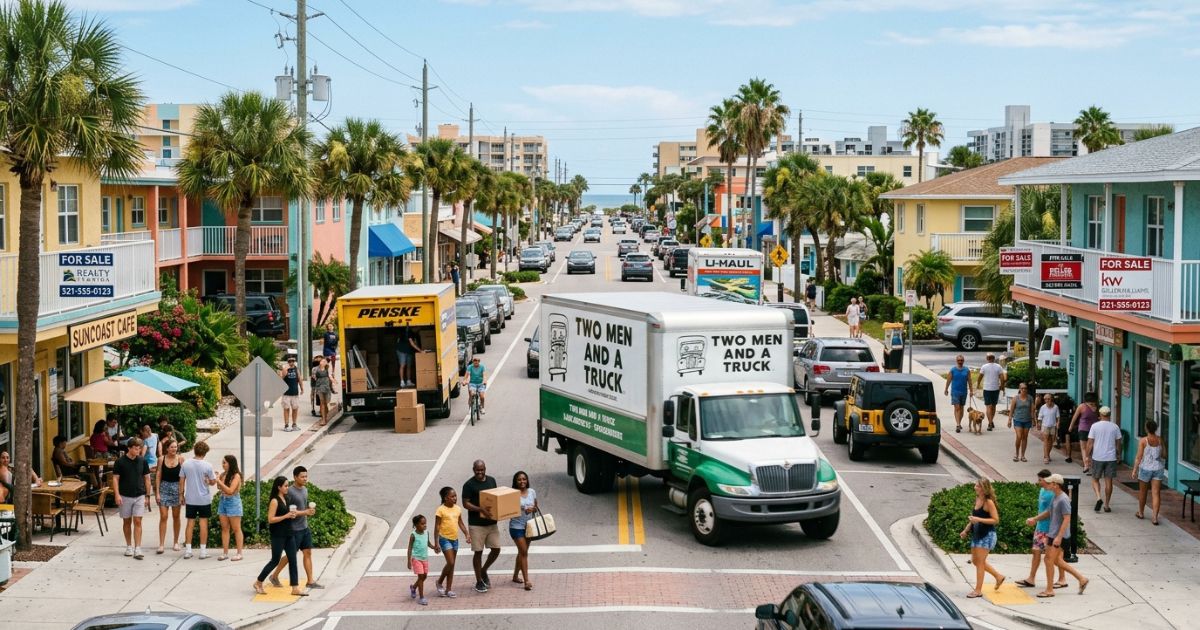
Florida has surpassed 23 million residents and leads US population growth for the third consecutive year — fueled by zero state income tax, a diversifying job market, and a quality of life that no other high-growth state has matched at scale.
Have you ever calculated how much state income tax you’d pay in New York, California, or Illinois on a $150,000 annual salary? Depending on the state, the number can exceed $15,000 — every year. That’s money Florida residents simply keep.
That single factor alone is enough to prompt serious conversations. But the people relocating to Florida aren’t moving on a whim or chasing a lifestyle trend. They’re responding to a combination of structural economic forces that have been building for over a decade — and that show no signs of reversing.
Most discussions about Florida growth focus on the sunshine and beaches. Those are real draws, but they’re not what moves families across the country. The real drivers are financial, occupational, and deeply practical. Understanding them matters whether you’re planning to move, thinking about buying land, or trying to make sense of why Florida real estate prices behave the way they do.
Table of Contents
- Why does Florida keep growing faster than any other state?
- How does zero state income tax actually change someone’s finances?
- What industries are driving Florida’s job market expansion?
- Is Florida’s climate and quality of life still worth the tradeoffs?
- What does sustained population growth mean for Florida real estate?
- Mistakes people make when moving or investing in Florida
- Hidden costs of living or owning property in Florida
- 📚 Glossary
- ✅ Immediate Actions
- FAQ
Why does Florida keep growing faster than any other state? {#why-growing}
Short answer: Florida combines zero state income tax, year-round warm weather, a rapidly expanding job market, lower costs relative to other large states, and significant infrastructure investment — creating a rare convergence of financial and lifestyle advantages that no other high-population state has been able to replicate.
The US Census Bureau tracks population movement closely. Florida has consistently added between 800 and 1,000 new residents per day over the past several years — a pace that puts it in a category of its own among large states.
By 2025, Florida surpassed 23 million residents, cementing its position as the third most populous state in the country. The state’s Office of Economic and Demographic Research projects continued growth well into the next decade, driven by the same structural factors that have sustained migration to date.
What the population data actually shows
The composition of Florida’s inbound migration tells a more complete story than raw numbers:
- More than 50% of new residents come from other US states — primarily New York, New Jersey, Illinois, California, and Ohio.
- International migration adds a substantial share annually, including significant numbers from Brazil, Colombia, Venezuela, and Cuba.
- High-income households are overrepresented among domestic migrants — particularly professionals in tech, finance, and healthcare who relocated during and after the remote work expansion.
- Growth corridor counties — St. Johns, Nassau, Flagler, Osceola, Pasco, and Manatee — are growing at some of the fastest rates in the entire country, not just Florida.
This isn’t a single wave. It’s a sustained, multi-directional inflow that continues to reshape the state’s demographics, economy, and real estate market.
How does zero state income tax actually change someone’s finances? {#no-income-tax}
Short answer: Florida charges no state income tax on wages, capital gains, retirement income, or investment returns. For professionals and retirees relocating from high-tax states, the annual savings can range from several thousand to well over $20,000 per year — making Florida's tax structure one of the most financially significant reasons people choose to relocate.
Florida’s lack of a state income tax is widely cited but frequently underestimated in its real financial impact. Let’s put it in concrete terms.
| State of Origin | Top State Income Tax Rate | Annual Tax on $200K Income | Annual Savings Moving to FL |
|---|---|---|---|
| California | 13.3% | ~ $26,600 | ~ $26,600/year |
| New York | 10.9% | ~ $21,800 | ~ $21,800/year |
| Illinois | 4.95% | ~ $9,900 | ~ $9,900/year |
| North Carolina | 4.75% | ~ $9,500 | ~ $9,500/year |
| Texas | 0% | $0 | No difference |
| Florida | 0% | $0 | — |
The savings scale with income. A household earning $300,000 annually moving from California to Florida keeps roughly $40,000 more per year — money that, over a decade, represents a substantial wealth transfer.
Who benefits most from moving to Florida?
Remote workers were the first major wave during the pandemic years, but they’ve been followed by a more diverse group:
- Retirees with pension and investment income — Florida taxes none of it at the state level.
- Business owners and entrepreneurs — who benefit from both the income tax advantage and Florida’s corporate-friendly regulatory environment.
- High-earning professionals — doctors, lawyers, executives, and finance professionals whose tax bills in high-rate states are significant enough to justify a major life decision.
- Investors with capital gains exposure — stock, real estate, and business sale proceeds are not subject to Florida state tax.
Federal income tax still applies — Florida’s advantage is state-level only. But for the right income profile, the difference is transformative.
What industries are driving Florida’s job market expansion? {#job-growth}
Short answer: Florida's economy has diversified significantly beyond tourism and retirement services. Technology, healthcare, financial services, and logistics are all expanding, creating well-paying jobs that attract skilled professionals — and those professionals, in turn, drive demand for housing and land.
The perception of Florida as a low-wage tourism economy is decades out of date. The state’s economic composition has shifted meaningfully — and that shift is one of the core reasons its population growth has accelerated rather than plateaued.
The sectors adding the most economic weight
Technology and startups: Miami’s emergence as a tech hub — marked by the “Miami Tech” movement, an influx of venture capital, and the arrival of major financial technology firms — has attracted thousands of high-income workers from San Francisco and New York who want the tax advantage without giving up career access.
Healthcare and life sciences: Tampa, Orlando, and Jacksonville host some of the Southeast’s largest hospital systems and biomedical research institutions. The life sciences sector continues expanding, pulling specialized workers into markets that weren’t previously on most relocation lists.
Financial services: Palm Beach, Boca Raton, and Miami have seen a notable migration of wealth management firms, family offices, and institutional investors. Florida’s tax structure and lifestyle combination has made it increasingly attractive for financial industry leadership.
Logistics and international trade: Florida’s geography gives it natural advantages in hemispheric commerce. Ports including Miami, Port Everglades, and Jacksonville move enormous volumes of cargo between the US, Latin America, and Europe — and the logistics sector supporting that trade employs tens of thousands of workers.
Each of these sectors creates its own downstream demand: more workers need more housing, more housing requires more land, and more land demand moves prices in corridors where supply hasn’t yet caught up.
Is Florida’s climate and quality of life still worth the tradeoffs? {#quality-life}
Short answer: Florida's year-round warm weather, outdoor lifestyle, and relative affordability compared to coastal metros remain compelling draws — but the state's climate risks are real and carry financial consequences. Hurricane exposure, flood risk, and rising insurance premiums are factors that must be weighed honestly alongside the lifestyle benefits.
Climate is often treated as a soft factor in relocation decisions. In Florida, it isn’t. Weather affects insurance costs, property values, construction decisions, and long-term financial planning in ways that most people from lower-risk states don’t fully anticipate.
The draws are genuine. A budget that buys a two-bedroom apartment in Manhattan buys a four-bedroom house with a yard in Jacksonville or Orlando. The outdoors is accessible year-round. The pace of life is different from the dense northeastern metros that most domestic migrants are leaving.
But Florida’s climate challenges deserve honest treatment:
| Climate Factor | Reality | Financial Impact |
|---|---|---|
| Hurricane season | June–November annually; major storm risk varies by region | Higher homeowners insurance premiums; separate wind coverage often required |
| Flood risk | Many Florida properties fall in FEMA-designated flood zones | Mandatory flood insurance for financed properties in high-risk zones |
| Summer heat | June–September averages above 90°F with high humidity | Higher utility costs; HVAC wear and replacement frequency |
| Year-round warmth | Average winter temperatures 60–75°F statewide | Lower heating costs; outdoor lifestyle year-round |
Anyone buying property in Florida — whether to live or invest — should research insurance costs specific to the property’s location before committing. Premiums vary dramatically based on proximity to the coast, flood zone classification, and construction type.
What does sustained population growth mean for Florida real estate? {#real-estate-impact}
Short answer: sustained population growth creates persistent upward pressure on housing demand — which, in turn, affects land prices, construction activity, and the availability of buildable lots. In Florida, this pressure is most intense in growth corridor counties where infrastructure is expanding and demand is arriving ahead of supply.
Population growth and real estate are directly connected. Every new household needs housing. New housing needs land. When hundreds of thousands of people arrive each year, the supply chain for that land gets stressed — and prices in the regions absorbing the most growth respond accordingly.
| State | Annual Population Growth | Median Home Price (2025) | State Income Tax |
|---|---|---|---|
| Florida | ~ 400,000/year | ~ $410,000 | 0% |
| Texas | ~ 375,000/year | ~ $320,000 | 0% |
| North Carolina | ~ 145,000/year | ~ $330,000 | 4.75% |
| Arizona | ~ 125,000/year | ~ $360,000 | 2.5% |
| Georgia | ~ 110,000/year | ~ $340,000 | 5.49% |
How land buyers can read population trends before prices catch up
The counties most directly affected by population-driven appreciation aren’t always the ones already in the news. The pattern repeats: growth saturates an established market, buyers look outward, and the adjacent counties absorb the next wave.
For buyers paying attention to where infrastructure investment is heading — new schools, road expansions, water system upgrades — the opportunity is in identifying that demand before it’s fully priced in. That requires understanding zoning restrictions, FEMA flood maps, utility access, and county regulations — not just the price per acre.
A lot that seems expensive in a growth corridor may represent better long-term value than a cheaper parcel in a region without the fundamentals that draw demand. Getting that analysis right is the difference between buying land and buying a long-term problem.
Mistakes people make when moving or investing in Florida {#mistakes}
Underestimating insurance costs. Homeowners insurance in Florida is among the highest in the country. Hurricane risk, flood exposure, and a challenging insurance market — where several carriers have reduced or exited Florida coverage — make this a serious financial variable. Research insurance costs before you research property prices.
Buying land without checking flood zone classification. Properties in FEMA-designated flood zones require separate flood insurance, which is not included in standard homeowners policies. Verify the flood zone status of any parcel before making an offer. Use FEMA’s flood map service or ask a local title company to confirm.
Ignoring zoning restrictions and deed restrictions. Not every vacant lot in Florida can be developed immediately. Zoning laws, deed restrictions, and county regulations can limit what you’re allowed to build — or require a costly rezoning process before construction is possible. Ask the county directly, and review the full title history.
Skipping the land survey. A land survey confirms exact parcel boundaries, identifies encroachments, and verifies that the property matches what the deed describes. Without one, you may be buying a lot that’s smaller than advertised — or has a neighbor’s structure partially on it.
Confusing price with value. A low-priced parcel in a county with limited growth drivers can be less valuable over time than a more expensive lot in a corridor with strong population and infrastructure momentum. Price per acre is a starting point, not a conclusion.
Hidden costs of living or owning property in Florida {#hidden-costs}
Florida’s financial advantages are real. So are the costs that don’t appear on the listing page:
- Property taxes: Florida property taxes vary by county and can be substantial for higher-value properties. The homestead exemption reduces the taxable value of a primary residence — but it doesn’t apply to vacant land or investment properties.
- Homeowners insurance: premiums have risen sharply in recent years. Coastal and near-coastal properties face the steepest increases.
- Flood insurance: required by lenders for properties in designated flood zones. Managed through the National Flood Insurance Program (NFIP) or private carriers — and priced separately from your standard homeowners policy.
- HOA fees: many Florida communities have a Homeowners Association with monthly or annual dues. Review the HOA documents and financials before purchasing in any managed community.
- Infrastructure costs for vacant land: buying a raw parcel and building on it often involves costs beyond the land price — water and sewer connections, septic system installation, driveway construction, and site preparation.
- Land survey costs: typically $400–$1,500 depending on parcel size and complexity. Strongly recommended on any purchase, required on most financed transactions.
📚 Glossary
Property tax: an annual tax levied by the county on the assessed value of real property. Rates vary by county and municipality.
Homestead exemption: a Florida tax benefit that reduces the assessed value of a primary residence for property tax purposes. Only available to permanent Florida residents who occupy the property as their main home.
Flood insurance: a separate insurance policy covering flood damage — not included in standard homeowners insurance. Required by lenders for properties in FEMA high-risk flood zones.
FEMA flood map: official government maps that classify US properties by flood risk level. Used by lenders, insurers, and local governments to determine insurance requirements and building standards.
Zoning: county or municipal regulations that define how a parcel of land can legally be used — residential, commercial, agricultural, mixed-use, or industrial.
Deed restriction: a legally binding limitation recorded in a property's title that restricts how the land or structure may be used, regardless of zoning.
Title company: a neutral third-party firm that researches a property's ownership history, processes the deed transfer, and issues title insurance at closing.
Title insurance: a policy that protects the buyer against undisclosed liens, ownership disputes, or title defects that could affect legal ownership after purchase.
Land survey: a licensed professional measurement of a parcel's exact boundaries, area, and physical features — used to confirm that the property matches its legal description.
HOA (Homeowners Association): an organization that manages a residential community's shared spaces and enforces community rules. Members pay periodic dues.
✅ Immediate Actions — Start Now
If you’re considering moving to Florida or buying property here, these are the first concrete steps:
- Run a real tax comparison. Calculate your current state income tax burden versus zero. Apply it to your actual household income — the number may be more compelling than you expect.
- Research counties, not just cities. Growth corridor counties like St. Johns, Nassau, Flagler, Osceola, and Pasco are outpacing established markets. Start there.
- Check FEMA flood maps for any property you’re evaluating. This step takes five minutes and can prevent an expensive surprise.
- Request insurance quotes before you request a purchase price. Homeowners and flood insurance costs vary dramatically by location and property type.
- Engage a title company before closing on anything. A title search protects you from inherited liens, disputes, or ownership gaps in the property’s history.
- Work with professionals who know the Florida market. Land transactions in Florida have specific legal, tax, and regulatory considerations that benefit from experienced, local guidance.
FAQ {#faq}
Can foreigners buy land and real estate in Florida? Yes. Foreign nationals have full legal rights to purchase real property in the United States, regardless of visa or residency status. The process is straightforward — but non-US residents should be aware of FIRPTA (Foreign Investment in Real Property Tax Act), which requires federal tax withholding when a foreign seller disposes of US real estate.
Does Florida really have no state income tax? Correct. Florida imposes no state income tax on wages, capital gains, retirement income, or investment returns. Federal income tax still applies, but the absence of a state-level tax creates real, measurable financial advantages — particularly for high earners and retirees.
Will Florida’s population growth continue? US Census Bureau projections and independent demographic research both indicate continued growth for the foreseeable future. The combination of favorable taxation, job market expansion, and relative affordability is expected to sustain migration from both domestic and international sources.
Is Florida’s population growth a housing bubble? Florida’s growth is supported by structural fundamentals — real migration of people and businesses, expanding payroll employment, and ongoing infrastructure investment. That doesn’t eliminate normal market cycles, but it distinguishes Florida’s housing demand from speculative-only pricing dynamics.
How does population growth affect land prices specifically? More residents require more housing. More housing requires more land. In counties where population growth is arriving faster than new lot supply, prices respond upward. Buyers who understand which counties are at the early or mid-stage of that cycle — before prices fully reflect demand — are better positioned than those who buy only after appreciation is already visible.
What insurance coverage does a Florida property require? Residential properties typically require a standard homeowners insurance policy plus, if the property is in a FEMA-designated flood zone, a separate flood insurance policy. Financed properties require both. Wind coverage may be bundled or separate depending on the insurer and county.
Is the homestead exemption available to non-Florida residents? No. The homestead exemption applies only to Florida residents who occupy the property as their primary residence and have established Florida domicile. Investment properties, second homes, and properties owned by non-residents do not qualify.
Conclusion
Florida’s population growth is not a trend. It’s a structural outcome of a combination of advantages — tax policy, economic diversification, climate, and geography — that no other large US state has assembled in the same way.
For buyers and investors, the practical takeaway is this: population growth determines housing demand, housing demand shapes land prices, and land prices in Florida are not uniform. They reflect where growth is concentrated — and where it’s still arriving.
The counties and corridors that are absorbing Florida’s newest residents today are the same ones most likely to see meaningful land appreciation over the next several years. Getting ahead of that curve requires knowing where to look, what to verify, and which costs to account for before committing.
TerraNoble offers expert, bilingual guidance for buyers navigating the Florida land market — in both English and Portuguese. Whether you’re evaluating a specific parcel, comparing counties, or just starting to understand the market, our team is available for a straightforward, no-pressure conversation about your goals. Get in touch to learn more.